
Quick Answer: What Does The Emperor Tarot Card Mean?
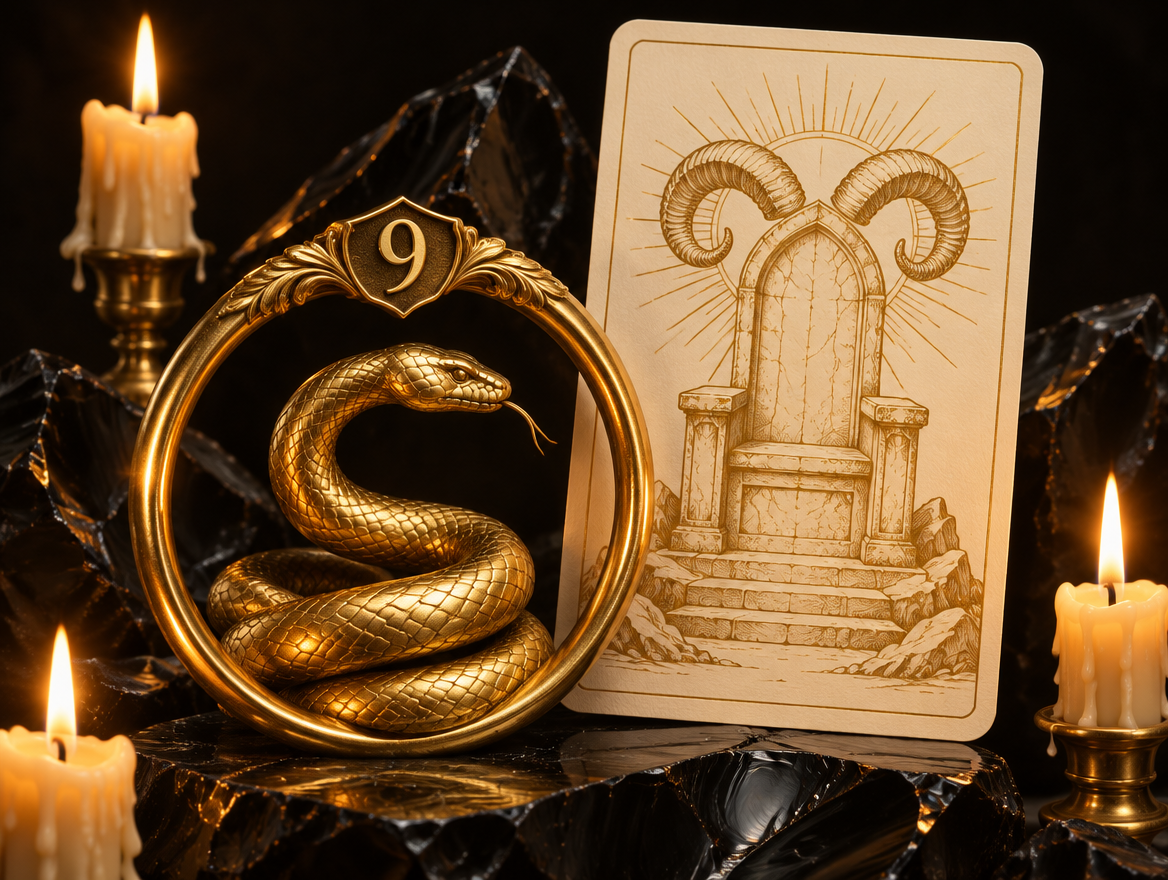
The Emperor is card IV of the Major Arcana. In the Rider–Waite–Smith deck he sits on a stone throne carved with rams’ heads, holding a sceptre and an orb, with bare mountains behind him.
Keywords: structure, authority, stability, protection, leadership, boundaries, responsibility.
- Upright: the card can point to healthy order: clear structure, steady leadership and the self-discipline to hold your ground.
- Reversed: readers often take it as structure gone wrong: rigid control, a power struggle, or the opposite, a life with no frame at all.
Astrology link: in the Golden Dawn–derived correspondences The 9th King uses, The Emperor is paired with Aries.
On The 9th King, tarot is a mirror for self-knowledge, not fortune-telling. The real question this card asks is simple: Who is in charge of your life, and are they ruling well?
Table of Contents

The Emperor at a glance
| The Emperor | |
|---|---|
| Number | IV (Major Arcana) |
| Core theme | Structure and authority |
| Upright | Order, stability, leadership |
| Reversed | Rigidity, control, or chaos |
| Zodiac (Golden Dawn) | Aries |
| Hebrew letter (Golden Dawn) | Heh |
| Element (via Aries) | Fire |
| Shadow | Control used to feel safe |
| Key question | Am I ruling, or just guarding? |
Below: what the card shows, its common upright and reversed meanings, where the Aries link comes from, and then the part that matters most here, how to use The Emperor for self-mastery.
What the Emperor card shows: the traditional imagery
The Rider–Waite–Smith Emperor
The best-known version of The Emperor comes from the deck designed by A. E. Waite and drawn by Pamela Colman Smith, first published by William Rider & Son in London in December 1909. Both Waite and Smith were members of the Hermetic Order of the Golden Dawn, which shaped the deck’s symbolism (Rider–Waite Tarot, Wikipedia).
In Waite’s own description in The Pictorial Key to the Tarot (1911), the Emperor is a crowned king on a throne whose arms are fronted with rams’ heads. He holds a sceptre shaped like an ankh (Waite calls it a form of the crux ansata) and a globe in his left hand (Waite, Pictorial Key, The Emperor, sacred-texts.com).
In the familiar illustration, you’ll also see:
- Red robes over armor. A ruler ready to defend what he has built.
- A stone throne. Something heavy, built to last, not easily moved.
- Bare mountains behind him. Hard, dry ground rather than gardens.
- The rams’ heads. Added in later decks such as the Rider–Waite and read as a sign of Aries (The Emperor (tarot card), Wikipedia).
What Waite thought the card was about
Waite reads the Emperor as worldly power: will, execution, the ability to make things real. He also pairs the card with The Empress (card III), the creative, fertile principle that the Emperor answers and protects. But he adds a second layer that’s easy to miss. The card, he says, also points to a higher kingship of the mind: “the lordship of thought rather than of the animal world” (Waite, Pictorial Key, sacred-texts.com).
That line is the doorway into the 9K reading. The deepest Emperor isn’t a man on a chair. It’s the part of you that can govern your own impulses.
Where the Emperor comes from
Tarot began as a card game, not a fortune-telling tool. Britannica dates the first tarot decks to Italy in the 1430s, when a suit of illustrated trump cards, the trionfi, was added to the ordinary four-suited pack. Using tarot for divination came much later, in France around 1780 (Britannica, Tarot).
The Emperor was among those early trumps. The Morgan Library’s online exhibition on Renaissance tarot shows an Emperor card from the hand-painted Visconti di Modrone deck, now held at Yale’s Beinecke Library, and dates the three surviving Visconti family decks to between 1441 and 1458 (The Morgan Library & Museum, Tarot exhibition). The astrological and esoteric layers most readers use today were added centuries after that.

The Emperor upright meaning
When The Emperor appears upright, readers commonly take it as a card of order that works. Waite’s own list of divinatory meanings opens with “Stability, power, protection, realization,” and goes on to aid, reason, conviction, authority and will (Waite, Pictorial Key, Part III §3, sacred-texts.com).
In plain terms, the upright Emperor can point to:
- Structure: routines, systems and rules that make life easier, not harder.
- Authority: the right to make a decision and the willingness to own it.
- Protection: using strength to keep something or someone safe.
- Boundaries: knowing where your responsibility starts and stops.
- Follow-through: turning a plan into something that actually exists.
Ask yourself: Where in my life would a little more structure set me free?
The Emperor as a person
Many people take The Emperor as a figure in their life: a parent, a boss, a mentor, an organized partner. Any gender can carry this card. It describes a role (the one who sets the frame), and it can also describe you, whenever you’re the one holding everything together.
The Emperor tarot in love
In love, the upright Emperor can point to steadiness: a partner, or a side of yourself, that shows up, keeps promises and builds something solid. It can describe a relationship that runs on commitment and clear agreements rather than drama.
The question it raises is about balance. Does the structure in this relationship hold both people, or only one person’s preferences? The card doesn’t tell you whether to stay or go. It asks you to look at how power and responsibility are shared, and to say what you need plainly.
The Emperor at work and with money
At work, The Emperor is often read as leadership, planning, systems and earned authority: taking charge, building processes, or stepping into a role where people look to you for direction.
With money, the card’s themes are budgeting, record-keeping and long-term planning. That’s a reflection on habits, not financial advice. The useful question: Is my structure serving my goals, or am I just following rules I never chose?
The Emperor reversed meaning
Waite’s reversed meanings are surprising to modern readers: he lists benevolence, compassion and credit, alongside obstruction, confusion to enemies and immaturity (Waite, Pictorial Key, Part III §3, sacred-texts.com). You could read that as the Emperor’s hard edge softening, which isn’t always a bad thing.
Most readers today use the reversed Emperor for structure that’s out of balance, in one of two directions:
- Too much: rigidity, micromanaging, control, stubbornness, authority that won’t be questioned.
- Too little: no routine, no boundaries, avoiding responsibility, waiting for someone else to take charge.
Both are the same problem. The frame of your life is either a cage or it’s missing. Ask yourself: Which way do I lean when I’m stressed: tightening my grip, or dropping the reins?
The Emperor reversed in love
Reversed in a love reading, the card can point to a power imbalance: one person making the rules, one person always deferring, or arguments about control that are really about fear. It can also point to the opposite: nobody wanting to commit to any plan at all.
Again, this isn’t a verdict on the relationship. It’s a prompt. Where do I give my authority away, and where do I take more than my share? If you’re seeing control that frightens you or makes you feel unsafe, that’s a matter for real-world support, not a card.
The Emperor reversed at work
At work, the reversed Emperor is often read as friction with authority, a leader who won’t delegate, or a system that’s grown so rigid it slows everyone down. It can also point to your own reluctance to lead when the moment calls for it.
Healthy order vs rigid control

| Area | Healthy order | Rigid control |
|---|---|---|
| Rules | Serve the people inside them | Serve the ruler’s comfort |
| Boundaries | Protect what matters | Wall everyone out |
| Decisions | Made and owned | Made for other people |
| Discipline | Keeps promises | Punishes mistakes |
| Authority | Earned and shared | Demanded and hoarded |
The Emperor and Aries: the astrology link
The Golden Dawn correspondence
The 9th King uses the Golden Dawn–derived correspondences, the tradition the Rider–Waite–Smith deck draws on. In Liber LXXVIII, Aleister Crowley’s printing of the Golden Dawn’s tarot text Book T, The Emperor is titled “Sun of the Morning, chief among the Mighty” and given the Hebrew letter Heh and the sign Aries (Liber LXXVIII, sacred-texts.com). Waite’s deck also puts Strength at VIII and Justice at XI; he said only that he did it “for reasons which satisfy myself” (Waite, Pictorial Key: Strength), and other writers usually explain it by the Golden Dawn’s Leo and Libra pairings (Rider–Waite Tarot, Wikipedia).
Other schools differ. Not every card maps neatly to a single sign either; the court cards and the Pages work differently from the Major Arcana. Treat this as one tradition’s symbolic map, not a law.
One well-known variation: Aleister Crowley, in his Thoth system, swapped the Hebrew letters of The Emperor and The Star. He gave The Emperor the letter Tzaddi and The Star the letter Heh, while keeping The Emperor with Aries and The Star with Aquarius (Thoth Tarot, Wikiwand). If you read with a Thoth deck, you’ll see that difference.
Why Aries fits the Emperor
Aries is a cardinal fire sign ruled by Mars, the first sign of the zodiac. Our Aries personality traits guide covers it in full: initiative, courage, directness, independence, with a shadow of impatience and bluntness.
At first glance, the Ram and the old king on his stone throne seem like opposites. Aries is the spark; the Emperor is the structure. But look closer and they tell one story:
- Aries starts. It’s the first sign, the beginning of spring in the Northern Hemisphere.
- The Emperor founds. He’s the one who turns a first push into a lasting kingdom.
- Both are about will. Aries is will as impulse; the Emperor is will as discipline.
For strong Aries placements, the Emperor’s gift is fire that builds instead of burning out. Our birth chart guide shows how to find Aries in your own chart. A card’s sign is a symbolic link, not a statement about your Sun sign.
The 9th King reading: authority you build inside yourself
The traditional meanings tell you what readers usually see in the card. This section is about what to do with it.
The Emperor’s tension
Every card holds a tension. The Emperor’s is order versus control.
Order is structure that serves life: a morning routine that protects your energy, a boundary that keeps a friendship healthy, a plan that gets the project finished. Control is structure that serves fear: rules you can’t bend, people you can’t trust, a life so locked down that nothing new can enter.
From outside they can look identical. The difference is the motive: Am I building this to protect something I love, or to avoid feeling powerless?
The shadow side of the Emperor
Shadow work means looking at the parts of yourself you’d rather not see. (If you’re new to the idea, Shadow Work, Plainly explains it simply.) The Emperor’s shadow tends to show up in a few recognizable ways:
- Control as safety. Needing to manage everything because uncertainty feels unbearable.
- Rightness over relationship. Winning the argument and losing the person.
- Coldness as strength. Treating feelings as weakness, including your own.
- The borrowed throne. Living by rules inherited from a parent or a system, never examined.
- The abandoned throne. Refusing all authority, including your own, because power once hurt you.
That last one matters. Some people meet The Emperor and feel a flinch, because their experience of authority was harsh or unfair. If that’s you, notice it gently. The card isn’t asking you to obey anyone. It’s asking whether you’ve had the chance to become a fair ruler of your own life. Exploring early experiences of authority can touch inner child work, and it’s worth going slowly.
Projection: the Emperor you see in other people
A useful Emperor question: Which authority figures make me react most strongly? The boss who “always” has to be right, the partner who “never” lets you decide. Sometimes they really are controlling. Sometimes we’re also seeing a part of ourselves we haven’t owned: our own need for control, or our own unused authority. That’s psychological projection, and The Emperor is one of the clearest mirrors for it.
The point isn’t to excuse anyone’s behavior. It’s to ask what the reaction shows you about your relationship with power.
Aries placements have their own shadow pattern too; our zodiac shadow work guide covers it alongside every other sign.
The self-mastery lesson
The Emperor’s lesson is this: rule yourself first. An inner Emperor doesn’t need everyone else to behave. He keeps his own word, sets his own boundaries and takes responsibility for his own kingdom, which is your time, your attention, your body, your choices and your promises.
Self-mastery isn’t rigid self-control. A good ruler listens, adjusts and protects the people inside the walls, including the softer parts of you. Structure is the container; it isn’t the point. The point is a life you can actually grow in.
The Emperor in a reading: two worked examples
Both examples below are fictional. They show how to turn the card into a question instead of a prediction.
Example 1 (fictional): upright Emperor, “Why can’t I finish anything?”
The situation: Dani has three half-built side projects and draws The Emperor upright when asking what’s in the way.
Reading: the card points to missing structure, not missing talent. Dani has plenty of Aries-style spark and no throne to sit it on: no schedule, no deadlines, no one project chosen as the priority.
The useful question: Which one project deserves my authority this month, and what’s the smallest rule that would protect it?
Example 2 (fictional): reversed Emperor, “Why do my team keep pulling away?”
The situation: Marcus leads a small team and draws The Emperor reversed while asking about tension at work.
Reading: the reversed card can point to control that’s tipped into rigidity. Marcus checks every task, rewrites other people’s work and calls it high standards. The team experiences it as distrust.
The useful question: What would I need to feel safe handing one decision back to someone else?
Both are reflections to test against real life, not verdicts. If you’re new to reading the cards this way, Code of Ascension’s Tarot for Beginners: How Tarot Really Works (Code of Ascension) covers the basics, and its guide to intuitive tarot (Code of Ascension) shows how to pair the traditional meanings with your own first impressions.
Myths and misreadings about The Emperor
- “The Emperor means a man is coming into your life.” The card describes a role, not a gender or an arrival. Any person, including you, can embody it.
- “The Emperor is a bad card because it’s about control.” Upright, it’s usually read as healthy structure and protection. Control is the shadow, not the meaning.
- “Reversed means your relationship is doomed.” No card dooms anything. The reversed Emperor raises questions about power and responsibility; what you do with them is yours.
- “The Emperor tells you to obey authority.” Waite himself pointed to a kingship of the mind. The card is about becoming your own fair authority, not submitting to someone else’s.
- “If I’m not an Aries, the Emperor doesn’t apply to me.” The Aries link is a symbolic correspondence. The card’s themes of structure and will belong to everyone.
Practice: build your inner constitution
This is the one practical exercise for The Emperor, plus journal prompts to go with it. A constitution is the set of rules a ruler agrees to live by. Here, you write one for yourself.

The exercise: your inner constitution (20 minutes)
- Name your kingdom. On one page, list what you’re actually responsible for: your health, your time, your work, your home, your promises. Keep it to what’s genuinely yours, not other people’s choices.
- Find the gaps. Circle one area where there’s almost no structure, the place where things keep slipping.
- Find the walls. Underline one area where you’re too tight: where you control, check or refuse to delegate.
- Write three laws. Short, kind, keepable rules. “I stop work at 7 pm on weekdays.” “I ask before I fix someone’s problem.” “I write tomorrow’s top task before bed.”
- Name the exceptions. For each law, write when it’s allowed to bend. A good ruler builds in mercy; that’s what keeps order from becoming control.
- Review in a week. Keep, change or retire each law. Laws that don’t serve you get repealed. That’s the job.
The test of a good constitution: Does it make my life larger or smaller?
Journal prompts for The Emperor
- Where in my life am I waiting for someone else to take charge?
- What rule am I living by that I never actually chose?
- When I feel out of control, what do I try to control instead?
- Who taught me what authority looks like, and what did I keep or reject from them?
- Which authority figure triggers me most, and what might they be mirroring? (See our shadow work prompts for more like this.)
- What would a fair, steady ruler of my life do this week?
- Am I ruling my life, or just guarding it?
A gentle note: these prompts can stir up memories of harsh or frightening authority. It’s fine to stop any prompt that feels like too much. If you’re dealing with trauma, abuse, thoughts of self-harm or overwhelming distress, please work with a qualified therapist; reflective practice like this isn’t a replacement for that support.

The Emperor Tarot Card: FAQ
What does The Emperor tarot card mean?
The Emperor is card IV of the Major Arcana, a card of structure, authority, stability and protection. Upright, readers often take it as healthy order: clear plans, steady leadership and good boundaries. On The 9th King it’s read as a mirror for self-mastery, asking how well you govern your own time, choices and promises, rather than as a prediction about what will happen.
What does The Emperor reversed mean?
Reversed, The Emperor is commonly read as structure out of balance. That can mean too much (rigid control, stubbornness, power struggles) or too little (no routine, no boundaries, avoiding responsibility). Waite’s own reversed meanings were softer, including benevolence and compassion. A useful reflection is to ask which way you lean under stress: tightening your grip or dropping the reins.
What does The Emperor mean in love?
In love, the upright Emperor can point to commitment, reliability and a relationship built on clear agreements. Reversed, it can point to a power imbalance or a lack of shared direction. The card doesn’t tell you whether to stay or leave. It asks how authority and responsibility are shared between you, and whether the structure you’ve built holds both people.
What zodiac sign is The Emperor?
In the Golden Dawn–derived correspondences The 9th King uses, The Emperor is paired with Aries, the cardinal fire sign ruled by Mars. The Golden Dawn’s Book T, printed as Liber LXXVIII, gives the card the sign Aries and the Hebrew letter Heh. Other systems differ in places; Crowley’s Thoth tarot, for example, keeps Aries but swaps the Emperor’s Hebrew letter with The Star’s.
Is The Emperor a yes or no card?
The 9th King doesn’t use tarot for yes-or-no answers or predictions. Instead of asking whether something will happen, try asking The Emperor a reflective question: what structure would support this, what am I responsible for here, and where am I holding on too tightly? Those questions usually lead to a clearer decision than a yes or no would.
Does The Emperor represent a specific person?
It can stand for someone in your life who plays the role of authority or structure, such as a parent, a boss or a steady partner. But the card describes a role, not a gender or a fixed identity, and it often describes you. Many readers take it as a sign to step into your own authority rather than look for it in someone else.
What is the difference between The Emperor and The Empress?
The Empress (card III) is usually read as creativity, abundance and nurture: growing things. The Emperor (card IV) is read as structure, protection and order: building a frame for what grows. Waite presented them as paired principles that answer each other. Most people need both: something alive to protect, and a structure strong enough to protect it.
Where did The Emperor tarot card come from?
The Emperor was one of the illustrated trump cards in the earliest tarot decks, made in Italy in the fifteenth century as a card game. An Emperor survives from the hand-painted Visconti di Modrone deck, now at Yale’s Beinecke Library. The rams’ heads familiar today were added in later decks such as the Rider–Waite–Smith, first published in 1909.

Your next step: write your inner constitution this week using the exercise above, then read our Aries personality traits guide to see how the Emperor’s sign handles fire, courage and the pull to charge ahead.
Explore Next
- The Emperor’s sign in full: Aries Personality Traits
- The shadow side of every sign: Zodiac Shadow Work
- When other people mirror your power: Psychological Projection
- New to shadow work: Shadow Work, Plainly
- All twelve signs: The Zodiac Signs
- More tarot on The 9th King: Tarot Card Meanings · The Major Arcana · Tarot & the Zodiac · The Chariot · Justice · Shadow Work Tarot Spread
- Structure’s shadow side: The Devil
Final Thought: Take the Throne, Keep the Mercy
The Emperor isn’t asking you to become hard. He’s asking you to become trustworthy, first of all to yourself. Build the structure, keep your word, protect what you love, and leave room for mercy inside the walls. That’s what a real ruler does. Know your nature. Rule your life.
About the Author
King is the founder of The 9th King, where zodiac psychology, relationships and shadow work are explored as tools for self-knowledge rather than fortune-telling. He’s a Libra Sun, and writes about the personal side of astrology on King The Kemist. Astrology on The 9th King is interpretation and self-reflection, not prediction or established fact.
Leave a Reply