Quick Answer: What Does the Six of Wands Mean?
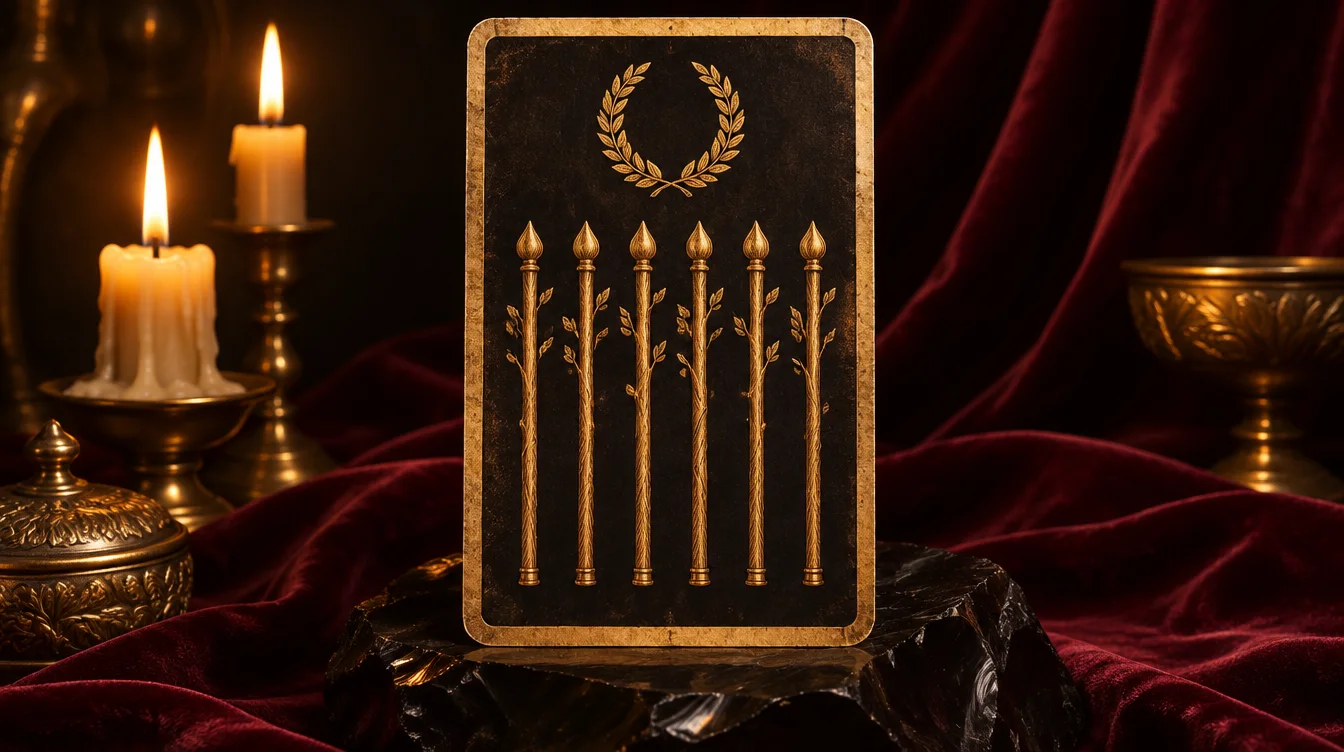
The Six of Wands (also written 6 of Wands) is a Minor Arcana card from the suit of Wands. In the Rider–Waite–Smith deck it shows a horseman wearing laurel, carrying a staff crowned with a laurel wreath, with people on foot holding staves at his side. Readers usually take it as the card of victory and recognition: effort that has paid off, and is now being seen.
- Keywords: victory, recognition, good news, confidence, public success, hope fulfilled, earned pride.
- Upright, in one line: a prompt to notice a win you’ve earned, and how you let yourself (and others) see it.
- Reversed, in one line: a prompt to look at fear that a win won’t last, success that isn’t landing, or recognition you’ve been waiting on.
On The 9th King, tarot is a mirror for self-knowledge, not fortune-telling. The Six of Wands doesn’t say a victory is on its way. It asks how you carry success, and what you need it to prove.
Table of Contents

The Six of Wands at a glance
| Six of Wands | |
|---|---|
| Arcana | Minor Arcana, a pip (number) card |
| Suit and element | Wands, the suit of fire |
| Number | Six |
| Golden Dawn title | Lord of Victory |
| Astrology (Golden Dawn) | Jupiter in Leo |
| Upright | Victory, recognition, good news |
| Reversed | Fear, doubt, a delayed win |
| Key question | Can I hold this win lightly? |
What the Six of Wands looks like
Most people know this card from the Rider–Waite–Smith deck, published in London by William Rider & Son in 1909. A.E. Waite wrote the instructions and Pamela Colman Smith drew the 78 cards; both were Golden Dawn members. Waite’s guide, The Pictorial Key to the Tarot, appeared in its revised form in 1911 (Wikipedia: Rider–Waite Tarot).
The laurelled horseman
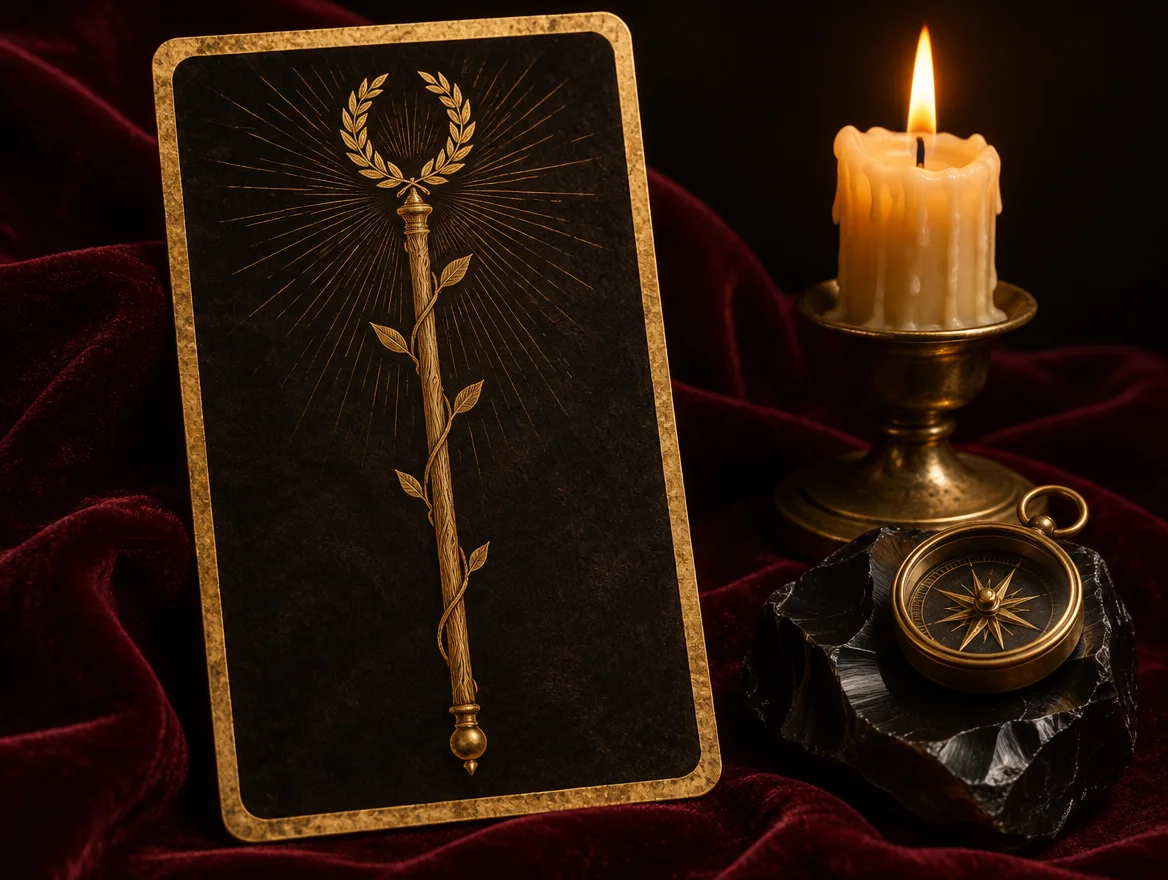
Waite’s description is one sentence long. A horseman wearing laurel carries a single staff adorned with a laurel crown (sacred-texts.com: Waite, Six of Wands). Laurel is the old sign of a winner. He’s not fighting. He’s being seen.
The footmen with staves
At his side, Waite says, are footmen with staves. He doesn’t say who they are. In a self-knowledge reading, they’re a reminder that few wins are made alone. The rider is raised up, but he isn’t traveling by himself.
What Waite leaves out
Apart from the laurelled horseman, the laurel crown on his staff and the footmen with their staves, Waite gives no visual detail. Anything more you notice on a printed deck is the artist’s addition, not Waite’s text.
Six of Wands meaning (upright)
Waite says the card was designed to carry several meanings at once (sacred-texts.com: Waite, Six of Wands). On the surface it is a victor triumphing. It can also be great news, the kind a royal courier might carry with ceremony. And it is “expectation crowned with its own desire, the crown of hope.” That last phrase is the heart of the card: something you hoped for, and worked toward, actually arriving.
The Golden Dawn’s teaching text on the tarot, Book T, as printed by Aleister Crowley in Liber LXXVIII, names the card the Lord of Victory. Its meaning begins “Victory after strife” and goes on to list love, pleasure gained by labour, carefulness, sociability and avoiding strife while still winning. It also names the card’s darker edge: insolence, and pride in riches and success (Liber LXXVIII, sacred-texts.com).
Even the source text holds both sides. On The 9th King, the upright card is read in three layers.
Earned recognition
The card can point to a moment when your effort becomes visible: a project that lands, a goal you finally reach. The key word is earned. Ask yourself: What did this win actually cost me, and have I let myself acknowledge that?
Good news, received well
Upright, readers often take Waite’s courier as a prompt to let good news in fully, instead of rushing past it to the next worry. Ask yourself: When something goes right, do I take a breath and receive it, or do I look straight for what could go wrong?
Confidence that includes others
The healthy Six of Wands is pride that still knows who walked beside it. Book T’s word sociability fits: a win that brings people closer, not one that sets you above them. Ask yourself: Who helped make this possible, and have I told them?
Six of Wands reversed
Readers handle reversals differently, and some skip them entirely. Waite’s reversed meaning is unusually vivid: apprehension and fear, as if a victorious enemy stood at the gate, along with treachery and disloyalty, like gates opened to an enemy, and also indefinite delay (sacred-texts.com: Waite, Six of Wands). In his separate list of additional meanings, he gives a gentler reversed line for this card: “Fulfilment of deferred hope” (sacred-texts.com: Waite, Additional Meanings). Waite himself offers both, so the reversed card isn’t one fixed message.
A card can’t tell you whether anyone is disloyal to you. On The 9th King, the Six of Wands reversed usually points to one of three inner patterns, offered as questions, not predictions.
Waiting for the enemy at the gate
You’ve won something, but you can’t enjoy it, because some part of you is braced for it to be taken away. This is Waite’s apprehension, turned inward. Ask yourself: What exactly am I afraid will happen if I let myself feel good about this?
The win that doesn’t land
Sometimes recognition arrives and feels strangely empty. You hit the goal and moved the bar the same afternoon. Ask yourself: If no one else ever knew about this success, would it still matter to me?
The delay
Waite’s indefinite delay can point to recognition that hasn’t come yet. His additional meaning reminds us the same card can mean that hope, finally fulfilled. Waiting isn’t failing. Ask yourself: Is the work done and the recognition slow, or is there still a piece of the work I’ve been avoiding?
Six of Wands astrology: Jupiter in Leo
The 9th King uses Golden Dawn–derived correspondences, the tradition the Rider–Waite–Smith deck draws on. Other schools of tarot and astrology use different systems, and not every card maps to a single sign: the court cards and Aces, for example, are handled differently. What follows is one traditional framework, offered as symbolism, not as a statement about anyone’s chart.
How the number cards get their planets
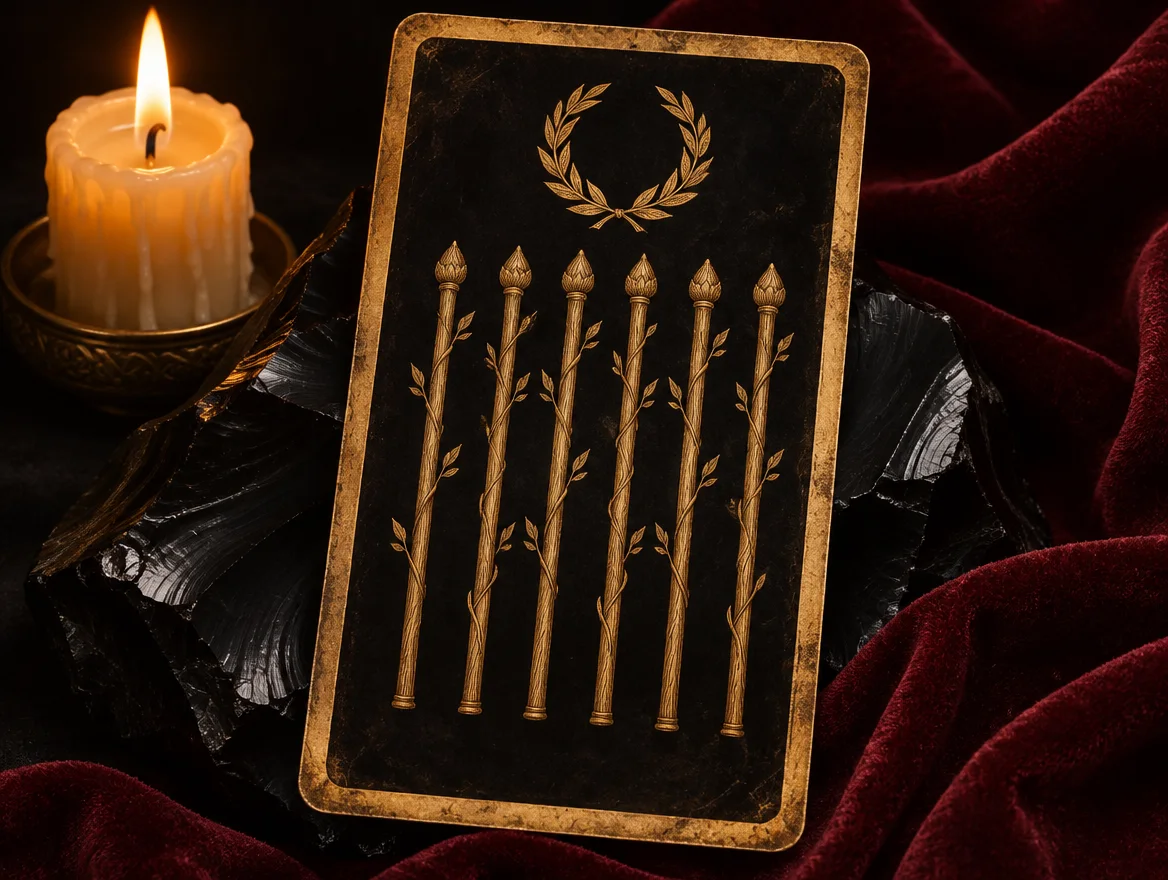
In Book T, the 36 small cards (the Twos through Tens) are matched to the 36 decans of the zodiac, ten-degree thirds of each sign, each ruled by a planet. Liber LXXVIII lists the Six of Wands, Lord of Victory, as Jupiter in Leo (Liber LXXVIII, sacred-texts.com). Its own description of the card is a Golden Dawn design, not the Rider–Waite–Smith picture: two hands in a grip holding six wands crossed three and three, with flames where they meet, and the symbols of Jupiter and Leo above and below to represent the decan.
The same text says the decans begin in Leo, at the royal star Cor Leonis, with Saturn’s decan first. Its table then runs Five of Wands (Saturn in Leo), Six of Wands (Jupiter in Leo) and Seven of Wands (Mars in Leo). So, going by the order of Liber’s own table, the Six is the middle of Leo’s three decan cards, and Liber’s separate table of central decans lists the Six of Wands for Leo. Book T places this card under Tiphareth, the sixth Sephirah on the Kabbalistic Tree of Life. Liber prints no degrees for this card, so this page gives none.
| Card | Liber LXXVIII title | Decan |
|---|---|---|
| Five of Wands | Lord of Strife | Saturn in Leo |
| Six of Wands | Lord of Victory | Jupiter in Leo |
| Seven of Wands | Lord of Valour | Mars in Leo |
Read in that order, the three Leo cards tell a small story: the scuffle in the Five of Wands, the victory ride, then the stand on the hill in the Seven of Wands.
What Jupiter brings
Jupiter is the planet of growth, generosity and good fortune, the traditional ruler of Sagittarius and Pisces. Our Sagittarius Personality Traits guide explores its hopeful side, and our Jupiter return guide follows its cycle in your own life. On this card, Jupiter is the laurel: the sense that things are opening up and going well.
What Leo brings
Leo is fixed fire, ruled by the Sun: the sign of heart, pride and visibility. Our Leo Personality Traits guide covers its warmth and its shadow. On this card, Leo is the ride itself: being seen in public.
The tension in the pairing
Jupiter enlarges. Leo wants to shine. Together they’re generous and glowing, and sometimes too much: a good moment inflated into a story about how special you are. Book T names both ends of that line: sociability on one side and insolence on the other. The Six of Wands sits right on it.
The 9K reading: wearing the laurel well
The card’s tension
The Six of Wands holds two true things at once: I did this and I am more than this. A win deserves to be felt. But when it becomes the main proof that you’re worth something, every success comes with a quiet fear of the next failure. The card asks you to wear the laurel, then set it down.
The shadow side
The shadow of the Six of Wands is needing applause to feel real. It’s the voice that says a success only counts if enough people saw it. It can look like:
- Chasing the next win before feeling this one.
- Measuring yourself by reactions. Likes, praise or a boss’s mood become the scoreboard for your worth.
- Forgetting the footmen. The story of the win slowly loses everyone who helped.
- Pride that stops listening. After a success, feedback starts to feel like an insult, which is Book T’s insolence in everyday form.
There’s a quieter shadow too: refusing the laurel altogether, waving off every compliment or hiding your wins. It looks like modesty, but it can keep you small. If being noticed once brought criticism, that reaction made sense at the time.
Both patterns usually began as sensible responses to something real. Zodiac Shadow Work shows how they surface sign by sign, and Shadow Work, Plainly explains how to start working with them.
How you hold a win
A simple check: are you carrying success, or is it carrying you?
| Practice | What it looks like |
|---|---|
| Celebrate | Mark the win on purpose, then let it settle |
| Credit | Name who helped, out loud or in writing |
| Keep it in size | A win, not a verdict on your worth |
| Stay open | Feedback still welcome after success |
| Rest | A pause that meets a real need |

The self-mastery lesson
The lesson of the Six of Wands is to let success be seen without letting it define you. You can enjoy praise without needing it, and thank the people beside you without shrinking your own part. You can feel unsure and still know you earned it. Waite’s crown of hope is real, but it’s a crown you can take off at night.
Six of Wands vs Seven of Wands
These two share a sign and sit side by side in Book T’s Leo sequence. Here’s how The 9th King reads the difference.
| Six of Wands | Seven of Wands | |
|---|---|---|
| Moment | The win is being recognized | The win is being challenged |
| Figure | Laurelled rider among footmen | Young man on high ground |
| Golden Dawn | Jupiter in Leo, Lord of Victory | Mars in Leo, Lord of Valour |
| Core question | Can I hold this win lightly? | Is this hill worth holding? |
Both Golden Dawn lines come from the same Liber LXXVIII table (sacred-texts.com). The Six is the parade; the Seven is the morning after, when others want what you’ve won.
Six of Wands as feelings, in love and at work
Six of Wands as feelings
Asked “how does this person feel?”, readers often take the Six of Wands as pride, admiration or confidence: someone proud to be seen with you. A card can’t tell you what another person feels, so look at what you can observe, and ask yourself: Am I hoping to be admired, or hoping to be known?
Six of Wands love meaning
In a love reading, the upright card can point to a relationship worth celebrating, a partner who openly supports you, or confidence after a hard season you got through together. Reversed, it can point to a relationship that looks good outside but feels unsure inside, to competing for credit, or to waiting for recognition that hasn’t come.
Tarot can’t tell you whether to stay or leave, and this page won’t either. Useful questions:
- Do we celebrate each other’s wins, or quietly keep score?
- Do I need this relationship to look good, or to feel good?
- What recognition am I waiting for, and have I asked for it plainly?
Healthy admiration rests on respect and consent. For how fiery and sensitive styles meet, see fire and water relationships.
Six of Wands at work
Waite’s great news and Book T’s pleasure gained by labour make this a natural work card. Upright, readers often take it as recognition for effort: a launch that lands, a team result. The shadow version is working for the applause, or taking the whole story of a team win. This is reflection, not career or financial advice. Ask yourself: If this success were never mentioned in a meeting, would I still be proud of how I did it?
Practical exercise: the laurel review
You need about twenty minutes and a notebook. Like every prompt here, it’s optional.
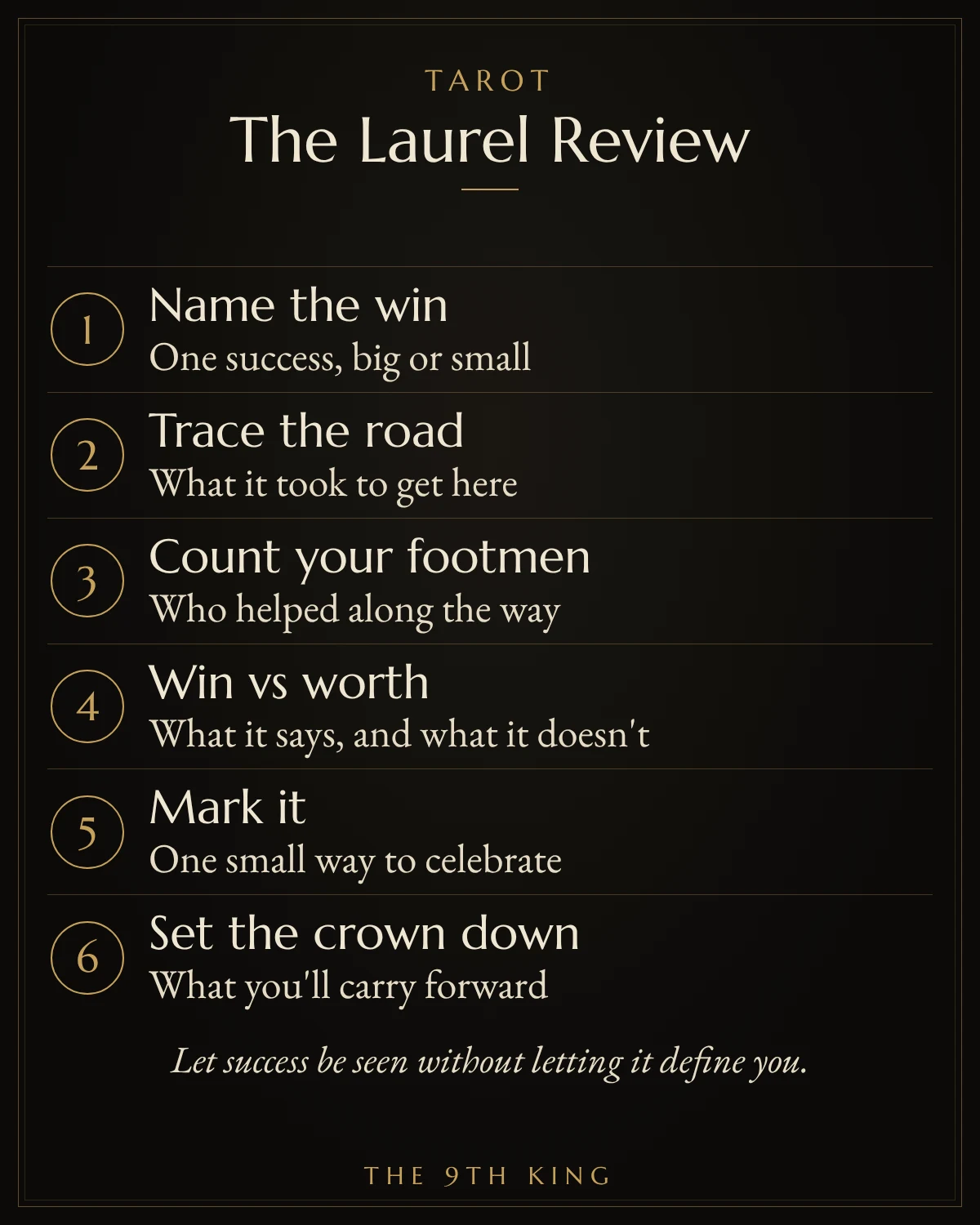
Step 1: Name the win
Write one sentence: What is one thing that went well recently? Large or small both count. If you can’t think of one, notice that too.
Step 2: Trace the road
List what it took: the hours, the setbacks, the days you nearly quit. Book T ties this victory to the strife before it.
Step 3: Count your footmen
Write down who helped, directly or quietly. Include your own past self.
Step 4: Separate win from worth
Draw a line down the page. On one side, write what this win actually shows (I can finish a hard project). On the other, write what it doesn’t prove (I’m only valuable when I succeed). Keep the first side. Question the second.
Step 5: Mark it
Choose one small way to celebrate: a meal, a walk, a note in your journal. Thanking someone is an option, not a requirement; do it if it feels true and useful.
Step 6: Set the crown down
Finish with one line: What do I want to carry forward from this, and what can I let go? Then close the notebook.
A worked example (fictional)
Dana (fictional) is a nurse who just passed a specialist certification after a year of night study. Her manager mentioned it in a team meeting, and instead of feeling proud, she feels exposed. She draws the Six of Wands upright and recognizes the tension.
She names the win: “I passed the certification.” She traces the road: twelve months of study, one failed practice exam and a lot of tired mornings. She counts her footmen: three of them, her sister who cooked on exam weeks, a colleague who quizzed her on breaks and her past self who signed up despite the fear.
The win shows “I can learn something hard while working full-time.” It doesn’t prove “now I can never make a mistake.” She marks it with dinner with her sister and a thank-you to her colleague. Setting the crown down, she writes: “Keep the study habit. Let go of waiting to slip.”
Journal prompts for the Six of Wands
- What’s a recent win I rushed past, and what would it mean to stop and feel it?
- Whose recognition do I most want right now, and why theirs?
- When I’m praised, what do I do with it: take it in, wave it off, or worry about living up to it?
- Who are the footmen beside me, and how do I show them they matter?
- What would I still be proud of if no one ever saw it?
For more questions like these, our shadow work prompts collection goes deeper. If being seen, or being praised, has felt unsafe since you were young, inner child work can be a gentle next step.
A warm note: this is reflective practice, not therapy. If your relationship with success or visibility is tied to trauma or abuse, or if you’re dealing with thoughts of self-harm or distress that feels overwhelming, please work with a qualified therapist who can walk with you. It’s always fine to stop a prompt that feels like too much.
Myths and misreadings of the Six of Wands
- “The Six of Wands means you’re about to win.” No. On The 9th King we don’t read outcomes. Waite does call it a card of a victor triumphing, but here it’s a mirror for how you meet success, not a forecast of one.
- “It’s purely a good card.” Book T lists insolence and pride in success alongside victory and love (Liber LXXVIII, sacred-texts.com). The card has a shadow like every other.
- “Reversed means someone will betray you.” Waite does mention treachery in his reversed meaning, but a card can’t establish what another person will do. Read it as a prompt to look at your own fear, trust and expectations.
- “Jupiter in Leo means this card is about Leo people.” No. It describes the card’s symbolism in the Golden Dawn tradition. Anyone can draw it.
Six of Wands: FAQ
What does the Six of Wands mean?
The Six of Wands is a Minor Arcana card in the suit of Wands. It shows a laurelled horseman carrying a staff crowned with laurel, with footmen holding staves beside him. Readers commonly take it as victory, recognition, good news and earned confidence. On The 9th King, it’s a mirror for how you carry success, not a prediction that success is coming.
What does the Six of Wands reversed mean?
Reversed, Waite reads the Six of Wands as apprehension and fear, possible disloyalty and indefinite delay, though his additional meanings also give deferred hope fulfilled. On The 9th King it often points to fear that a win won’t last, success that feels hollow, or recognition that’s slow to arrive. Some readers don’t use reversals. A card can’t tell you whether anyone is disloyal.
What does the Six of Wands mean as feelings?
As feelings, readers often take the Six of Wands as pride, admiration or confidence: someone who feels good about a connection or proud to be seen with someone. A card can’t reveal what another person feels, so look at what you can observe in how they treat you. It can also prompt you to ask whether you want to be admired or truly known.
What does the Six of Wands mean in love?
In love, the upright card can point to a relationship worth celebrating, a supportive partner, or confidence after getting through a hard season together. Reversed, it can point to a relationship that looks better outside than it feels inside, or to waiting for recognition that hasn’t come. The card doesn’t tell you to stay or leave.
What zodiac sign is the Six of Wands?
In the Golden Dawn system, the tradition The 9th King uses, the Six of Wands corresponds to Jupiter in Leo. Liber LXXVIII, which prints the Golden Dawn’s Book T, calls it the Lord of Victory, the middle of Leo’s three decan cards in its table. Other schools use different systems, so treat this as one symbolic framework, not a statement about your chart.
Is the Six of Wands a yes or no card?
The 9th King doesn’t do yes or no readings, because tarot here is a tool for self-reflection, not fortune-telling. Instead, ask what the card shows you: a win you haven’t let yourself feel, a need for recognition, or the people who helped you get here.

Your next step: do the laurel review above for one win from the last month, however small. Then read our Leo Personality Traits guide and look at which of the 12 houses Leo falls in on your own birth chart: that area of life can show where you most want to be seen, the same theme the Golden Dawn tied to this card.
Explore Next
- The heart and pride behind the card: Leo Personality Traits
- Jupiter’s growth in your own timeline: Jupiter Return
- Go deeper with questions: Shadow Work Prompts
- The suit’s other fire: Ace of Wands · Four of Wands · Five of Wands · Seven of Wands · King of Wands
- Victory in the Major Arcana: The Chariot · The Sun
- Reading by feel: Intuitive Tarot (Code of Ascension)
- New to the cards: Tarot for Beginners: How Tarot Really Works (Code of Ascension)
- More tarot on The 9th King: Tarot Card Meanings · Minor Arcana · Tarot & the Zodiac · Shadow Work Tarot Spread
- More cards in this set: Three of Cups, Three of Pentacles, Six of Pentacles

Final Thought: Wear the Laurel, Then Set It Down
The rider on the Six of Wands has earned his moment, and he isn’t riding alone. Let your wins be seen. Thank the people walking beside you. Then take off the crown and remember that you were worth something before the parade, and you’ll be worth the same after it. Know your nature. Rule your life.
About the Author
King is the founder of The 9th King, where zodiac psychology, relationships and shadow work are explored as tools for self-knowledge rather than fortune-telling. He’s a Libra Sun, and writes about the personal side of astrology on King The Kemist. Astrology on The 9th King is interpretation and self-reflection, not prediction or established fact.
Leave a Reply