
Quick Answer: What Does the Five of Wands Mean?
The Five of Wands (also written 5 of Wands) is a Minor Arcana card from the suit of Wands. A.E. Waite described it as a group of young people brandishing staves, maybe in play and maybe in earnest. Readers often take it as the card of friction: competition, clashing ideas, many voices at once, and the question of whether the struggle is a game or a real fight.
- Keywords: competition, friction, rivalry, debate, sparring, scattered effort, testing your strength.
- Upright, in one line: a prompt to notice where friction is testing you, if it is, and whether you can treat it as practice rather than war.
- Reversed, in one line: a prompt to look at conflict that has turned tangled or hidden, or at friction you keep avoiding, and ask what a cleaner way through would look like.
On The 9th King, tarot is a mirror for self-knowledge, not fortune-telling. The Five of Wands doesn’t say an argument is coming, and it can’t tell you who is right. It asks how you handle friction, and what kind of opponent you are.
Table of Contents
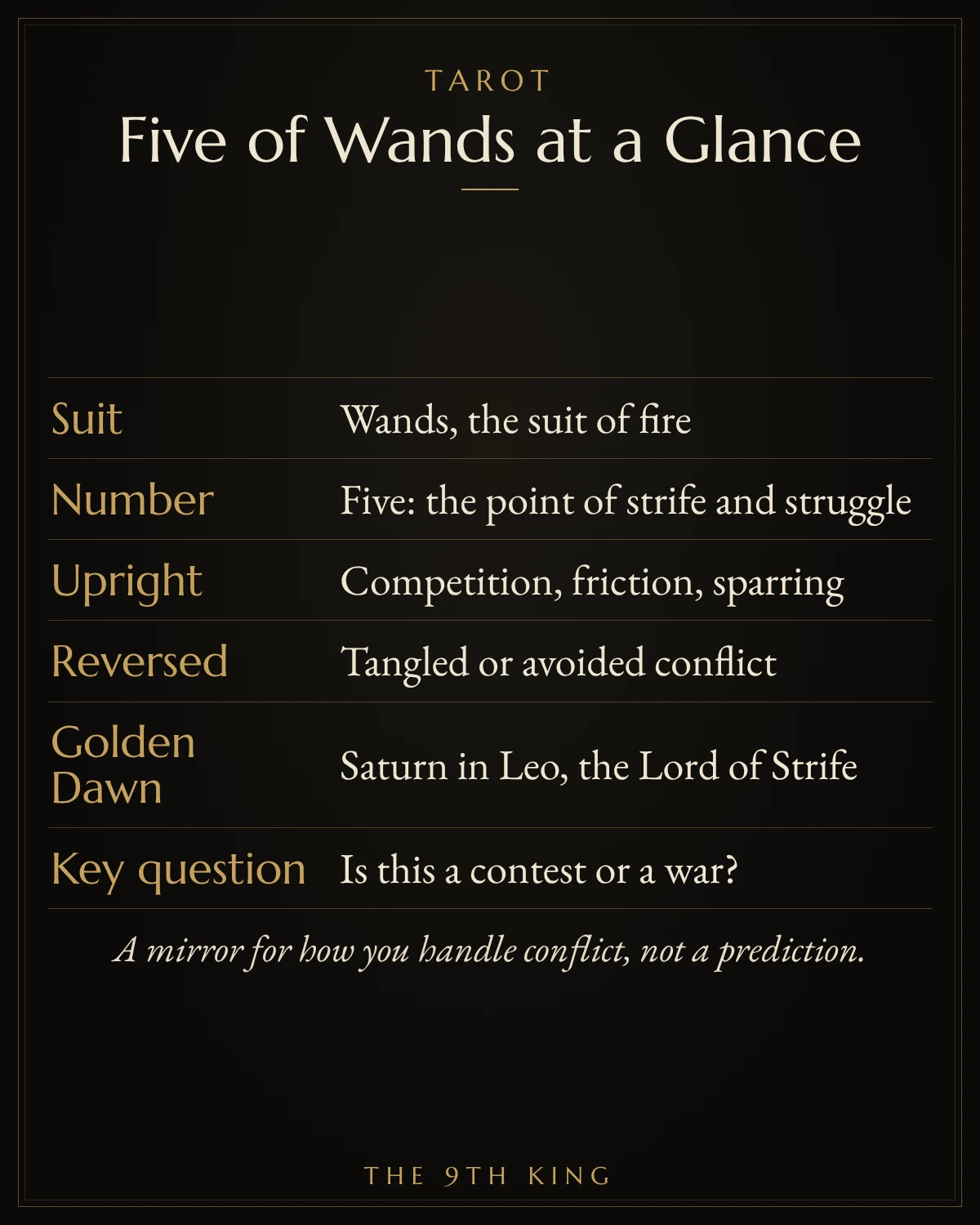
The Five of Wands at a glance
| Five of Wands | |
|---|---|
| Arcana | Minor Arcana, a pip (number) card |
| Suit and element | Wands, linked with fire |
| Number | Five, the middle of the run |
| Golden Dawn title | Lord of Strife |
| Astrology (Golden Dawn) | Saturn in Leo |
| Upright | Competition, friction, sparring |
| Reversed | Tangled, hidden or avoided conflict |
| Key question | Is this a contest or a war? |
What the Five of Wands looks like
Most people meet this card through the Rider–Waite–Smith deck, first published in London by William Rider & Son in 1909. A.E. Waite wrote the instructions and Pamela Colman Smith drew the art, and both were members of the Hermetic Order of the Golden Dawn (Wikipedia: Rider–Waite Tarot).
Waite’s own description
Waite’s description in The Pictorial Key to the Tarot is one of his shortest. He calls the scene “a posse of youths, who are brandishing staves, as if in sport or strife,” and then names it plainly as mimic warfare: a mock battle, not a real one (sacred-texts.com: Waite, Five of Wands).
Waite doesn’t describe anyone winning, losing or getting hurt. The crowd might be playing or fighting; he leaves that open.
What the 1909 card shows
Waite doesn’t say how many figures there are. On the 1909 Smith card, five young figures each hold one staff, so the number of people matches the number of the card.
The Golden Dawn’s version
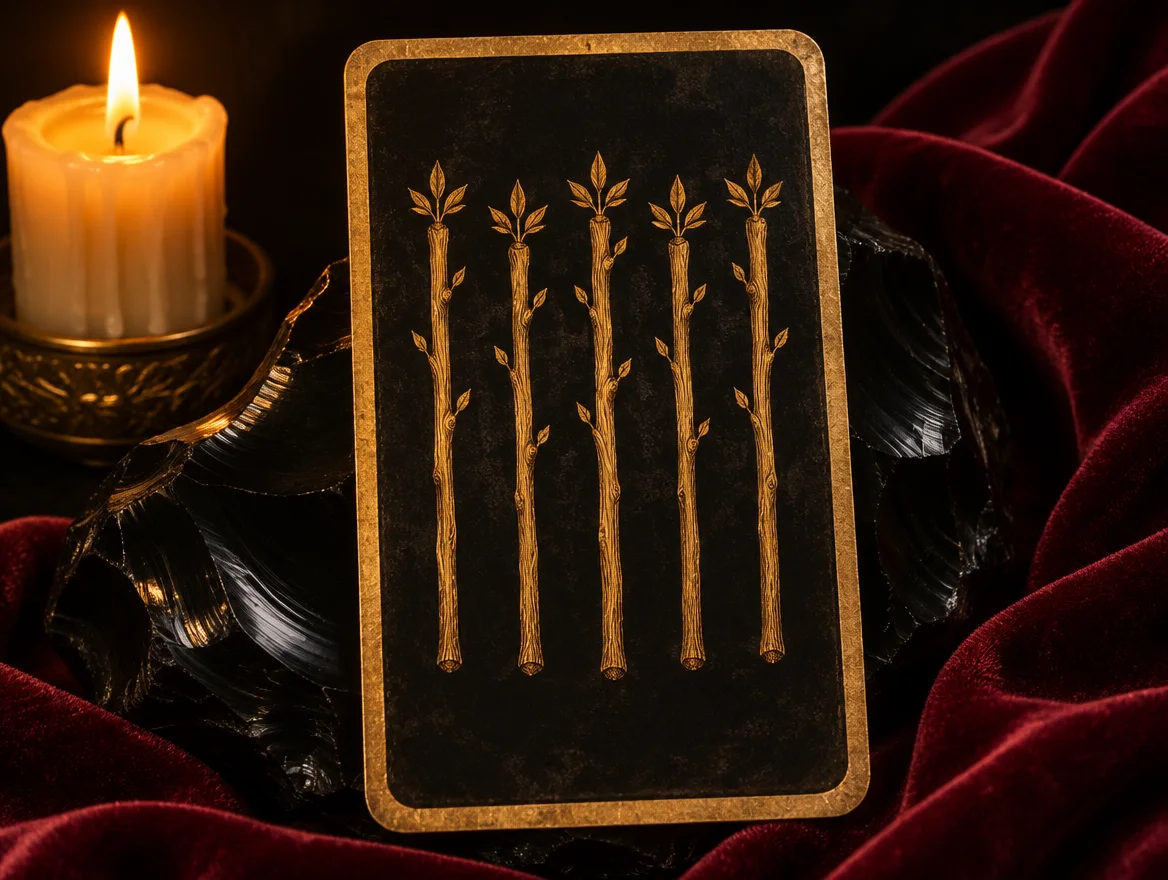
The Golden Dawn described its own design for this card in Book T, as printed by Aleister Crowley in Liber LXXVIII. There are no people at all: two white hands come out of clouds, clasped together, holding five wands by their centers. One wand stands upright in the middle, the other four cross it, and flames leap from the point where they meet. The sign of Saturn sits above the middle wand and the sign of Leo below it (Liber LXXVIII, sacred-texts.com).
Five of Wands meaning (upright)
Waite’s divinatory meanings start with imitation, such as a sham fight, and then widen to the hard competition and struggle of chasing riches and fortune, which he ties to the wider battle of life. He adds that some attributions call it a card of gold, gain and opulence (sacred-texts.com: Waite, Five of Wands). In his list of additional meanings, Waite gives the card success in financial speculation (sacred-texts.com: Waite, Additional Meanings). That’s a historical note, not money advice.
On The 9th King, the upright Five of Wands meaning readers commonly use has three layers.
Competition
The card can point to rivalry: a job market, a contest, a team where everyone wants the same spot. Competition can show you what you’re capable of. Ask yourself: Is this rivalry making me better, or only making me tense?
Friction and debate
On 9K, we often read the Five of Wands as clashing ideas: a meeting where everyone talks at once, a family group chat, a creative project with five strong opinions. Fire needs something to rub against before it sparks.
Sparring, not war
Waite’s idea of a mock battle is the heart of the upright card. Sparring partners hit each other on purpose, with rules, so both get stronger. The upright card can be a prompt to treat a current struggle as practice: something with limits, where nobody has to be destroyed for the round to count.
Five of Wands reversed
Readers handle reversals differently: some read the opposite meaning, some the same energy blocked, and some skip reversals entirely. Waite’s reversed meanings for this card are litigation, disputes, trickery and contradiction (sacred-texts.com: Waite, Five of Wands). His additional reversed meaning is more hopeful: quarrels may be turned to advantage (sacred-texts.com: Waite, Additional Meanings).
A card can’t tell you that anyone is tricking you, and it can’t establish what another person intends. On The 9th King, the Five of Wands reversed usually points to one of three patterns, offered as questions, not predictions.
The conflict has gone formal or tangled
When sparring stops being playful, people stop talking and start building cases. Ask yourself: Is there a simpler conversation that would make the case-building unnecessary, and is it safe to have it?
The conflict has gone underground
Sometimes the staves come down in public but keep swinging in private: sarcasm, silent treatment, side conversations. The fight hasn’t ended; it’s just harder to see. Ask yourself: What disagreement am I acting out instead of saying?
You’re avoiding friction altogether
The reversed card can also point to the opposite problem: steering around every disagreement until nothing honest gets said. Ask yourself: What would I say if I trusted the relationship to survive a disagreement?
| Pattern | Upright tone | Reversed tone |
|---|---|---|
| Conflict | Open, energetic | Tangled or hidden |
| Rules | Shared and fair | Unclear or ignored |
| Rivals | Sharpen each other | Wear each other down |
| Outcome | Practice and growth | Stalemate or silence |
Five of Wands astrology: Saturn in Leo
The 9th King uses Golden Dawn–derived correspondences, the tradition the Rider–Waite–Smith deck draws on. Other schools of tarot and astrology use different systems, and not every card maps to a single sign: the court cards and Pages, for example, are handled differently. What follows is one traditional framework, offered as symbolism.
The title and the decan
In the Golden Dawn system, the 36 small cards (the Twos through Tens of the four suits) are matched to the 36 decans of the zodiac, the ten-degree thirds of each sign, each with a ruling planet. Liber LXXVIII names the Five of Wands The Lord of Strife and lists its decan as Saturn in Leo (Liber LXXVIII, sacred-texts.com). The same text says this decan “hath its beginning from the Royal Star of Leo.” It lists the three Leo cards in order as the Five, Six and Seven of Wands and gives the Six as Leo’s central decan, which places the Five in Leo’s first decan. The page doesn’t print degree numbers for it, so this article doesn’t either.
Book T also gives all four Fives to Geburah, the sphere of severity on the Kabbalistic Tree of Life, and describes the Fives generally as opposition, strife and struggle, an obstacle to the thing in hand. For this card it lists a wide range of possible meanings, from boldness, desire and generosity to rashness, cruelty and violence, depending on whether the card is well or ill dignified (Liber LXXVIII, sacred-texts.com). In its reading method, a decan card is always modified by the cards around it. So even in the Golden Dawn’s own system, the Five of Wands isn’t a fixed verdict. It’s a charge that can run clean or run hot.
What Saturn brings
Saturn is the planet of structure, limits, rules, time and consequences, and it’s the traditional ruler of Capricorn. See Capricorn Personality Traits. On a card about strife, Saturn is the referee: the rules of the game, the time limit, the cost of playing dirty.
What Leo brings
Leo is fixed fire, ruled by the Sun: pride, self-expression, play and the need to be seen. See Leo Personality Traits. On this card, Leo is the reason everyone has raised a staff: each person wants to shine, and each wants their idea to win.
The tension in the pairing
Leo wants to win and be recognized. Saturn wants limits, rules and accountability. Put together, you get a contest: pride with a rulebook. When Saturn’s limits hold, the clash is a fair fight that builds skill. When they don’t, pride turns the game into a grudge.
The 9K reading: a contest or a war?
The card’s tension
The Five of Wands holds two true things at once: conflict can make me stronger and conflict can wear me out. Some people see only the first; others only the second. The card asks you to tell the difference, case by case.
The shadow side
The shadow of the Five of Wands is needing to win more than needing to be right, or its quiet twin, refusing to play at all. It can look like:
- Scorekeeping. Remembering every point you lost and every point you made.
- Arguing with the person instead of the idea. Moving from “that plan has a problem” to “you always do this.”
- Turning everything into a contest. Comparing yourself with everyone until nothing feels like enough.
- Avoidance dressed up as maturity. Calling it “keeping the peace” when you’re really afraid of being disagreed with.
- Projection. Seeing rivals where there are only people with different views. Our guide to psychological projection explains how this works.
These patterns usually started somewhere sensible: a home where you had to fight to be heard, or one where conflict felt dangerous. The question is whether they still fit your life now.
Sparring or fighting: how to tell
A contest has shared rules, a limit and a point. A war has none of those: it keeps going, the rules keep shifting and the goal becomes the other person losing.
| A contest | A war |
|---|---|
| Argues with ideas | Attacks the person |
| Has agreed rules | Rules shift or vanish |
| Ends, then you shake hands | Keeps going |
| Both can get better | Someone has to lose |

Feelings aren’t a reliable test. A fair disagreement can feel uncomfortable and still be healthy, and a polite one can still be a quiet war. Look at behavior instead: Are we talking about the issue or about each other? Do we both know the rules? Could this end with neither of us humiliated?
Safety comes first. If a “disagreement” involves threats, intimidation, control or violence, it isn’t a contest and you don’t owe it a fair fight. Responsibility for that behavior belongs to the person doing it. Distance, no contact or leaving are all valid choices, and leaning on people and services you trust for support is wise.
The self-mastery lesson
The lesson of the Five of Wands is to fight clean, or choose not to fight. Self-mastery here doesn’t mean avoiding conflict. It means you decide which battles are contests worth entering, you play by rules you’d be proud of, and you can walk away from the rest without feeling you lost.
Five of Wands as feelings, in love and at work
Five of Wands as feelings
When someone asks “how does this person feel?” and draws the Five of Wands, readers often take it as mixed or restless energy: attraction tangled with competitiveness, or interest alongside a lot of noise. The card can’t tell you what anyone feels or will do. It can prompt you to ask yourself: Is there a pattern of friction between us, and how do we each handle it? If the card is about your own feelings: Am I excited, or am I braced for a fight?
Five of Wands love meaning
In a love reading, the upright card can point to lively friction: two people who debate, tease and push each other, sometimes in a way both enjoy. It can also point to outside noise, such as friends, family or past partners with opinions. The reversed card can point to arguments that have gone underground, or to a habit of avoiding every hard conversation.
Tarot can’t tell you whether to stay or leave, and this page won’t either. The card can help you notice how conflict works between you. Useful questions:
- When we disagree, do we argue about the issue or about each other?
- Do we have shared rules, spoken or not, for how we fight?
- Is one of us always the one who backs down?
If your relationship mixes a lot of heat with a lot of feeling, our piece on fire and water relationships explores how intense and sensitive styles can learn to work together.
Five of Wands at work
At work, readers often take the card as competition: a busy market, a team with clashing ideas, a pitch where everyone wants the lead. The shadow version is the office where every meeting is a contest and nothing gets decided. This is reflection, not career or financial advice. Ask yourself: Am I competing to do good work, or competing to be seen winning?
Practical exercise: sparring rules
This exercise turns the self-mastery lesson into something you can use this week. You need about twenty minutes and a notebook. It works best for an ongoing disagreement where you feel safe; skip it for any situation involving threats or control.

Step 1: Name the match
Write one sentence: What is this disagreement about? Keep it to the issue, not the person. “How we split the holidays,” not “my sister is impossible.”
Step 2: Find the question
Under most arguments sits a decision. Write it as a question: What are we actually trying to decide? Often the staves are flying because nobody has said this out loud.
Step 3: Write your rules
List three rules you’ll hold yourself to, whatever the other person does. For example: I’ll argue with ideas, not character. I’ll let them finish. I won’t bring up old fights. You can’t control their rules, only yours. If it feels safe and useful, you can choose to share them.
Step 4: Mark your limit
Decide in advance when you’ll pause: a time limit, a point where voices rise, or a topic you won’t go into today. A limit isn’t losing. It’s Saturn keeping the game fair.
Step 5: Review the round
Afterward, write down what got stronger: your clarity, the relationship, the idea, or none of these. If nothing did, some matches aren’t worth playing again.
A worked example (fictional)
Marcus (fictional) runs a small design team, and every planning meeting turns into five people talking over each other. He draws the Five of Wands upright and recognizes his Mondays.
He names the match: “which project we take on first.” His real question is “what can we deliver well by the end of the quarter?” His rules: he’ll ask each person for one sentence before anyone debates, he’ll argue with plans rather than people, and he won’t decide in the room when he’s frustrated. His limit is a forty-minute meeting. In the review, he notices the meeting was shorter and calmer. Two people still disagreed, but this time they disagreed about the plan, not each other.
Journal prompts for the Five of Wands
- Which conflicts in my life feel like practice, and which feel like war?
- When I disagree with someone, do I argue with their idea or with who they are?
- Where am I competing with people who don’t even know we’re in a contest?
- What did I learn about conflict growing up, and does that lesson still fit?
- What rules would I want everyone to follow in a fair fight, including me?
- Which battle could I put down this month without losing anything that matters?
For more prompts like these, our shadow work prompts collection goes deeper, and Shadow Work, Plainly explains how to start safely. Our zodiac shadow work guide looks at how each sign handles its own hard edges.
A warm note: this is reflective practice, not therapy. If conflict in your life is tied to trauma or abuse, or if you’re dealing with thoughts of self-harm or distress that feels overwhelming, please work with a qualified therapist who can walk with you. It’s always fine to stop a prompt that feels like too much.
Myths and misreadings of the Five of Wands
- “The Five of Wands means a fight is coming.” No. On The 9th King, tarot doesn’t predict events. The card reflects how you handle friction, not what someone else will do.
- “It means someone is against you.” A card can’t establish anyone’s motives. Waite himself described the scene as possibly sport, not only strife.
- “Conflict is always bad.” Waite described the scene as a mock battle, and readers often see healthy competition in it. Friction can test ideas and build skill.
- “Reversed means you’ve lost.” A reversal can point to conflict that needs a cleaner path, or to friction you’ve been avoiding. That’s information, not a verdict.
- “Saturn in Leo means this card is about Leo people.” No. It’s Golden Dawn symbolism; anyone can draw it.

Five of Wands: FAQ
What does the Five of Wands mean?
The Five of Wands is a Minor Arcana card in the suit of Wands. Waite described a group of youths brandishing staves, perhaps in play and perhaps in earnest, and readers commonly take it as competition, friction, rivalry and clashing ideas. On The 9th King, it’s a mirror for how you handle conflict: whether a struggle is a fair contest that builds strength or a fight that only wears everyone down.
What does the Five of Wands reversed mean?
Reversed, the Five of Wands is often read as conflict that has turned tangled, formal or hidden, or as friction you keep avoiding. Waite listed disputes and contradiction among its reversed meanings, and also noted that quarrels may be turned to advantage. Some readers don’t use reversals at all. Treat it as a question, such as “what would a cleaner way through look like?”, not a forecast.
What does the Five of Wands mean as feelings?
As feelings, readers often take the Five of Wands as mixed or restless energy: attraction tangled with competitiveness, or interest mixed with a lot of noise. The card can’t tell you what someone feels or intends. It can prompt you to notice how friction shows up between you, and whether you feel excited or braced when you’re together.
What does the Five of Wands mean in love?
In love, the upright card can point to lively friction, such as debate, teasing or outside opinions. Reversed, it can point to arguments that have gone underground or to avoiding hard conversations. The card doesn’t tell you to stay or leave. It invites you to look at how you disagree, and whether you both play by fair rules. Threats or control are never a fair fight.
What zodiac sign is the Five of Wands?
In the Golden Dawn system, the tradition The 9th King uses, the Five of Wands corresponds to Saturn in Leo, the first decan of Leo. Liber LXXVIII, which prints the Golden Dawn’s Book T, calls the card the Lord of Strife. Other schools use different correspondences, so treat this as one traditional framework for symbolism rather than a fixed rule.
Is the Five of Wands a yes or no card?
The 9th King doesn’t do yes or no readings, because tarot here is a tool for self-reflection, not fortune-telling. Instead, ask what the card shows you: where friction is testing you, whether the struggle has fair rules, and which battles are worth your energy.
Is the Five of Wands a good or bad card?
Neither, on The 9th King. Waite’s meanings range from sham fights and the battle of life to gain and success in financial speculation, and Book T says the card shifts with the cards around it. Most modern readers see both sides: competition can sharpen you or drain you. Read it as a mirror for how you handle conflict, not as a good or bad omen.

Your next step: try the sparring rules exercise above on one disagreement you feel safe working with this week. Then read our Leo Personality Traits guide: Leo is the sign the Golden Dawn tied to this card, and it shows how pride can shine without turning every room into a contest.
Explore Next
- The Lion’s pride and its shadow: Leo Personality Traits
- Saturn’s steady, rule-minded side: Capricorn Personality Traits
- When you see rivals who aren’t there: Psychological Projection
- Go deeper with questions: Shadow Work Prompts
- The suit’s starting spark: Ace of Wands
- The one still standing: Nine of Wands
- Reading by feel: Intuitive Tarot (Code of Ascension)
- New to the cards: Tarot for Beginners: How Tarot Really Works (Code of Ascension)
- More tarot on The 9th King: Tarot Card Meanings · Minor Arcana · Tarot & the Zodiac · Knight of Wands · Shadow Work Tarot Spread
- More cards in this set: Four of Wands, Seven of Wands, Five of Swords

Final Thought: Fight Clean or Put the Staff Down
Waite’s figures brandish their staves “as if in sport or strife”: mimic warfare, with rules and limits. In your own life, which kind of contest you’re in is often yours to choose. Pick the contests that make you stronger, play them by rules you respect, and let the rest go without calling it defeat. Know your nature. Rule your life.
About the Author
King is the founder of The 9th King, where zodiac psychology, relationships and shadow work are explored as tools for self-knowledge rather than fortune-telling. He’s a Libra Sun, and writes about the personal side of astrology on King The Kemist. Astrology on The 9th King is interpretation and self-reflection, not prediction or established fact.
Leave a Reply