
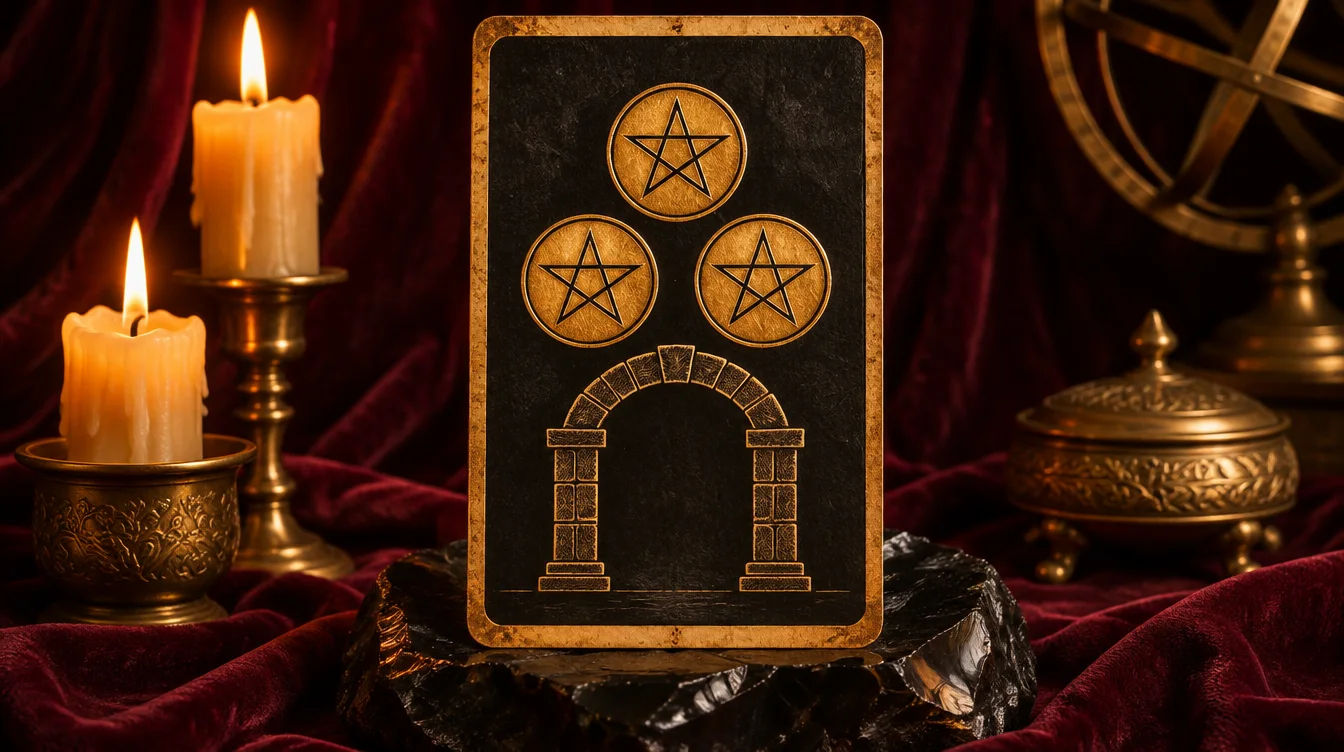
Quick Answer: What Does the Three of Pentacles Mean?
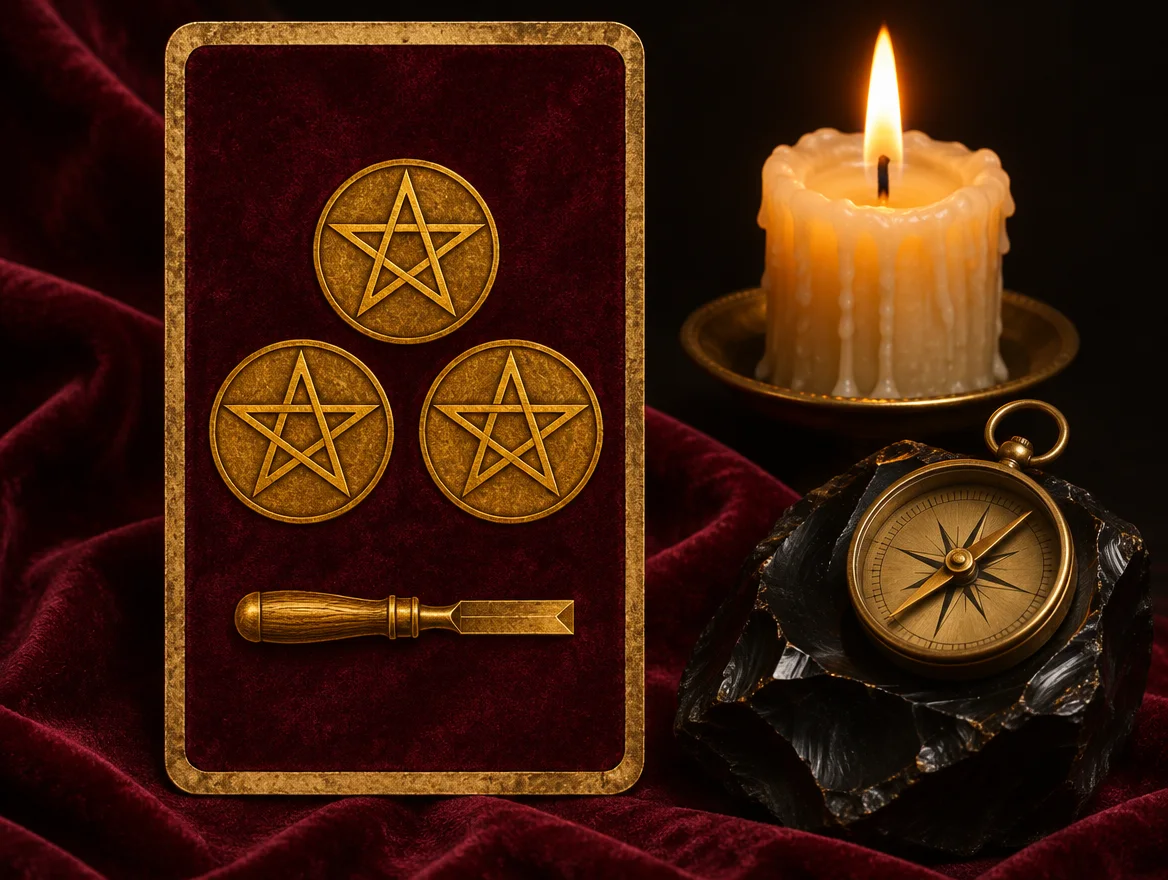
The Three of Pentacles (also written 3 of Pentacles) is a Minor Arcana card from Pentacles, the earth suit of work, money, body and home. A.E. Waite describes it as a sculptor at work in a monastery: the learner of the Eight of Pentacles, now working for real. On The 9th King, it’s the card of skill put to use: the point where practice turns into building something that lasts.
- Keywords: skill, craft, trade, good work, recognition, building, foundations, learning in earnest.
- Upright, in one line: a prompt to notice where your skill is ready for real work, if you’ve been practicing something for a while.
- Reversed, in one line: coasting, pettiness or work done below your own standard; a prompt to ask what you’re building and who it’s for.
On The 9th King, tarot is a mirror for self-knowledge, not fortune-telling. The Three of Pentacles doesn’t say your work is about to be rewarded. It asks how you relate to your own craft.
Table of Contents
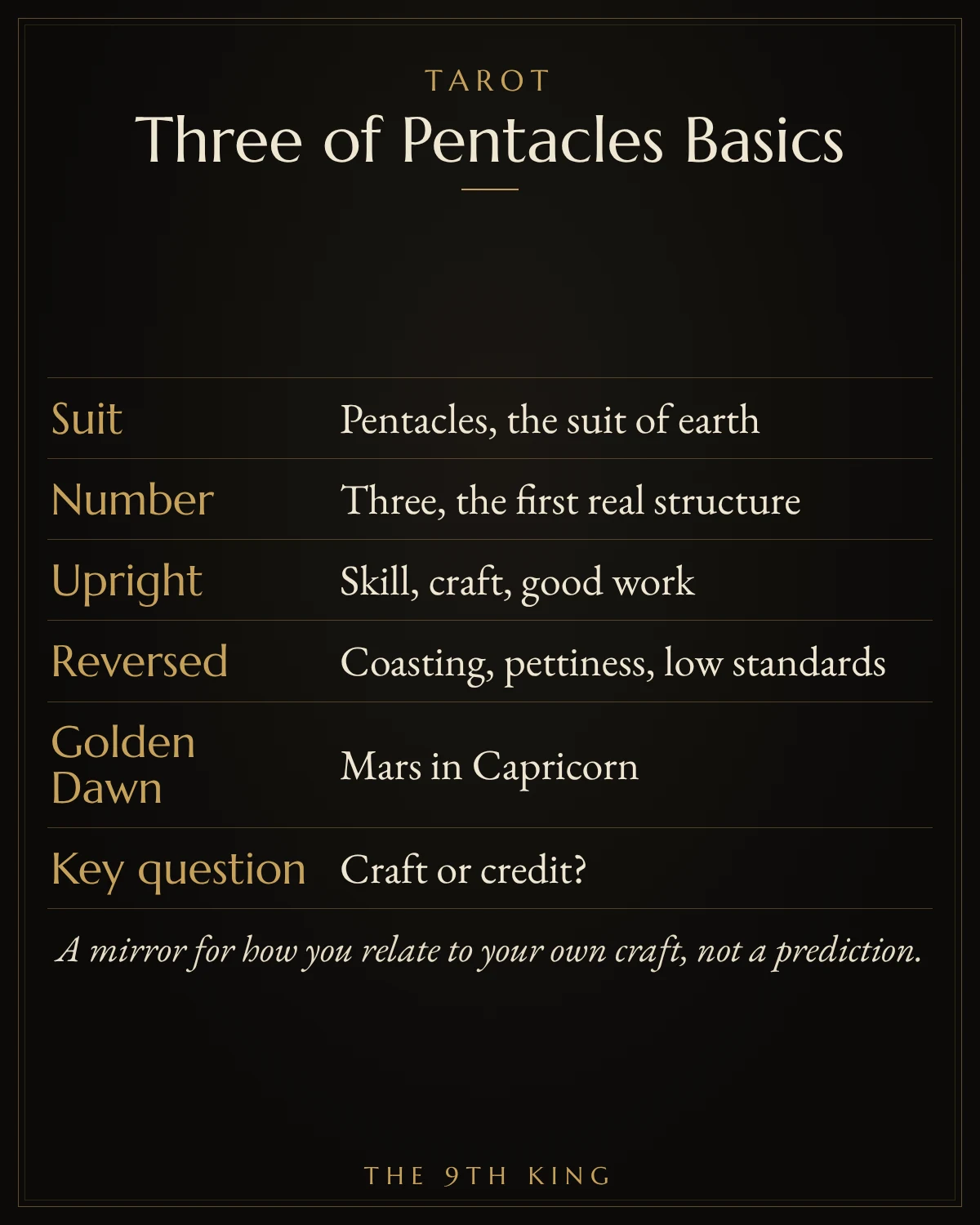
The Three of Pentacles at a glance
| Three of Pentacles | |
|---|---|
| Arcana | Minor Arcana, a pip (number) card |
| Suit and element | Pentacles, linked with earth |
| Number | Three |
| Golden Dawn title | Lord of Material Works |
| Astrology (Golden Dawn) | Mars in Capricorn |
| Upright | Skill, trade, recognition |
| Reversed | Mediocrity, pettiness, weakness |
| Key question | Am I building for the craft or the credit? |
What the Three of Pentacles looks like
Most people meet this card through the Rider–Waite–Smith deck, first published in London by William Rider & Son in 1909. A.E. Waite wrote the instructions and Pamela Colman Smith drew the art, and both were members of the Hermetic Order of the Golden Dawn (Wikipedia: Rider–Waite Tarot).
Waite’s description in The Pictorial Key to the Tarot (1911) is short, so this section stays close to his words (sacred-texts.com: Waite, Three of Pentacles).
A sculptor at work
Waite’s whole scene fits in one line: “A sculptor at his work in a monastery.” Someone skilled is in the middle of a job, not admiring a finished one. Sculpture is slow, careful work that’s hard to undo, and nobody does it well by accident.
The setting
Waite places the sculptor in a monastery. We describe that setting as he does and don’t read a religious message into it, for or against any faith. On The 9th King, the setting is simply a reminder that good craft often serves something bigger than one person.
The apprentice, grown up
Waite asks the reader to compare this card with the Eight of Pentacles, where a learner practices his trade. Here, he says, that apprentice has received his reward and is now “at work in earnest.” So the Three shows the moment practice becomes a real job.
Apart from the sculptor and the monastery, Waite’s text describes nothing else in the scene. The other figures and details people know from the 1909 Smith card aren’t in his words, so we leave them to the card itself rather than invent meanings for them.
The Golden Dawn version of the card
The Golden Dawn’s teaching text on the tarot, Book T, as printed by Aleister Crowley in Liber LXXVIII, describes a different design. A white-winged angelic hand holds a branch of a rose tree; two white rosebuds touch and rise above the topmost pentacle; the three pentacles form an equilateral triangle; and the symbols of Mars and Capricorn sit above and below (Liber LXXVIII, sacred-texts.com). The structure is in place; the flowering is still ahead.
Three of Pentacles meaning (upright)
Waite gives two layers of meaning. The first is plain: a trade, a métier, skilled labour. The second, which he says is the more usual reading, turns the card toward nobility, renown and glory (sacred-texts.com: Waite, Three of Pentacles).
Book T, under the title Lord of Material Works, is longer. It lists working, constructive force: building up and creating, the growth of material things, gain in trade, rank, influence and cleverness in business. It adds a beginning: “Commencement of matters to be established later” (Liber LXXVIII, sacred-texts.com). In the same entry, the card’s place on the Tree of Life is summed up as business, paid employment and commercial transaction.
Waite also printed a short list of extra fortune-telling meanings, where the Three of Pentacles gets fame for a man’s eldest son (sacred-texts.com: Waite, Additional Meanings). Waite himself notes that these extras have little connection with the designs.
On 9K, we also read the Three of Pentacles as a card of teamwork and collaboration. Waite’s text doesn’t use those words, so we treat that as a modern reading. On The 9th King, the upright card has three layers.
Skill put to real use
The card can point to the moment practice becomes production: the drawing becomes the commission, the course becomes the job. Ask yourself: Where am I still calling myself a beginner when the work says otherwise?
Good work, seen
Waite’s second layer, renown, is about being recognized for what you do well. On The 9th King, we read it as a healthy wish: wanting your work to matter to someone. Ask yourself: Who benefits from this work, and have I let them see it?
Laying a foundation
This is the layer Book T points toward: a beginning built to last. Ask yourself: What am I building now that I’d like to still be standing in five years?
Three of Pentacles reversed
Some readers read reversals as the opposite meaning, some as blocked energy, and some skip them. Waite’s reversed meaning is blunt: mediocrity, in work and otherwise, along with childishness, pettiness and weakness (sacred-texts.com: Waite, Three of Pentacles). His extra list says the reversed card depends on the cards around it.
Book T doesn’t give reversals, but its upright entry includes a harder side: selfishness, being narrow and prejudiced, and sometimes chasing impossible goals (Liber LXXVIII, sacred-texts.com). On The 9th King, the reversed card usually points to one of three patterns, offered as questions, not predictions.
Coasting
You know the work, so you do it on autopilot, a notch below your own standard. Ask yourself: Is this my real level, or just the level nobody has questioned yet?
Pettiness about credit
The work becomes a contest over whose name goes on it. Small fights, guarding territory, refusing a good idea because of who suggested it. Ask yourself: Would I still care about this detail if nobody was keeping score?
Building the impossible, alone
This is Book T‘s note about impossibilities. You plan something so big or so perfect that it never gets built, or you refuse help so the vision stays yours. Ask yourself: What’s the smallest real piece of this I could build this month, with help?
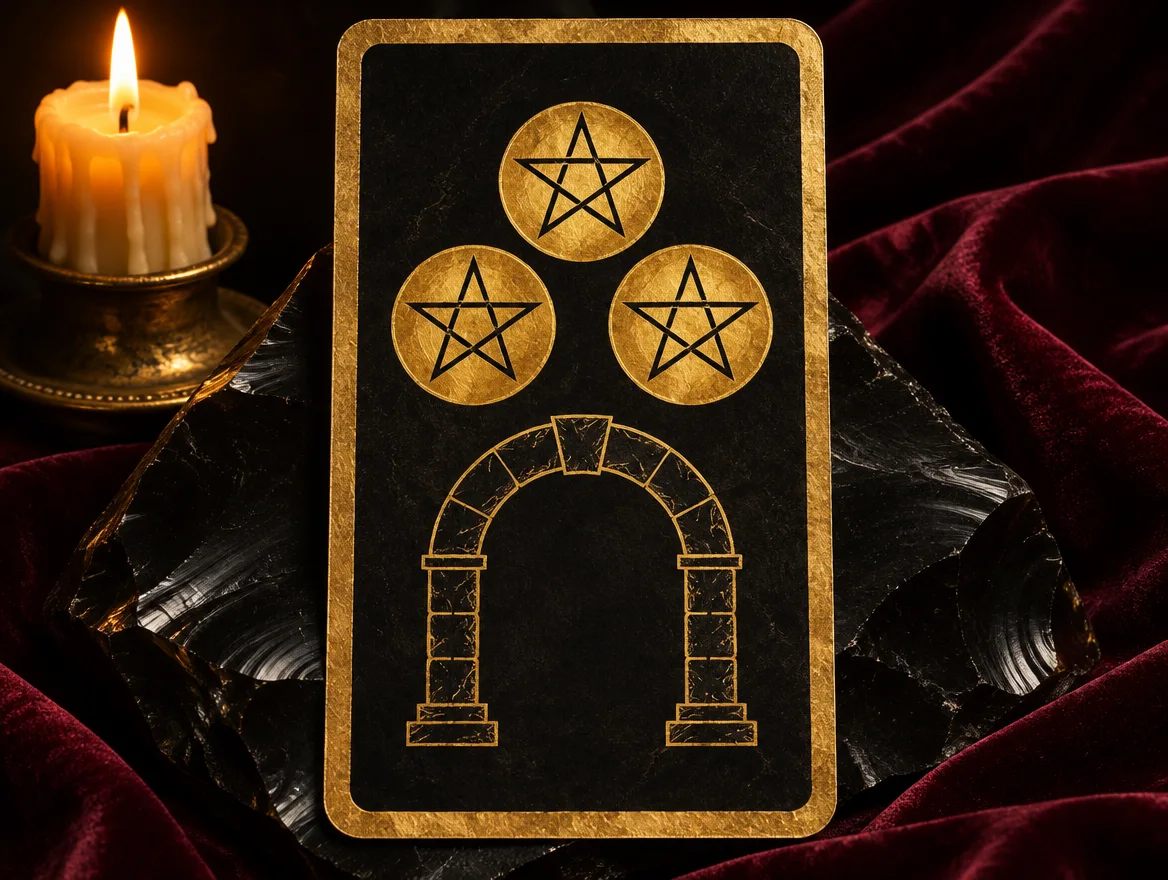
Three of Pentacles astrology: Mars in Capricorn
The 9th King uses Golden Dawn–derived correspondences, the tradition the Rider–Waite–Smith deck draws on. Other schools use different systems, and not every card maps to a single sign: the court cards and Pages are handled differently. This is one traditional framework, offered as symbolism.
How the number cards get their planets
In the Golden Dawn system, the 36 small cards (Twos through Tens) are matched to the 36 decans of the zodiac: ten-degree thirds of a sign, each with a ruling planet. Book T‘s table lists the Three of Pentacles, Lord of Material Works, under Mars in Capricorn, and the card’s own entry places the symbols of Mars and Capricorn on the card (Liber LXXVIII, sacred-texts.com).
Capricorn’s three decans in that table run in this order:
| Card | Golden Dawn title | Decan |
|---|---|---|
| Two of Pentacles | Harmonious Change | Jupiter in Capricorn |
| Three of Pentacles | Material Works | Mars in Capricorn |
| Four of Pentacles | Earthly Power | Sun in Capricorn |
So the Three is the middle decan of Capricorn. Book T also places all four Threes in Binah on the Kabbalistic Tree of Life, and describes Binah in the small cards as action that has definitely begun, for good or ill. In the same text, Pentacles is the suit of earth; its Ace is the Root of the Powers of the Earth.
What Mars brings
On The 9th King, Mars is the planet of drive, effort, courage and getting physical work done. It rules Aries and, in traditional astrology, Scorpio, so those pages show Mars’s style in a person. This isn’t “the Aries card” or “the Scorpio card”; Mars is simply the energy at work in this decan. On this card, Mars is the hand on the chisel.
What Capricorn brings
Capricorn is cardinal earth, ruled by Saturn: the sign of structure, long goals and reputation. Our Capricorn Personality Traits page covers the Goat’s patience and its harder edge. On this card, Capricorn is the building itself, and the plan that’s bigger than today.
The tension in the pairing
Mars wants to act now and see results. Capricorn wants it done properly, in order, to last. Mars teaches Capricorn to actually start; Capricorn teaches Mars to build something worth the effort.
The 9K reading: craft or credit?
The card’s tension
The Three of Pentacles holds two honest wishes at once: I want to do this well and I want it to be seen. The trouble starts when the second one takes over the first, and the work becomes a way to be noticed rather than a thing worth making.
The shadow side
The shadow of the Three of Pentacles is letting the work become about your standing instead of the work. Book T names part of this in its own list: selfishness, narrowness, prejudice. It can look like:
- Credit-keeping. Tracking who did what so carefully that it slows down the job.
- Gatekeeping. Treating your skill as a reason to dismiss people still learning, forgetting you were the apprentice of the Eight not long ago.
- Perfection as a hiding place. Not showing work until it’s flawless, so nobody can help and nobody can criticize.
- Coasting on reputation. Doing less because people already think you’re good.
These patterns usually come from caring about your craft, and sometimes from old experiences of not being taken seriously. If being overlooked is a sore spot, inner child work is a related, gentle place to look.
Rest is not mediocrity
Pacing is part of good work. Taking a break, working at a slower speed during illness or a hard season, or doing a plain job on something that only needs a plain job aren’t this card’s reversed side. On 9K, we read Waite’s reversed word, mediocrity, as effort that has stopped meeting your own standard, not the times you need to rest. That reading is ours; Waite doesn’t define the word.
Craft or credit?
| Craft | Credit |
|---|---|
| Focus is on the work itself | Focus is on who notices |
| Feedback is useful information | Feedback feels like a verdict on you |
| Others’ skill makes the work better | Others’ skill feels like competition |
| Unfinished work is shown to helpers | Unfinished work is hidden until perfect |
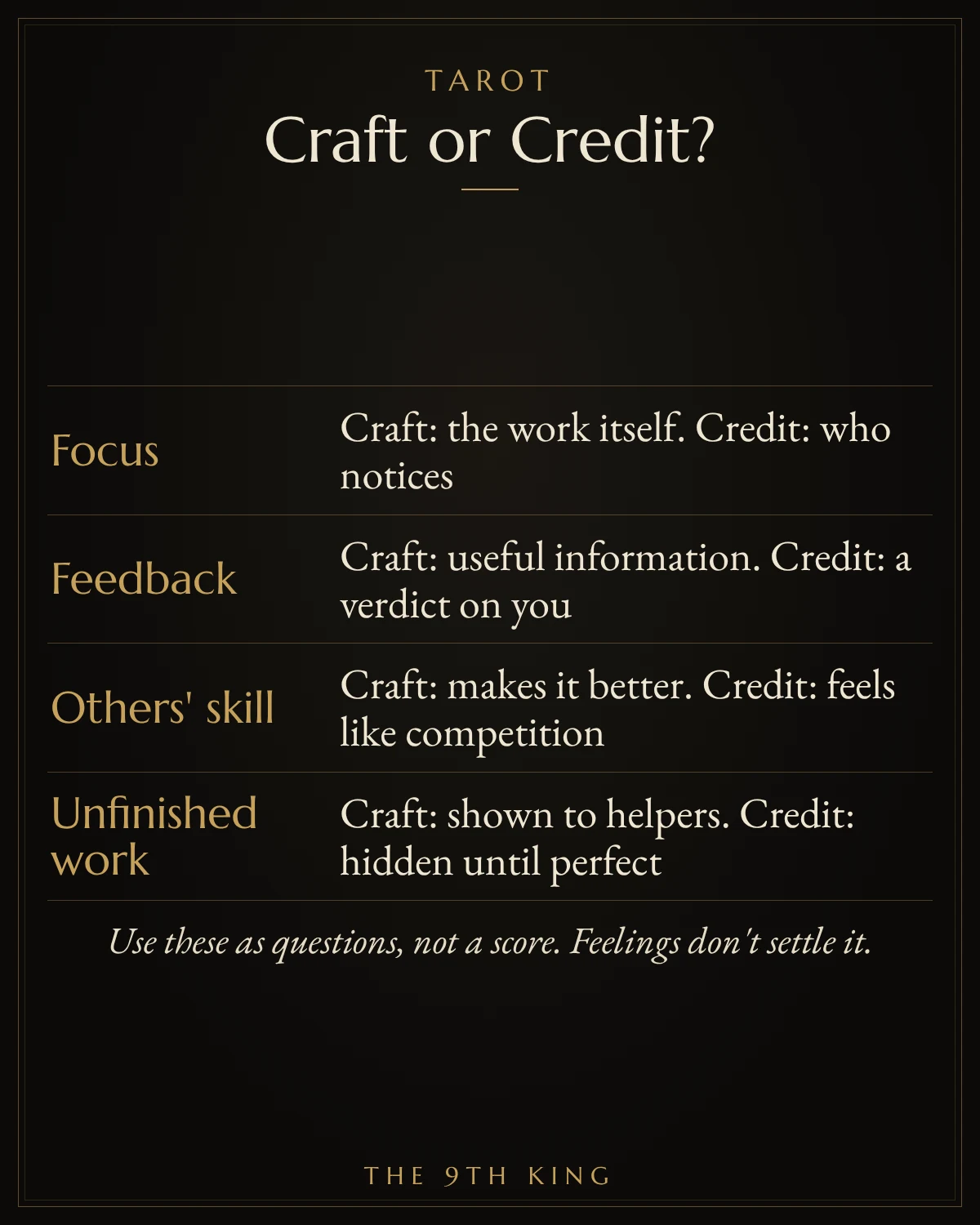
Use the table as questions, not a score. How you feel in the moment doesn’t settle which column you’re in; you can feel anxious and still be doing honest craft.
The self-mastery lesson
The lesson of the Three of Pentacles is to let your skill serve the work. Recognition can come, and it’s fine to want it, but it isn’t the foundation. Self-mastery here means holding a standard because the work deserves it, sharing the build when sharing makes it better, and remembering you were once the apprentice.
Three of Pentacles as feelings, in love and at work
Three of Pentacles as feelings
As feelings, readers often take the card as respect and steady effort: someone who values what you’re building together and wants to do their part well. A card can’t tell you what someone feels or will do; their words and actions can. About your own feelings, ask: Do I respect the effort here, or just the result?
Three of Pentacles love meaning
In a love reading, the upright card can point to a relationship being built on purpose: shared plans, practical care, two people each bringing a skill. The reversed card can point to keeping score, one person doing the building alone, or treating the relationship as a project to manage rather than a life to share.
Tarot can’t tell you whether to stay or leave, and this page won’t either. If you don’t feel safe with someone, this isn’t about effort or craft: your safety comes first. Otherwise, useful questions:
- What are we each actually contributing lately, in behavior I can see?
- Where do I want credit for something I’d rather just ask for help with?
- What’s one small thing we could build together this month?
If you and a partner work at different speeds and temperatures, fire and water relationships looks at how drive and caution can share a project.
Three of Pentacles at work and with money
None of this is career or financial advice, only reflection.
At work, readers often take the card as skilled work or a job that finally uses what you know. Ask yourself: Where could my skill do more good if I shared it, and where have I stopped really trying?
With money, the card’s lesson is about the link between work and worth, not about amounts. Book T ties it to paid employment and trade. Ask: Do I value my own skill fairly, and do I value other people’s? For actual decisions, talk to a qualified professional.
The Ace of Pentacles is the raw material this card starts shaping, and the Seven of Pentacles is the later pause to look at what the work has grown.
Practical exercise: the workshop review
You need about twenty minutes, a notebook and one project where your skill matters.
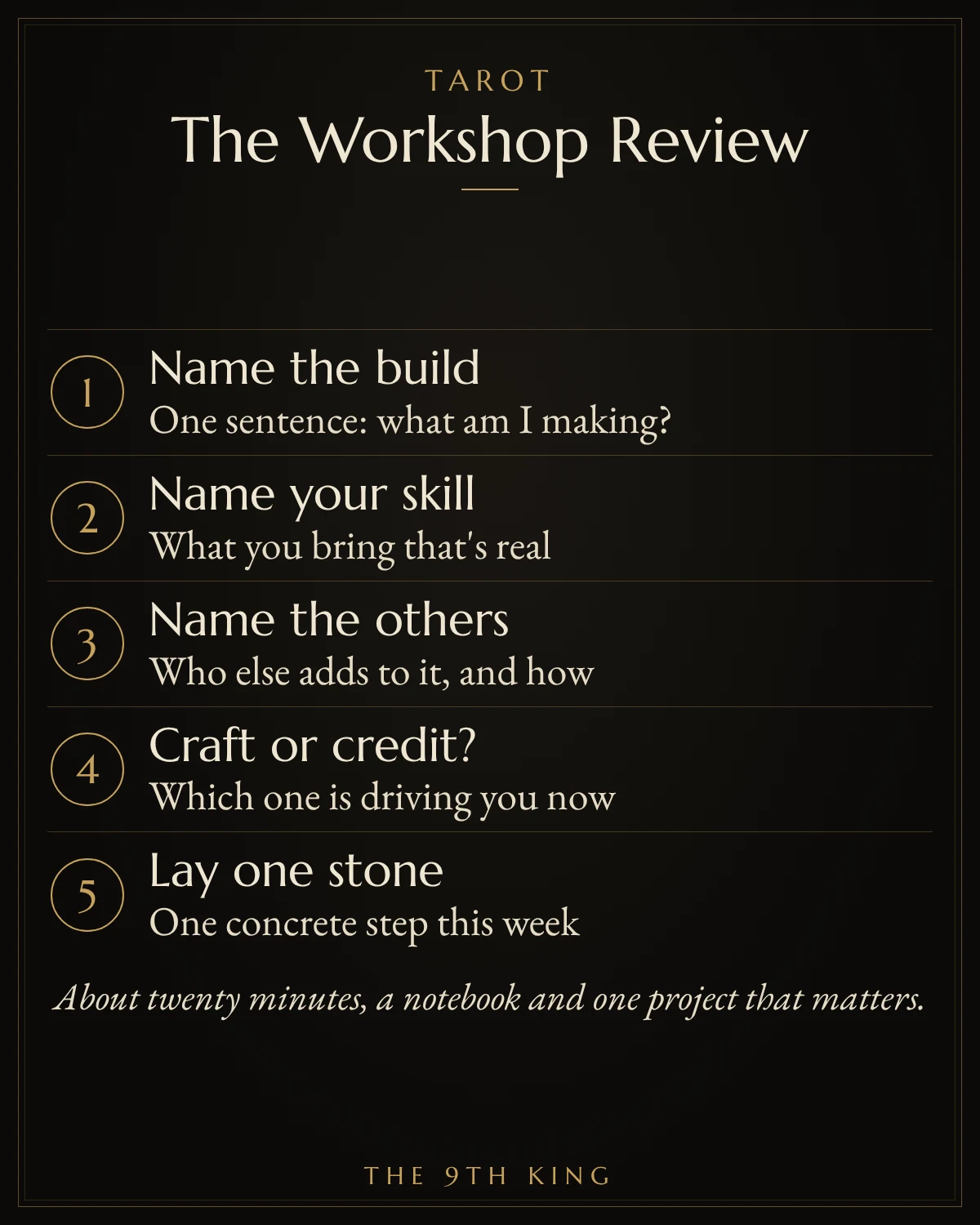
Step 1: Name the build
Write one sentence: What am I making? “My career” is too big; “a portfolio of six finished illustrations” is a build.
Step 2: Name your skill
List what you actually bring to it: abilities, experience, habits that work. Be accurate, not modest and not inflated.
Step 3: Name the others
List anyone who adds to this build: a teacher, a client, a coworker, a friend who reads drafts. Next to each, write what they’ve actually done, in things you’ve seen. If you work alone, note that too.
Step 4: Craft or credit?
Look at the table in the shadow section and notice which column has been steering you on this project lately. No grade. If it’s credit, write one sentence about what recognition you’re hoping for, and whether asking for it directly might be simpler.
Step 5: Lay one stone
Choose one concrete step for this week that moves the build forward: finish one piece, show one draft, ask one question. Put it in your calendar.
A worked example (fictional)
Leah (fictional) is a carpenter rebuilding a porch for a client, working with one helper. She draws the Three of Pentacles reversed.
She names the build as “a porch that will still be solid in twenty years.” Her skill: twelve years of framing and finish work. The others: her helper, who measured and cut every stair tread, and the client, who chose the layout. Craft or credit? She notices she’s been redoing her helper’s cuts without explaining why, partly to keep the job “hers.”
Her one stone for the week: show the helper what she’s checking for, and let the next cut stand if it’s right. Two people on the porch, one standard.
Journal prompts for the Three of Pentacles
- Where has my practice quietly turned into real skill, and have I admitted it to myself?
- Whose work makes mine better, and have I told them?
- Where do I want credit, and what would it look like to ask for it plainly?
- Where have I been coasting, and where have I simply needed rest? How can I tell them apart?
- Who taught me, and what could I pass on to someone still learning?
For more, our shadow work prompts go deeper and Shadow Work, Plainly explains how to start safely. Zodiac shadow work shows how the same patterns look across the signs.
A warm note: this is reflective practice, not therapy. If you’re dealing with trauma, abuse, thoughts of self-harm or distress that feels overwhelming, please work with a qualified therapist who can walk with you. It’s always fine to stop a prompt that feels like too much.
Myths and misreadings of the Three of Pentacles
- “The Three of Pentacles means you’re about to be promoted or praised.” No. On The 9th King, tarot doesn’t predict outcomes. A card can’t tell you what other people will decide. It’s a prompt to look at your own work.
- “It’s only a teamwork card.” Teamwork is a popular modern reading, but Waite describes a single sculptor at work and gives meanings about trade, skill and renown. It applies to solo craft too.
- “Mars in Capricorn means this card is about Capricorn people.” No. The correspondence describes the card’s symbolism in the Golden Dawn tradition. Anyone can draw it, whatever their sign.
Three of Pentacles: FAQ
What does the Three of Pentacles mean?
The Three of Pentacles is a Minor Arcana card in the earth suit. Waite describes it as a sculptor at work in a monastery, the learner of the Eight of Pentacles now working in earnest. Readers commonly take it as skill, craft, good work and recognition. On The 9th King, it’s a mirror for how you relate to your own craft: whether you’re building for the work itself or for the credit, not a prediction of results.
What does the Three of Pentacles reversed mean?
Reversed, the Three of Pentacles is often read as mediocrity, coasting, pettiness or fights over credit. Waite’s reversed meanings include mediocrity in work and otherwise, pettiness and weakness. It can also point to plans so big or so perfect they never get built. Some readers don’t use reversals at all. Treat it as a prompt to check your standards and your motives, rather than a sign that something will go wrong.
What does the Three of Pentacles mean as feelings?
As feelings, readers often take the Three of Pentacles as respect and steady effort: someone who values what you’re building together and wants to do their part well. A card can’t tell you what someone feels or will do; their words and actions can. If the card is about your own feelings, it can prompt you to ask whether you respect the effort in a relationship or only the results.
What does the Three of Pentacles mean in love?
In love, the upright card can point to a relationship built on purpose, with shared plans and practical care from both people. Reversed, it can point to scorekeeping, one person carrying the building alone, or treating love like a project to manage. The card doesn’t tell you to stay or leave. It invites you to look at what each of you is contributing, in behavior you can see.
What zodiac sign is the Three of Pentacles?
In the Golden Dawn system, the tradition The 9th King uses, the Three of Pentacles corresponds to Mars in Capricorn, the middle of Capricorn’s three decans. The Golden Dawn’s Book T calls the card the Lord of Material Works. It’s a planet in a sign rather than a sign card. Other schools use different correspondences, so treat this as one traditional framework for symbolism, not a fixed rule.
Is the Three of Pentacles a yes or no card?
The 9th King doesn’t do yes or no readings, because tarot here is for self-reflection, not fortune-telling. Instead, ask what the card shows you: where your skill is ready for real work, who else is part of the build, and whether you’re working for the craft or the credit.
Is the Three of Pentacles a good or bad card?
Neither, on The 9th King. Waite gives it hopeful meanings like skilled labour and renown, while the Golden Dawn’s Book T pairs building and gain with selfishness and narrowness. Both sides are there. Read it as a mirror for how you build and how you handle wanting to be seen, not as a good or bad omen.

Your next step: do the workshop review above for one project where your skill matters, and lay your one stone before the week is out. Then find where Capricorn and Mars fall in your own chart with our guide on how to read a birth chart: the earth sign and the planet of effort the Golden Dawn tied to this card.
Explore Next
- The Goat’s long game and its shadow: Capricorn Personality Traits
- Mars’s drive in a person: Aries Personality Traits
- Where the earth suit begins: Ace of Pentacles
- The steady worker of the suit: Knight of Pentacles
- The pause to look at what’s grown: Seven of Pentacles
- Go deeper with questions: Shadow Work Prompts
- Reading by feel: Intuitive Tarot (Code of Ascension)
- New to the cards: Tarot for Beginners: How Tarot Really Works (Code of Ascension)
- More tarot on The 9th King: Tarot Card Meanings · Minor Arcana · Tarot & the Zodiac · King of Pentacles · Shadow Work Tarot Spread
- More cards in this set: Four of Pentacles, Five of Pentacles, Six of Pentacles
Final Thought: Lay the Stone Well
The sculptor in the Three of Pentacles isn’t waiting to be discovered. He’s working, in earnest, on something that asks for real skill. Learn your craft, share the build when it helps, and let recognition follow the work. Know your nature. Rule your life.
About the Author
King is the founder of The 9th King, where zodiac psychology, relationships and shadow work are explored as tools for self-knowledge rather than fortune-telling. He’s a Libra Sun, and writes about the personal side of astrology on King The Kemist. Astrology on The 9th King is interpretation and self-reflection, not prediction or established fact.
Leave a Reply