
Quick Answer: What Does the Four of Wands Mean?
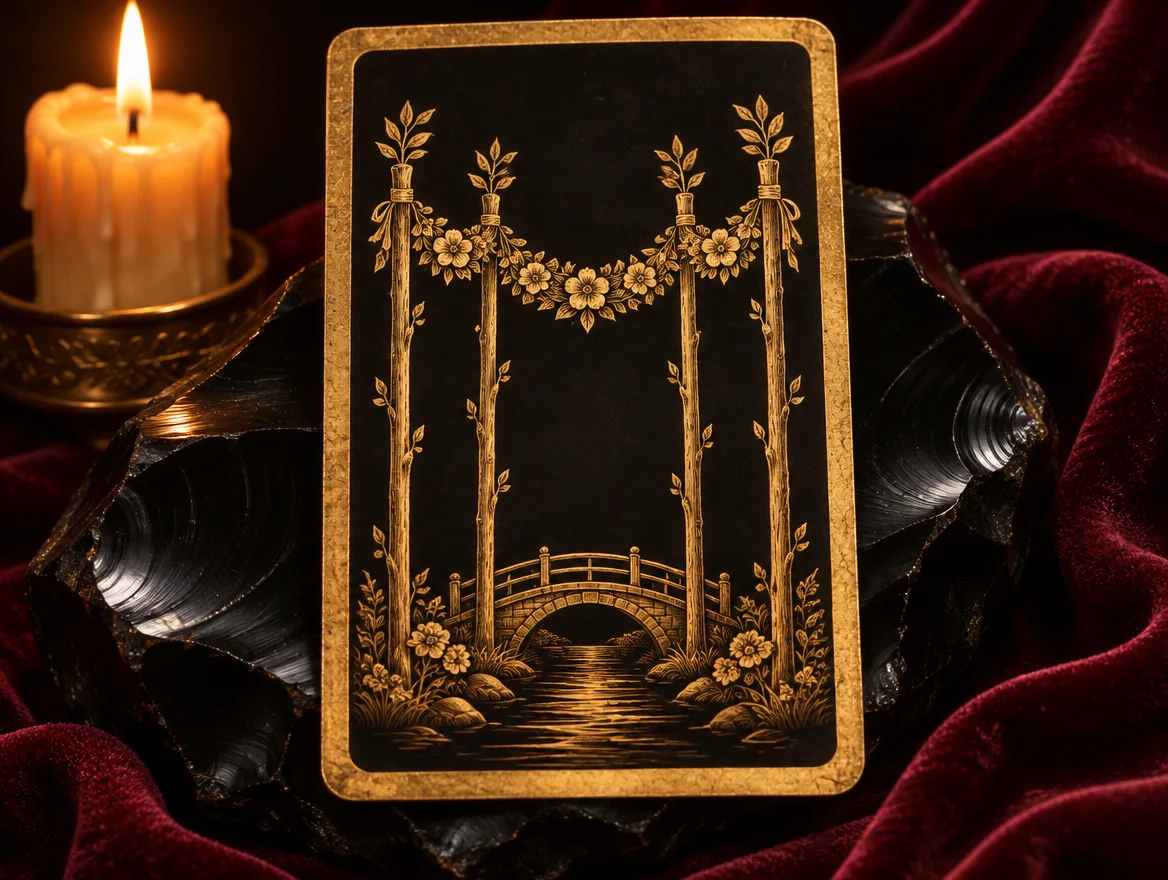
The Four of Wands (also written 4 of Wands) is a Minor Arcana card from the suit of Wands. It shows four tall staves planted in the ground with a garland hung across them, two figures raising bunches of flowers, and an old house beyond a bridge. Readers usually take it as the card of the finished stage: work that has come together, a place of welcome, and a reason to pause and celebrate.
- Keywords: celebration, homecoming, rest after labor, completion of a stage, harmony, belonging, shelter.
- Upright, in one line: a prompt to notice what you’ve already built, if a stage of work has come together, and to mark it before you move on.
- Reversed, in one line: the celebration feels delayed, hollow or out of reach; a prompt to ask what would make “home” feel real again.
On The 9th King, tarot is a mirror for self-knowledge, not fortune-telling. The Four of Wands doesn’t say a wedding or a party is coming. It asks how you treat your own milestones, and whether you ever let yourself arrive.
Table of Contents

The Four of Wands at a glance
| Four of Wands | |
|---|---|
| Arcana | Minor Arcana, a pip (number) card |
| Suit and element | Wands, linked with fire |
| Number | Four, a frame that stands |
| Golden Dawn title | Lord of Perfected Work |
| Astrology (Golden Dawn) | Venus in Aries |
| Upright | Celebration, completion, welcome |
| Reversed | Delay, hollowness, unsettled home |
| Key question | Can I let this count? |
What the Four of Wands looks like
Most people meet this card through the Rider–Waite–Smith deck, first published in London by William Rider & Son in December 1909. A.E. Waite wrote the instructions and Pamela Colman Smith drew the art, and both were members of the Hermetic Order of the Golden Dawn (Wikipedia: Rider–Waite Tarot).
The four staves and the garland
In The Pictorial Key to the Tarot, Waite describes four great staves planted in the foreground with a great garland hanging from them (sacred-texts.com: Waite, Four of Wands). On this card the Wands aren’t weapons or burdens. They’re the posts of something shared.
The two figures with flowers
Waite says two female figures lift up nosegays, small bunches of flowers. The mood is welcome, the end of a long day.
The bridge, the moat and the old house
Beside them, Waite places a bridge over a moat, leading to an old manor house. The house is protected, but there’s a way across.
Details on the 1909 Smith card
Some details people mention come from Smith’s painting rather than Waite’s words. Wikipedia’s summary of the card notes that the garland carries summer fruit, such as grapes and peaches, compares the frame to a wedding canopy, and mentions large walls and more people in the background (Wikipedia: Four of Wands). Apart from the garland, the staves, the two figures with flowers, the bridge, the moat and the house, none of this is in Waite’s text.
Four of Wands meaning (upright)
Waite begins his divinatory meaning by saying that, for once, the meanings are almost on the surface. He lists “country life, haven of refuge, a species of domestic harvest-home,” then repose, concord, harmony, prosperity and peace, and the perfected work of these (sacred-texts.com: Waite, Four of Wands).
The Golden Dawn’s teaching text on the tarot, Book T, as printed by Aleister Crowley in Liber LXXVIII, names the card The Lord of Perfected Work. Its meaning begins: “Perfection or completion of a thing built up with trouble and labour.” It goes on to list rest after labor, cleverness, beauty, mirth and success in completion (Liber LXXVIII, sacred-texts.com).
Put together, the upright Four of Wands meaning readers commonly use has three layers.
A stage is complete
The card can point to the end of a chapter: a move finished, a project shipped, a hard season survived. Not the end of everything, just a frame that now stands. Ask yourself: What have I finished lately that I haven’t really acknowledged?
Rest after labor
Both Waite and Book T tie this card to rest, because a piece of work is done. On The 9th King, the Four of Wands is read as permission to stop for a moment without guilt.
Home and welcome
Waite’s idea of a haven gives the card its warmth. It can point to a place, a relationship or a group where you’re welcome as you are. Ask yourself: Where do I feel at home, and who feels at home with me?
Four of Wands reversed
Readers handle reversals differently: some read the opposite meaning, some the same energy blocked, and some skip reversals entirely. This card has an unusual history here. Waite wrote that reversed, “The meaning remains unaltered,” and listed prosperity, increase, felicity, beauty and embellishment (sacred-texts.com: Waite, Four of Wands). In other words, for Waite even the upside-down Four is a good card.
Book T doesn’t separate upright and reversed in the same way, but its list for the card ends with a harder edge: unreadiness, unsteadiness through over-anxiety and hurried action, and a manner that is graceful but sometimes insincere (Liber LXXVIII, sacred-texts.com).
On The 9th King, the Four of Wands reversed usually points to one of three patterns, offered as questions, not predictions.
The celebration keeps getting postponed
You finished the thing, but you’ve told yourself you’ll celebrate “when it’s really done”, and that moment keeps moving. Ask yourself: What would have to be true for me to call this finished, and is that a fair bar?
The celebration feels hollow
The party happens, but it feels like a performance, or you feel like an outsider at your own milestone. This echoes Book T‘s note about insincerity, read gently: not that you’re fake, but that something in the moment isn’t true for you yet. Ask yourself: What part of this am I celebrating for other people, and what part for me?
Home feels unsettled
The reversed card can point to a home or group in transition: a move, a change in who lives with you, a circle shifting. The frame just isn’t standing yet. Ask yourself: What small thing would help this place feel like mine again?
| Pattern | Upright tone | Reversed tone |
|---|---|---|
| Milestone | Marked and felt | Postponed or skipped |
| Celebration | Sincere, shared | Hollow or performed |
| Home | A haven | In transition |
| Rest | Taken without guilt | Put off again |
Four of Wands astrology: Venus in Aries
The 9th King uses Golden Dawn–derived correspondences, the tradition the Rider–Waite–Smith deck draws on. Other schools of tarot and astrology use different systems, and not every card maps to a single sign: the court cards and the Aces, for example, are handled differently.
How the number cards get their planets
In the Golden Dawn system, the 36 small cards (the Twos through Tens of the four suits) are matched to the 36 decans of the zodiac. A decan is a ten-degree third of a sign, and each one is given a ruling planet. Liber LXXVIII‘s table lists the Four of Wands, Lord of Perfected Work, under the decan Venus in Aries, and the card’s own description places the symbols of Venus and Aries above and below the wands to represent the decan (Liber LXXVIII, sacred-texts.com).
The same text gives the first decan of Aries to Mars (the Two of Wands) and makes the Sun’s Three of Wands the central Aries decan, so the Four of Wands sits in the third and last decan of Aries. In the same text the suit of Wands is the suit of fire.
What Aries brings
Aries is the first sign of the zodiac, cardinal fire: the starter, the one who goes first. Our Aries Personality Traits page covers the Ram’s courage and its shadow. Aries is often already looking for the next hill.
What Venus brings
Venus describes what you value, what you find beautiful and how you connect with people. Venus rules Taurus and Libra, so our Taurus Personality Traits and Libra Traits pages are good context for its steadier, pleasure-loving side. For how Venus differs from your emotional needs, see Moon vs Venus.
The tension in the pairing
Aries wants to move. Venus wants to enjoy. The Four of Wands sits right in that gap: the moment when the restless builder is asked to stand still, hang a garland and let the beauty of the thing land. That’s also where Book T‘s warnings about hurried action make sense. The risk of this card isn’t failure. It’s rushing past success.
The 9K reading: can you let it count?
The card’s tension
The Four of Wands holds two true things at once: this is finished and there’s more to do. Both are usually true. Hear only the second and you never celebrate. Hear only the first and you stall. The card asks you to hold both.
The shadow side
The shadow of the Four of Wands is the milestone that never counts. It’s the voice that says it wasn’t that hard, anyone could have done it, or I’ll enjoy it after the next thing. It can look like:
- Moving the finish line. Every time you get close, the goal grows.
- Celebration as performance. Marking milestones for how they look, not how they feel.
- Conditional belonging. Feeling welcome only when you’ve just achieved something.
- Guilt about rest. Treating a pause as proof you’re falling behind.
Rest after real work isn’t laziness, avoidance or a shadow pattern. It’s part of what the card means. Avoidance is something different: putting off a task you’ve chosen and want to do. If you’re tired after finishing something, the Four of Wands says stop for a while.
These patterns often started for a reason, like a home where praise was rare. Our Zodiac Shadow Work guide explores how patterns like these show up differently by sign.
Where the bridge comes in
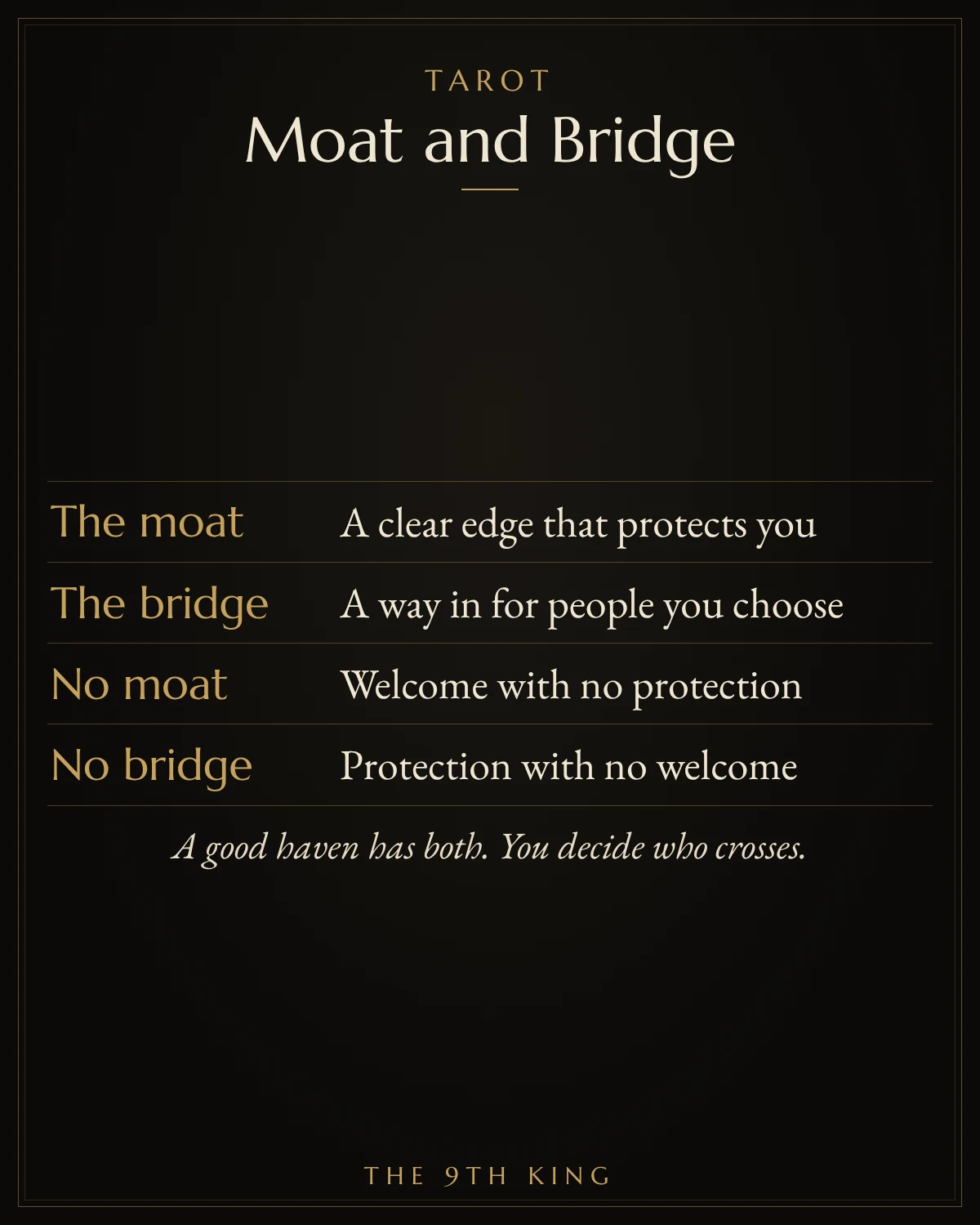
The bridge over the moat is the quiet center of this card. A home with no moat has no protection. A home with no bridge has no welcome. The 9K reading of the Four of Wands is that a good shelter has both: a clear edge, and a clear way in for the people you choose. You decide who crosses. You’re allowed to keep some people out, for good if that’s what keeps you safe.
| Part of the card | What it can stand for |
|---|---|
| The moat | A clear edge that protects you |
| The bridge | A way in for people you choose |
| No moat | Welcome with no protection |
| No bridge | Protection with no welcome |
If someone is hurting, threatening or controlling you, keeping them on the far side of the moat is a boundary, not a failure. Responsibility for the harm stays with the person causing it.
The self-mastery lesson
The lesson of the Four of Wands is to mark the stage before you build the next one. Not necessarily with a party: a sentence in a notebook or a meal with one friend will do.
You don’t need applause to know a stage is done, or to finish everything to deserve rest. Our Ace of Wands guide covers the spark that starts a Wands story. The Four is where that spark first becomes something that stands.
Four of Wands as feelings, in love, at home and at work
Four of Wands as feelings
When someone asks “how does this person feel?” and draws the Four of Wands, readers often take it as warmth and ease: feeling comfortable, glad and at home. It doesn’t tell you what someone will do, and a card can’t establish facts about another person’s inner life. What you can go on is what they actually say and do. If the card is about your own feelings, it can be a prompt to ask: Where do I feel at ease, and am I letting myself enjoy it?
Four of Wands love meaning
In a love reading, the upright card can point to a relationship reaching a settled, happy stage: moving in, meeting friends and family, or simply feeling at home with each other. Because the frame on the 1909 card has been compared to a wedding canopy, it’s easy to think of weddings. On The 9th King, we read it as a mirror, not a forecast: the card can’t tell you a proposal is coming.
The reversed card can point to a relationship in transition, or to celebrations that feel strained. Tarot can’t tell you whether to stay or leave, and this page won’t either. Useful questions:
- What have we built together that we’ve never paused to appreciate?
- Do we both feel at home here, by what we each say and do?
For how two charts meet, see Synastry for Beginners.
Four of Wands and home or family
Because Waite links the card with a place of refuge, it often comes up in questions about home. If home is a good place for you, the card can be a prompt to notice and enjoy it. If home or family hasn’t felt safe, the Four of Wands isn’t asking you to pretend otherwise or to go back. A haven can be built somewhere new, with people you choose, and you get to decide who crosses your bridge. If old family patterns are behind your feelings about home, inner child work can be a gentle next step.
Four of Wands at work
At work, readers often take the card as a project finished, a launch, a team milestone or a workplace that feels good to be part of. The shadow version hits the target and immediately worries about the next one. This is reflection, not career or financial advice. Ask yourself: Who helped hold this up, and have I told them?
Practical exercise: the four posts
This exercise turns the self-mastery lesson into something you can do this week. You need about twenty minutes and a notebook.

Step 1: Name the stage
Write one sentence: What have I finished? It doesn’t need to be big: a hard conversation, a semester, a room finally unpacked.
Step 2: Raise the posts
Draw four lines, one for each staff on the card. On each, write one thing that held this stage up. For example: your own effort, a skill you used, a person who helped, and something that went your way. You don’t have to weigh them. Just name them.
Step 3: Hang the garland
Choose one small, real way to mark the stage. A favorite meal, a walk, a note to your future self. Pick something sincere, not something that looks good to others.
Step 4: Open the gate (optional)
If it feels safe and you’d like to, tell one person what you finished. This is a choice, not a requirement. Some milestones are private, and that’s fine.
Step 5: Rest
Give yourself one evening with nothing next on the list. If a voice says you haven’t earned it, write down what it says, and then rest anyway.
A worked example (fictional)
Marcus (fictional) just finished a two-year evening course while working full time. He draws the Four of Wands upright and laughs, because he hasn’t told anyone he passed.
In the four posts, he names the stage as “I finished the course.” His posts: his late nights, his study group, his partner covering dinners, and a flexible manager. His garland: dinner at the restaurant he kept saying he’d try “after the course.” He chooses to open the gate, texting the study group to say thank you. His rest: one Saturday with no plans.
Journal prompts for the Four of Wands
- What have I finished in the last year that I’ve never really acknowledged?
- When I reach a goal, what’s the first thing I tell myself?
- Where do I feel most at home, and what makes it feel that way?
- Whose welcome do I need, and whose welcome do I already have?
- What would a celebration look like if nobody else ever saw it?
For more prompts like these, our shadow work prompts collection goes deeper, and Shadow Work, Plainly explains how to start safely.
A warm note: this is reflective practice, not therapy. If questions about home or family bring up trauma or abuse, or if you’re dealing with thoughts of self-harm or distress that feels overwhelming, please work with a qualified therapist who can walk with you. It’s always fine to stop a prompt that feels like too much.
Myths and misreadings of the Four of Wands
- “The Four of Wands means you’ll get married.” No. On The 9th King, tarot doesn’t predict events. The 1909 card’s frame has been compared to a wedding canopy, but the card reflects how you mark and enjoy what you’ve built, not what will happen next.
- “It means everything is finished.” Not quite. Book T calls it perfected work, but the card is a four, not a ten. Readers often take it as one stage complete, with more of the story still to come.
- “Reversed, it’s a bad omen.” Waite himself wrote that the reversed meaning stays the same. On 9K, the reversal is read as a question about delay or sincerity, not as a warning.
- “Venus in Aries means this card is about Aries people.” No. The correspondence describes the card’s symbolism in the Golden Dawn tradition. Anyone can draw it, whatever their sign.

Four of Wands: FAQ
What does the Four of Wands mean?
The Four of Wands is a Minor Arcana card in the suit of Wands. It shows four staves with a garland hung across them, two figures raising flowers and an old house beyond a bridge. Readers commonly take it as celebration, homecoming and rest after a stage of work. On The 9th King, it’s a mirror for how you treat your own milestones, not a prediction of events.
What does the Four of Wands reversed mean?
A.E. Waite wrote that the reversed meaning stays the same: prosperity, increase and happiness. On The 9th King, we also read it as a celebration that’s delayed, hollow or feels out of reach, or a home in transition. Some readers don’t use reversals at all. On The 9th King, treat it as a question, such as “what keeps me from letting this count?”, rather than a sign that something will go wrong.
What does the Four of Wands mean as feelings?
As feelings, readers often take the Four of Wands as warmth, ease and feeling at home with someone. A card can’t tell you what another person feels or will do; their words and actions are the better guide. If the card is about your own feelings, it can prompt you to notice where you feel comfortable and whether you’re letting yourself enjoy it.
What does the Four of Wands mean in love?
In love, the upright card can point to a settled, happy stage, such as moving in, meeting each other’s people or simply feeling at home together. On The 9th King it isn’t a forecast of an engagement or anything else. Reversed, it can point to a relationship in transition. The card doesn’t tell you to stay or leave; it invites you to appreciate what you’ve built.
What zodiac sign is the Four of Wands?
In the Golden Dawn system, the tradition The 9th King uses, the Four of Wands corresponds to Venus in Aries, the third decan of Aries. The Golden Dawn’s Book T, as printed in Liber LXXVIII, calls the card the Lord of Perfected Work. Other schools use different correspondences, so treat this as one traditional framework for symbolism rather than a fixed rule.
Is the Four of Wands a yes or no card?
The 9th King doesn’t do yes or no readings, because tarot here is a tool for self-reflection, not fortune-telling. Instead of asking whether the card says yes, ask what it shows you: what you’ve already finished, where you feel at home, and whether you’re giving yourself room to rest and celebrate before the next push.
Is the Four of Wands a good card?
On The 9th King, it’s read as one of the warmer cards in the deck. Waite listed harmony, prosperity and peace, and even kept the reversed meaning positive. Book T added a caution about hurried action and insincerity. Still, it’s neither good nor bad here: it’s a mirror for whether you let good things land.
Your next step: do the four posts exercise above for one thing you’ve finished this year. Then read our Aries Personality Traits guide: if you’re always racing to the next goal, the Ram’s restless fire, the sign the Golden Dawn tied to this card’s decan, may feel familiar.
Explore Next
- The sign behind the decan: Aries Personality Traits
- Venus and the heart: Moon vs Venus
- Where the Wands story starts: Ace of Wands
- Another Wands lesson in rest: Nine of Wands
- Go deeper with questions: Shadow Work Prompts
- Reading by feel: Intuitive Tarot (Code of Ascension)
- New to the cards: Tarot for Beginners: How Tarot Really Works (Code of Ascension)
- More tarot on The 9th King: Tarot Card Meanings · Minor Arcana · Tarot & the Zodiac · Three-Card Tarot Spread
- More cards in this set: Two of Wands, Three of Wands, Five of Wands, Seven of Wands

Final Thought: Hang the Garland
The people on the Four of Wands aren’t waiting for permission to celebrate. The frame is up, the flowers are raised, and the bridge is down for the people they choose. You can do the same, without finishing everything first. Mark the stage, rest a while, then build the next one. Know your nature. Rule your life.
About the Author
King is the founder of The 9th King, where zodiac psychology, relationships and shadow work are explored as tools for self-knowledge rather than fortune-telling. He’s a Libra Sun, and writes about the personal side of astrology on King The Kemist. Astrology on The 9th King is interpretation and self-reflection, not prediction or established fact.
Leave a Reply