Quick Answer: What Does the Three of Wands Mean?
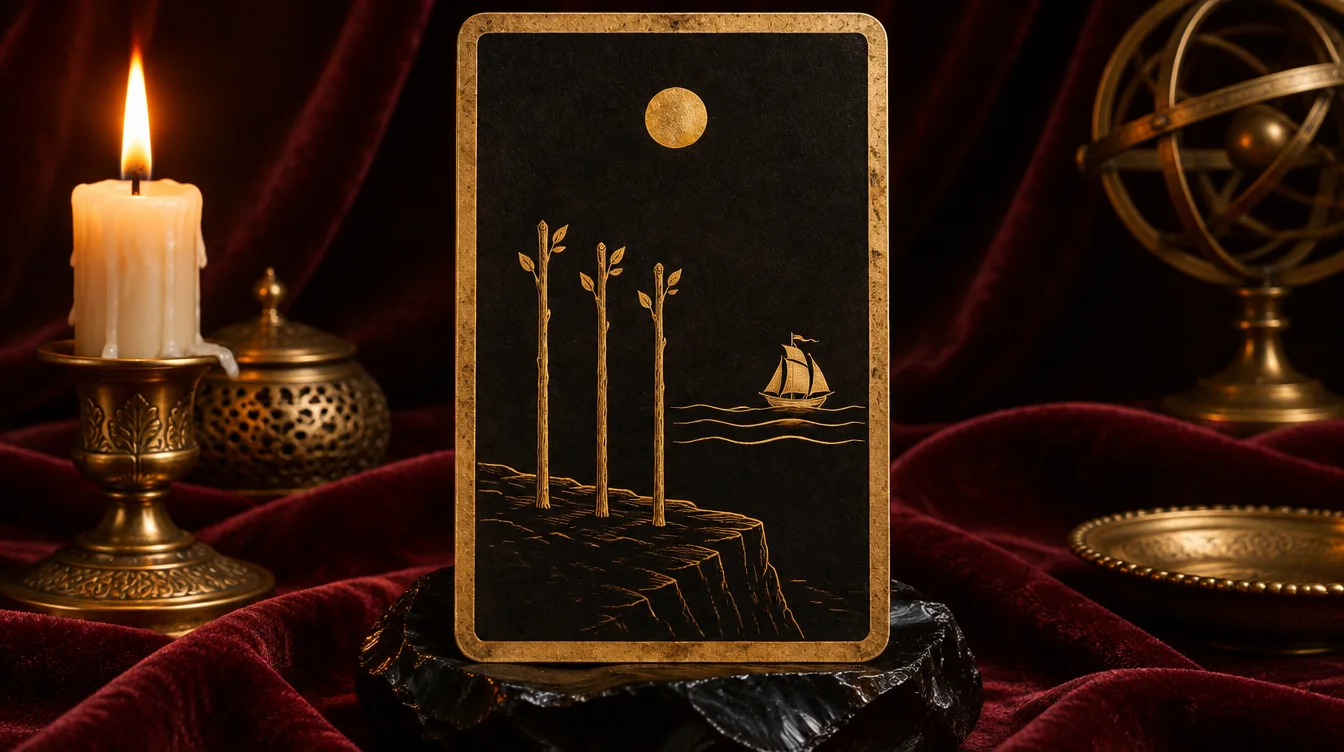
The Three of Wands (also written 3 of Wands) is a Minor Arcana card from the suit of Wands. A.E. Waite describes a figure on a cliff’s edge, his back to us, watching ships cross the sea, with three staves planted in the ground beside him. Readers often take it as the card of ships already sent: you’ve put something into motion, and now you’re watching the horizon.
- Keywords: foresight, expansion, enterprise, patience, partnership, early progress, the wider view.
- Upright, in one line: a prompt to notice what you’ve already set in motion, if you’ve been so busy watching for results that you’ve forgotten how much you’ve done.
- Reversed, in one line: a prompt to look at where waiting has turned into hovering, or where a long, tiring stretch may be easing.
On The 9th King, tarot is a mirror for self-knowledge, not fortune-telling. The Three of Wands doesn’t say your ships are coming in. It asks how you’re handling the space between launching something and seeing what it becomes.
Table of Contents
The Three of Wands at a glance
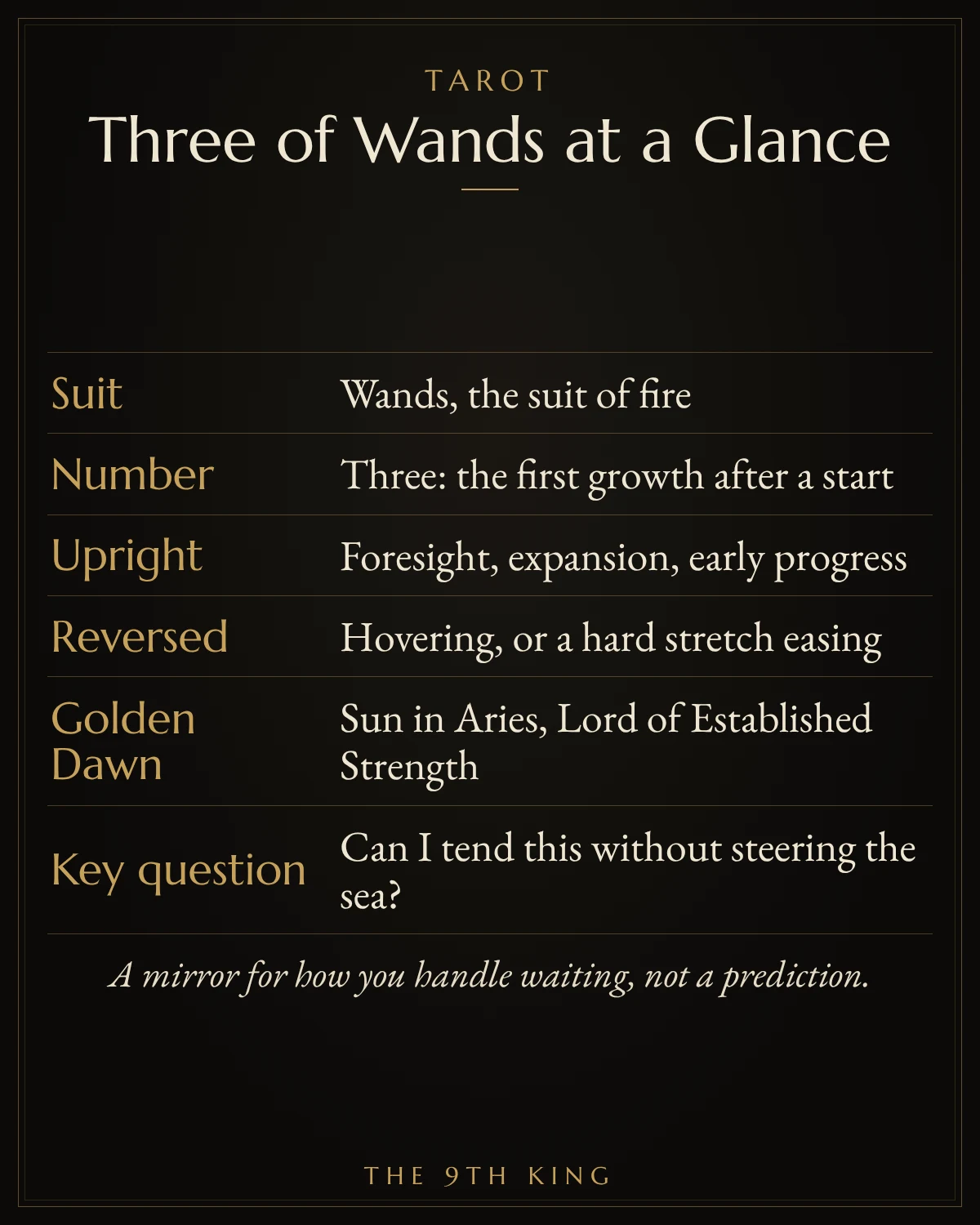
| Three of Wands | |
|---|---|
| Arcana | Minor Arcana, a pip (number) card |
| Suit and element | Wands, linked with fire |
| Number | Three, the first growth after a start |
| Golden Dawn title | Lord of Established Strength |
| Astrology (Golden Dawn) | The Sun in Aries |
| Upright | Foresight, expansion, enterprise |
| Reversed | Hovering, impatience, or relief |
| Key question | Can I tend this without steering the sea? |
What the Three of Wands looks like
Most people meet this card through the Rider–Waite–Smith deck, first published in London by William Rider & Son in December 1909. It was drawn by Pamela Colman Smith to A.E. Waite’s instructions, and both were members of the Hermetic Order of the Golden Dawn (Wikipedia: Rider–Waite Tarot).
The figure on the cliff
Waite’s The Pictorial Key to the Tarot (1911) gives the scene in a single sentence. He describes “a calm, stately personage, with his back turned,” standing at a cliff’s edge and looking out at ships passing over the sea (sacred-texts.com: Waite, Three of Wands).
We can’t see his face, only where he’s looking: outward and forward.
The three staves
Waite says three staves are planted in the ground and the figure leans slightly on one of them. The other two simply stand. The work is planted, and he rests a little of his weight on it.
The ships
Waite’s divinatory meaning explains the ships directly: they are his, carrying his merchandise across the sea (sacred-texts.com: Waite, Three of Wands). He’s watching his own work travel somewhere he can’t follow.
The Golden Dawn’s version
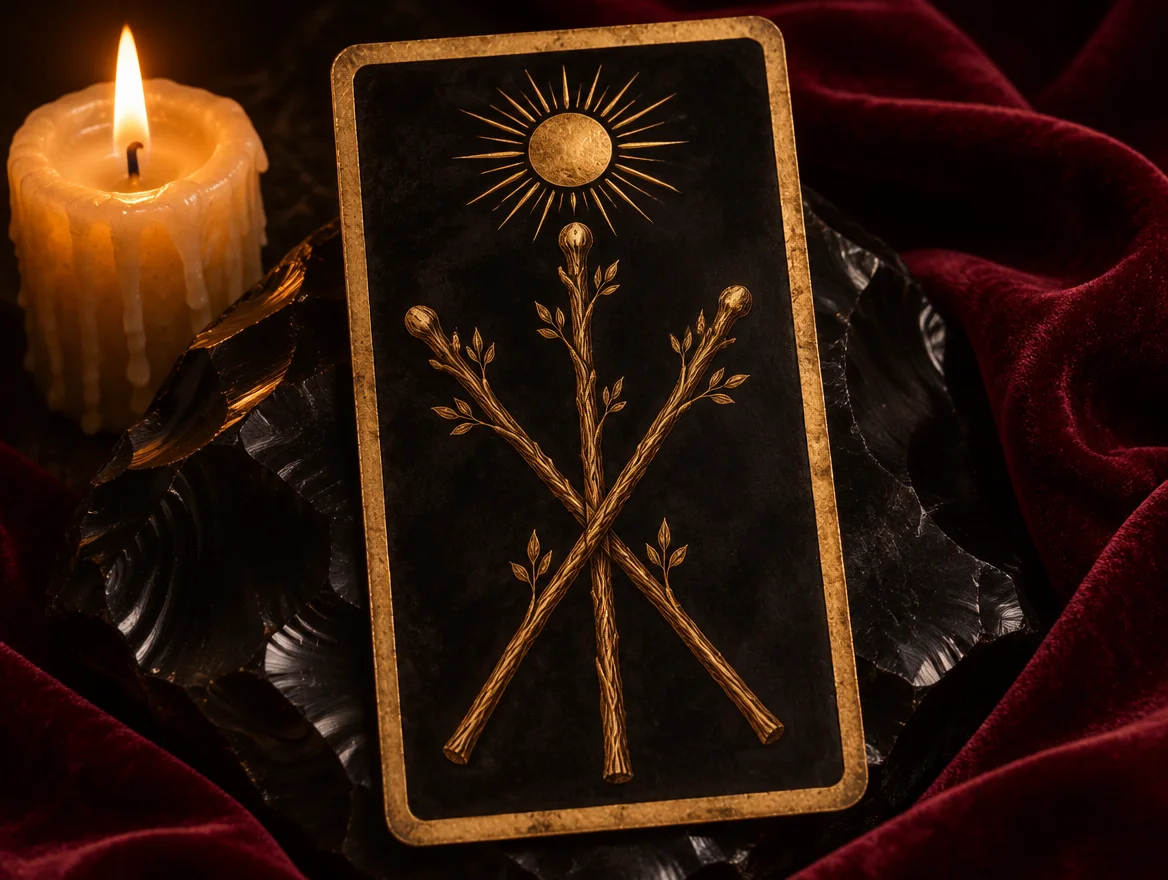
The Golden Dawn’s own card, as described in Book T, looks quite different. It shows a white, radiating hand issuing from clouds and grasping three wands, two crossed and one upright, with flames at the point where they meet and the symbols of the Sun and Aries above and below (Liber LXXVIII, sacred-texts.com).
Three of Wands meaning (upright)
Waite’s upright meaning is a list: established strength, enterprise, effort, trade, commerce and discovery. He adds that the card signifies “able co-operation in business,” as if a successful merchant were looking over from his side toward yours, ready to help (sacred-texts.com: Waite, Three of Wands).
The Golden Dawn’s Book T, as printed by Aleister Crowley in Liber LXXVIII, names the card the Lord of Established Strength. Its meaning begins “Established force, strength, realization of hope,” and goes on to list the completion of labor and success after struggle (Liber LXXVIII, sacred-texts.com).
Put together, the upright Three of Wands meaning readers commonly use has three layers.
Something is already in motion
The card can point to a stage where the first push is done. You started the thing (the Ace of Wands is the spark), and now it has a life of its own: an application sent, a project launched, a conversation opened, a move begun. Ask yourself: What have I already set in motion that I keep forgetting to count?
The wider view
The figure stands high up for a reason. Readers often take the Three of Wands as foresight: stepping back far enough to see the whole coastline instead of just the next wave.
Help from the side
Waite’s merchant who looks over from his side, ready to help, is easy to miss, and it’s a warm detail. On The 9th King, we read it as a reminder that expansion is rarely a solo act. Ask yourself: Who is already standing on the next cliff over, and have I let them see what I’m building?
Three of Wands reversed
Readers handle reversals differently: some read the opposite meaning, some the same energy blocked, and some skip reversals entirely. Waite’s reversed meaning for this card is unusually gentle. He lists the end of troubles and a pause or end to adversity, toil and disappointment (sacred-texts.com: Waite, Three of Wands).
On The 9th King, the reversed card usually points to one of three patterns, offered as questions, not predictions.
The hard stretch is easing
This is Waite’s own reading: the toil letting up, the pressure lifting a little. Ask yourself: Have I noticed that something has gotten easier, or am I still bracing out of habit?
Waiting has turned into hovering
The figure in the upright card watches calmly. The reversed card can point to the opposite: refreshing your inbox every few minutes, rereading what you sent, needing an update before you can relax. Ask yourself: Is my watching helping the ships, or just keeping me on the cliff?
The horizon has become an escape
Sometimes the reversed card points to a person who is always looking outward, always planning the next voyage, and never quite at home in the present. The far view becomes a way of not dealing with what’s close. Ask yourself: What am I avoiding by always looking at what’s next?
| Pattern | Upright tone | Reversed tone |
|---|---|---|
| Waiting | Calm, trusting | Hovering, restless |
| Vision | Wide, forward | Escape from now |
| Effort | Planted, done | Lifting, easing |
| Help | Offered and open | Unasked for |
Three of Wands astrology: the Sun in Aries
The 9th King uses Golden Dawn–derived correspondences, the tradition the Rider–Waite–Smith deck draws on. Other schools of tarot and astrology use different systems, and not every card maps to a single sign: the court cards and Pages, for example, are handled differently. What follows is one traditional framework, offered as symbolism.
How the number cards get their planets
In the Golden Dawn system, the small cards (the Twos through Tens of the four suits) are matched to the 36 decans of the zodiac. A decan is a ten-degree third of a sign, and each one is given a ruling planet. Liber LXXVIII lists the Three of Wands, the Lord of Established Strength, with the decan Sun in Aries (Liber LXXVIII, sacred-texts.com).
The same table runs through Aries in order: the Two of Wands with Mars, the Three with the Sun, the Four with Venus. That places the Three in the middle of Aries’s three decans. Liber doesn’t print the degrees for this card, so we don’t give them here.
Book T also places the card in Binah on the Kabbalistic Tree of Life, and for this card it lists pride, arrogance and self-assertion. It then adds a short bracketed note that the card is much better than the description suggests. That’s an honest little moment in an old text: it admits its own shadow list runs harsh.
This is the Sun in Aries, not “the Aries card.” Anyone can draw it, whatever their sign.
What the Sun brings
On The 9th King, the Sun describes identity, vitality and the self you’re growing into. It’s the planet of “this is who I am.” Astrologers traditionally give the Sun rulership of Leo, which our Leo Personality Traits page explores, and your Sun’s place in your chart is usually the first thing a reading covers (see How to Read a Birth Chart). On this card, the Sun is the part of you that’s invested: your name is on the cargo.
What Aries brings
Aries is cardinal fire, ruled by Mars: the sign of beginnings, nerve and the first move. Our Aries Personality Traits page covers the Ram’s courage and its impatience. On this card, Aries is the reason the ships left harbor at all. Somebody had to go first.
The tension in the pairing
The Sun wants to shine and be seen. Aries wants to act now. The Three of Wands puts both on a cliff and asks them to wait. That’s the heart of the card: a bold, self-starting energy learning to hold steady once the ships are out.
The 9K reading: tending what you launched
The card’s tension
The Three of Wands holds two true things at once: I did my part and I don’t control the rest. Some people can’t stop steering what’s already out of their hands; others give up the moment results aren’t instant. The card asks you to hold both: real ownership of what you sent, and real humility about the sea.
The shadow side
The shadow of the Three of Wands is control dressed up as vision. It’s the part of you that says I’m just keeping an eye on things, while in practice you can’t rest until you know. Book T’s own shadow list (pride, conceit, rude self-assumption, obstinacy) points the same way: the high view can turn into looking down. It can look like:
- Hovering. Checking for news so often that waiting becomes a full-time job.
- Restless horizon-chasing. Launching the next thing before the last one has had a chance to land.
- Pride in the plan. Treating your forecast as a fact, and getting annoyed when life doesn’t follow it.
- Going it alone. Ignoring the merchant on the next cliff because accepting help would mean sharing the credit.
These patterns usually start as strengths: ambition, foresight, independence.
Watching or hovering: how to tell
Both involve paying attention. The difference is what the attention does.
| Watching | Hovering | |
|---|---|---|
| Checking | At set times | Constantly |
| Focus | The next step | The last step |
| Between news | Can rest | Can’t settle |
| Help | Welcomed | Kept out |

Feelings aren’t a reliable test: you can feel anxious and still be watching well. Use questions instead: Is there anything left that’s actually mine to do? When did I last check, and did checking change anything? What could I tend at home while I wait?
Our Zodiac Shadow Work guide covers how each sign’s shadow shows up, Aries included.
The self-mastery lesson
The lesson of the Three of Wands is to tend what you sent without trying to steer the sea. A good merchant sends the ships, checks the harbor at sensible times and gets on with his life.
Self-mastery here means letting your effort be finished when it’s finished, and planning the next voyage without needing today’s outcome in your hands.
Three of Wands as feelings, in love and at work
Three of Wands as feelings
When someone asks “how does this person feel?” and draws the Three of Wands, readers often take it as forward-looking interest: thinking about what could come next, maybe planning, maybe a little distant because their eyes are on the horizon. A card can’t tell you what’s in another person’s mind, and it doesn’t tell you what they’ll do. What you can go on is how they actually behave and what they tell you. If the card is about your own feelings, ask: Am I invested in this, or in my picture of where it’s going?
Three of Wands love meaning
In a love reading, the upright card can point to a relationship that’s growing, with both people looking in the same direction, or to a stage of waiting: a first message sent, a long-distance stretch, a conversation that needs time to land. The reversed card can point to impatience, or to one person always planning the future while the other wants more presence now.
Tarot can’t tell you whether to stay or leave, and this page won’t either. It can help you notice the pattern. Useful questions:
- Am I giving this time to develop, or demanding an answer on my schedule?
- Do we both want to go where I’m looking? Have I asked, and listened to the answer?
- What could I enjoy about this relationship today, instead of only its future?
If you’ve reached out and someone hasn’t answered, their time and choices are theirs. If you want to talk about pace or space, our piece on privacy without mixed signals shows how to ask for what you need clearly, without games.
Three of Wands at work
At work, readers often take the card as enterprise and expansion: a project that has launched, a pitch that’s out, a plan that reaches beyond your usual borders. The shadow version micromanages a launched project or pitches the next idea before the current one has had a fair chance. This is reflection, not career or financial advice. Ask yourself: What have I launched that deserves more patience than I’m giving it, and who could help me carry it?
Practical exercise: the harbor log
This exercise turns the self-mastery lesson into something you can do this week. It takes about twenty minutes, a notebook and a calendar.

Step 1: List your ships
Write down everything you’ve already sent out into the world that you’re waiting on. Applications, messages, projects, requests, plans. Include the small ones.
Step 2: Mark your part
Next to each ship, write done if your part is finished, or note the one thing that’s still genuinely yours to do. Be honest. “Check again” doesn’t count as a task.
Step 3: Name the tide
For each ship, write one sentence about what’s outside your control: someone else’s timeline, a decision you can’t make for them, a season that has to pass.
Step 4: Pick one sail
Choose one next step you can take this week, either on a ship that still needs you or on a new voyage you’ve been planning.
Step 5: Set a check-in
Pick one set time this week to review the whole log. Put it on your calendar.
Step 6: Come ashore
Name one thing close to home that deserves your attention while the ships are out: a person, a room, your body, a hobby you’ve neglected. Give it some of the time you’d have spent on the cliff.
A worked example (fictional)
Priya (fictional) has sent a short-story collection to five publishers, applied for a writing residency and pitched an article to a magazine. She draws the Three of Wands upright while checking her email on every break.
In her harbor log, she lists seven ships. Six are marked done: the five publisher submissions and the magazine pitch. The seventh, the residency, still needs a reference letter, so that becomes her sail for the week. Her tides: publishers’ reading periods, a committee’s timeline, an editor’s inbox. She sets one check-in for Friday afternoon.
Her come-ashore item is her sister, who she’s been half-listening to for a month. On Friday, nothing has come back yet. But the reference letter is in, she’s had a long lunch with her sister, and she checked her email twice that week. The ships are still out; she’s just not living on the cliff.
Journal prompts for the Three of Wands
- What have I already set in motion that I’m not giving myself credit for?
- Where am I trying to steer something that’s no longer in my hands?
- Who is standing on the next cliff over, and what would it cost me to accept their help?
- When I look at the horizon, am I planning, or escaping?
- What would “my part is done” feel like if I let myself believe it?
- What’s close to home that I’ve been neglecting while I watch for news?
For more prompts like these, our shadow work prompts collection goes deeper, and Shadow Work, Plainly explains how to start safely.
A warm note: this is reflective practice, not therapy. If waiting stirs up old fears tied to trauma or abuse, or if you’re dealing with thoughts of self-harm or distress that feels overwhelming, please work with a qualified therapist who can walk with you. It’s always fine to stop a prompt that feels like too much.
Myths and misreadings of the Three of Wands
- “The Three of Wands means your ships are coming in.” On The 9th King, tarot doesn’t predict events or timing. The card reflects how you’re handling what you’ve already sent out, not when or whether it returns.
- “It means travel.” Some readers link it with journeys because of the ships, but Waite’s own meanings are about enterprise, trade and cooperation.
- “Reversed means your plans failed.” Waite’s reversed meaning is mostly relief: the end of troubles and a pause in toil. A reversal can also point to impatience. Neither is a verdict.
- “The Sun in Aries means this card is about Aries people.” No. The correspondence describes the card’s symbolism in the Golden Dawn tradition. Anyone can draw it, whatever their sign.

Three of Wands: FAQ
What does the Three of Wands mean?
The Three of Wands is a Minor Arcana card in the suit of Wands. Waite describes a calm figure on a cliff’s edge watching his own ships sail, with three staves planted beside him. Readers commonly take it as foresight, expansion, enterprise and early progress: you’ve set something in motion and now you’re watching it travel. On The 9th King, it’s a mirror for how you handle waiting, not a prediction of results.
What does the Three of Wands reversed mean?
Waite’s reversed meaning is unusually gentle: the end of troubles and a pause or end to adversity, toil and disappointment. On The 9th King, the reversed card can also point to waiting that has turned into hovering, or to always looking at the next horizon instead of the present. Some readers don’t use reversals at all.
What does the Three of Wands mean as feelings?
As feelings, readers often take the Three of Wands as forward-looking interest: someone thinking about what could come next, perhaps planning, perhaps a little distant. A tarot card can’t tell you what another person feels or intends. Go by what they actually say and do.
What does the Three of Wands mean in love?
In love, the upright card can point to a relationship that’s growing with both people looking the same way, or to a stage of patient waiting. Reversed, it can point to impatience or to one person living in the future while the other wants presence now. The card doesn’t tell you to stay or leave. It invites you to notice your pace and to respect the other person’s.
What zodiac sign is the Three of Wands?
In the Golden Dawn system, the tradition The 9th King uses, the Three of Wands corresponds to the Sun in Aries, the middle of the three Aries decans. Book T, as printed in Liber LXXVIII, calls it the Lord of Established Strength. It’s a planet-in-sign pairing, so it isn’t simply “the Aries card.” Other schools use different correspondences, so treat this as one traditional framework for symbolism.
Is the Three of Wands a yes or no card?
The 9th King doesn’t do yes or no readings, because tarot here is a tool for self-reflection, not fortune-telling. Instead of asking whether the card says yes, ask what it shows you about the situation: what you’ve already sent out, what’s still yours to do, and whether you’re watching calmly or hovering over something you can’t control.
Is the Three of Wands a good or bad card?
Neither, on The 9th King. Waite gave it a positive upright meaning of strength, enterprise and helpful cooperation, and a reversed meaning of troubles ending. Book T lists both success after struggle and a shadow of pride, then adds a note that the card is better than described. Read it as a mirror for how you’re handling your ambitions, not as a good or bad omen.

Your next step: start a harbor log this week for the things you’re waiting on, and set one check-in on your calendar. Then look at where the Sun sits in your own birth chart with our How to Read a Birth Chart guide: your Sun describes the self you’re growing into, and it’s the same planet the Golden Dawn tied to this card.
Explore Next
- The spark that starts the suit: Ace of Wands
- The Ram’s nerve and its impatience: Aries Personality Traits
- Your Sun’s yearly reset: Solar Return Chart
- Go deeper with questions: Shadow Work Prompts
- Another Wands lesson in endurance: Nine of Wands
- The Major Arcana card named for the Sun: The Sun
- Reading by feel: Intuitive Tarot (Code of Ascension)
- New to the cards: Tarot for Beginners: How Tarot Really Works (Code of Ascension)
- More tarot on The 9th King: Tarot Card Meanings · Minor Arcana · Tarot & the Zodiac · King of Wands · Three Card Tarot Spread
- More cards in this set: Two of Wands, Four of Wands

Final Thought: Send the Ships, Then Come Ashore
The figure in the Three of Wands has already done the brave part. The ships are out. He doesn’t need to stand guard over the sea; he needs to trust what he planted, accept help when it comes and keep living while he waits. Tend what’s yours, release what isn’t, and come home to the present. Know your nature. Rule your life.
About the Author
King is the founder of The 9th King, where zodiac psychology, relationships and shadow work are explored as tools for self-knowledge rather than fortune-telling. He’s a Libra Sun, and writes about the personal side of astrology on King The Kemist. Astrology on The 9th King is interpretation and self-reflection, not prediction or established fact.
Leave a Reply