
Quick Answer: What Does the Nine of Cups Mean?
The Nine of Cups (also written 9 of Cups) is a Minor Arcana card from Cups, the water suit of feelings, relationships and inner life. In the traditional image, a well-fed man sits before a long row of cups after a good feast. It’s often called the wish card. On The 9th King, we read it as the card of enough: what you want, what you already have, and whether you can let satisfaction land.
- Keywords: contentment, satisfaction, pleasure, well-being, wishes, enjoyment, comfort, gratitude.
- Upright, in one line: a prompt to notice what’s already full in your life, if you’re chasing a wish and haven’t stopped to count what you have.
- Reversed, in one line: satisfaction that keeps slipping away, happiness kept up for show, or a wish that needs an honest second look.
On The 9th King, tarot is a mirror for self-knowledge, not fortune-telling. This card asks what your wish is really for.
Table of Contents

The Nine of Cups at a glance
| Nine of Cups | |
|---|---|
| Arcana | Minor Arcana, a pip (number) card |
| Suit and element | Cups, linked with water |
| Number | Nine |
| Golden Dawn title | Lord of Material Happiness |
| Astrology (Golden Dawn) | Jupiter in Pisces |
| Upright | Contentment, well-being, success |
| Reversed | Truth, loyalty, liberty; mistakes |
| Key question | What would be enough? |
What the Nine of Cups looks like
Most people know this card from the Rider–Waite–Smith deck, first published in December 1909 by William Rider & Son of London. A.E. Waite wrote the instructions and Pamela Colman Smith drew the art, and both were members of the Hermetic Order of the Golden Dawn (Wikipedia: Rider–Waite Tarot).
Waite’s description in The Pictorial Key to the Tarot is short (sacred-texts.com: Waite, Nine of Cups), so this section stays close to it.
A man who has feasted
Waite opens with a single image: “A goodly personage has feasted to his heart’s content.” That’s the whole mood of the card. The meal is over, and he’s had plenty. Nothing is missing at the table.
The wine on the arched counter
Behind him, Waite says, there’s plenty of wine on an arched counter, which he takes as a sign that the future seems taken care of as well. On The 9th King, we read that line as a picture of security, not a forecast: the sense that there’s more where that came from.
“The material side only”
Waite then adds a line that matters for this whole page: “The picture offers the material side only, but there are other aspects.” He doesn’t spell out those other aspects. On The 9th King, we take that as permission to look at the inner side of satisfaction: having enough, and what gets in the way of feeling it.
On the early Smith card
On the 1909 Smith card (Wikimedia Commons: 1909 Nine of Cups scan), the man sits on a wooden bench with his arms folded, wearing a red cap with a feather. Behind him, nine cups stand in a curved row on a high counter draped with a blue cloth, against a yellow background. Apart from the man, the cups and the arched counter, none of this is in Waite’s text.

The Golden Dawn version of the card
The Golden Dawn’s teaching text on the tarot, Book T, as printed by Aleister Crowley in Liber LXXVIII, describes a different design. A white, radiant angelic hand comes from a cloud holding lotus or water-lilies. One flower hangs over each cup, white water pours from it, and the cups stand in three rows of three (Liber LXXVIII, sacred-texts.com). There’s no feast and no seated man, but every cup is being filled.
Nine of Cups meaning (upright)
Waite’s upright meanings are warm and simple: concord, contentment, physical bien-être (well-being); also victory, success and advantage; and satisfaction for the person asking (sacred-texts.com: Waite, Nine of Cups).
Book T calls it the Lord of Material Happiness and describes the complete realization of pleasure and happiness, which it calls nearly perfect. It’s also frank about the shadow: self-praise, vanity, much talk about oneself, yet kind and lovable, generous, high-minded, and sometimes foolish (Liber LXXVIII, sacred-texts.com).
Why it’s called the wish card
The nickname doesn’t come from Waite. In Joan Bunning’s Learning the Tarot, she writes that “in many tarot traditions, the Nine of Cups is known as the Wish Card” (Learning the Tarot: Nine of Cups). Book T points the same way: its short summary for this card includes wishes fulfilled.
On The 9th King, we keep the nickname and drop the promise. A card can’t make a wish come true or tell you that one will. What it can do is help you look at your wishes clearly.
On The 9th King, we read the upright card in three layers.
Satisfaction you can feel
The card can point to a season where something is genuinely good: a goal reached, a hard stretch behind you, a body that feels well. Ask yourself: What is going right that I haven’t let myself enjoy yet?
Pleasure without apology
Waite’s “physical well-being” is a real part of this card. Good food, rest, comfort and ease aren’t rewards you have to earn twice. Ask yourself: Where am I allowed to simply enjoy something, without explaining why I deserve it?
Knowing your own wish
The card can also point to a wish you’re carrying. Upright, it invites you to name it plainly. Ask yourself: If I’m honest, what do I actually want, and what would it give me?
Nine of Cups reversed
Some readers read reversals as the opposite meaning, some as blocked energy, and some don’t use them at all. Waite’s reversed meanings are unusual: truth, loyalty and liberty. He then admits that readings differ, and adds mistakes and imperfections (sacred-texts.com: Waite, Nine of Cups).
In his additional meanings, Waite gives the Nine of Cups as a good sign for military men, and reversed, good business (sacred-texts.com: Waite, Additional Meanings of the Lesser Arcana). He warns on that page that these extra meanings often disagree with his main ones.
On The 9th King, the reversed card usually points to one of three patterns, offered as questions, not predictions.
The line that keeps moving
The reversed card can point to satisfaction that never quite arrives. You reach the goal, and the goal moves. That isn’t greed; it’s often a habit of looking ahead. Ask yourself: When did I last stop and say “this is enough for now”?
Happiness for show
Book T names self-praise and much talking of self in this card. The reversed card can point to a life that has to look full: the cups lined up where everyone can see them. Ask yourself: Would I enjoy this as much if nobody knew about it?
Truth and imperfection
Waite’s own reversed words are truth and imperfection. On The 9th King, we read Waite’s word “truth” as honesty about the wish itself: noticing that what you’ve been chasing isn’t quite what you want, or that the picture has cracks you’ve been painting over. Imperfection isn’t failure. It’s what real satisfaction usually looks like. Ask yourself: What would I admit about this wish if I didn’t have to defend it?
| Pattern | Upright tone | Reversed tone |
|---|---|---|
| Getting it | You stop and use it | The goal moves again |
| Showing it | Shared when it fits | Kept on display |
| The wish | Named honestly | Assumed, unchecked |
| Imperfection | Allowed | Hidden |

Nine of Cups astrology: Jupiter in Pisces
The 9th King uses Golden Dawn–derived correspondences, the tradition the Rider–Waite–Smith deck draws on. Other schools use different systems, and not every card maps to a single sign: the court cards and Pages work differently.
How the number cards get their planets
In the Golden Dawn system, the 36 small cards (Twos through Tens) are matched to the 36 decans of the zodiac: ten-degree thirds of a sign, each given a planet. Book T‘s table lists the Nine of Cups, Material Happiness, under Jupiter in Pisces (Liber LXXVIII, sacred-texts.com), and the card’s own entry names Jupiter and Pisces as the symbols above and below. In the table it sits directly after the Eight of Cups (Saturn in Pisces), and the next entry is the Ten of Cups (Mars in Pisces). Liber prints no degrees for it.
Liber also has a separate table of central decans, the middle third of each sign, which it gives to the four Threes, Sixes and Nines. It lists the Nine of Cups there for Pisces. The other two water cards in that table are the Three of Cups for Cancer and the Six of Cups for Scorpio, so all three water central decans belong to Cups.
Book T places all the Nines in Yesod on the Kabbalistic Tree of Life, and sums this card up as “Complete success, pleasure and happiness, wishes fulfilled.”
What Jupiter brings
On The 9th King, Jupiter is the planet of growth, generosity, meaning and plenty. Before the modern planets were found, Jupiter was given rulership of two signs, Sagittarius and Pisces; modern astrologers usually give Pisces to Neptune and keep Jupiter as its traditional ruler (Wikipedia: Domicile (astrology)). Our Jupiter return guide covers Jupiter’s themes in depth. On this card, Jupiter is the overflowing table.
What Pisces brings
Pisces is mutable water: the sign of dreams, feeling, imagination and longing. Our Pisces traits page covers its tenderness and its shadow. On this card, Pisces is the wish itself, the soft, hard-to-name want under the full cups.
The tension in the pairing
On The 9th King, we read Jupiter in its traditional home sign as about as generous as the symbolism gets. That’s the card’s gift and its trap. Jupiter says more. Pisces says I want, and I’m not sure what. Put together, they describe abundance that can blur into longing. At its best, Pisces gives Jupiter’s plenty some heart, and Jupiter gives Pisces’s dreams something solid to rest on.
The 9K reading: enough or display?
The card’s tension
The Nine of Cups holds two true things at once: you can have plenty and plenty doesn’t always feel like enough. The man in Waite’s picture has feasted to his heart’s content. The card asks whether your heart has a “content” setting at all, or only a “next.”
The shadow side
The shadow of the Nine of Cups is treating satisfaction as something to prove or postpone. It can look like:
- “I’ll be happy when.” Putting contentment on hold until one more thing arrives, then moving the line when it does.
- Lining up the cups. Needing your wins to be seen, and checking who noticed.
- The borrowed wish. Chasing something because it’s what you’re supposed to want.
- Waiting for the catch. Being unable to enjoy a good stretch because something must be about to go wrong.
- Self-denial as virtue. Book T says this card’s nature may be self-denying too. Refusing every pleasure can be its own way of keeping score.
Some of these patterns are learned early. If that rings true, inner child work is a gentle, related place to look.
Contentment or display?
Sharing good news isn’t vain; celebrating is human. A card can’t tell you anyone’s motives, so The 9th King looks at behavior you can observe in yourself.
| Notice | Contentment | Display |
|---|---|---|
| Being seen | You use it either way | You check who noticed |
| Others’ wins | You congratulate, move on | You steer back to yours |
| The next goal | You pause first | New target at once |
| What’s hard | You still mention it | Hidden for the picture |
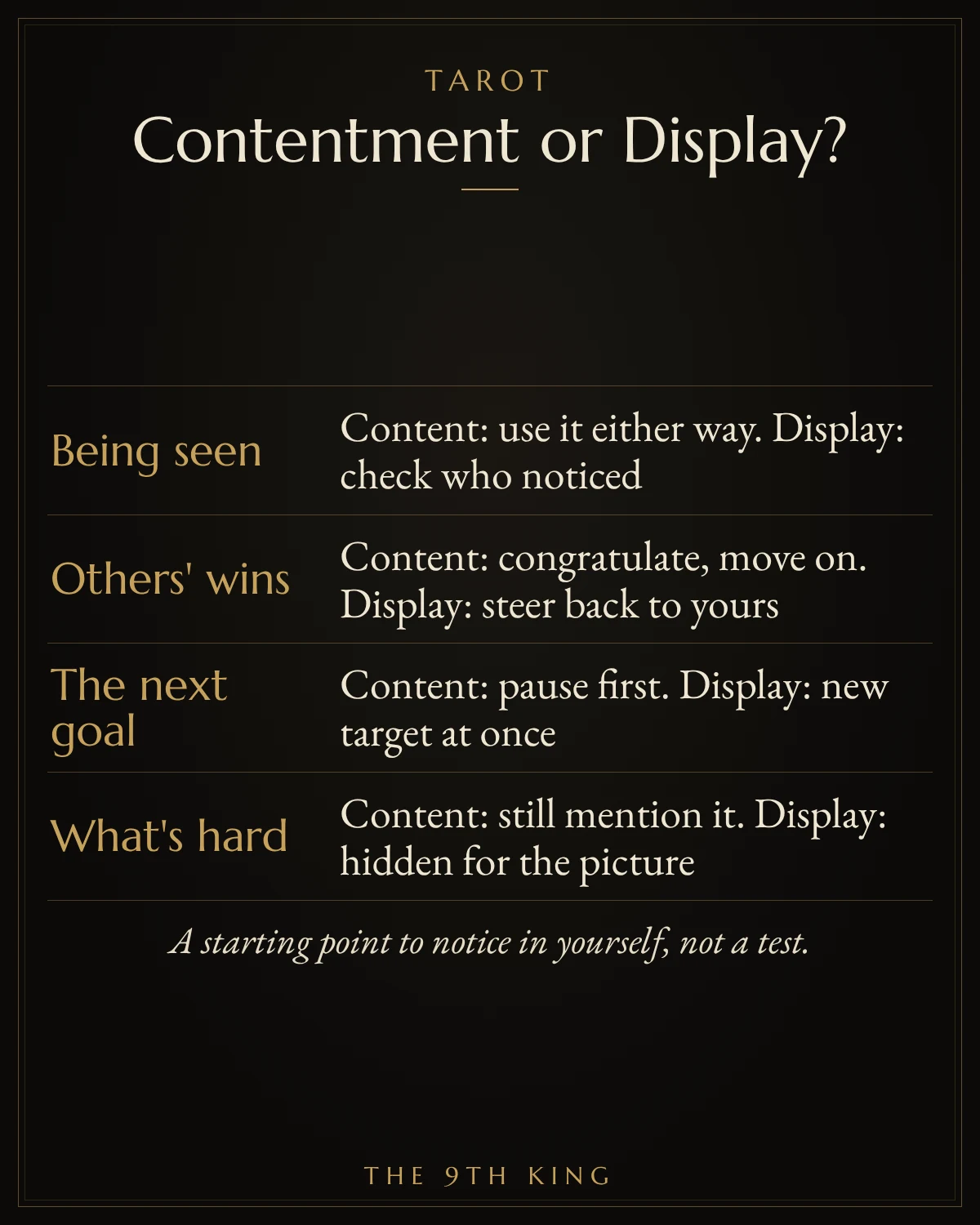
Treat this table as a starting point, not a test. Ambition isn’t a flaw, and one column proves nothing about you.
The self-mastery lesson
The lesson of the Nine of Cups is to let enough be enough, for now. You can still want more. You can still have goals. But you can also stop, look at what’s full, and let it count. And when you wish for something, you can name it honestly and put your effort where it actually reaches.
Nine of Cups as feelings, in love and at work
Nine of Cups as feelings
As feelings, readers often take the card as contentment or pleasure: someone enjoying a connection, or feeling satisfied with where things are. A card can’t tell you what someone else feels or will do; their words and actions can. About your own feelings, ask: Am I happy with this, or happy with how it looks? Both can be true at once.
Nine of Cups love meaning
In a love reading, the upright card can point to enjoyment, ease and appreciation: a relationship you can rest in, or a single life you’re genuinely enjoying. The reversed card can point to a relationship that looks good from outside, a wish you’ve placed on another person, or a “someday” you keep waiting for.
Tarot can’t tell you whether to stay or leave, and this page won’t either. Some useful questions instead:
- What do I enjoy about this relationship, or about my life right now, in moments I can actually name?
- Is there a wish I’ve placed on someone that I’ve never said out loud to them?
- Am I waiting for one thing to change before I let myself enjoy the rest?
If your hopes in love and your style of enjoyment don’t line up, our Moon vs. Venus guide shows how astrologers separate what you need from what you enjoy.
Nine of Cups at work and with money
None of this is financial or career advice, only reflection.
At work, readers often take the card as satisfaction with a result, recognition, or a goal reached. Ask yourself: Did I mark this win, or did I go straight to the next one?
With money, the card asks whether “enough” has a definition for you, not how much you have. For actual decisions, talk to a qualified professional.
The Ace of Cups is where the water suit begins, and the Seven of Cups is its card of many wishes, which makes it a useful companion to this one.
Practical exercise: the enough inventory
This is a quiet look at your own wishes, not a gratitude list. You need twenty minutes and a notebook.

Step 1: Name the wish
Write down one thing you’ve been wanting. Keep it specific: “a calmer job,” not “a better life.”
Step 2: Find the need
Under it, write what the wish would give you: rest, respect, security, closeness, freedom, fun. There may be more than one.
Step 3: List what’s full
Now list anything in your life that already meets some of that need, even partly. Don’t force it. If the list is short, that’s useful information too.
Step 4: Sort the reach
Mark which parts of the wish are yours to act on and which depend on other people, luck or timing. Effort alone can’t change the second group.
Step 5: Choose one step
Pick one thing: a small action toward the part that’s yours, or one pause to enjoy something already on your “full” list. Either counts.
A worked example (fictional)
Marcus (fictional) draws the Nine of Cups after getting the promotion he’d wanted for two years, and notices he hasn’t marked it at all.
His wish, written down, is “to feel like I’ve made it.” Under it, he writes two needs: respect and rest. Under “what’s full,” he lists three things: the new title, a friend who called to congratulate him, and his Sunday mornings, which are still free.
Sorting the reach, he sees that rest is mostly his to act on. Respect is partly his and partly up to other people.
His one step: he takes the Sunday morning off for real, with no work email, and tells the friend who called what the promotion meant to him.
Journal prompts for the Nine of Cups
- What’s one good thing in my life I haven’t let myself enjoy yet?
- What does “enough” mean to me right now, in plain words?
- Is there a wish I’m carrying that isn’t really mine?
- When good things happen, do I relax, or wait for the catch? Where did I learn that?
- Who do I want to see my wins, and what would their noticing give me?
For more, our shadow work prompts go deeper, and Shadow Work, Plainly explains how to start safely.
A warm note: this is reflective practice, not therapy. If you’re dealing with trauma, abuse, thoughts of self-harm or distress that feels overwhelming, please work with a qualified therapist who can walk with you. It’s always fine to stop a prompt that feels like too much.
Myths and misreadings of the Nine of Cups
- “The wish card means your wish will come true.” No. On The 9th King, tarot doesn’t predict outcomes. The card is a mirror for what you want and what you already have.
- “Reversed means your wish is denied.” No. Waite’s own reversed list starts with truth, loyalty and liberty. Reversed, the card asks for a closer look, not a closed door.
- “It’s a shallow, material card.” Waite himself says the picture shows only the material side and that there are other aspects. Satisfaction has an inner side, and that’s where this page spends its time.
- “Jupiter in Pisces means this card is about Pisces people.” No. The correspondence describes the card’s symbolism in the Golden Dawn tradition. Anyone can draw it, whatever their sign.

Nine of Cups: FAQ
What does the Nine of Cups mean?
The Nine of Cups is a Minor Arcana card in the water suit. Waite describes a man who has feasted to his heart’s content, with wine on the counter behind him, and gives it meanings of contentment, well-being and success. Readers commonly take it as satisfaction and enjoyment. On The 9th King, it’s a mirror for what “enough” means to you, not a prediction.
What does the Nine of Cups mean reversed?
Reversed, Waite lists truth, loyalty and liberty, then says readings vary and include mistakes and imperfections. On The 9th King, the reversed card can point to satisfaction that keeps slipping away, happiness kept up for show, or a wish that needs an honest second look. Some readers don’t use reversals at all, and that’s a valid choice.
Why is the Nine of Cups called the wish card?
Joan Bunning’s Learning the Tarot says that in many tarot traditions the Nine of Cups is known as the Wish Card, and the Golden Dawn’s Book T includes wishes fulfilled in its summary of the card. On The 9th King, we keep the nickname as a prompt to look at your wishes honestly. A card can’t promise that a wish will come true.
What does the Nine of Cups mean as feelings?
As feelings, readers often take the Nine of Cups as contentment or pleasure: someone enjoying where things are. A card can’t tell you what another person feels or will do; their words and actions can. About your own feelings, it can prompt you to ask whether you’re happy with something itself, or with how it looks to other people.
What does the Nine of Cups mean in love?
In love, the upright card can point to ease, enjoyment and appreciation, whether you’re partnered or happily single. Reversed, it can point to a relationship that looks better than it feels, or a wish placed on someone that’s never been said aloud. The card doesn’t tell you to stay or leave. It invites you to notice what you actually enjoy.
What zodiac sign is the Nine of Cups?
In the Golden Dawn system, the tradition The 9th King uses, the Nine of Cups corresponds to Jupiter in Pisces, the central decan of Pisces in Book T’s table. Book T calls the card the Lord of Material Happiness. Other schools use different correspondences, so treat this as one traditional framework for symbolism, not a rule about Pisces people.
Is the Nine of Cups a yes or no card?
The 9th King doesn’t do yes or no readings, because tarot here is for self-reflection, not fortune-telling. Even as the wish card, the Nine of Cups can’t answer whether a wish comes true. Instead, ask what it shows you: what you want, what that wish would give you, and what’s already full in your life.

Your next step: do the enough inventory above, and choose your one step before you close the notebook. Then find where Jupiter sits in your own chart with our guide on how to read a birth chart: the planet of plenty that the Golden Dawn tied to this card.
Explore Next
- Pisces’s tenderness and its shadow: Pisces Traits
- Jupiter’s other traditional sign: Sagittarius Personality Traits
- Jupiter’s growth cycles in your life: Jupiter Return
- Where the water suit begins: Ace of Cups
- The card of many wishes: Seven of Cups
- Reading by feel: Intuitive Tarot (Code of Ascension)
- New to the cards: Tarot for Beginners: How Tarot Really Works (Code of Ascension)
- More tarot on The 9th King: Tarot Card Meanings · Minor Arcana · Tarot & the Zodiac · Nine of Wands · Shadow Work Tarot Spread
- More cards in this set: Eight of Cups, Ten of Cups
Final Thought: Let Enough Count
The man in the Nine of Cups has feasted to his heart’s content. Most of us are better at wanting than at noticing we’ve arrived. Name your wishes honestly, put your effort where it reaches, and when something is full, let it count before you reach for the next cup. Know your nature. Rule your life.
About the Author
King is the founder of The 9th King, where zodiac psychology, relationships and shadow work are explored as tools for self-knowledge rather than fortune-telling. He’s a Libra Sun, and writes about the personal side of astrology on King The Kemist. Astrology on The 9th King is interpretation and self-reflection, not prediction or established fact.
Leave a Reply