Quick Answer: What Do Tarot Card Meanings Tell You?
A standard tarot deck has 78 cards: 22 Major Arcana and 56 Minor Arcana in four suits of 14. Each card’s traditional meaning is usually given two ways:
- Upright: the card’s theme expressed openly or in balance.
- Reversed: the same theme blocked, turned inward, overdone or not yet ready.
- Major Arcana: big life lessons and turning points.
- Wands (fire): drive, creativity, ambition.
- Cups (water): feelings, love, relationships.
- Swords (air): thoughts, truth, conflict.
- Pentacles (earth): body, work, money, the material world.
On The 9th King, tarot card meanings are a mirror for self-knowledge, not fortune-telling. A card can point to a pattern worth looking at; it doesn’t tell you what will happen. Look up any card in the library below, then read on to use a meaning well.
Table of Contents
All 78 cards are listed below. Filters and search need JavaScript.
The Fool
The step into the unknown, taken before you have all the answers.
Reversed: carelessness, apathy
Shadow: Calling avoidance freedom, or not looking where you step.
Read the full card →The Magician
Your tools are already on the table; the question is what you will aim them at.
Reversed: misused talent, self-doubt
Shadow: Performing confidence, or using talent to manipulate rather than create.
The High Priestess
What you know but have not said, even to yourself.
Reversed: surface knowledge, ignored instinct
Shadow: Withholding as control, or hiding behind mystery to avoid being known.
The Empress
Growth that comes from tending something patiently, including yourself.
Reversed: stalled growth, indecision
Shadow: Giving until you are empty, or measuring your worth by output.
The Emperor
The order you build so that what matters can stand.
Reversed: rigidity, immaturity
Shadow: Mistaking control for safety and rules for wisdom.
Read the full card →The Hierophant
The traditions and teachers that shaped you, and which ones you still choose.
Reversed: over-compliance, empty ritual
Shadow: Handing your conscience to rules, groups or experts.
The Lovers
A choice of the heart that asks you to be honest about what you value.
Reversed: disharmony, poor choices
Shadow: Waiting to be chosen, or blaming others for choices that were yours.
The Chariot
Moving forward by steering opposing drives in one direction.
Reversed: loss of direction, conflict
Shadow: Winning at any cost, or armoring up so no one sees the strain.
Read the full card →Strength
Strength that tames rather than crushes, starting with your own instincts.
Reversed: self-doubt, heavy-handedness
Shadow: Suppressing what you feel and calling it self-control.
The Hermit
Stepping back from the noise to find the light you already carry.
Reversed: isolation, excess caution
Shadow: Withdrawing to avoid people rather than to find yourself.
Wheel of Fortune
The cycles you cannot control, and the response you can.
Reversed: overreach, resisting change
Shadow: Blaming luck for everything, or believing you control everything.
Read the full card →Justice
Weighing things honestly, including your own part in them.
Reversed: bias, imbalance
Shadow: Judging others harshly while excusing yourself.
Read the full card →The Hanged Man
A willing pause that lets you see the situation from another angle.
Reversed: stalling, selfishness
Shadow: Martyrdom, or waiting forever and calling it patience.
Death
A symbolic ending that clears ground for what comes next.
Reversed: stagnation, resisting endings
Shadow: Holding on to what has already ended because the unknown feels worse.
Temperance
Mixing opposites patiently until they work together.
Reversed: excess, discord
Shadow: Keeping the peace by never taking a side.
The Devil
The chains that feel locked but are often loose enough to lift off.
Reversed: denial, weakness
Shadow: Calling a habit freedom, or a choice a cage.
Read the full card →The Tower
A false structure falling so something truer can be built.
Reversed: smaller disruption, inner pressure
Shadow: Clinging to a story that is already cracking.
The Star
Quiet hope after a hard season, and the courage to be seen as you are.
Reversed: discouragement, arrogance
Shadow: Waiting to be rescued instead of tending your own light.
The Moon
Walking by moonlight, where fear and imagination can look alike.
Reversed: instability, quieter confusion
Shadow: Trusting the scariest story your mind tells in the dark.
Read the full card →The Sun
Plain, warm joy and the freedom of having nothing to hide.
Reversed: muted joy, overconfidence
Shadow: Needing to shine so much that no one else gets any light.
Read the full card →Judgement
A call to wake up and answer honestly for the life you are living.
Reversed: hesitation, avoiding a reckoning
Shadow: Self-judgment so harsh it keeps you from rising.
Read the full card →The World
A cycle completed and integrated before the next one opens.
Reversed: unfinished business, stagnation
Shadow: Refusing to call something finished, or never letting it end.
Read the full card →Ace of Wands
A raw spark of desire or creativity, before it has a shape.
Reversed: fizzled start, clouded joy
Shadow: Chasing every spark and finishing nothing.
Two of Wands
Holding the world in your hand and deciding how far you want to go.
Reversed: restlessness, fear
Shadow: Planning endlessly so you never have to risk starting.
Three of Wands
Watching what you started head out into the wider world.
Reversed: stalled progress, disappointment
Shadow: Impatience with anything that does not move at your speed.
Four of Wands
A pause to celebrate what has been built and who built it with you.
Reversed: incomplete harmony, transition
Shadow: Performing happiness for others instead of feeling it.
Five of Wands
A clash of energies that can sharpen you or just wear you out.
Reversed: disputes, avoiding conflict
Shadow: Fighting to be right instead of fighting to get somewhere.
Six of Wands
Public success, and the question of what it means to you privately.
Reversed: apprehension, delay
Shadow: Needing applause to believe you did well.
Seven of Wands
Holding your position from higher ground when others push back.
Reversed: overwhelm, indecision
Shadow: Treating every disagreement as an attack.
Eight of Wands
Everything in motion at once, and the skill of aiming before you fly.
Reversed: jealousy, inner conflict
Shadow: Rushing so fast you never notice where you landed.
Nine of Wands
Battle-tested and still standing, guarding what you have earned.
Reversed: obstacles, defensiveness
Shadow: Staying braced for attacks that are no longer coming.
Read the full card →Ten of Wands
Carrying more than you need to, often because you agreed to.
Reversed: strain, hidden complications
Shadow: Proving your worth by how much you can carry.
Page of Wands
Eager to explore, with more spark than plan for now.
Reversed: indecision, unwelcome news
Shadow: Loving the start of things and dropping them when they get hard.
Knight of Wands
Charging toward the next horizon with heat and little patience.
Reversed: rupture, impulsiveness
Shadow: Leaving before anything can ask you to stay and grow.
Queen of Wands
Confident warmth that draws people in and keeps the home fire lit.
Reversed: jealousy, possessiveness
Shadow: Needing to be the brightest person in every room.
King of Wands
Leadership through vision and honest fire, not volume.
Reversed: harshness, rigidity
Shadow: Expecting everyone to move at your pace and burn at your heat.
Read the full card →Ace of Cups
A full cup of feeling, offered to you or from you.
Reversed: blocked feeling, instability
Shadow: Pouring love outward while refusing to receive any.
Read the full card →Two of Cups
Two people meeting as equals, each seeing the other clearly.
Reversed: imbalance, misunderstanding
Shadow: Losing yourself in another person and calling it love.
Three of Cups
Shared joy among friends who hold each other up.
Reversed: overindulgence, rushed endings
Shadow: Using the party to avoid what you feel when you are alone.
Four of Cups
Turning away from what is offered while you sort out what you want.
Reversed: new interest, fresh possibilities
Shadow: Refusing every gift because none is the one you imagined.
Five of Cups
Grieving what spilled while two cups still stand behind you.
Reversed: moving on, reconnection
Shadow: Making a home in regret so you never risk caring again.
Six of Cups
Memories and simple kindness that remind you who you were before.
Reversed: clinging to the past, renewal
Shadow: Idealizing the past so the present can never measure up.
Read the full card →Seven of Cups
Many shining options, not all of them real. Which one is yours?
Reversed: clarity, determination
Shadow: Daydreaming so richly that you never choose anything.
Eight of Cups
Leaving something that worked on paper but no longer feeds you.
Reversed: hesitation to leave, return of joy
Shadow: Walking away whenever things get real and calling it growth.
Nine of Cups
Satisfaction with what you have, and an honest look at why.
Reversed: smugness, imperfection
Shadow: Hoarding comfort so you never have to want anything again.
Ten of Cups
Belonging that feels like home, built through care over time.
Reversed: false harmony, resentment
Shadow: Pretending everything is fine to protect the picture.
Page of Cups
A tender, imaginative message from the heart that surprises even you.
Reversed: infatuation, self-deception
Shadow: Treating every feeling as a fact and every crush as fate.
Read the full card →Knight of Cups
Following the heart forward and offering an invitation.
Reversed: unreliability, false promises
Shadow: Loving the idea of love more than the person in front of you.
Read the full card →Queen of Cups
Deep empathy held steady by a clear sense of self.
Reversed: emotional overwhelm, untrustworthiness
Shadow: Absorbing everyone's feelings until you cannot find your own.
Read the full card →King of Cups
Feeling everything and staying calm enough to lead through it.
Reversed: dishonesty, manipulation
Shadow: Calm on the surface, with unspoken storms underneath.
Read the full card →Ace of Swords
A clean cut of clarity that names what is true.
Reversed: harsh words, misused force
Shadow: Using truth as a weapon instead of a light.
Two of Swords
A blindfolded truce that holds until you look at the choice.
Reversed: self-deception, broken truce
Shadow: Refusing to decide so you never have to feel the loss.
Three of Swords
The ache of a hard truth, named so it can begin to heal.
Reversed: lingering hurt, confusion
Shadow: Replaying the wound so it never has to close.
Four of Swords
A deliberate rest so your mind can recover before the next move.
Reversed: overcaution, restlessness
Shadow: Hiding in rest long after you have recovered.
Five of Swords
Winning the argument and losing what mattered more.
Reversed: lingering resentment, regret
Shadow: Needing to be right more than you need to be close.
Six of Swords
Moving away from rough water with only what you need to carry.
Reversed: unfinished business, confession
Shadow: Bringing old swords into new places without unpacking them.
Seven of Swords
Getting what you want by indirection, and what that costs.
Reversed: good counsel, gossip
Shadow: Telling yourself a half-truth is the same as honesty.
Eight of Swords
Bound more by your own thoughts than by the loose cords around you.
Reversed: disquiet, struggle to break free
Shadow: Believing there is no way out so you never have to try one.
Nine of Swords
Worry that grows loudest at night and smaller when spoken aloud.
Reversed: doubt, shame
Shadow: Treating your worst-case thinking as the most accurate kind.
Ten of Swords
The symbolic end of a painful story, with dawn on the horizon.
Reversed: recovery, temporary relief
Shadow: Dramatizing defeat to avoid the slower work of getting up.
Page of Swords
Alert, questioning and eager to learn, with ideas still untested.
Reversed: unpreparedness, sharp tongue
Shadow: Watching and judging others so no one watches you.
Knight of Swords
Charging ahead on an idea at full speed, mind before heart.
Reversed: recklessness, carelessness
Shadow: Cutting people down because they slow your argument.
Queen of Swords
Clear sight sharpened by experience, honest without being cruel.
Reversed: coldness, bitterness
Shadow: Letting old grief harden into coldness toward everyone.
King of Swords
Fair, firm judgment grounded in clear principles.
Reversed: cruelty, misuse of power
Shadow: Hiding behind logic so you never have to feel anything.
Ace of Pentacles
A seed of practical potential in your hand. What will you plant?
Reversed: misused resources, greed
Shadow: Treating money or security as proof of your worth.
Two of Pentacles
Keeping several things in motion with lightness and rhythm.
Reversed: forced cheer, overload
Shadow: Staying busy so you never have to choose what matters most.
Three of Pentacles
Skilled work done well, with others who respect the craft.
Reversed: mediocrity, weak effort
Shadow: Refusing input because you think only you do it right.
Four of Pentacles
Holding tight to what you have. Is it security or fear?
Reversed: delay, opposition
Shadow: Gripping so hard that nothing new can come in.
Five of Pentacles
Feeling left out in the cold while walking past help you have not noticed.
Reversed: disorder, discord
Shadow: Believing you must struggle alone rather than ask for help.
Six of Pentacles
Giving and receiving, and the power dynamics inside both.
Reversed: envy, unequal exchange
Shadow: Giving to stay in control, or receiving to stay small.
Seven of Pentacles
Pausing over slow growth to ask whether it is worth the work.
Reversed: anxiety, impatience
Shadow: Pulling up the seeds every week to check if they are growing.
Eight of Pentacles
Repetition, attention and the quiet satisfaction of getting better.
Reversed: vanity, shortcuts
Shadow: Perfectionism that keeps you polishing instead of finishing.
Nine of Pentacles
Enjoying what you have cultivated, on your own terms.
Reversed: bad faith, hollow comfort
Shadow: Independence that has quietly become isolation.
Ten of Pentacles
What lasts across generations, and what you choose to pass on.
Reversed: risk, family strain
Shadow: Valuing the family name or estate over the people in it.
Page of Pentacles
A student's patient focus on something real and worth learning.
Reversed: distraction, wastefulness
Shadow: Studying forever so you never risk doing.
Read the full card →Knight of Pentacles
Slow, steady effort that finishes what it starts.
Reversed: stagnation, carelessness
Shadow: Calling stubbornness patience and routine a plan.
Read the full card →Queen of Pentacles
Practical care that makes a home, a body and a life feel held.
Reversed: mistrust, worry
Shadow: Caring for everyone's comfort while neglecting your own.
King of Pentacles
Steady stewardship of resources, people and time.
Reversed: corruption, materialism
Shadow: Measuring everything, and everyone, by what it produces.
The full tarot cards list: how the 78 cards are organized
Once you know the shape of the deck, a card you’ve never seen already tells you something before you read a keyword.
| Group | Cards | What it usually covers |
|---|---|---|
| Major Arcana | 22: The Fool (0) to The World (XXI) | Life lessons, turning points |
| Wands | Ace–Ten, Page, Knight, Queen, King | Drive, passion, creative work |
| Cups | Ace–Ten, Page, Knight, Queen, King | Feelings, love, connection |
| Swords | Ace–Ten, Page, Knight, Queen, King | Thought, truth, conflict |
| Pentacles | Ace–Ten, Page, Knight, Queen, King | Body, work, resources |
Britannica describes the same structure: 22 trumps, including the unnumbered Fool, and four suits of ten numbered and four court cards (Britannica, “Tarot”).
The Major Arcana in order
The Major Arcana in the Rider–Waite–Smith numbering: 0 The Fool, I The Magician, II The High Priestess, III The Empress, IV The Emperor, V The Hierophant, VI The Lovers, VII The Chariot, VIII Strength, IX The Hermit, X Wheel of Fortune, XI Justice, XII The Hanged Man, XIII Death, XIV Temperance, XV The Devil, XVI The Tower, XVII The Star, XVIII The Moon, XIX The Sun, XX Judgement, XXI The World.
Many readers treat this sequence as the Fool’s Journey, a story of lessons on the way to the World. It’s a reading device, not a rule, but it reminds you a Major card is a stage, not a sentence.

Where tarot card meanings come from
Tarot didn’t start as a mirror for the psyche. Britannica dates the first decks to Italy in the 1430s, when makers added a fifth suit of illustrated trumps and the Fool to an ordinary four-suit pack. Tarot was first adapted for occult and fortune-telling use in France around 1780 (Britannica). Today’s meanings, including ours, are layered interpretation, not an ancient fixed code.
The Rider–Waite–Smith deck
The Rider–Waite–Smith deck was published by William Rider & Son in 1909, guided by A. E. Waite and drawn by Pamela Colman Smith, who illustrated all 78 cards in pen and ink wash (Battersea Society). Smith met Waite through the Hermetic Order of the Golden Dawn, and he commissioned her in 1909 (The Morgan Library & Museum).
Waite’s The Pictorial Key to the Tarot (1910) describes every card and lists its divinatory meanings, upright and reversed (Waite, Pictorial Key, sacred-texts.com). In his deck, every numbered Minor card except the Aces carries a full scene, and Waite saw those pictures as a help to intuition (Pictorial Key, Lesser Arcana). That’s a big part of why the deck is so readable.
Why Strength is VIII and Justice is XI
Rider–Waite–Smith decks number Strength VIII and Justice XI; Marseille-pattern decks reverse them. Of Strength, Waite wrote only: “For reasons which satisfy myself, this card has been interchanged with that of justice” (Pictorial Key, Strength). The usual explanation, from later writers, is the Golden Dawn’s astrology, where Leo takes the eighth place and Libra the eleventh (Major Arcana). The library follows the Rider–Waite–Smith numbering. If your deck numbers them the other way, the meanings don’t change.
Old meanings, plain English
Waite’s lists were written for predicting events, and some sound dated: inheritances, lawsuits, fair or dark young men. Our keywords are our own plain-English synthesis, consistent with Waite’s imagery but reframed for self-reflection.
Tarot meanings upright and reversed
Every tile in the library shows three upright keywords and a “Reversed:” line with two reversed keywords. Waite gives a reversed meaning for nearly every card, so reversals belong to this deck’s tradition, and Britannica lists orientation among the things readers weigh in a spread (Britannica).
How to read a reversal
A reversed card rarely means “the opposite.” Readers commonly use one of four lenses:
- Blocked: the energy is there but stuck, like a reversed Eight of Wands’ tangled momentum.
- Internal: the theme is happening inside you. A reversed Hermit might be a solitude you need but haven’t taken.
- Too much or too little: a reversed Strength can be self-doubt or heavy-handedness.
- Not yet: the theme is forming but isn’t ready to act on.
Pick the lens that fits, not the most dramatic one.
You don’t have to read reversals
Plenty of readers skip them and let the upright meaning hold the card’s full range. That’s fine. We keep both because reversed keywords are a quick way into a card’s shadow.

Keywords vs context: how to actually use a card meaning
A keyword is a doorway, not a room. “Ten of Swords: painful ending” tells you where to look, not what you’ll find. Four things turn a keyword into a meaning.
1. The question you asked
The same card reads differently under “What am I avoiding?” and “What do I need to build?” Write your question down first. What and how questions work better for self-reflection than yes/no questions, which we don’t try to answer.
2. The position in the spread
Each spread position has a job: past, present, obstacle, advice. Britannica notes that cards are read by position and neighbors as well as orientation (Britannica). The Tower as an obstacle reads like a story that needs to crack; as advice, like permission to stop propping something up.
3. The cards around it
Cards modify each other. Lots of Cups and the reading is about feeling; lots of Swords, thinking or overthinking. Several Majors together suggest a big theme. A run of court cards often points to people, roles or parts of you talking at once.
4. Your first response
Before looking anything up, notice what you feel: relief, dread, a memory, a face. That reaction is often the most useful data in the reading. Code of Ascension’s guide to intuitive tarot (Code of Ascension) goes deeper on reading from first impressions and imagery.
The Minor Arcana at a glance: suits, elements, numbers and courts
You can read most of a Minor card from its suit, its number and, for court cards, its rank. Learn those and the 56 cards stop being 56 things to memorize.
Suits and elements
The Golden Dawn’s Book T, the tarot manual of the order Waite and Smith both belonged to, names each Ace the root of its element: Wands fire, Cups water, Swords air and Pentacles earth. We cite it as printed by Aleister Crowley under the title Liber LXXVIII (Liber LXXVIII, sacred-texts.com). That’s the pairing The 9th King uses. Other traditions sometimes pair the suits and elements differently, so check which system a deck or book uses.
| Suit | Element | Themes |
|---|---|---|
| Wands | Fire | Desire, drive, creativity, courage |
| Cups | Water | Emotion, love, intuition, memory |
| Swords | Air | Thought, truth, words, conflict |
| Pentacles | Earth | Body, work, money, home, skill |
If you know your zodiac element, this table already connects. Our zodiac signs overview covers the elements in more depth.
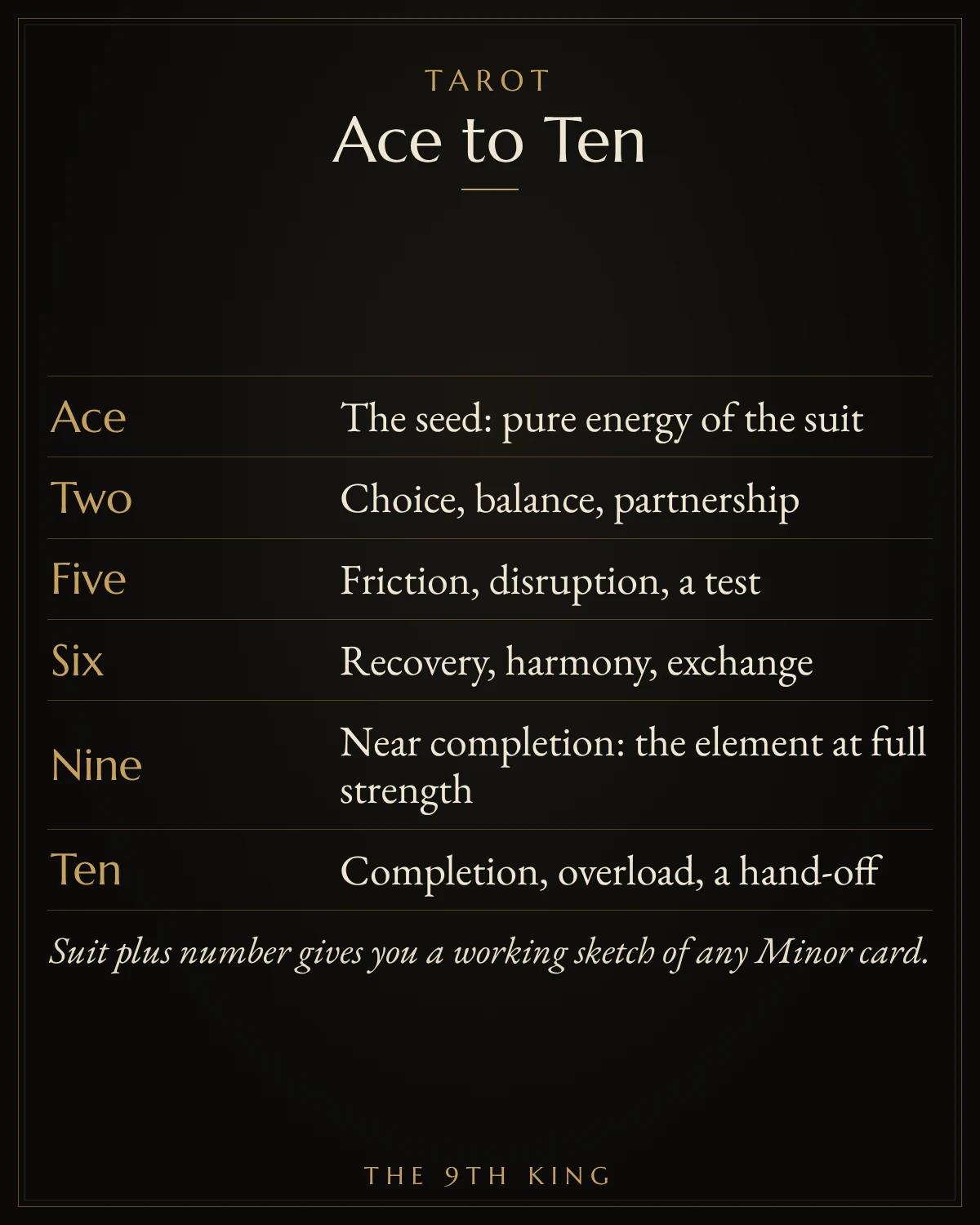
Numbers: Ace to Ten
Each suit runs from seed to completion. Readers commonly use the numbers like this:
- Ace: the raw seed of the element, a pure dose of its energy.
- Two: choice, balance, partnership.
- Three: first growth, expression, shared effort.
- Four: stability and structure, sometimes too much of it.
- Five: disruption, friction, a test.
- Six: recovery, harmony, giving and receiving.
- Seven: assessment, challenge, standing your ground.
- Eight: movement, effort, practice.
- Nine: near completion, intensity, the element at its fullest.
- Ten: completion, sometimes overload, and the hand-off to a new cycle.
Put suit and number together and you can sketch any card. A Nine of Wands is fire near its limit: tired, still holding the line. Let the picture and your question finish the thought.
Court cards: people, roles or parts of you
Court cards trip up a lot of readers. Three common ways to read them:
- As people in your life who carry that energy.
- As roles you’re being asked to play: student, champion, caretaker, leader.
- As parts of you, usually the first reading we try.
A simple rank guide: Pages are learning and curious, Knights are in motion, Queens hold and nurture the suit’s energy from within, and Kings direct and steward it outward.
Each court card also carries an element within its suit. The 9th King follows the court-card naming in Liber LXXVIII (the Golden Dawn’s Book T): Knights are fire of their suit, Queens water, Kings air, Pages earth. Applying that text’s titles to the Rider–Waite–Smith courts is our convention: under it the Knight of Wands is “Fire of Fire” and the King of Wands “Air of Fire” (Liber LXXVIII). Other systems pair the ranks differently, so a book that calls the King “fire” isn’t wrong, just using another convention.
How The 9th King reads a card: tension, shadow, self-mastery
The traditional meaning tells you how a card has commonly been read. The 9th King adds three questions, and you can use them on any card today.
Tension: what’s pulling against what?
Most cards hold two forces at once. The Two of Swords’ truce lasts only while the blindfold stays on. Naming the tension turns a label into a live question: where am I being pulled two ways?
Shadow: where does this card go wrong in me?
Every gift has a shadow. The Queen of Cups’ empathy can turn into absorbing everyone’s feelings until you lose your own. Each tile in the library ends with a one-line “Shadow:” to start you off. If shadow work is new to you, Shadow Work, Plainly is the best place to begin, and Psychological Projection helps when the card seems to be about someone else but stings anyway.
Self-mastery: what’s the next small, honest step?
Insight without action fades. The last question is practical: one thing you could do, say or stop doing this week that moves the card from shadow toward its gift. Keep it small.
A note on care: this is reflective practice, not therapy. If a card or prompt brings up trauma, abuse, self-harm thoughts or overwhelming distress, please work through it with a qualified therapist. It’s fine to stop any prompt that feels like too much.

How to use this tarot card meanings library
The grid at the top holds all 78 cards, and everything is on the tile itself. Each one shows:
- the card’s name, whether it’s a Major or which suit, and its number
- its element, and its Golden Dawn astrology link when it has one; a single sign or a planet in a sign links to our page for that sign
- three upright keywords and a one-line summary
- a “Reversed:” line with two reversed keywords
- a “Shadow:” line, the card’s shadow in one sentence
Cards that have a full guide also show a “Read the full card” link. Those guides, with imagery, tension, shadow, journal prompts and an exercise, are being added card by card; until one is live, the tile is the whole entry.
Filters and search
- All 78 / Major Arcana / Minor Arcana: the whole deck, the 22 Majors, or the 56 suit cards.
- Wands, Cups, Swords, Pentacles: one suit at a time.
- Element dropdown: fire, water, air or earth. Majors appear by their correspondence, so the Fool sits with air and the Emperor (Aries) with fire. Planetary Majors have no element of their own, with one exception: Liber LXXVIII gives The World to Earth as well as Saturn, so it also appears under earth.
- Zodiac sign dropdown: the Major and the three decan cards for that sign.
- Search: matches card names, upright and reversed keywords and the astrology line, so “Mars” or “grief” both work.
Try reading one suit Ace to King to watch the numbers tell a story, or pick your Sun, Moon or Rising sign from the dropdown.
Tarot and the zodiac: connecting cards to the 12 sign pages
The astrology in our library uses Golden Dawn–derived correspondences, the tradition The 9th King uses. It’s the system set out in the Golden Dawn’s Book T, the order Waite and Smith both belonged to. Other schools differ, and not every card maps to a single sign. We only list a correspondence where Book T states one, checked against Liber LXXVIII (sacred-texts.com).
How the correspondences work
- Twelve Major Arcana each correspond to one zodiac sign.
- Seven Major Arcana correspond to a planet: the Magician (Mercury), the High Priestess (Moon), the Empress (Venus), Wheel of Fortune (Jupiter), the Tower (Mars), the Sun (Sun) and the World (Saturn, with earth).
- Three Major Arcana correspond to an element: the Fool (air), the Hanged Man (water) and Judgement (fire, with spirit).
- The 36 cards from Two to Ten each rule a ten-degree slice of the zodiac, a decan, given as a planet in a sign. The Two of Wands is Mars in Aries.
- Aces are the root of their element and have no sign.
- Court cards show their suit’s element on the tile. In Liber LXXVIII, Knights, Queens and Kings each rule a span of the zodiac that crosses two signs, and Pages rule none, so no court card sits under a single sign filter. Card guides list a card’s span where it has one.
Cards by zodiac sign
| Sign | Major Arcana | Minor cards (decans) |
|---|---|---|
| Aries | The Emperor | 2, 3, 4 of Wands |
| Taurus | The Hierophant | 5, 6, 7 of Pentacles |
| Gemini | The Lovers | 8, 9, 10 of Swords |
| Cancer | The Chariot | 2, 3, 4 of Cups |
| Leo | Strength | 5, 6, 7 of Wands |
| Virgo | The Hermit | 8, 9, 10 of Pentacles |
| Libra | Justice | 2, 3, 4 of Swords |
| Scorpio | Death | 5, 6, 7 of Cups |
| Sagittarius | Temperance | 8, 9, 10 of Wands |
| Capricorn | The Devil | 2, 3, 4 of Pentacles |
| Aquarius | The Star | 5, 6, 7 of Swords |
| Pisces | The Moon | 8, 9, 10 of Cups |
All pairings are from Book T (Liber LXXVIII). Each sign or planet-in-sign link on a tile goes to its sign page, so The Emperor leads to Aries Personality Traits and The Moon to Pisces Traits.
Why this connection matters
A correspondence alone is trivia. Paired with a sign page, it’s a second lens on one pattern: if The Moon keeps turning up and you have planets in Pisces, both point at imagination, fear and what’s hidden. Zodiac Shadow Work gives each sign a gift and shadow to set beside the card’s.
You don’t need astrology to use tarot. If you do work with your chart, How to Read a Birth Chart shows where your Sun, Moon and Rising sit, so you know which sign filters to try first.
Practice: a one-card meaning worksheet
Use this with any deck and any card. It takes about fifteen minutes.
The worksheet
- Write one question. Start with what or how. “What am I not seeing about this decision?”
- Draw one card. Note whether it’s upright or reversed.
- First response (one line). What did you feel before you knew the meaning?
- Traditional meaning (one line). Look the card up in the library and pick the keyword that lands.
- Tension (one line). What two forces are in this card, and where are they in your life?
- Shadow (one line). Read the card’s shadow line. Where have you done this recently?
- One step. One small, concrete action for this week.
- Check-in. A week later, reread it. What changed?
A worked example (fictional)
Dana (fictional) asks: “What am I not seeing about taking on another project at work?” She draws the Ten of Wands, upright.
- First response: “Tired. My shoulders tensed.”
- Meaning: burden, responsibility, overload.
- Tension: wanting to look capable vs. limited energy.
- Shadow: “Proving your worth by how much you can carry.” She said yes twice last month to avoid looking unhelpful.
- One step: before agreeing to anything new, she’ll write down what she’d have to put down to pick it up.
Nothing in that reading tells Dana whether the project will succeed or what to decide. It shows her a pattern and one honest experiment. That’s the job.
For more prompts to use after a reading, see our shadow work prompts. If you’re brand new to the deck, Code of Ascension’s Tarot for Beginners (Code of Ascension) walks through the basics.
Myths and misreadings about tarot card meanings
“Death means someone will die”
On The 9th King, Death is read as an ending, a transformation or a clearing, never as literal death. The same goes for The Tower and the Ten of Swords: change and endings in a symbolic sense. Fear framing makes for bad readings.
“Every card has one correct meaning”
Card meanings are traditions, not definitions. Waite’s own lists give several meanings per card, some contradictory. Context, position and your response shape the reading.
“Reversed cards are bad cards”
A reversal is a variation on the theme, not a warning. A reversed Four of Cups can be curiosity returning. A reversed Ten of Swords can be recovery.
“Tarot predicts the future”
Not on The 9th King. Tarot here is a mirror for self-knowledge. If a reading leaves you feeling locked into an outcome, step back and reframe the question around what you can notice or do.
Tarot Card Meanings: FAQ
How many tarot cards are there?
A standard tarot deck has 78 cards: 22 Major Arcana, from The Fool (0) to The World (XXI), and 56 Minor Arcana in four suits, Wands, Cups, Swords and Pentacles. Each suit has ten numbered cards, Ace to Ten, plus four court cards: Page, Knight, Queen and King.
What do tarot cards mean in general?
Each card carries traditional themes. The Major Arcana describe big life lessons; the Minor Arcana describe everyday situations through their suit’s element. On The 9th King, a meaning is something to reflect on, not a prediction: it can point to a pattern, feeling or choice worth a closer look.
What’s the difference between upright and reversed meanings?
Upright, a card’s theme is usually read as expressed openly or in balance. Reversed, the same theme can be blocked, turned inward, overdone or not ready yet. A reversal is rarely the simple opposite. Some readers skip reversals and fold both sides into the upright reading, which is a valid approach too.
Do tarot cards have zodiac signs?
In the Golden Dawn system The 9th King uses, many cards do. Twelve Major Arcana each correspond to a sign, seven to a planet and three to an element, and each numbered card from Two to Ten corresponds to a planet in a sign. Aces and court cards work differently. Other traditions use different pairings, so a correspondence is a symbolic link, not a fixed rule.
Is the Death card bad?
No. On The 9th King, Death is read as a symbolic ending, transformation or release, never as literal death. It invites you to look at change: a role, habit or chapter that may be finishing. Use it as a prompt to ask what’s ready to end in your life and what that ending might make room for.
Can tarot predict the future?
There’s no evidence that tarot predicts events. On The 9th King, tarot is a reflective tool: the cards are symbols that help you notice patterns, name feelings and choose your next step. A “what” or “how” question about yourself will give you far more than asking what will happen.
Your next step: draw one card today, or pick the card that’s been on your mind, and run it through the worksheet above. Then filter the library by your Sun sign and read that sign’s page in our zodiac signs hub beside it.
Explore Next
- Start shadow work gently: Shadow Work, Plainly
- Each sign’s gift and shadow: Zodiac Shadow Work
- Questions to journal after a reading: Shadow Work Prompts
- Find your Sun, Moon and Rising: How to Read a Birth Chart
- All twelve signs: Zodiac Signs
- Reading from first impressions: Intuitive Tarot (Code of Ascension)
- More tarot on The 9th King: Major Arcana · Minor Arcana · Tarot & the Zodiac · Three-Card Tarot Spread · Shadow Work Tarot Spread
Final Thought: A Meaning Is Where the Reading Starts
A card meaning is a word someone else wrote down. The reading begins when you hold it up to your own life. Learn the language here, then use it to ask better questions about yourself. Know your nature. Rule your life.
About the Author
King is the founder of The 9th King, where zodiac psychology, relationships and shadow work are explored as tools for self-knowledge rather than fortune-telling. He’s a Libra Sun, and writes about the personal side of astrology on King The Kemist. Astrology on The 9th King is interpretation and self-reflection, not prediction or established fact.