Quick Answer: What Does the Judgement Tarot Card Mean?
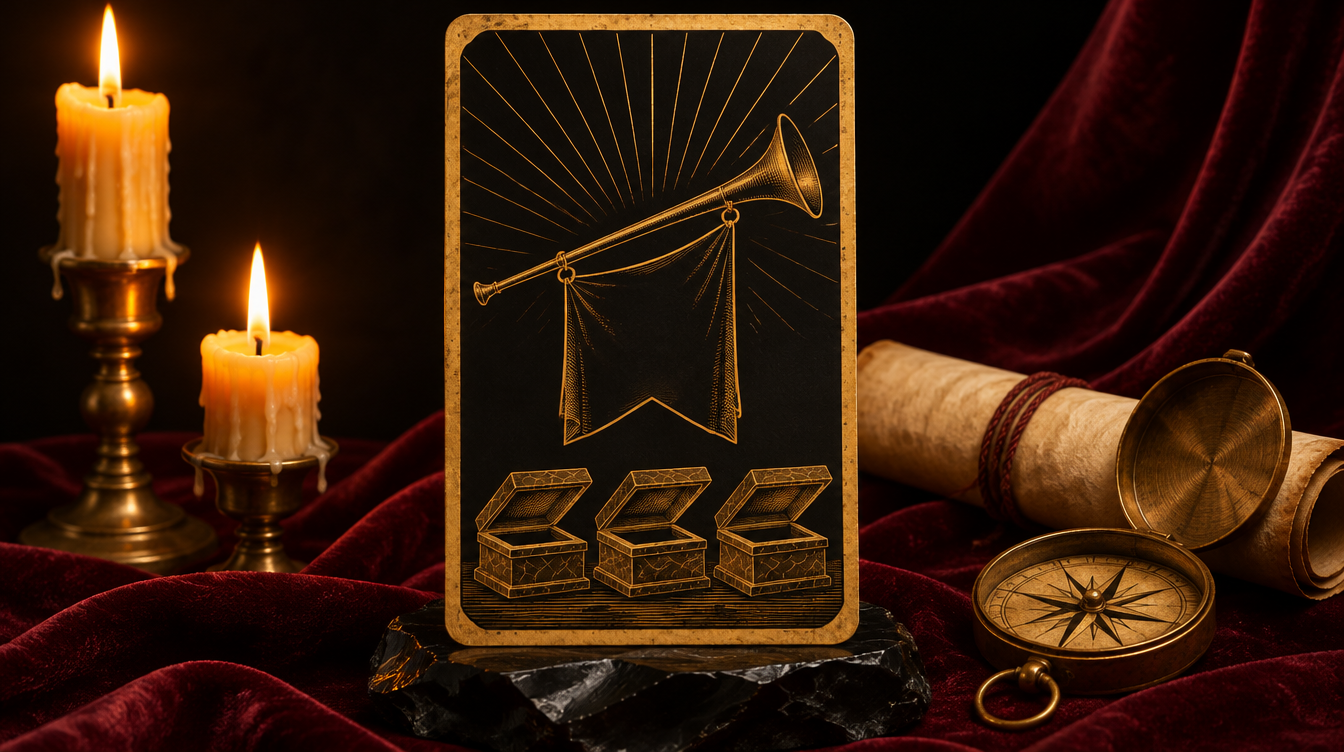
Judgement (also spelled Judgment) is card XX (20) of the Major Arcana. The traditional card shows a great angel in the clouds blowing a trumpet, while figures rise from open tombs below with their arms raised. It’s the card of the wake-up call: something sounds, and part of you answers.
Keywords: awakening, reckoning, renewal, a calling, honest review, rising, release.
- Upright, in one line: the card can point to a moment of clear self-review, where you hear what matters and decide to answer it.
- Reversed, in one line: readers often take it as ignoring the call, or as harsh self-judgment that keeps you lying down.
- Astrology link: in the Golden Dawn–derived correspondences The 9th King uses, Judgement is attributed to Fire (the source lists “Spirit and Fire”), not to a zodiac sign.
On The 9th King, tarot is a mirror for self-knowledge, not fortune-telling. Judgement isn’t a sentence passed on you. It asks a cleaner question: what is calling me to wake up, and can I answer it honestly without beating myself up?
Table of Contents

The Judgement tarot card at a glance
| Judgement | |
|---|---|
| Number | XX (20), Major Arcana |
| Core theme | Awakening and honest review |
| Upright | A call heard and answered |
| Reversed | The call ignored, or self-condemnation |
| Correspondence (Golden Dawn–derived) | Spirit and Fire |
| Hebrew letter in that system | Shin |
| 9K tension | Reckoning vs condemnation |
| Key question | What is asking me to wake up? |
What’s on the card: Judgement tarot symbolism, piece by piece
Most modern decks follow the Rider–Waite–Smith design, drawn by Pamela Colman Smith to A. E. Waite’s instructions and first published by William Rider & Son in 1909. Both were members of the Hermetic Order of the Golden Dawn (Wikipedia: Rider–Waite Tarot). Waite explained the card in The Pictorial Key to the Tarot, where he calls it The Last Judgment (sacred-texts.com: Waite, The Last Judgment).
A quick note on spelling: “Judgement” and “Judgment” are both used, and both are correct. Waite and the Golden Dawn text below use “Judgment”; many modern decks print “Judgement” (Wikipedia: Judgement (tarot card)). It’s the same card.
The angel and the trumpet
At the top of the traditional card, a great angel appears among clouds and blows a long trumpet. A banner hangs from the trumpet, and Waite notes that it carries a cross, as it usually does on this card. The title and the scene come from the Christian image of the Last Judgment; Waite says plainly that the card can keep that meaning for those who read it that way.
But he also points somewhere else. He describes the card as the summons of something higher, a summons that, in his words, “is heard and answered from within.” That’s the door The 9th King walks through. The trumpet isn’t only an outside voice. It’s the moment something inside you says now.
The figures rising
Below the angel, the dead rise from their tombs. Waite describes a woman on the right, a man on the left and a child between them with its back turned. He adds that more than three figures are shown rising, and that all of them share the same attitude of wonder, adoration and ecstasy.
Nobody on the card is cowering or being sentenced. The figures are reaching up toward the call. Judgement is less a courtroom and more an alarm clock.
The open tombs
The tombs stand open. Whatever held these figures down has given way. Readers often take the tombs as old roles or stories about yourself, lived in so long they felt like home.
Waite’s own question
Waite asks, in effect, what it is within us that sounds a trumpet so that all that is lower in our nature rises in answer, almost in the twinkling of an eye. He calls it the card of a great work of transformation completed, and he compares it with Temperance. In plain terms: Judgement is the moment change stops being a slow blend and becomes a clear yes.

Judgement tarot meaning: upright and reversed
Below are the meanings tarot readers commonly use, followed by the older list Waite printed. The 9K interpretation comes after.
Judgement upright
Upright, readers usually take Judgement as a moment of awakening and honest review. Something becomes clear, and you can’t un-hear it. Common upright themes:
- A calling: a pull toward a path, a value or a version of yourself you’ve been putting off.
- Reckoning: looking squarely at what you’ve done and what it’s led to.
- Renewal: a fresh start built on what you learned, not on pretending the past didn’t happen.
- Release: letting go of a role or story you’ve outgrown.
- Decision: a choice that feels less like weighing options and more like answering.
The upright message isn’t “you’re about to be judged.” It’s “you’re ready to look honestly, and rise.”
Judgement reversed
Reversed, readers tend to go one of two ways, and your own situation usually decides which fits:
- Not answering the call. You hear it, but you keep hitting snooze: putting off a decision, ignoring a clear lesson or staying in a role you’ve outgrown.
- Judgment turned into condemnation. The review never ends. You go over old mistakes so harshly that you can’t get up, and self-criticism becomes a reason to stay still.
What Waite’s list said
Waite’s divinatory list for the card is short. Upright, he gave change of position, renewal and outcome, and noted another account that gave loss through a lawsuit. Reversed, he gave weakness, faint-heartedness (his word is pusillanimity) and simplicity, and also deliberation, decision and sentence (sacred-texts.com: Waite, Divinatory Meanings). The Golden Dawn’s own short table, printed in Liber LXXVIII, reads the card as a final decision or judgment on a matter (Liber LXXVIII, sacred-texts.com).
That’s the language of old fortune-telling. Tarot began as an Italian card game in the 1430s, and Britannica dates its adaptation to fortune-telling to France around 1780 (Britannica: Tarot). On The 9th King we turn the old words into questions. “Outcome” becomes what has my past actually produced? “Sentence” becomes what verdict am I passing on myself, and is it fair?

| Position | Common reading | Question to ask |
|---|---|---|
| Upright | Awakening, honest review | What is calling me now? |
| Reversed (snooze) | The call heard but ignored | What am I putting off? |
| Reversed (harsh) | Review turned to self-attack | Is my verdict fair? |
Judgement and Fire: the Golden Dawn correspondence
Why Fire, not a zodiac sign?
The astrology links used on The 9th King are Golden Dawn–derived correspondences, the tradition The 9th King uses and the background the Rider–Waite–Smith deck comes from. In that system, most trumps are attributed to a zodiac sign or a planet, but a few are attributed to an element instead, and Liber LXXVIII‘s reading instructions treat these “elemental trumps” as their own group. Judgement is one of them.
The Golden Dawn’s Book T, as printed in Aleister Crowley’s Liber LXXVIII, lists the card as The Judgment, gives it the Hebrew letter Shin, attributes it to “Spirit and Fire” and gives it the title The Spirit of the Primal Fire (Liber LXXVIII, sacred-texts.com). The same list attributes The Fool to Air, another of the elemental trumps.
So when someone asks “what zodiac sign is the Judgement tarot card?”, the honest answer in this tradition is: none. It’s an element card.
Other schools differ
Other traditions use different attributions, and not every card maps to a single sign. Court cards and Pages work on a different scheme entirely. Treat the Fire pairing as a symbolic lens, not a law. If another system suits you better, use it consistently.
The fire signs, as element links only
Because Judgement is a Fire card in this system, it shares an element with the three fire signs: Aries, Leo and Sagittarius. That’s an element link, not a sign assignment. The card doesn’t “belong” to fire signs, and it doesn’t mean anything special for people born under them.
In astrology, Fire is the element of drive, courage and the spark that gets you moving. Read Judgement through that lens and its themes line up: a call that warms you from the inside, the courage to stand when you’ve been lying down, and the burning away of what no longer fits. If the progressed chart tracks slow inner growth over years, Judgement is the moment that growth becomes impossible to ignore.
The 9K reading: reckoning, not condemnation
The tension: honest review vs harsh verdict
Judgement’s core tension is between reckoning and condemnation. They can look alike from the outside. Both involve looking back. Both involve a verdict of some kind. But they lead to opposite places.
- Reckoning is an honest review aimed at rising. It names what happened, what you did and what you want to do next.
- Condemnation is a review aimed at punishment. It replays the past to prove you’re bad, and it never ends with a next step.
The figures on the card are rising, not kneeling for sentence. That’s the 9K reading in one image. The point of the review is to get up.
Judgement vs Justice: two kinds of verdict
People often mix up Judgement (XX) and Justice (XI). Both involve truth and consequences, but they work differently.
| Justice | Judgement | |
|---|---|---|
| Focus | A specific choice | Your whole direction |
| Mode | Weighing facts | Hearing a call |
| Asks | What’s fair here? | What am I waking up to? |
Justice is accountability: weighing what happened and owning your part. Judgement builds on that and goes further: taking everything you’ve learned and answering a bigger call with it.
The shadow side: when review becomes a trial that never ends
The shadow of Judgement is turning a wake-up call into a life sentence. It shows up in a few familiar ways:
- The endless replay. Going over one old mistake again and again, as if enough guilt could change it.
- The inner prosecutor. A voice that treats every slip as proof of who you “really” are.
- Judging others to avoid yourself. Becoming sharply critical of other people’s choices while yours go unexamined. Our guide to psychological projection explains how this works.
- Waiting for permission to rise. Staying in the tomb until someone else tells you you’ve suffered enough.
And one shadow that runs the other way: skipping the review. Calling every past choice “growth” so you never have to look at it honestly. That’s not self-compassion. It’s avoidance in a nicer outfit.
The self-mastery lesson: answer honestly, then stand
The self-mastery lesson of Judgement is simple to say and hard to do: you can tell yourself the full truth and still be on your own side.
Self-mastery here means three things:
- Hear the call. Name what keeps returning: the restless feeling, the repeated lesson, the path you keep circling.
- Answer it honestly. Own what’s yours, without padding and without punishment.
- Rise. Let the review end in a step, not a sentence.
If the inner prosecutor is loud, it often has an older voice behind it: a parent, a teacher, a time when you learned that mistakes meant you were bad. Shadow Work, Plainly and our guide to inner child work are gentle places to start looking at where that voice came from.
The Judgement tarot card in love, work and self-growth
These are reflections, not predictions. Judgement points at what’s calling you, and at how you’re judging yourself and others.
Judgement in love
In love readings, Judgement often points to an honest look at a relationship pattern: something you’ve repeated across connections that you’re finally ready to see. It can also point to how you judge yourself and a partner, including old resentments still being replayed long after the event.
Questions worth asking:
- What pattern in my relationships keeps calling for my attention?
- Am I holding a past mistake (mine or theirs) as an open case or as a lesson?
- What would I do differently if I treated myself as worth a second chance?
Judgement doesn’t tell you to stay or leave. It asks you to see clearly first.
Judgement at work
At work, Judgement can point to a calling question: does what you do still fit who you’re becoming? It can also point to a review, such as a hard look at a project, a habit or your own part in how something turned out.
A grounded approach: write down what you’ve learned in your current role, not just what went wrong; name the part that still feels alive; and don’t make a big, irreversible decision in a single burst of fire.
Nothing here is career or financial advice. For money or contract decisions, talk to a qualified professional.
Judgement in self-growth
For personal growth, Judgement is the card of the honest birthday. It’s a fitting card to sit with around your solar return, when many people take stock of the year behind them. The growth isn’t in judging the year as good or bad. It’s in asking what it taught you and what it’s asking of you now.
A practical exercise: the Wake-Up Call Review
This takes about 20 minutes and works with or without a deck. You need paper, a pen and, if you like, the Judgement card in front of you (pull it on purpose; no random draw needed). Use it whenever you feel a call you’ve been ignoring, or a verdict you’ve been passing on yourself.

The steps
- Hear. At the top of the page, write the call in one sentence. “I keep feeling I should go back to writing.” or “I keep replaying how I handled that argument.”
- Review. List what actually happened, facts only. Dates, actions, words said. No adjectives about yourself.
- Own. Next to the facts, write your part, plainly and fairly. Use the voice you’d use for a friend you respect: honest, specific, not cruel.
- Release. Write what isn’t yours to carry. Other people’s choices, things you couldn’t have known, and any harm someone else did to you. Responsibility for abuse or mistreatment always belongs to the person who caused it, never to you.
- Rise. Choose one step that answers the call. Small is fine. Write it at the bottom, with when you’ll take it.
Worked example (fictional)
Marcus (fictional) keeps pulling Judgement and keeps thinking about a falling-out with his brother two years ago. Hear: “I keep wanting to fix things with Andre.” Review: they argued at a family dinner; Marcus said Andre never showed up for anyone; they haven’t spoken since.
Own: Marcus writes that the comment was harsh and said in front of everyone, and that he’s let pride keep him silent. He notices the urge to add “I’m a terrible brother” and leaves it off, because it’s a verdict, not a fact. Release: he writes that Andre’s silence is Andre’s choice, and that he can’t control how his message will land.
Rise: one short message this weekend, owning the comment without demanding a reply. Whatever Andre does next, Marcus has answered the call honestly and stopped replaying the trial.
Using the exercise in a reading
If Judgement comes up in a spread, do the Wake-Up Call Review for the question you asked. For a structured way to look at the hidden side of a pattern, try our shadow work tarot spread. If you prefer to read by feel, Code of Ascension’s guide to intuitive tarot (Code of Ascension) covers working with your own impressions of a card.
Journal prompts for Judgement
Use one prompt per session. Write for ten minutes, then reread what you wrote and underline one sentence that feels true.
- What call keeps returning to me, however often I put it off?
- What old mistake am I still replaying, and what would it take to treat it as closed?
- Whose voice does my inner critic sound like, and how old is that voice?
- Where am I quick to judge other people for something I haven’t looked at in myself?
- What role or story have I outgrown but keep lying down inside?
- If I reviewed the last year the way a fair, kind mentor would, what would I see?
- What is one step that would show I’ve heard the call?
For more prompts on the hidden self, see our full list of shadow work prompts, and our zodiac shadow work guide if you want to explore the fire signs’ shadow side.
A gentle note: this is reflective practice, not therapy. If you’re dealing with trauma, abuse, thoughts of self-harm or distress that feels overwhelming, please work with a qualified therapist who can support you properly. And it’s always fine to stop a prompt that feels like too much.
Myths and misreadings about Judgement
- “Judgement means you’re about to be punished.” No. The traditional figures are rising in wonder, not facing sentence. On The 9th King, the card is a wake-up call, not a penalty.
- “Judgement is a religious card, so it’s only for believers.” The title and imagery come from Christian tradition, and you can respect that. Waite himself invited readers to also look for an inner meaning. You can read it as a symbol of awakening whatever your beliefs.
- “Judgement and Justice mean the same thing.” Justice weighs a specific choice; Judgement asks what you’re waking up to across your whole direction.
- “Being hard on yourself is the same as being honest.” Harshness often blocks honesty, because you can’t look clearly at something you expect to be punished for.
- “Judgement reversed always means you failed the test.” It can point to putting off the call or to judging yourself too harshly. Neither is a final verdict, and both can change.
Judgement Tarot Card: FAQ
What does the Judgement tarot card mean?
The Judgement tarot card, Major Arcana XX, is commonly read as awakening, reckoning, renewal and answering a calling. The traditional card shows an angel blowing a trumpet while figures rise from open tombs. On The 9th King it’s read as a mirror, not a prediction: it asks what is calling you to wake up, and invites an honest review of your life that ends in rising, not in self-punishment.
What does Judgement reversed mean?
Readers usually take Judgement reversed in one of two ways. Either you hear a call but keep putting it off, or your self-review has turned into harsh self-judgment that keeps you stuck. Some also read it as fear of what others will think. Your own situation decides which fits best, so treat it as a question about how you’re responding to change rather than a verdict.
Is it spelled Judgement or Judgment?
Both spellings are correct and refer to the same card. Many modern decks print “Judgement,” while older sources often use “Judgment.” A. E. Waite called the card The Last Judgment, and the Golden Dawn text printed in Liber LXXVIII lists it as The Judgment. Search for either spelling and you’ll find the same card, numbered XX.
What zodiac sign is the Judgement tarot card?
In the Golden Dawn–derived correspondences The 9th King uses, Judgement isn’t linked to a zodiac sign. It’s one of three elemental trumps, attributed to “Spirit and Fire” in Liber LXXVIII. That means it shares an element with the fire signs Aries, Leo and Sagittarius, but it doesn’t belong to them. Other tarot traditions use different attributions.
What does Judgement mean in love?
In love, Judgement often points to an honest look at a relationship pattern you’re ready to see clearly, or to how you judge yourself and a partner, including old resentments still being replayed. It doesn’t tell you to stay or leave. It invites a fair review: what’s yours to own, what isn’t, and what step would show you’ve learned from the past.
What’s the difference between Judgement and Justice in tarot?
Justice (XI) is about weighing a specific situation fairly and owning your part in it: accountability. Judgement (XX) is broader. It’s a wake-up call about your whole direction, asking what you’ve learned and what you’re being called toward. A simple way to remember it: Justice weighs the facts, Judgement hears the call and rises to answer it.
Is Judgement a yes or no card?
The 9th King doesn’t use tarot for yes or no answers. Judgement in particular is about an inner call and an honest review, which doesn’t reduce well to a single word. A more useful approach is to ask what keeps calling for your attention, what you need to own and what you can release, and what one step would show that you’ve heard it.

Your next step: the next time a call keeps coming back, or an old mistake keeps replaying, try the Wake-Up Call Review above before you decide anything. Then read Shadow Work, Plainly to learn where a harsh inner verdict often comes from.
Explore Next
- Accountability for a specific choice: Justice Tarot Card
- The card that follows Judgement: The World Tarot Card
- Where the harsh inner voice comes from: Shadow Work, Plainly
- Growth over years, in astrology: Progressed Chart
- When criticism lands on other people: Psychological Projection
- More tarot on The 9th King: Tarot Card Meanings · Major Arcana · Tarot & the Zodiac · Three-Card Tarot Spread
- More new cards: The Sun · The Fool · Wheel of Fortune · The Devil

Final Thought: The Call Is an Invitation, Not a Sentence
Judgement doesn’t drag you into a courtroom. It sounds a note and waits to see if you’ll rise. Hear what keeps calling, tell yourself the full truth, put down what was never yours, and stand up into the next chapter. You can be honest and on your own side at the same time. Know your nature. Rule your life.
About the Author
King is the founder of The 9th King, where zodiac psychology, relationships and shadow work are explored as tools for self-knowledge rather than fortune-telling. He’s a Libra Sun, and writes about the personal side of astrology on King The Kemist. Astrology on The 9th King is interpretation and self-reflection, not prediction or established fact.
Leave a Reply