Quick Answer: What Does The Fool Tarot Card Mean?
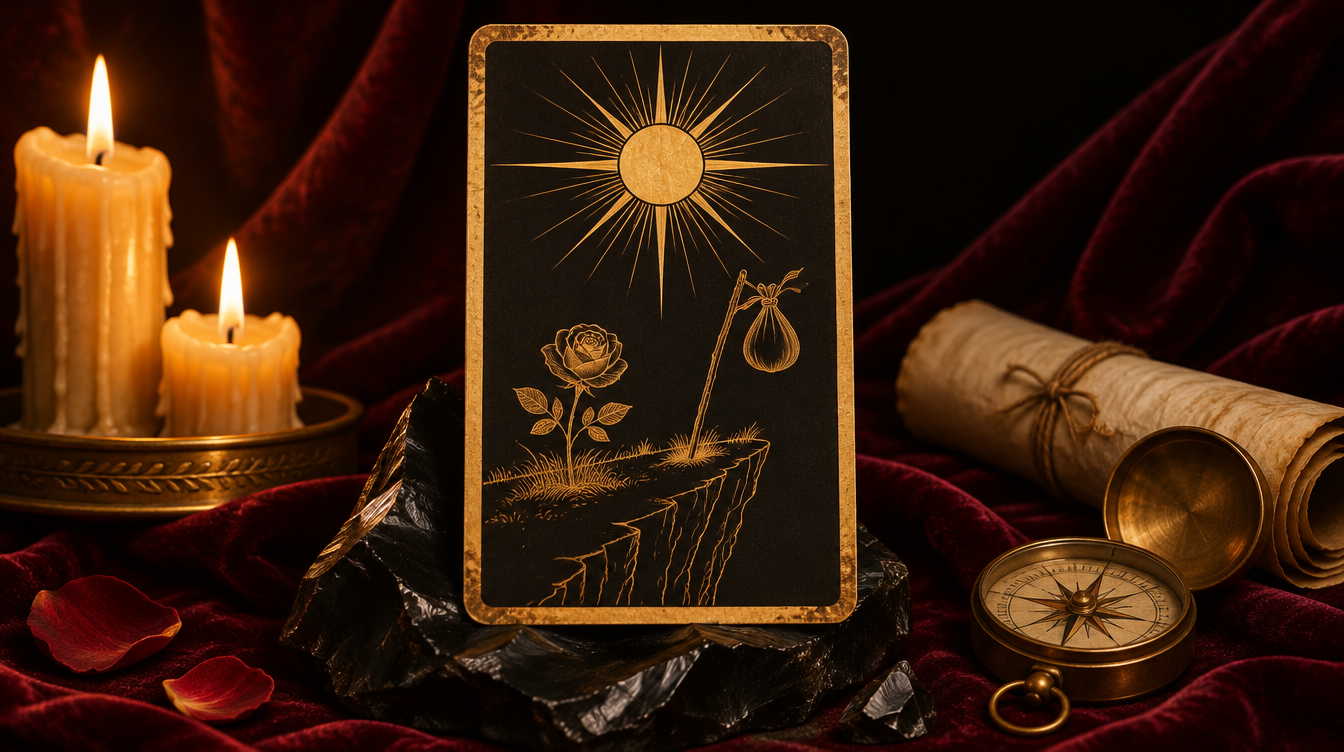
The Fool is card 0 of the Major Arcana. On the traditional Rider–Waite–Smith card, a young traveler in rich clothes stands at the edge of a high cliff, looking up rather than down, with a small dog bounding beside him. It’s the card of the first step: open, unguarded and not yet tested.
Keywords: beginnings, trust, openness, spontaneity, freedom, innocence, the leap.
- Upright, in one line: something new is calling, and the card can point to meeting it with trust and curiosity rather than a guarantee.
- Reversed, in one line: readers often take it as holding back from a beginning out of fear, or as rushing ahead without looking where you’re stepping.
- Astrology link: in the Golden Dawn–derived correspondences The 9th King uses, The Fool is paired with the element Air, not with a zodiac sign.
On The 9th King, tarot is a mirror for self-knowledge, not fortune-telling. The Fool doesn’t predict a lucky break or a fall. It asks: am I stepping toward something, or only away from something?
Table of Contents

The Fool tarot card at a glance
| The Fool | |
|---|---|
| Card | Major Arcana 0 (zero) |
| Keywords | Beginnings, trust, openness, the leap |
| Upright | Step toward the new with trust and curiosity |
| Reversed | Holding back in fear, or rushing blind |
| Correspondence | Air, the element (Golden Dawn–derived) |
| Key question | Am I moving toward something, or away? |
What’s on the card: The Fool tarot symbolism
The traditional Rider–Waite–Smith design was drawn by Pamela Colman Smith to A. E. Waite’s instructions and first published by William Rider & Son in 1909 (Wikipedia: Rider–Waite Tarot). Waite described each image in The Pictorial Key to the Tarot, now in the public domain (sacred-texts.com: Waite, The Fool).
The traveler at the edge
A young man in richly decorated clothes stands at the brink of a high precipice. He isn’t looking at the drop. His face is turned toward the sky and the distance ahead, and Waite describes him as unafraid of the edge. He is mid-stride, as if he has paused only for a moment.
Waite puts it simply: “He is the spirit in search of experience.” That’s the key to the card. The Fool isn’t stupid. He’s new, and he wants to find out what the world will teach him.
The rose, the wand and the wallet
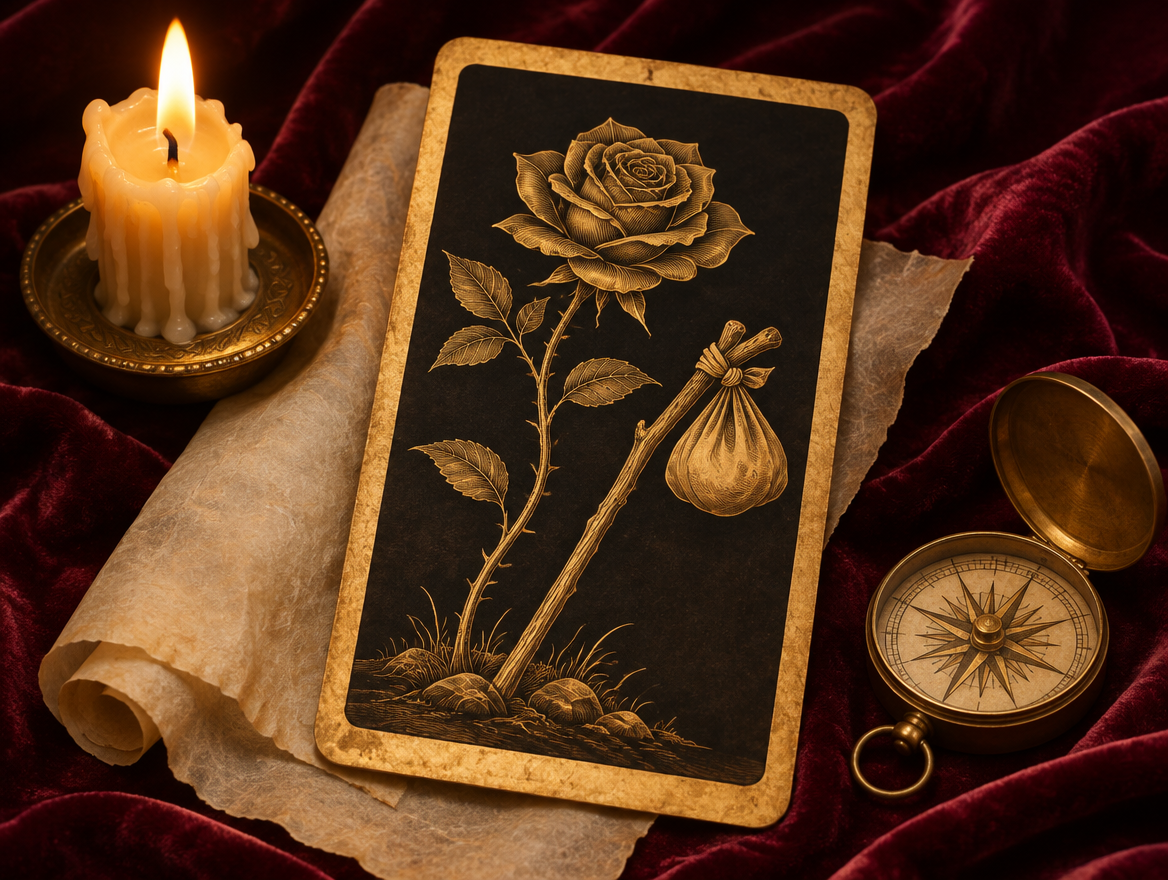
In one hand he holds a rose. In the other he holds a costly wand, and from it an embroidered wallet, a small traveler’s bag, hangs over his shoulder. Readers often take the rose as openness and the bag as what he brings with him. He travels light, but not empty-handed.
The dog
A small dog bounds at his side. Many modern readers see it as instinct or the part of you that notices danger. Is it warning him or cheering him on? The card doesn’t say. Your own inner alarm can be either, and you have to check which.
The sun behind him
The sun shines behind the traveler. Waite reads it as knowing where he came from and where he is going, and calls the Fool a kind of visitor from another world. Put plainly: there’s a bigger arc to the journey than the next step shows.
An older, harsher Fool
Waite also notes that older decks drew this card very differently. In those versions the Fool looks back over his shoulder, unaware he’s at a cliff edge, while a dog or another animal, which some called a tiger, attacks him from behind. Etteilla’s deck showed a court jester with cap and bells (sacred-texts.com: Waite, The Trumps Major). In his own entry for the card, Waite adds that one old nickname for it was the alchemist, a satire on folly at its most extreme (sacred-texts.com: Waite, The Fool).
The Rider–Waite–Smith Fool is a more hopeful figure: not a man chased off a cliff, but a seeker choosing to begin. Both versions live inside the card. One is trust. The other is the risk of not looking.
Why zero?
Tarot began as an Italian card game in the 1430s, with 21 illustrated trumps plus an unnumbered card called il matto, “the fool” (Britannica: Tarot). Modern decks number him 0. Zero fits him well. It’s the point before counting starts: nothing yet, and so everything still possible.

The Fool tarot meaning: upright and reversed
The Fool upright
Upright, readers usually take The Fool as a beginning: a new chapter, idea, relationship or path. Common upright themes:
- New beginnings: the start of something you haven’t done before.
- Trust: moving forward without needing every answer first.
- Openness and curiosity: meeting the unknown as interesting rather than threatening.
- Spontaneity: saying yes to something because it feels alive.
- Freedom: traveling light, not weighed down by old roles or expectations.
The useful upright message isn’t “jump and everything will work out.” It’s “you’re allowed to begin before you’re an expert.”
The Fool reversed
Reversed, readers tend to go one of two ways, and your situation decides which fits:
- Holding back. You want to begin something, but fear of looking foolish, failing or being judged keeps you frozen at the edge.
- Rushing blind. You’re leaping without looking: chasing novelty, ignoring real warnings, or starting over again and again to avoid finishing anything.
Some readers also take it as naivety or a plan not thought through. Treat any of these as a question, not a verdict.
What Waite and the Golden Dawn said
Waite’s 1911 divinatory list for The Fool was not flattering. Upright, he gave words like folly, mania, extravagance and intoxication. Reversed, he gave negligence, absence, carelessness, apathy and vanity (sacred-texts.com: Waite, Divinatory Meanings). That’s the language of old fortune-telling.
The Golden Dawn’s Book T, as printed in Liber LXXVIII, splits the card in two. In a question about spiritual matters, it says the Fool means idea, thought, spirituality, “that which endeavours to transcend Earth.” In a material question, it means folly or eccentricity (Liber LXXVIII, sacred-texts.com).
That split is the heart of the 9K reading: the energy that lifts you toward something new can also float you away from what needs doing. So we turn the old warnings into questions. “Folly” becomes where am I not looking? “Negligence” becomes what am I leaving undone by starting something else?

| Position | Common reading | Question to ask |
|---|---|---|
| Upright | A beginning met with trust | What is calling me forward? |
| Reversed: frozen | Fear keeps you at the edge | What am I afraid of looking like? |
| Reversed: rushing | Leaping without looking | What am I leaving behind unfinished? |
The Fool and Air: the Golden Dawn correspondence
Why Air?
The astrology links here are Golden Dawn–derived correspondences, the tradition The 9th King uses. Waite and Smith were both members of the Hermetic Order of the Golden Dawn, an occult society, and their deck reflects its system (Wikipedia: Rider–Waite Tarot).
In the Golden Dawn’s Book T, as printed in Liber LXXVIII, card 0 is called The Foolish Man, with the title The Spirit of the Aethyr. Its Hebrew letter is Aleph and its attribution is Air (Liber LXXVIII, sacred-texts.com).
An element, not a sign
The Fool has no zodiac sign in this system. Most trumps take a sign or a planet, but the same table gives three trumps to elements: The Fool to Air, The Hanged Man to Water, and Judgement to Spirit and Fire. The World is listed with Earth and Saturn (Liber LXXVIII, sacred-texts.com).
So the air signs, Gemini, Libra and Aquarius, share The Fool’s element, but the card isn’t theirs: it’s a family link, not a match. To see Air in a personality, our guides to Gemini personality traits, Libra traits and Aquarius personality traits cover the three air signs in depth.
Other schools differ
Waite himself notes that in many arrangements of his time the zero card was placed late in the sequence and linked to the letter Shin, and he admits that nobody knows the cards’ true original order (sacred-texts.com: Waite, The Trumps Major). The Golden Dawn put The Fool first, with Aleph. Court cards work on another scheme entirely, and not every card maps to a single sign. Use one system consistently and treat it as a lens, not a law.
What Air adds to the card
In astrology, Air is the element of ideas, words, movement and connection. Read through that lens, The Fool is light on his feet and not yet tied down. Air can also drift: ideas are easy to start and easy to drop. The Fool’s gift and his risk come from the same place.
The 9K reading: openness or avoidance?
The tension: toward vs away
The Fool’s core tension is between openness and avoidance. Both involve leaving something familiar, and both feel like freedom.
- Openness moves toward something. It’s willing to learn, look foolish and keep going.
- Avoidance moves away from something. It’s less interested in the new thing than in escaping the old one: a hard conversation, a dull middle stretch, a feeling, a commitment.
Here’s the honest part: a fresh start feels exciting either way, so the feeling can’t tell you which it is. Look instead at what you’d be walking away from, and whether you’ve faced it.
The shadow side: the Fool who never lands
The shadow of The Fool isn’t the leap. It’s the leap used as a habit, so you never have to stay, or its mirror image, never leaping at all:
- The serial restart. New project, new plan, new city, new person, each abandoned as soon as it stops feeling new.
- Calling avoidance “trust.” Skipping the hard questions and labeling it faith in the universe.
- Refusing to look down. Treating every warning, from friends or from your own gut, as negativity.
- Frozen at the edge. The opposite shadow: waiting so long for certainty that you never begin at all.
Both shadows dodge the same thing: being a beginner in public.
The self-mastery lesson: trust with your eyes open
The self-mastery lesson of The Fool is simple to say and hard to live: real trust isn’t the absence of looking. It’s looking, and stepping anyway.
The traditional traveler looks at the sky, but he carries a bag, a rose and a companion. Self-mastery here means three things:
- Know what you’re moving toward, not only what you’re leaving.
- Hear the warning without letting it decide for you.
- Take a first step you can learn from, and stay long enough to learn it.
The beginner’s mind and the inner child
The Fool is the part of you that was curious before you learned to be careful. Many people lose touch with it early, through criticism or embarrassment. If beginning anything feels impossible, it may help to meet that younger self gently. Our guide to inner child work is a good place to start.
The Fool and The World: 0 and XXI
The first card and the last
The Fool is 0 and The World is XXI, the final trump. In the Golden Dawn’s table they also hold the first and last Hebrew letters: Aleph for The Fool, Taw for The World (Liber LXXVIII, sacred-texts.com). One is the open beginning; the other is the cycle complete.
The Fool asks will I begin? The World asks will I finish, and let it be finished? Avoidance can hide in both: never starting, or restarting so you never complete.
The Fool’s Journey: a modern teaching frame
Many readers learn the Major Arcana as a story in which The Fool sets out, meets each trump as a lesson, and arrives at The World. That story is called the Fool’s Journey. It’s a modern teaching frame, not something printed on the early cards. Tarot writer Mary K. Greer credits Eden Gray with the term, as the epilogue title of her 1970 book A Complete Guide to the Tarot (Mary K. Greer: Eden Gray’s Fool’s Journey).
It’s helpful as long as you don’t treat it as a ladder. You can be a Fool in one part of life and near The World in another. Our Major Arcana guide walks through the whole sequence.
The Fool tarot card in love and work
These are reflections, not predictions. In every area, The Fool is about letting yourself be a beginner: the clumsy start is part of the path, not proof you chose the wrong one.
The Fool in love
In love readings, The Fool often points to something new: a new connection, a new stage in an existing one, or a new way of showing up.
The shadow version is falling for the beginning rather than the person. Questions worth asking:
- Am I curious about this person, or about how they make me feel at the start?
- When things get ordinary, do I tend to look for the next new thing?
The Fool doesn’t tell you to stay or leave. It asks whether you’re moving toward closeness or away from it. If you tend to project hopes onto new people, our guide to psychological projection may help.
The Fool at work
At work, The Fool can point to a new role, idea or direction, or to restlessness: wanting a fresh start mainly because the middle stretch is hard.
A grounded approach:
- Write down what draws you to the new thing, and separately what you’d be glad to escape.
- Look for a small, low-stakes way to test the new direction before any big change.
- Ask one person who knows your field what you might not be seeing.
Nothing here is career or financial advice. For decisions about money, contracts or leaving a job, talk to a qualified professional.
A practical exercise: the Cliff-Edge Check
This takes about 15 minutes, with or without a deck. Use it when you’re about to start something new, or itching to start over. You need paper, a pen and, if you like, The Fool card in front of you (pulled on purpose; no random draw needed).

The steps
- Name the leap. At the top of the page, write the new step in one sentence. “I want to start a podcast.”
- Toward or away. Draw two columns. On the left, write what you’re moving toward. On the right, write what you’d be leaving or avoiding: the task, feeling or situation this step gets you out of. Both columns are allowed.
- Check the bag. List what you already carry: skills, time, people who’d support you, facts you know. The Fool travels light, but not empty-handed.
- Hear the dog. Write down the warning voice, as specifically as you can. Then ask: is this a real risk I can check, or an old fear of looking foolish? If you can check it, note how.
- First step. Choose one small step you can learn from, ideally one you could undo. Write it at the bottom.
A long right-hand column doesn’t mean “don’t do it.” It means the leap may carry an escape inside it, and what you’re escaping may need attention too.
Worked example (fictional)
Jordan (fictional) has started three online courses this year and finished none. Now he wants a fourth, in graphic design.
His left column is real: he has wanted to try design for years. His right column surprises him: each new course starts right when the last one reaches the part where he’d have to show his work for feedback.
His bag is fuller than he thought: a friend who’s a designer and two drawings he’s proud of. The dog’s warning is “you’ll quit again.” Checking it, he sees the pattern isn’t random. He quits at feedback.
His first step: before paying for anything, he sends one drawing to his friend for honest notes. He tests the hard part first. That’s the Fool with his eyes open.
Using the exercise in a reading
If The Fool comes up in a spread, run the check for the question you asked. New to spreads? Try how tarot really works for beginners (Code of Ascension) or our three-card tarot spread.
Journal prompts for The Fool
Use one prompt per session. Write for ten minutes, then read it back the next day.
- What new beginning keeps calling me, and what has stopped me so far?
- When did I last let myself be a beginner at something? How did it feel?
- Where have I called something “trust” when it was really not wanting to look?
- What do I tend to leave right when it gets hard or ordinary?
- What would I try if I didn’t mind looking foolish for a while?
- What did I love doing as a child, before I learned to be careful?
- What’s one small first step I could take this week and learn from?
For more, see our full list of shadow work prompts or try the shadow work tarot spread.
A gentle note: this is reflective practice, not therapy. If you’re dealing with trauma, abuse, thoughts of self-harm or distress that feels overwhelming, please work with a qualified therapist who can support you properly. And it’s always fine to stop a prompt that feels like too much.
Myths and misreadings about The Fool
- “The Fool means you’re being stupid.” The card describes someone new, not someone foolish.
- “The Fool says take any risk and it’ll work out.” Trust and recklessness aren’t the same. The card asks you to step forward with your eyes open, not shut.
- “The Fool reversed means don’t start.” That’s one reading. It can also mean you’re rushing. Your situation decides which fits.
- “The Fool is the card for air signs.” In the Golden Dawn system it’s paired with the element Air, not a sign.
- “The Fool’s Journey is ancient.” It’s a modern teaching frame, credited to Eden Gray in 1970.
The Fool Tarot Card: FAQ
What does The Fool tarot card mean?
The Fool tarot card, Major Arcana 0, is commonly read as new beginnings, trust, openness, spontaneity and freedom. The traditional card shows a young traveler at the edge of a cliff, looking at the sky, with a small dog beside him. On The 9th King it’s read as a mirror, not a prediction: it asks whether you’re stepping toward something new with your eyes open, or only escaping something you don’t want to face.
What does The Fool reversed mean?
Readers usually take The Fool reversed in one of two ways. Either you’re frozen at the edge of a beginning, held back by fear of failing or looking foolish, or you’re rushing ahead without looking, chasing novelty or ignoring real warnings. Some also read it as naivety. Your own situation decides which fits, so treat the card as a question about how you’re approaching change, not a verdict.
What zodiac sign is The Fool tarot card?
In the Golden Dawn–derived correspondences The 9th King uses, The Fool isn’t paired with a zodiac sign at all. Its attribution is the element Air, with the Hebrew letter Aleph. The three air signs, Gemini, Libra and Aquarius, share that element, but the card doesn’t belong to any one of them. Other tarot traditions place The Fool differently, so treat this as a symbolic lens.
What does The Fool tarot card mean in love?
In love, The Fool often points to something new: a fresh connection, a new stage in a relationship, or a more open way of showing up. Its shadow is loving the thrill of beginnings and losing interest when things become ordinary. It doesn’t tell you to stay or leave. It asks whether you’re moving toward real closeness or away from it, and invites you to notice which.
Is The Fool a yes or no card?
The 9th King doesn’t use tarot for yes or no answers. The Fool is about beginnings, and whether a beginning is wise depends on what you’re moving toward and what you might be avoiding. A more useful approach is the Cliff-Edge Check in this article: name the leap, look honestly at both sides, hear the warning, and choose one small first step you can learn from.
Why is The Fool numbered zero?
In the earliest Italian tarot decks of the 1430s, the fool card was unnumbered and stood apart from the 21 illustrated trumps. Modern decks usually give it the number 0. That suits the card’s meaning well. Zero is the point before counting begins: nothing has happened yet, so everything is still possible. It lets The Fool stand at the start of the sequence, or outside it.
Your next step: the next time you feel the pull of a fresh start, run the Cliff-Edge Check above before you leap. Then read our guide to inner child work to reconnect with the curious part of you that knew how to begin.
Explore Next
- The card at the other end of the sequence: The World Tarot Card
- The whole sequence from 0 to XXI: Major Arcana
- Meeting your younger, curious self: Inner Child Work
- Questions for the hidden self: Shadow Work Prompts
- The element behind the card: Gemini Personality Traits · Libra Traits · Aquarius Personality Traits
- Reading by feel, not only the book: Intuitive Tarot (Code of Ascension)
- More tarot on The 9th King: Tarot Card Meanings · Tarot & the Zodiac · Shadow Work Tarot Spread · Three-Card Tarot Spread
- More new cards: The Sun · Wheel of Fortune · Judgement · The Devil
Final Thought: Look, Then Step
The Fool never shows you the bottom of the cliff. He shows you a traveler who carries what he needs, listens to his companion and still chooses to begin. Know what you’re moving toward, hear the warning without obeying it blindly, and take one step you can learn from. Know your nature. Rule your life.
About the Author
King is the founder of The 9th King, where zodiac psychology, relationships and shadow work are explored as tools for self-knowledge rather than fortune-telling. He’s a Libra Sun, and writes about the personal side of astrology on King The Kemist. Astrology on The 9th King is interpretation and self-reflection, not prediction or established fact.
Leave a Reply