
Quick Answer: What Does the Page of Pentacles Mean?
The Page of Pentacles is a court card in the Minor Arcana, the youngest member of the suit of Pentacles (also called Coins), the suit traditionally linked to the element earth. On The 9th King, it’s the card of the student: someone holding a real, small beginning and paying close attention to it.
- Keywords (upright): study, curiosity, practice, a first practical step, patience, a message or opportunity worth taking seriously.
- Keywords (reversed): scattered effort, all plan and no start, waste, a lesson skipped, perfectionism that stops the first step.
- Upright in one line: you have an idea worth grounding, so treat it like a student would: learn the basics and take one real step.
- Reversed in one line: the idea is still floating, and the card asks what’s keeping you from turning it into something you can actually touch.
Tarot here is a mirror for self-knowledge, not fortune-telling. The card doesn’t say what will happen. It can point to a pattern worth looking at.
Table of Contents
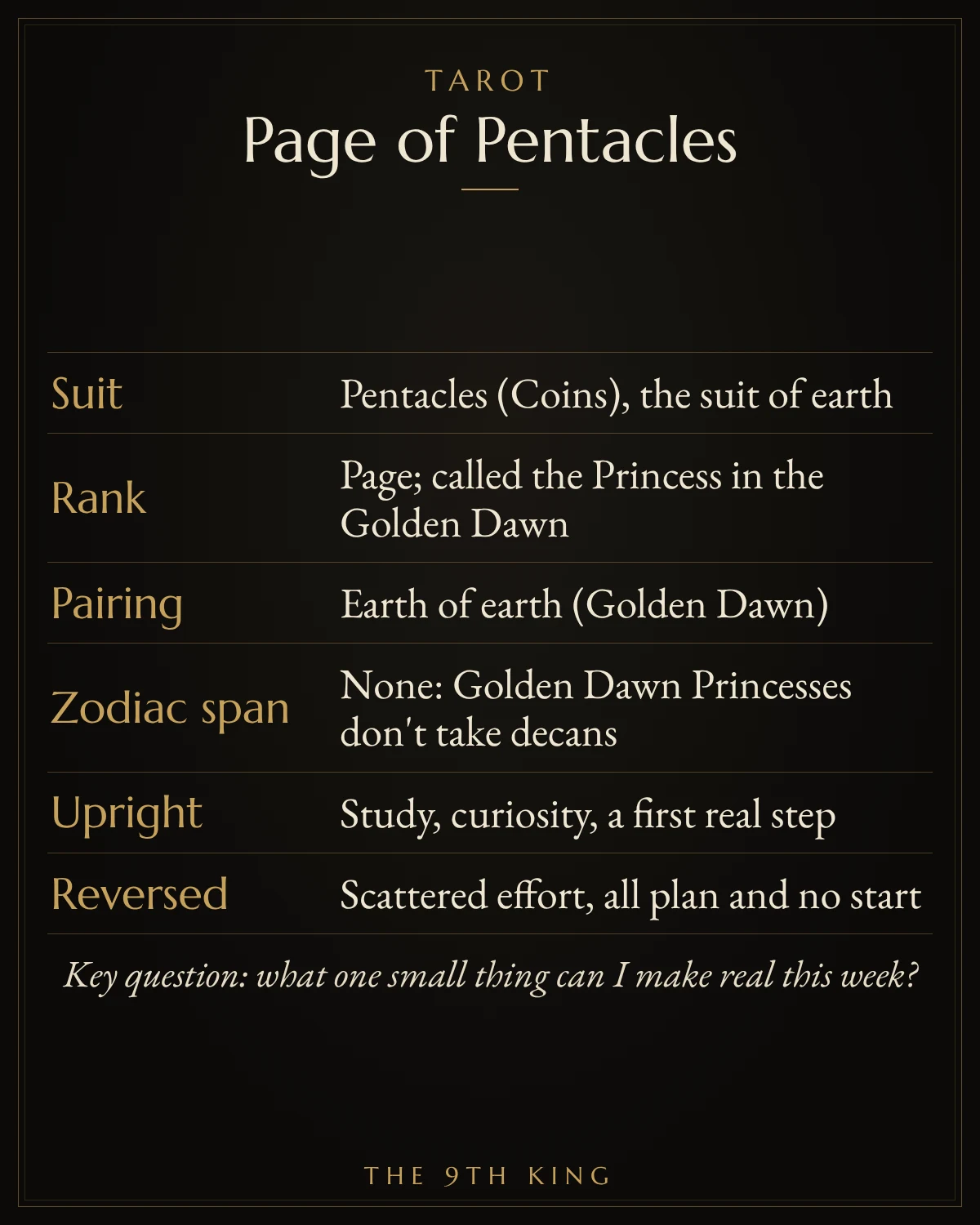
Page of Pentacles at a glance
| Page of Pentacles | |
|---|---|
| Arcana | Minor Arcana, court card |
| Suit | Pentacles (Coins) |
| Element of the suit | Earth |
| Rank | Page (the Princess in the Golden Dawn system) |
| Golden Dawn pairing | Earth of earth |
| Zodiac span | None; Golden Dawn Princesses don’t rule decans |
| Upright themes | Study, practice, a first practical step |
| Reversed themes | Scattered effort, waste, a step not taken |
| Key question | What is one small thing I can make real this week? |
Tarot began as a card game. Encyclopaedia Britannica dates the first decks to Italy in the 1430s, says fortune-telling use first appeared in France around 1780, and matches the coins suit to diamonds in ordinary playing cards.
The deck most English-speaking readers picture, the Rider–Waite–Smith, was first published in December 1909, written up by A.E. Waite and drawn by Pamela Colman Smith, both members of the Hermetic Order of the Golden Dawn, according to Wikipedia’s overview of the deck. That’s why this page uses the Golden Dawn’s correspondences, the tradition The 9th King uses. Other schools differ, and we’ll be specific about where.
What the Page of Pentacles shows
The imagery is quiet on purpose. Nothing dramatic happens in this card.
The figure and the coin
A young figure stands outdoors, holding a single pentacle (a gold disc marked with a five-pointed star) up in both hands and gazing at it. In The Pictorial Key to the Tarot, Waite describes a youthful figure looking intently at a pentacle that seems to hover over his raised hands, and adds a line that sums up the card’s mood: “He moves slowly, insensible of that which is about him” (Waite, The Pictorial Key to the Tarot, 1911).
The Page is absorbed. For now, the coin is the whole world.
What the imagery is pointing at
Put the pieces together and you get the core of the card:
- One coin, not a pile. This isn’t wealth. It’s a single resource, idea or skill.
- Two hands, full attention. The Page is studying it, not spending it.
- Slow movement. Earth moves at the pace of growth, not the pace of impulse.
- Open ground. In Smith’s drawing the Page stands in green country with a worked field nearby: potential that still needs planting.

Page of Pentacles meaning (upright)
Waite’s own divinatory list for the card begins “Application, study, scholarship, reflection” (Waite, 1911). He adds an alternative reading of news and messages, and a sense of rule and management. Modern readers mostly build on the first group: the Page as student.
The student mindset
The upright Page of Pentacles describes a particular way of approaching something new. You don’t pretend to be an expert. You don’t wait to feel ready. You get curious, gather the basics and learn by handling the thing itself. Readers often take it as encouragement to be a beginner on purpose.
A first real step
Pentacles is the suit of the physical, the practical and the tangible. So this Page isn’t about dreaming up an idea. It’s about the moment an idea becomes something you can touch: the first lesson booked, the first page written, the first sample made, the first conversation with someone who already does what you want to do.
Patience and steady practice
Earth rewards repetition. The upright Page can point to a season of small, quiet gains, where showing up consistently matters more than any breakthrough. Twenty minutes a day beats the free weekend that never comes.
A message or opportunity worth taking seriously
Following Waite’s “news and messages” reading, some readers see the Page as an offer or invitation with practical potential. We read that as a prompt, not a promise: What have I dismissed because it looks too small?
Page of Pentacles reversed
Waite’s reversed meanings are prodigality, dissipation, liberality and luxury, along with unfavorable news (Waite, 1911). In plain language: the coin gets spent, scattered or ignored instead of studied. Modern readers tend to read the reversal in a few related ways.
All plan, no start
The most common reversed reading is the idea that never touches the ground. Research becomes a hiding place. You collect courses, notes and bookmarks, and the first step keeps moving to next month.
Scattered attention
The upright Page looks at one coin. The reversed Page tries to hold five at once, or keeps putting the coin down to pick up something shinier. Effort spreads so thin that nothing takes root.
Perfectionism dressed as preparation
I’ll start when I have the right equipment. When I’ve read one more book. When I’m better. The card can point to fear of being a visible beginner.
Upright and reversed side by side
| Theme | Upright | Reversed |
|---|---|---|
| Attention | Focused on one thing | Scattered or distracted |
| Learning | Hands-on, curious | Endless research, no practice |
| Pace | Slow and steady | Stalled, or rushed and sloppy |
| Resources | Studied, protected | Spent carelessly |
| First step | Taken, however small | Postponed again |

Page of Pentacles in love and as feelings
A card can describe a pattern or an attitude. It can’t tell you what someone else will do, and it isn’t a reason to stay in or leave a relationship. Those decisions are yours.
Page of Pentacles as feelings
When readers pull the Page of Pentacles in a “how does this person feel?” position, they usually describe feelings that are sincere, careful and slow to show. The Page is interested and paying attention, but wants something solid before committing. Think steady curiosity rather than fireworks.
The more useful question is about you: When I’m interested in someone, do I study them from a safe distance, or let them see it?
Page of Pentacles in love (upright)
Upright, readers often take the card as a picture of love built step by step: consistent texts, small plans kept, learning what the other person actually likes. In a new connection, it can point to a slow, grounded beginning. In a long relationship, it can point to treating your partner with a student’s curiosity again, as someone you’re still learning.
Page of Pentacles reversed in love
Reversed, the card can point to mixed signals in the practical sense: plans that don’t happen, or interest that isn’t backed by action. It can also describe your own habit of reading into every message instead of asking a direct question. If mixed signals are a theme for you, our guide to privacy without mixed signals covers how to stay private without leaving people guessing.
A practical script
If you feel unsure where you stand, try a direct, earthy question instead of a guess: “I’d like to see you again. What does your week look like?” The answer tells you more than any card.
The Page of Pentacles at work, in study and with money
This section is about attitude and habits, not financial advice. The card can’t tell you what to buy, invest in or quit, and nothing here should be read that way.
Study and new skills
This is the Page’s home ground: a course, an apprenticeship or a self-taught skill. The lesson is learn by doing. Read enough to start, practice, then read again with better questions.
Work and side projects
Upright, the Page can describe the new hire who asks good questions, or a side idea becoming a first working version. Reversed, it can point to a project that lives only in planning documents. A useful test: Could I show someone a small finished piece of this by Friday?
Money as a resource
As a reflective prompt, the Page’s single coin asks how you treat small amounts of anything: time, money, energy. Do you study them, or dismiss them because they’re small? Real money decisions belong with your own judgment and, where it matters, a qualified professional.
The Page of Pentacles and astrology: earth of earth
Every correspondence below comes from the Golden Dawn system, the tradition The 9th King uses, which the Rider–Waite–Smith deck draws on. Other schools of tarot assign things differently, and some don’t use astrology at all.
Pentacles and the element of earth
The suit of Pentacles (also called coins or disks) is linked to the element earth in the standard suit correspondences, as Wikipedia’s Minor Arcana table summarizes. The Golden Dawn’s tarot manual, Book T, largely the work of MacGregor Mathers according to this overview of Golden Dawn tarot, calls the Ace of Pentacles the root of the powers of earth in Liber LXXVIII, Aleister Crowley’s printing of the text (Liber LXXVIII, sacred-texts.com).
The naming trap: Page or Princess?
The Golden Dawn didn’t call this card the Page. The 9th King follows the court-card naming in Liber LXXVIII (the Golden Dawn’s Book T): Knights are fire of their suit, Queens water, Kings air, Pages earth. In that text the four court figures are King, Queen, Prince and Princess, and each title sits beside the card it belongs to: its King is the RWS Knight, its Prince the RWS King, and its Princess the Knave, the older name for the Page (Liber LXXVIII). Other systems differ, so check which naming a source uses.
So when you read about the “Princess of Pentacles” in Golden Dawn sources, that’s this card. Liber LXXVIII titles her Princess of the Echoing Hills and Rose of the Palace of Earth, and lists among her qualities generous, kind, diligent, careful and persevering. Diligence and perseverance sit close to the student mindset this page describes.
Earth of earth
Each Golden Dawn court card pairs the element of its rank with the element of its suit. The Princesses carry the earthy, grounding part of each suit, and Pentacles is the earth suit, so the Princess of Pentacles is earth of earth, the attribution Liber LXXVIII gives her (Liber LXXVIII). Readers often treat it as the most grounded card in the deck: the seed and the soil at once.
Why there’s no zodiac span
Many tarot tables give cards a zodiac span: a ten-degree slice of a sign, called a decan. In the Golden Dawn system those 36 decans go to the numbered small cards, as the Golden Dawn tarot overview notes. The Princesses are placed somewhere else entirely. Liber LXXVIII says they rule “the Four Parts of the Celestial Heavens which lie around the north Pole” (Liber LXXVIII), and it describes the Kings, Queens and Princes as ruling the region between the Princesses’ realm and the zodiac. So the Princess’s territory is the sky near the pole, not a slice of the zodiac belt.
Plainly: in this system the Page of Pentacles has no zodiac sign. We give the element pairing only.
The earth signs as element links
The card shares its element with the three earth signs. That’s an element link, not a sign assignment. These pages show how earth plays out in each:
- Taurus personality traits: earth that builds slowly and holds on.
- Virgo personality traits: earth that studies, refines and improves.
- Capricorn personality traits: earth that plans the long climb.
Virgo’s love of refining a craft may feel closest to the Page, but that’s a reflection, not a correspondence. To see where earth sits in your own chart, start with how to read a birth chart.
The 9th King reading: tension, shadow and self-mastery
The tension: wonder versus work
The Page of Pentacles holds two things at once. There’s the wonder of a new possibility, the coin held up to the light. And there’s the work of earth, which is slow, repetitive and often boring. The second has to happen for the first to mean anything. Many people love beginnings for the same reason they abandon them: the start feels like possibility, the middle feels like chores.
The shadow side: the eternal student
The Page’s shadow is staying a student forever. It looks like:
- Research as avoidance. Always learning about the thing, never doing the thing.
- Fear of the visible beginner stage. Practicing only where nobody can see your clumsy first attempts.
- Smallness as an excuse. “It’s only a little side project,” so it never gets real time.
- Hoarding potential. Keeping the coin in your hands because spending it on a real attempt means it might fail.
If shadow work is new to you, Shadow Work, Plainly explains what it is and how to start safely, and the shadow work prompts page has more questions to work with.
The inner-child angle
The Page’s best quality is a child’s absorbed attention: the kid who spends an hour with one rock. Many adults lost permission to be bad at things somewhere along the way. If being a beginner brings up old shame, inner child work is a gentle place to look at where that came from.
A quick, warm note: these are reflective practices, not therapy. If you’re dealing with trauma, abuse, thoughts of self-harm or distress that feels overwhelming, please work with a qualified therapist. And it’s always fine to stop a prompt that feels like too much.
The self-mastery lesson
Respect the small beginning. The Page doesn’t wait for a big coin. It gives full attention to the one it has. Self-mastery here means letting a tiny, real step count, then taking the next one.
Journal prompts
- What idea have I been holding up to the light for months without planting it?
- Where am I using research, planning or “getting ready” to avoid being a visible beginner?
- What’s one skill I’d learn if I were allowed to be bad at it for a while?
- Which small resource (twenty minutes, one contact, one tool) am I dismissing because it’s small?
- When did I last feel the absorbed curiosity the Page feels? What was I doing?
- What is one small thing I can make real this week?
Practical exercise: the First Furrow
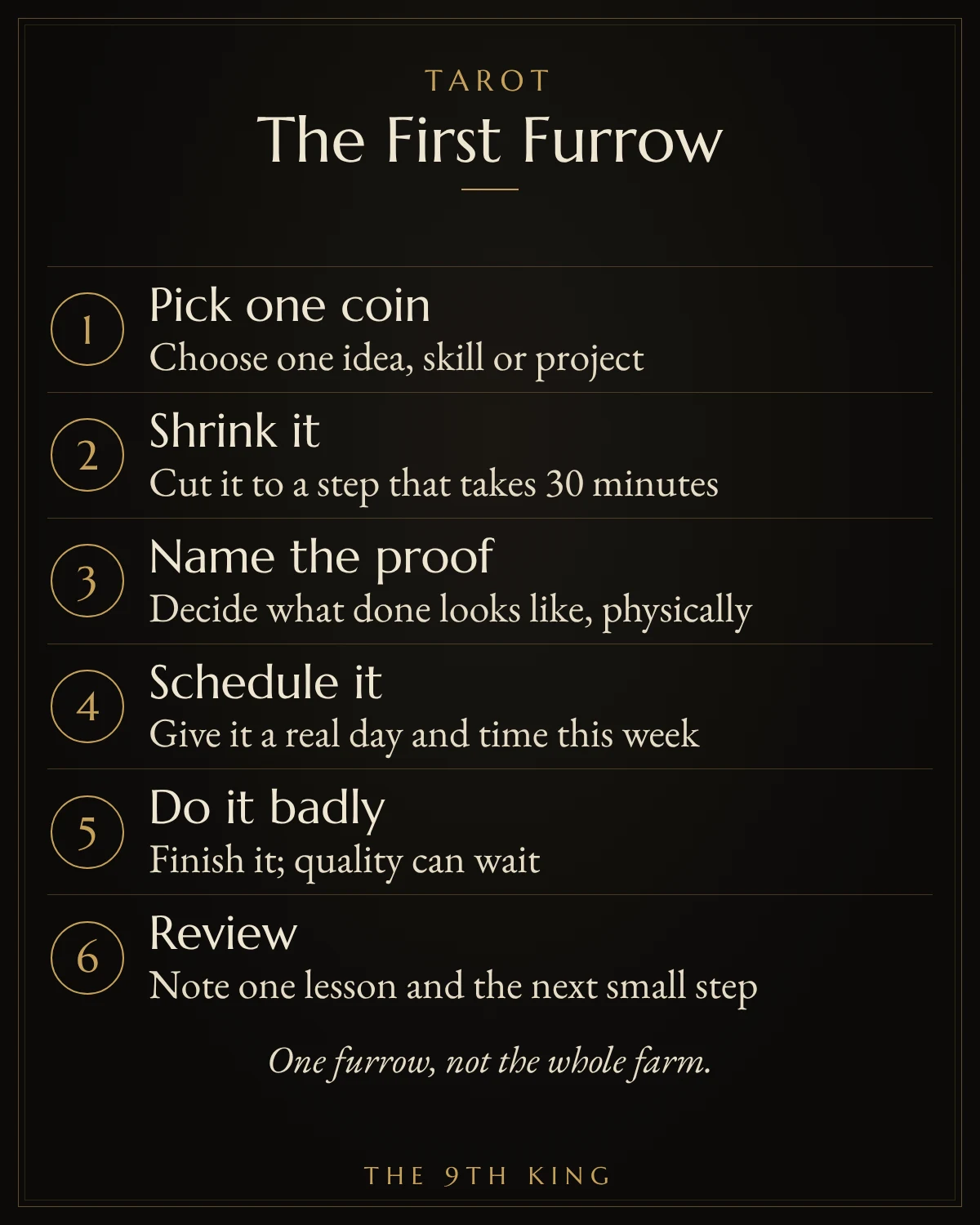
This is a one-week exercise for turning an idea into a first real step. It’s named after the field in the card: one furrow, not the whole farm.
The steps
- Pick one coin. Choose one idea, skill or project. Only one.
- Shrink it. Cut it down until the first step takes thirty minutes or less. “Learn guitar” becomes “learn three chords.”
- Name the proof. Decide what “done” looks like as something physical: a page, a photo, a sent email, a recording.
- Schedule it. Give it a real day and time this week.
- Do it badly. Finish it. Quality doesn’t matter yet. The point is that it exists.
- Review. Afterward, write one thing you learned and the next thirty-minute step.
The worksheet
| Question | Your answer |
|---|---|
| My one coin | |
| The 30-minute version | |
| Proof it happened | |
| Day and time | |
| What I learned | |
| Next small step |
A worked example (fictional)
Dana (fictional) has wanted to start pottery for three years. She’s watched dozens of videos and saved a list of studios, but hasn’t touched clay. She draws the Page of Pentacles reversed in a single-card reading and recognizes herself: all plan, no start.
She picks one coin (pottery), shrinks it (make one pinch pot from air-dry clay), names the proof (a photo of the pot) and schedules it (Sunday at 10 a.m.). The pot is wobbly. Her lesson: the clay dries fast. Her next step: book one beginner class.
Nothing about the card predicted any of this. The card gave her a question, and she answered it with her hands.
Myths and misreadings about the Page of Pentacles
- “The Page of Pentacles means money is coming.” No card predicts income. This Page is about learning to handle a resource, not receiving one.
- “It’s a weak card because it’s the lowest court card.” The Page is the start of the journey, not the bottom of it. In Golden Dawn terms it’s earth of earth, about as grounded as a card gets.
- “Reversed means bad news.” Waite listed unfavorable news among the reversed meanings, but we don’t read cards as omens. Reversed, the Page usually points to effort that isn’t landing, which you can change.
- “The Page of Pentacles is a Virgo (or Taurus, or Capricorn) card.” Not in the Golden Dawn system. Princesses don’t take a zodiac span. The earth signs share its element, that’s all.
- “You need to be an expert reader to use this card.” The Page would disagree. If you’re just starting out, Code of Ascension’s Tarot for Beginners (Code of Ascension) explains how the deck works, and its Intuitive Tarot guide (Code of Ascension) covers reading from your own impressions.

Page of Pentacles: FAQ
What does the Page of Pentacles mean?
The Page of Pentacles is the student card of the earth suit. Upright, readers commonly link it to study, curiosity, patient practice and a first practical step toward an idea. Waite listed application, study, scholarship and reflection among its meanings. On The 9th King we read it as a prompt to treat something new like a beginner would: learn the basics, then take one small, real step.
What does the Page of Pentacles reversed mean?
Reversed, the Page of Pentacles often points to effort that isn’t landing: endless planning without a start, scattered attention, perfectionism that delays the first step, or a resource used carelessly. Waite’s reversed meanings include waste and dissipation. It isn’t a bad omen. It’s a question about what’s keeping your idea from becoming something you can actually touch.
What does the Page of Pentacles mean as feelings?
As feelings, readers usually describe the Page of Pentacles as sincere, careful interest that’s slow to show. The person may be paying close attention and wanting something solid before committing. A card can’t read another person’s mind, though, so the more useful question is about you: are you watching from a safe distance, or letting your own interest be seen?
What does the Page of Pentacles mean in love?
In love, the upright Page of Pentacles often describes a slow, grounded connection built through small, consistent actions. Reversed, it can point to plans that don’t happen or interest that isn’t backed by action. It can’t tell you whether to stay or leave. Treat it as a mirror for how you show care, and ask direct questions instead of guessing.
Is the Page of Pentacles a person?
It can be read that way. Some readers use court cards for people, and Waite’s additional meanings include a youth or a child. But the card can just as easily describe an attitude you’re being invited to take: curious, focused, willing to be a beginner. If it doesn’t clearly match someone in your life, read it as a part of yourself.
What zodiac sign is the Page of Pentacles?
In the Golden Dawn system The 9th King uses, none. This card is the Princess of Pentacles there, and the Princesses rule quadrants of the heavens around the north pole rather than a stretch of the zodiac. Its element pairing is earth of earth. It shares its element with Taurus, Virgo and Capricorn, but that’s an element link, not a sign.
What element is the Page of Pentacles?
Earth, twice over. The suit of Pentacles is the earth suit, and in the Golden Dawn system the Princess rank carries the earthy part of each suit. That makes the Page of Pentacles, called the Princess of Pentacles there, earth of earth. It’s read as the most grounded card in the deck, tied to the physical, the practical and slow growth.

Your next step: do the First Furrow this week. Pick one idea, shrink it to thirty minutes, and put it on your calendar. Then read Virgo personality traits or Taurus personality traits to see how the earth element works when it’s lived, not just studied.
Explore Next
- Earth that builds slowly: Taurus Personality Traits
- Earth that studies and refines: Virgo Personality Traits
- Earth that plans the long climb: Capricorn Personality Traits
- Permission to be a beginner: Inner Child Work
- Questions for the eternal-student pattern: Shadow Work Prompts
- The shadow side of every sign: Zodiac Shadow Work
- All twelve signs in one place: The Zodiac Signs
- More tarot on The 9th King: Tarot Card Meanings · Minor Arcana · Tarot & the Zodiac · Knight of Pentacles · Page of Cups · Three-Card Tarot Spread · Shadow Work Tarot Spread

Final Thought: Plant the One Coin You Have
The Page of Pentacles never holds a fortune. It holds one coin and gives it full attention. That’s the whole lesson: stop waiting for a bigger beginning and take care of the small one in your hands. Know your nature. Rule your life.
About the Author
King is the founder of The 9th King, where zodiac psychology, relationships and shadow work are explored as tools for self-knowledge rather than fortune-telling. He’s a Libra Sun, and writes about the personal side of astrology on King The Kemist. Astrology on The 9th King is interpretation and self-reflection, not prediction or established fact.
Leave a Reply