

Quick Answer: What Does the Ace of Pentacles Mean?
The Ace of Pentacles is the first card of the suit of Pentacles, the tarot suit linked with earth: the body, work, money and home. In the classic Rider–Waite–Smith image, a hand comes out of a cloud and holds up a single large pentacle, a disc marked with a five-pointed star.
Keywords: practical opening, a foothold, resources, health and the body, stability, a seed you can plant.
- Upright, in one line: a prompt to notice a practical opening, if one is available (time, a skill, a little money, energy, a chance), and to plant it rather than just admire it.
- Reversed, in one line: the same opening gets hoarded, spent all at once or ignored while you wait for something bigger, so the card asks what you’re doing with what you already hold.
On The 9th King, tarot is a mirror for self-knowledge, not fortune-telling. The Ace of Pentacles doesn’t promise money. It points to what’s already in your hands and asks whether you’ll treat it as seed or as a windfall.
Table of Contents
The Ace of Pentacles at a glance
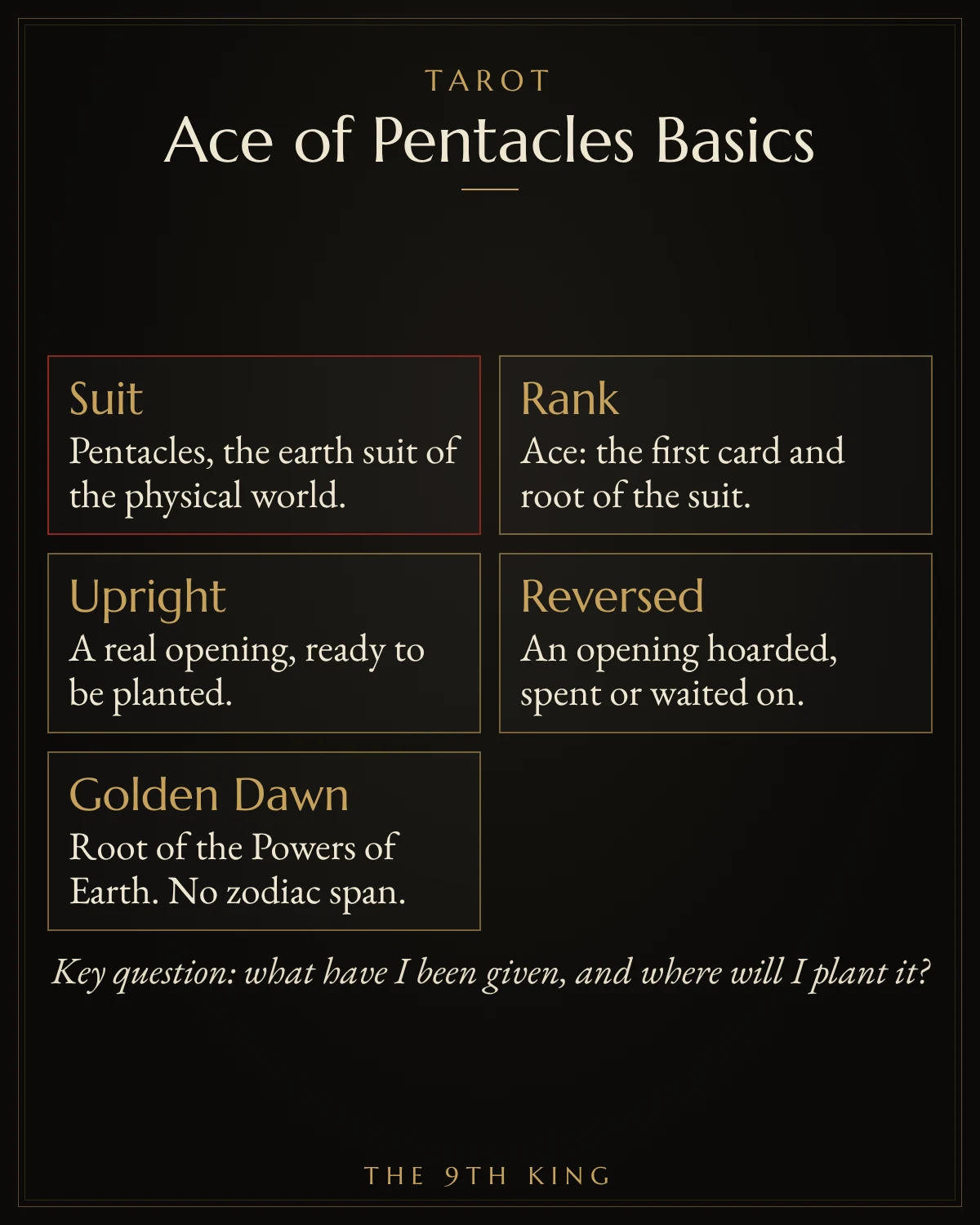
| Ace of Pentacles | |
|---|---|
| Arcana | Minor Arcana, the Ace (one) |
| Suit | Pentacles, also called coins (earth) |
| Rank | Ace, the first card and root of the suit |
| Golden Dawn title | Root of the Powers of Earth |
| Zodiac span | None (Aces don’t take one) |
| Upright themes | Opening, foothold, resources |
| Reversed themes | Hoarding, spending, waiting |
| Key question | What have I been given, and where will I plant it? |
What the Ace of Pentacles shows: the traditional imagery
Most modern readers know this card from the Rider–Waite–Smith deck, first published by William Rider & Son in London in 1909. A.E. Waite gave the instructions and Pamela Colman Smith drew the cards, and both were members of the Hermetic Order of the Golden Dawn (Wikipedia: Rider–Waite Tarot). Britannica dates the first tarot decks to Italy in the 1430s, made for card games, and says tarot was first adapted for fortune-telling in France around 1780 (Britannica: Tarot).
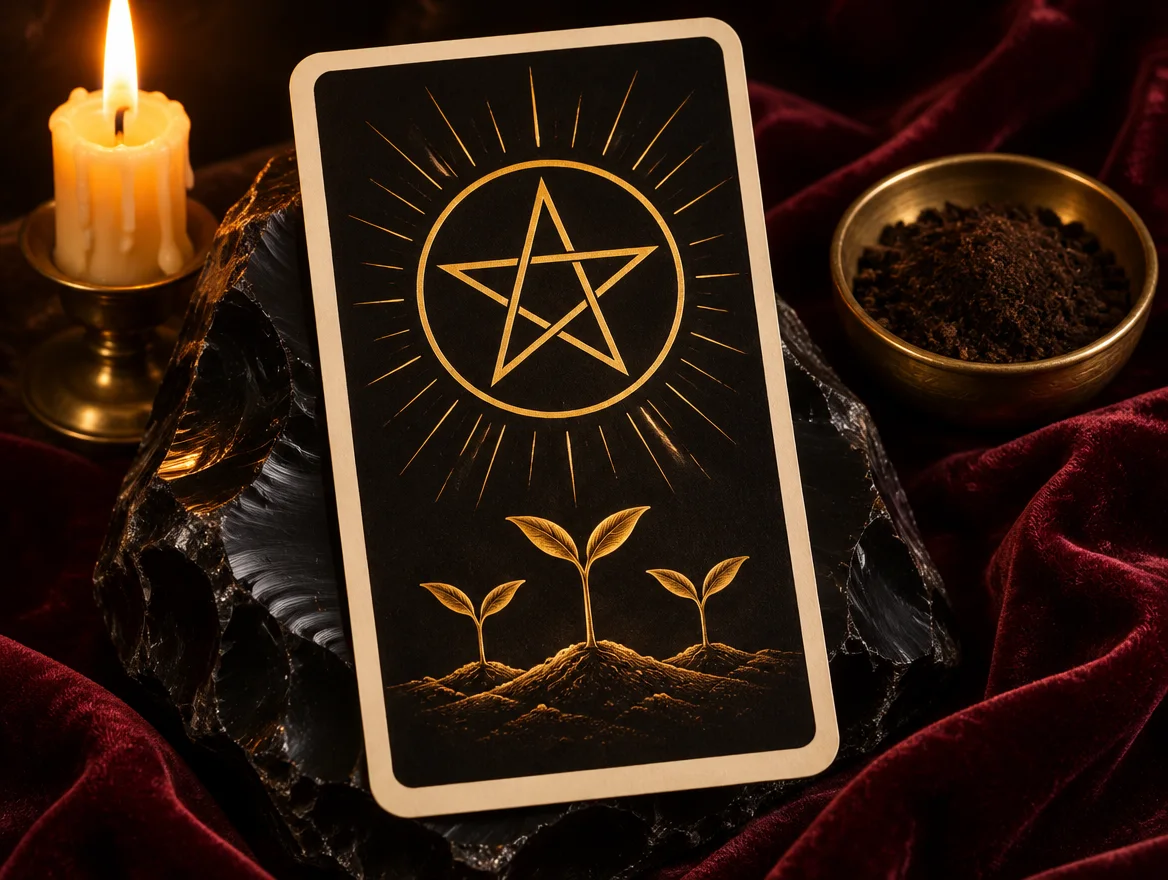
The images below are described in words. The art on this page is an original 9th King line-art interpretation, not a copy of the traditional card.
The hand and the single coin
Waite’s description in The Pictorial Key to the Tarot is brief: a hand comes out of a cloud, as on the other Aces, and holds up a pentacle (Waite, Pictorial Key, Ace of Pentacles, sacred-texts.com). That’s all. Something is offered from outside, before anyone has worked for it.
In the Rider–Waite–Smith deck, each disc in the suit carries a pentacle, a five-pointed star, and older decks simply called the suit coins (Wikipedia: Suit of coins).
The plain picture matters most: one coin, held out, not yet spent or planted.
The garden on the 1909 card
Waite’s text describes no background, but Pamela Colman Smith drew one. On the 1909 Smith card, a garden of white flowers lies below the hand, and a path leads through an opening in a hedge toward mountains beyond. Wikipedia’s summary of the suit reads the garden as plenty and notes the two mountain peaks outside it (Wikipedia: Suit of coins).
On 9K, we read it simply: the coin is held over ground that can grow things. A resource is a beginning, not an arrival.
What the Golden Dawn saw in the same card
In Liber LXXVIII, the Golden Dawn’s Book T as printed by Aleister Crowley, a white radiant hand from the clouds holds a branch of a rose tree bearing a large pentacle of five circles, one inside another. The innermost circle is white with a red Greek cross, twelve white rays run to the edge, and the text compares the design to an astrological figure of the heavens. A white Maltese cross and two white wings sit above it (Liber LXXVIII, sacred-texts.com).
The meaning Liber gives is the useful part: the card represents “materiality in all senses, good and evil,” and shows material gain, labor, power and wealth. It also calls materiality, in a sense, illusionary (Liber LXXVIII). Money and matter are real, and they’re also not the whole story.
Ace of Pentacles meaning upright
Upright, readers commonly take the Ace of Pentacles as a practical beginning. Waite’s divinatory meanings open with “Perfect contentment, felicity, ecstasy; also speedy intelligence; gold” (Waite, Pictorial Key). (“Intelligence” is an old word that can mean news as well as a quick mind.) He adds that the card shows prosperity and comfortable material conditions. Modern readers usually gather this into five themes:
- A practical opening. A job lead, a class, a few free hours.
- A foothold. Not the whole climb, just the first solid place to stand.
- Resources. Money, but also time, skill, energy, contacts and health.
- The body and the everyday. Food, sleep, movement, home.
- Steadiness. Something real under your feet.
On 9K, we add one thing: the upright card asks you to plant the coin. The card shows one pentacle, not a pile. A start only grows if you put it somewhere and tend it.
Ace of Pentacles reversed
Reversed, the energy turns sour or stalls. Waite’s reversed meanings are a little surprising: the evil side of wealth, bad intelligence, and also great riches (Waite, Pictorial Key). So reversed doesn’t simply mean “no money.” Waite says whether prosperity helps the person “will depend on whether the card is reversed or not.” The reversed card is about what you do with the resource, and what it does to you.
On 9K, we read the reversed card through three patterns.
1. The hoarded coin
You have the opening and you clutch it. You don’t use the time or the skill, or mention the chance, in case it gets used up or taken. The coin stays safe, and nothing grows from it.
2. The windfall coin
Something arrives and you treat it as luck instead of seed. A bonus, a burst of energy, a good month: it goes out as fast as it came in. The card can point to a habit of reading every resource as a one-time treat.
3. The waited-on coin
You don’t see the coin at all, because you’re waiting for a bigger one. When I have real money. When my health is perfect. Then I’ll start. The card can point to the belief that a large enough amount will fix everything, so the small foothold in your hand gets ignored.
The check: am I planting this, or clutching it, spending it or waiting past it?
Pentacles, earth and the Golden Dawn: the card’s correspondences
The correspondences below are Golden Dawn–derived correspondences, the tradition The 9th King uses, which is the system the Rider–Waite–Smith deck draws on. Other schools differ, and not every card maps to a single sign. Aces and court cards work differently from the numbered cards.
Pentacles are earth
In occult and divinatory use, the suit of coins or pentacles is connected with the classical element of earth, the physical body and possessions or wealth (Wikipedia: Suit of coins). The whole suit deals with solid things you can count, touch or grow.
The Root of the Powers of Earth
Liber LXXVIII opens its list of titles with the four Aces: the Ace of Pentacles is called the Root of the Powers of Earth (Liber LXXVIII). The text places the Aces first in order and importance and calls them the radical forces of their elements.
In plain terms, this card is the source of the whole earth suit. Every other Pentacles card is that same earth taking a more specific shape.
Why there’s no zodiac span
Many numbered Minor Arcana cards in the Golden Dawn system are tied to a decan, a ten-degree slice of a sign, and most court cards rule a wider span. The Aces don’t. Liber LXXVIII says the four Aces are placed on the North Pole of the universe, where they revolve and govern its revolution, acting as the connecting link between what it calls Yetzirah and the material universe (Liber LXXVIII).
So the card isn’t tied to any birthday. It sits above the zodiac as the root of its element.
The Ace and the Page of Pentacles
Liber LXXVIII says the four Princesses form the thrones of the powers of the four Aces, and its entry for the Princess of the Echoing Hills, the Rose of the Palace of Earth, names her earth of earth and the throne of the Ace of Pentacles (Liber LXXVIII). The 9th King follows the court-card naming in Liber LXXVIII (the Golden Dawn’s Book T): Knights are fire of their suit, Queens water, Kings air, Pages earth. Under that convention, that Princess is our Page of Pentacles. Other systems match the titles differently, so check which naming a source uses.
Read together: the Ace is the coin offered, and the Page is the student who picks it up. Then comes the Knight of Pentacles, the slow, steady worker who keeps tending the field.
The earth signs, as element links
These are element links, not official correspondences:
- Taurus personality traits: earth as comfort and security.
- Virgo personality traits: earth as craft and routine.
- Capricorn personality traits: earth as structure and patience.
For the whole suit, see our Minor Arcana guide; for cards that do take signs, see Tarot & the Zodiac.
The 9th King reading: tension, shadow and self-mastery
The tension: planting vs. keeping
The Ace of Pentacles lives between planting a resource and keeping it. You need some safety. But a resource that’s only ever kept never becomes more than it was on day one.
Many of us learned about money and time in seasons of not enough. When something solid shows up, the old fear says hold on to it, or the old hunger says enjoy it now, it won’t last. Both make sense. Neither plants anything.
The shadow side
The card’s shadow shows up in a few familiar shapes:
- The hoarder. Nothing gets used, because using it might mean losing it.
- The spender. Every good thing becomes a quick reward and is gone.
- The waiter. Nothing starts until the amount is big enough.
- The counter. Only money counts; rest, skill and friendship don’t.
If one stings, that’s information, not a verdict. Our zodiac shadow work guide covers the earth signs’ shadows, which overlap with this card.

| Strength | Shadow version | The rebalance |
|---|---|---|
| Security | Hoarding the coin | Put one part to work |
| Enjoyment | Spending it all at once | Keep some seed back |
| Hope | Waiting for a windfall | Start with what you have |
| Practicality | Counting only money | Name what else counts |
| Patience | Waiting until it’s perfect | Plant it small now |
The self-mastery lesson
The Ace of Pentacles teaches one skill: treat what you have as seed, not as a windfall.
A windfall is something you react to. Seed is something you decide about. The difference isn’t the size of the coin. It’s whether you choose a place for it and come back to tend it.
Our guide to Jupiter returns looks at growth over long cycles, a useful lens if you judge every start by its first week.
Ace of Pentacles in love and as feelings
“Ace of Pentacles as feelings” usually means: how does someone feel about me? Here’s the honest 9K answer.
What readers commonly say
Readers often take the Ace of Pentacles in a feelings position as sincere, grounded interest: care that wants to show up in practical ways and become something steady.
What a card can and can’t tell you
A card can’t read another person’s mind. It can reflect the question you brought. A more useful question is: What does this card say about what I want to build? This is where psychological projection is worth knowing about: we often see in others the hopes or fears we haven’t owned in ourselves.
If you want to know how someone feels, and it’s safe to ask, ask them kindly. Steady actions over time say more than any card.
Ace of Pentacles in love
In a love reading, readers commonly associate the card with:
- A grounded start. A connection built on shared routines and showing up.
- Practical care. Cooking a meal, remembering the appointment.
- Building something together. A home, a shared habit.
It helps to separate what you need to feel safe from what you’re drawn to; our Moon vs Venus guide explains the difference. The card doesn’t tell you to stay, leave, commit or wait. It asks: What small, real thing could I plant here, and would it be welcome?
Ace of Pentacles at work, with money and with health
None of what follows is financial, career or medical advice. It’s a prompt to look at what you already hold.
At work, readers often take the card as a foothold: a first client, an entry-level role, a course, a side project. The card doesn’t say the opening will succeed. It asks whether you’ll give it a real place in your week.
With money, the lesson is about attitude more than amount. Waite lists great riches among the reversed meanings (Waite, Pictorial Key), a reminder that having more doesn’t settle whether it’s doing you good. The reflection question: Do I treat what comes in as seed, as a treat or as something to guard? For actual decisions, get qualified help.
With health and the body, readers sometimes take the Ace as a fresh physical start: a sleep routine, a daily walk, a checkup you’ve put off. Some of the same patterns can show up: going all out and burning out, or I’ll start when I feel better when that’s really avoidance. Rest and pacing your body needs aren’t a trap; they’re part of planting well. A card can’t tell you anything about your health. It can help you notice one small foothold, alongside whatever care you already get.
A worked example (fictional)
Tomas (fictional) draws the Ace of Pentacles after a friend offers him a few free hours a week in her studio. He’s been saying he’ll start making pottery to sell “once I can afford my own studio.”
Upright reading: the card can point to a real foothold. Tomas asks: What is this offer, plainly, and how could I use it this month? He books two sessions and makes a small test batch. It isn’t a business. It’s the first planted coin.
If it had come up reversed: is Tomas waiting past the coin, telling himself borrowed space doesn’t count? Or hoarding it, saying yes but never going? Am I planting this, or waiting for a bigger one?
Neither reading predicts whether the pottery will sell.
Myths and misreadings about the Ace of Pentacles
- “The Ace of Pentacles means money is coming.” A card isn’t a forecast. On 9K, read it as a look at the resources you already have and what you’re doing with them.
- “It’s a yes card.” We don’t give yes-or-no readings.
- “More money will fix everything.” That’s the card’s shadow, not its message. Waite even lists great riches among the reversed meanings.
- “Reversed means you’ll be broke.” Reversed cards on 9K point to a hoarded, spent or ignored version of the same energy, not a prediction of loss.
- “The Ace of Pentacles is a Taurus card.” In the Golden Dawn system we use, Aces don’t take a zodiac span. The earth signs are element links, not official correspondences.
- “Pentacles are only about money.” The suit covers the body, home, work and skill too.
Journal prompts and a practical exercise
The prompts and exercise below are reflective practice, not therapy. If you’re working through trauma, abuse, thoughts of self-harm or distress that feels overwhelming, please work with a qualified therapist. And it’s always fine to stop a prompt that feels like too much and come back another day, or not at all.
Seven journal prompts for the Ace of Pentacles
- What real resource have I been calling “not enough”?
- When something good comes in, do I tend to clutch it, spend it or wait for more?
- What did I learn about money or time growing up, and is it still true?
- What am I waiting to have before I start, and what would starting small look like?
- Which of my resources don’t involve money at all?
- Where in my week could I take one small, steady foothold?
- What have I been given, and where will I plant it?
For more prompts in this style, see our shadow work prompts. New to shadow work? Shadow Work, Plainly explains how to start safely.
The exercise: the Planted Coin
A short practice for when a new opening shows up, or whenever the card appears.

| Step | What to do | Example (fictional) |
|---|---|---|
| 1. Name the coin | One real resource you have now | Two free evenings a week |
| 2. Describe it | What it is today, not what it could become | “Two evenings, a laptop, some patience” |
| 3. Choose the plot | One place to put it to work | Learning basic bookkeeping |
| 4. Plant it small | One first action this week | Sign up for a free intro lesson |
| 5. Tend it | A short check-in each week | Sunday, five minutes, one note |
| 6. Look back | Notice what grew after a month | Three lessons done, less dread |
- Step 2 is the heart of it. “Two evenings” is a description. “This will change my life” is a forecast.
- Step 3 means one plot. A small coin spread across five plans plants nothing.
- Step 5 isn’t a test. If a week slips, pick it up again.
If you like reading intuitively, Code of Ascension’s guide to intuitive tarot (Code of Ascension) covers pairing card meanings with first impressions.

Ace of Pentacles: FAQ
What does the Ace of Pentacles mean?
The Ace of Pentacles is the first card of the suit of Pentacles, the earth suit. Upright, readers commonly take it as a practical beginning: a foothold or resource in work, money, home or the body. On The 9th King it’s an invitation to plant what you already have, not a prediction that money is coming.
What does the Ace of Pentacles mean reversed?
Reversed, the Ace of Pentacles often points to an opening that’s hoarded, spent too fast or ignored while you wait for something bigger. A.E. Waite’s reversed meanings include the evil side of wealth and, surprisingly, great riches. The useful question isn’t whether you have enough, but what you’re doing with what you have.
What does the Ace of Pentacles mean as feelings?
In a feelings position, readers often take the Ace of Pentacles as sincere, grounded interest: care that wants to show up in practical ways. A card can’t read another person’s mind, though. If you want to know how someone feels, ask them kindly and watch their actions over time.
What does the Ace of Pentacles mean in love?
In love readings, the Ace of Pentacles is commonly linked with a grounded start, practical care and building something real together, like a shared home or routine. It doesn’t tell you to stay, leave, commit or wait. It asks what small, real thing you could plant, and whether it would be welcome.
What element is the Ace of Pentacles?
Pentacles are the earth suit, linked with the body and possessions. In the Golden Dawn system, the tradition The 9th King uses, the Ace of Pentacles is titled the Root of the Powers of Earth. That makes it the source of the whole suit.
Does the Ace of Pentacles have a zodiac sign?
Not in the Golden Dawn system. Many numbered Minor Arcana cards are tied to decans of zodiac signs, but the Aces are described as placed on the North Pole of the universe, above the zodiac, as the roots of their elements. Taurus, Virgo and Capricorn are useful earth-element links, not official signs for this card.
Is the Ace of Pentacles a good card for money?
Waite lists gold among its meanings, so it’s easy to read it as a money card. The 9th King doesn’t read cards as money forecasts, though. Use it to ask what resources you hold and how you’re treating them, and take real money decisions to a qualified professional.

Your next step: pick one real resource you have this week, run the Planted Coin above and write down the one small action you chose for step 4. Then read the Page of Pentacles to see what happens when someone picks up the coin and starts to learn.
Explore Next
- The student who picks up the coin: Page of Pentacles
- The steady worker who tends the field: Knight of Pentacles
- Another Ace, for feeling instead of matter: Ace of Cups
- Earth as comfort and security: Taurus Personality Traits
- Earth as craft and routine: Virgo Personality Traits
- Earth as structure and patience: Capricorn Personality Traits
- New to tarot: Tarot for Beginners: How Tarot Really Works (Code of Ascension)
- More tarot on The 9th King: Tarot Card Meanings · Minor Arcana · Tarot & the Zodiac · Shadow Work Tarot Spread
- More cards in this set: Queen of Pentacles, King of Pentacles, Ace of Wands, Ace of Swords

Final Thought: Plant the Coin You Have
Most of us were taught to wait for the big break, the perfect health, the right amount. The Ace of Pentacles points somewhere smaller and more useful: the one real coin already in your hand. It won’t look like much on day one. Plant it anyway, tend it each week, and let it show you what it can become. Know your nature. Rule your life.
About the Author
King is the founder of The 9th King, where zodiac psychology, relationships and shadow work are explored as tools for self-knowledge rather than fortune-telling. He’s a Libra Sun, and writes about the personal side of astrology on King The Kemist. Astrology on The 9th King is interpretation and self-reflection, not prediction or established fact.
Leave a Reply