
Quick Answer: What Does The Magician Tarot Card Mean?
The Magician is card I (1) of the Major Arcana. On the traditional Rider–Waite–Smith card, a young figure stands behind a table holding a wand raised to the sky while the other hand points to the ground. The symbols of all four suits lie on the table, a horizontal figure 8 floats above his head, and roses and lilies grow below. It’s the card of focused will: everything you need is in front of you.
Keywords: will, skill, focus, resourcefulness, communication, initiative, follow-through.
- Upright, in one line: the card can point to the moment you stop gathering tools and start using them, with clear intent.
- Reversed, in one line: readers often take it as unused talent, scattered focus, or skill turned into a trick or a performance.
- Astrology link: in the Golden Dawn–derived correspondences The 9th King uses, The Magician is paired with the planet Mercury (not a zodiac sign).
On The 9th King, tarot is a mirror for self-knowledge, not fortune-telling. The Magician doesn’t promise that a plan will work. It asks a plain, slightly uncomfortable question: I have the tools. Am I actually using them, and honestly?
Table of Contents
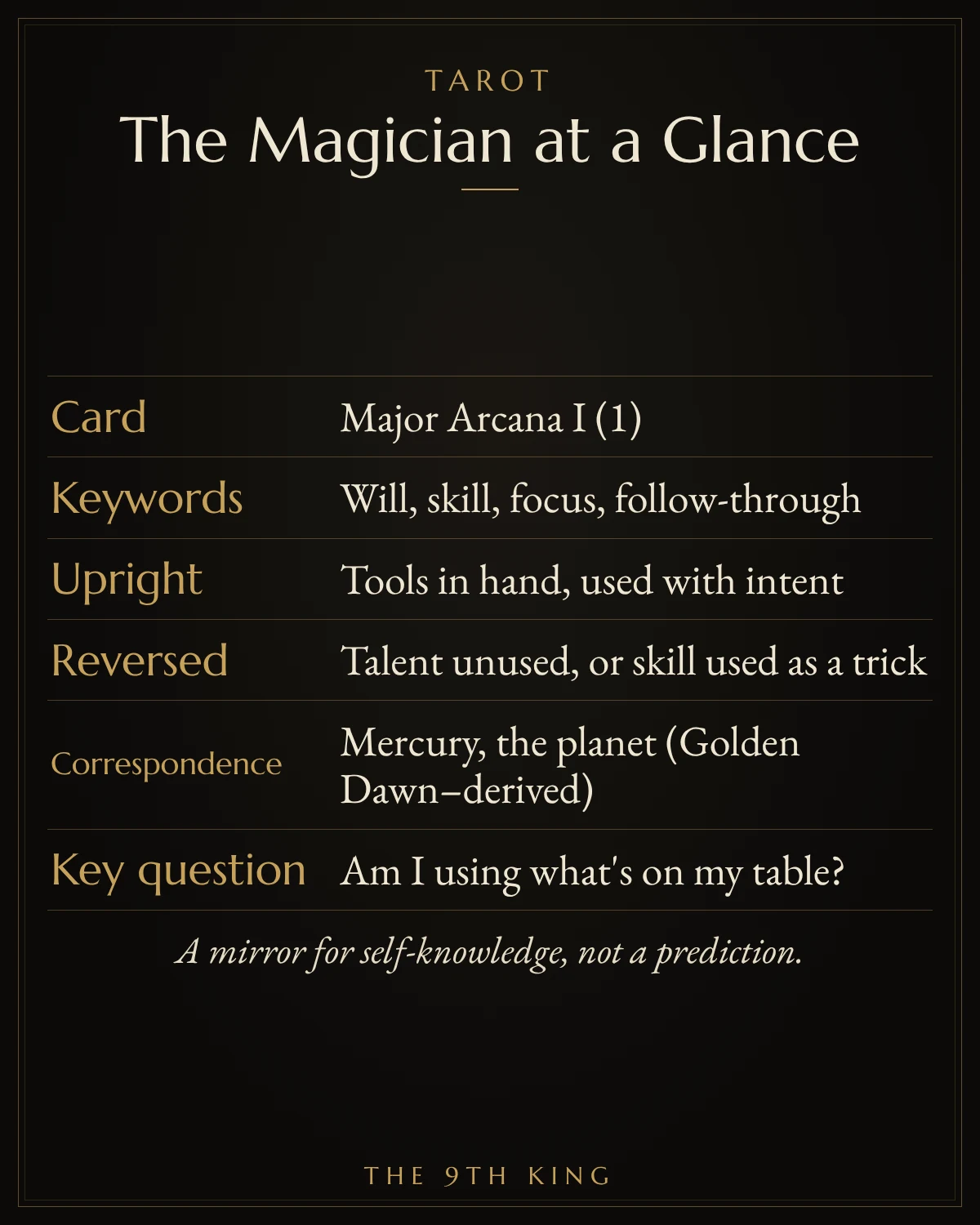
The Magician tarot card at a glance
| The Magician | |
|---|---|
| Number | I (1), Major Arcana |
| Core theme | Will meeting skill |
| Upright | Focus, initiative, using your tools |
| Reversed | Talent unused, or skill used as a trick |
| Correspondence (Golden Dawn–derived) | Mercury (planet) |
| Hebrew letter (Golden Dawn) | Beth |
| 9K tension | Will vs skill |
| Key question | Am I using what’s on my table? |
What’s on the card: The Magician tarot symbolism, piece by piece
Most modern decks follow the Rider–Waite–Smith design, illustrated by Pamela Colman Smith to A. E. Waite’s instructions and first published by William Rider & Son in 1909 (Wikipedia: Rider–Waite Tarot). Waite described the card himself in The Pictorial Key to the Tarot, now in the public domain (sacred-texts.com: Waite, The Magician). Details below come from Waite unless marked as the 1909 card.
The figure and the two hands
Waite describes a youthful figure in a magician’s robe, with a confident smile and shining eyes. One hand raises a wand toward the sky; the other points down to the earth. Waite reads this double gesture as power drawn from above and brought down into the world below (sacred-texts.com: Waite, The Magician).
The Magician isn’t just reaching for something higher. He’s bringing it down to the table where the work happens.
The figure 8 above his head
Above the figure’s head, Waite describes a sign of life, like an unbroken cord, forming a figure 8 lying on its side. Today most people know it as the infinity symbol (the lemniscate). Waite connects the 8 with ideas of rebirth and spiritual life (sacred-texts.com: Waite, The Magician).
Readers often take it as energy that keeps circulating between you and your craft.
The serpent belt
Around the figure’s waist is a belt shaped like a serpent swallowing its own tail. Waite notes that this is a familiar symbol of eternity, which he reads here as lasting spiritual attainment (sacred-texts.com: Waite, The Magician).
The four tools on the table
On the table lie the symbols of the four tarot suits: the cup, the pentacle, the sword and the wand. Waite calls them the elements of natural life, which “lie like counters before the adept, and he adapts them as he wills” (sacred-texts.com: Waite, The Magician).
That line is the whole card in miniature: the tools are already there, and what matters is using them on purpose.
The roses and lilies
Below the table, Waite describes roses and lilies, wildflowers turned into garden flowers, which he says show the culture of aspiration (sacred-texts.com: Waite, The Magician). Something wild, tended until it grows well: a fair picture of skill.
What the 1909 card adds
A few details readers often mention aren’t in Waite’s text. On the 1909 Smith card, the figure wears a red outer mantle over a white robe, and the wand looks double-ended. Many readers take the red as desire and drive and the white as purity of intent. Treat those as reading habits, not as Waite’s own explanations.
The older card: the juggler at the table
The Magician wasn’t always a magician. Its older Italian name was Il Bagatto and its French name Le Bateleur, a street performer or sleight-of-hand artist, and in English it was long called The Juggler (Wikipedia: The Magician (tarot card)). Waite himself lists the card as the Magus, Magician or juggler, and admits that the popular reading made him a caster of dice and a mountebank, which he rejected as missing the deeper symbolism (sacred-texts.com: Waite, Part I, The Trumps Major).
That double history matters for the 9K reading: the same figure can be a master of real skill or a performer working a crowd.

The Magician tarot meaning: upright and reversed
The Magician upright
Upright, readers usually take The Magician as active, focused energy:
- Will: a clear decision about what you’re aiming for.
- Skill: ability you’ve practiced, not just talent you’re born with.
- Resourcefulness: noticing that you already have more to work with than you thought.
- Communication: saying what you mean, persuading honestly, making your case well.
- Initiative: starting, rather than preparing to start.
The useful upright message isn’t “you’ll succeed.” It’s “you have what you need on the table, so pick it up.”
The Magician reversed
Reversed, readers tend to go one of two ways, and your own situation usually decides which fits:
- The tools sit unused. Talent, time or ideas are there, but nothing moves. You may be waiting to feel ready, spreading yourself too thin, or doubting skills you actually have.
- The skill turns into a trick. Ability gets used to impress, persuade or cover gaps: overpromising, spinning a story, or performing confidence you don’t feel. This is the old juggler showing through.
What Waite’s 1911 list said
Waite’s divinatory list for The Magician opens with “Skill, diplomacy, address, subtlety,” adds self-confidence and will, and also includes older fortune-telling warnings such as loss and the snares of enemies. Reversed, his list runs from physician and Magus to disgrace and disquiet (sacred-texts.com: Waite, Divinatory Meanings).
That’s old card-reading language. Britannica dates tarot to Italy in the 1430s, as a card game, and its adaptation for occult and fortune-telling use to France around 1780 (Britannica: Tarot). On The 9th King we turn Waite’s list into questions. Skill becomes what can I actually do well? Subtlety becomes am I being clever, or being clear?
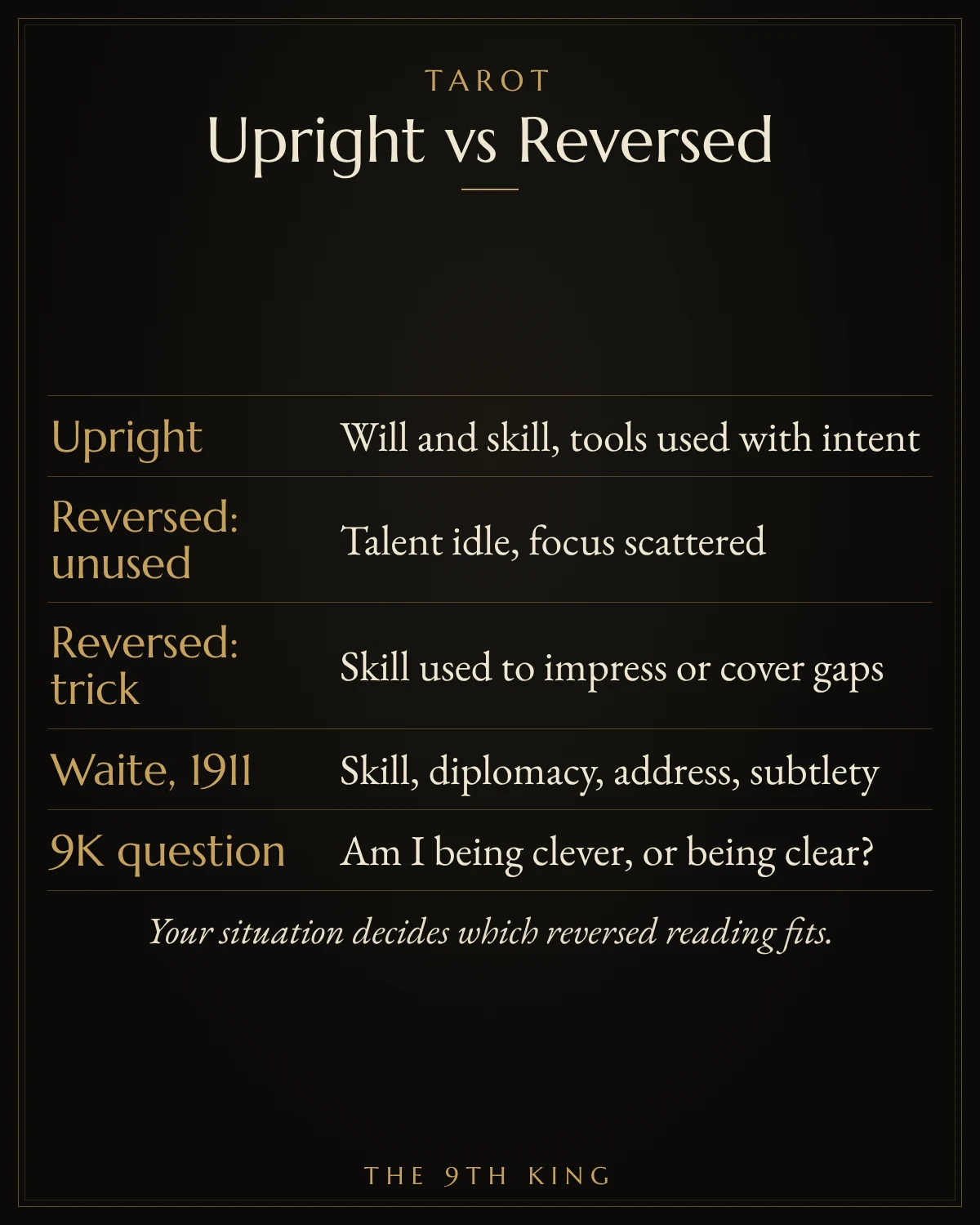
| Position | Common reading | Question to ask |
|---|---|---|
| Upright | Will and skill, tools in use | What can I do well? |
| Reversed (unused) | Talent idle, focus scattered | What am I waiting for? |
| Reversed (trick) | Skill used to impress or cover | What am I overselling? |
| Waite, 1911 | Skill, diplomacy, address, subtlety | Where do I use my skill? |
| 9K question | Cleverness vs clarity | Am I being clever, or being clear? |
The Magician and Mercury: the Golden Dawn correspondence
Why a planet, not a sign?
The astrology links on The 9th King are Golden Dawn–derived correspondences, the tradition The 9th King uses. Waite and Pamela Colman Smith were both members of the Hermetic Order of the Golden Dawn, and their deck reflects that background (Wikipedia: Rider–Waite Tarot).
In that system, the 22 Major Arcana are shared out among the elements, the planets and the zodiac signs. The Magician is one of the planetary cards. The Golden Dawn’s Book T, as printed in Liber LXXVIII, lists card 1, The Magician, with the Hebrew letter Beth (printed there as “Bet”) and the planet Mercury (Liber LXXVIII, sacred-texts.com).
So The Magician isn’t “the Gemini card.” Its correspondence is the planet itself.
Other schools differ
Other traditions use different attributions, and not every card maps to a single sign or planet (court cards work differently). The Mercury pairing is a symbolic lens, not a law.
What Mercury adds to the card
In astrology, Mercury is the planet linked with thinking, speech, writing, learning and trade, as our Gemini personality traits guide puts it. Through that lens the card’s themes line up neatly: skill with words and tools, and turning an idea into something real.
The Gemini and Virgo connection
Mercury rules two signs: Gemini and Virgo. Our Gemini guide covers Mercury’s quick, curious side, and our Virgo guide its careful, craft-minded side: a range of ideas, and the patience to make one work. That’s a planet-to-ruler link, not a claim that the card belongs to either sign.
If the card keeps turning up, look at where Mercury sits in your own chart. Our guide on how to read a birth chart shows how to find it.
From The Fool to The Magician: the order of the cards
The first number
The Magician is card I, and it comes straight after The Fool, card 0. The Fool is the moment before anything is counted. The Magician is the first time a direction is chosen and something gets done.
In the modern “Fool’s Journey” frame, which runs through the trumps toward The World (XXI), The Magician is where the traveler first notices their own tools.
Before the quiet card
After The Magician comes The High Priestess, card II, often read as inner knowing and stillness. The Magician acts and speaks; The High Priestess waits and listens.
For will steered through resistance, see The Chariot (VII).
| Card | Mode | What it asks |
|---|---|---|
| The Fool (0) | Open potential | Will I begin? |
| The Magician (I) | Focused action | Will I use what I have? |
| The High Priestess (II) | Inner stillness | What do I already know? |
The 9K reading: will vs skill
The tension: wanting it vs being able to do it
The Magician’s core tension is between will and skill. Most of us lean too hard on one.
- Will without skill wants something badly and pushes hard, but hasn’t learned the craft yet. Lots of energy, little traction.
- Skill without will is genuinely good at something and never points it anywhere. The tools stay polished and unused.
The figure on the card has both: one hand raised in intent, the other pointing to where the work happens. Tools laid out like counters do nothing until someone chooses and moves.
Think of the plan that has been “almost ready” for a year. That gap, between having the tools and using them, is where this card works.
The shadow side: the juggler
The Magician’s shadow is skill that has stopped serving the work and started serving the image. Because the card has long carried the juggler’s face, its shadow is easy to recognize:
- Manipulation. Using charm or words to steer people where they wouldn’t go with the full picture.
- Performance. Looking capable instead of being capable. Polishing the pitch while the work waits.
- Overclaiming. Saying you can do more than you can, or taking credit for someone else’s tools. Small exaggerations add up.
- The quiet shadow: hiding the tools. Downplaying real ability so no one expects anything.
Not every Magician problem is too much confidence. For many people it’s too little permission to say I’m good at this. The work then isn’t to perform. It’s to describe what you can do plainly, in small, safe steps.
If someone has used charm or clever words to manipulate you, that responsibility belongs to them, not to you for being persuaded.
The self-mastery lesson: skill you can stand behind
The self-mastery lesson of The Magician is simple: use what you have, say only what you can back up, and let the work do the convincing.
Self-mastery here means three things:
- Name what’s on your table. Your real skills, resources and allies, without inflating or shrinking them.
- Point it somewhere. Choose one aim and make one move toward it, even if it’s small.
- Keep your words level with your work. Promise what you can deliver, and let people see the real thing.
You don’t become The Magician by looking more impressive, but by closing the distance between what you say and what you do.
The Magician tarot card in love, work and self-growth
These are reflections, not predictions.
The Magician in love
In love readings, The Magician often points to initiative and clear communication: saying what you want and putting real effort in. It can also point to charm, and whether it’s honest.
Questions worth asking:
- Am I saying what I actually want, plainly?
- Am I putting real effort into this connection, or mostly talking about it?
- Is my charm an invitation to know me, or a way to manage how I’m seen?
The Magician doesn’t tell you to stay or leave. It asks whether your words and actions match. For how two people’s charts talk to each other, see synastry for beginners.
The Magician at work
At work, The Magician can point to skill and making your case well, and to the pressure to sound more certain than you are. A grounded approach:
- List the skills and resources you already have for the task in front of you, before reaching for new ones.
- Notice one place where you’re overselling or underselling yourself, and adjust it toward plain accuracy.
Nothing here is career or financial advice. For money or contract decisions, talk to a qualified professional.
A practical exercise: the Four Tools Inventory
This takes about twenty minutes, plus a short check-in at the end of the week. You need a notebook and, if you like, The Magician card in front of you (pulled on purpose, not drawn at random).
The four suits make a handy checklist. Readers commonly link wands with drive, cups with feeling and relationships, swords with thinking, and pentacles with practical resources. Use those as prompts, not rules.
The steps
- Name the aim. Write one thing you want to move forward, in one sentence. “Finish the first chapter of my book.”
- Lay out the table. Under four headings (wand, cup, sword, pentacle), list what you already have for that aim: energy, support, skills and ideas, practical resources.
- Find the idle tool. Circle one thing on your list you’ve had for a while and haven’t used.
- Make one honest move. Use that idle tool for one small, real step this week, and write down when.
- Check the claim. At week’s end, compare what you did with what you said. Note any gap, without judgment.
Worked example (fictional)
Dana (fictional) wants to start a small bookkeeping side business. Her aim sentence: “Get my first paying client.”
Her table: wand, real enthusiasm and free Saturday mornings; cup, a former manager who once offered to refer people; sword, ten years of bookkeeping experience; pentacle, a laptop and the software she already uses.
Her idle tool is obvious once written down: the manager’s offer, months old, never followed up because asking felt like bragging.
Her honest move: a short, plain message to him on Saturday saying what she offers. At the end of the week she checks the claim. She sent it. She also notices she’d told friends she “basically has a business already,” a little ahead of the truth, and decides to call it “starting out” for now.
Using the exercise in a reading
If The Magician comes up in a spread, run the inventory for the area of life you asked about. A three-card tarot spread pairs well with it: aim, idle tool, honest move. For reading by feel, see Code of Ascension’s guide to intuitive tarot (Code of Ascension).

Journal prompts for The Magician
Use one prompt per session. Write for ten minutes, then stop.
- What skill do I have that I almost never mention, and why?
- Where am I waiting to feel ready before I use something I already have?
- When did I last talk about a plan more than I worked on it?
- Where do I tend to oversell myself, and what am I afraid would happen if I didn’t?
- If my words and my actions were exactly level this month, what would change?
- What one tool on my table would make the biggest difference if I picked it up this week?
For more, see our shadow work prompts and zodiac shadow work guide.
A gentle note: this is reflective practice, not therapy. If you’re dealing with trauma, abuse, thoughts of self-harm or distress that feels overwhelming, please work with a qualified therapist who can support you properly. And it’s always fine to stop a prompt that feels like too much.
Myths and misreadings about The Magician
- “The Magician means your plan will succeed.” On The 9th King, no card predicts outcomes. It points to tools you can choose to use.
- “The Magician is always a positive card.” The card has long carried the juggler’s face. Its shadow, skill used as a trick or a show, is part of the card, not a mistake in it.
- “The Magician reversed means someone is deceiving you.” On 9K it’s first a question about your own habits: unused talent, or performing more than doing.
- “The Magician is the Gemini card.” In the Golden Dawn–derived system, its correspondence is the planet Mercury. Gemini and Virgo are linked through rulership: Mercury rules both.

The Magician Tarot Card: FAQ
What does The Magician tarot card mean?
The Magician, Major Arcana I, is commonly read as will, skill, focus, resourcefulness and clear communication. The traditional card shows a figure with one hand raised, one pointing down, and the four suit symbols on a table. On The 9th King it’s read as a mirror, not a prediction: it asks whether you’re actually using the tools you already have, with honest intent, rather than waiting or performing.
What does The Magician reversed mean?
Readers usually take The Magician reversed in one of two ways: either the tools sit unused, with talent idle and focus scattered, or skill turns into a trick, used to impress, oversell or cover gaps. Waite’s 1911 reversed list included the physician, the Magus, disgrace and disquiet. On The 9th King, treat the reversal as a question about where your words and actions have drifted apart, not as a warning about the future.
What planet is The Magician tarot card?
In the Golden Dawn–derived correspondences The 9th King uses, The Magician is paired with the planet Mercury and the Hebrew letter Beth, as listed in the Golden Dawn’s Book T printed in Liber LXXVIII. It isn’t assigned to a zodiac sign. Mercury rules Gemini and Virgo, so many readers feel echoes of both signs in the card. Other tarot schools use different attributions.
What does The Magician tarot card mean in love?
In love, The Magician often points to initiative and clear communication: saying what you want and putting real effort into a connection. It can also prompt you to look at your charm and ask whether it’s an honest invitation or a way of managing how you’re seen. It doesn’t tell you to stay or leave. It asks whether your words and actions in the relationship match.
Is The Magician a yes or no card?
The 9th King doesn’t use tarot for yes or no answers. The Magician is often called a “yes” card elsewhere, but treating it that way skips the useful part. A better approach is to ask what tools you already have for the situation, which one you haven’t used yet, and what one honest step would look like this week.
What do the four objects on The Magician’s table mean?
Waite describes the four items on the table as the symbols of the four tarot suits: the cup, the pentacle, the sword and the wand. He calls them the elements of natural life, laid out before the figure to be used as he wills. Many readers treat them as a checklist of resources: drive, feeling, thought and practical means. The point is that all four are already within reach.
Why was The Magician once called The Juggler?
Older decks showed a street performer at a table, and the card’s Italian and French names, Il Bagatto and Le Bateleur, point to a sleight-of-hand entertainer. In English it was long called The Juggler. Waite kept “juggler” as one of its names but rejected the trickster reading as shallow. On The 9th King, that older face is a useful reminder of the card’s shadow: skill used as a show.

Your next step: run the Four Tools Inventory tonight for one aim you’ve been circling. Then read our Gemini personality traits guide to see how Mercury, The Magician’s planet, shapes the way you think, speak and make things happen.
Explore Next
- The card before this one: The Fool Tarot Card
- Will on the road: The Chariot Tarot Card
- The two signs Mercury rules: Gemini Personality Traits · Virgo Personality Traits
- Find Mercury in your chart: How to Read a Birth Chart
- Looking at the shadow without shame: Shadow Work, Plainly
- New to tarot: Tarot for Beginners: How Tarot Really Works (Code of Ascension)
- More tarot on The 9th King: Tarot Card Meanings · Major Arcana · Tarot & the Zodiac · Shadow Work Tarot Spread
- More Major Arcana: The High Priestess · The Empress · The Hierophant · The Lovers

Final Thought: Pick Up What’s Already on the Table
The Magician doesn’t ask you to become someone more impressive. It shows a figure with the tools already laid out, one hand raised in intent and one pointing to the work. Name what you have, pick up the tool you’ve been ignoring, and keep your words level with what you actually do. Know your nature. Rule your life.
About the Author
King is the founder of The 9th King, where zodiac psychology, relationships and shadow work are explored as tools for self-knowledge rather than fortune-telling. He’s a Libra Sun, and writes about the personal side of astrology on King The Kemist. Astrology on The 9th King is interpretation and self-reflection, not prediction or established fact.
Leave a Reply