

Quick Answer: What Does The Hierophant Tarot Card Mean?
The Hierophant is card V of the Major Arcana. In the Rider–Waite–Smith deck a figure in a triple crown sits between two pillars, giving a sign with his raised right hand, with crossed keys at his feet and two ministers kneeling before him.
Keywords: tradition, teaching, belonging, shared values, ritual, mentorship, inherited rules.
- Upright: the card can point to learning inside a tradition: a teacher, a community, a proven path or a commitment you make in front of others.
- Reversed: readers often take it as a strained relationship with rules: obeying without thinking, outgrowing a system, or rebelling against everything by reflex.
Astrology link: in the Golden Dawn–derived correspondences The 9th King uses, The Hierophant is paired with Taurus.
On The 9th King, tarot is a mirror for self-knowledge, not fortune-telling. The real question this card asks is simple: Whose rules am I living by, and have I ever chosen them?
Table of Contents
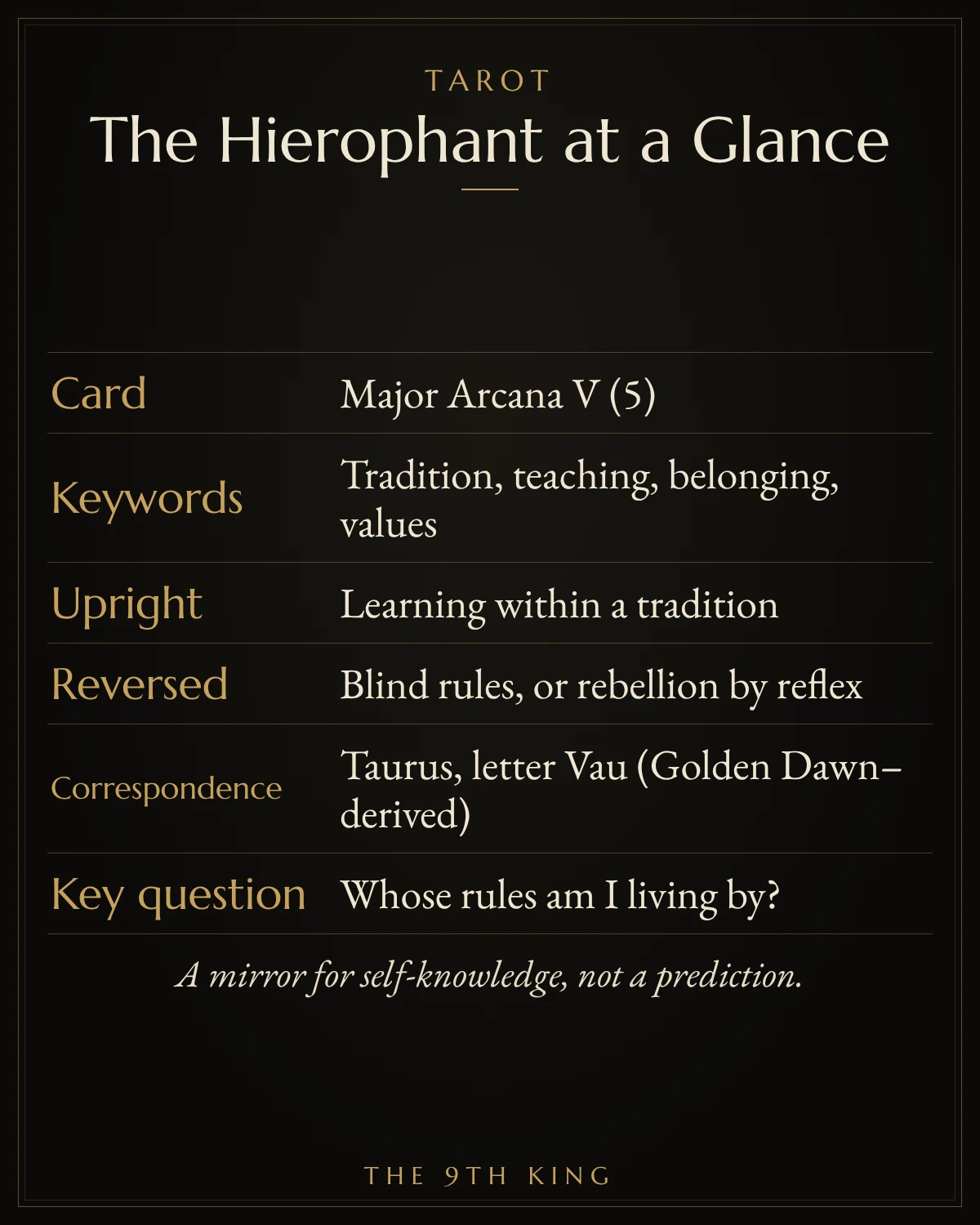
The Hierophant at a glance
| The Hierophant | |
|---|---|
| Number | V (Major Arcana) |
| Core theme | Tradition and teaching |
| Upright | Learning, belonging, shared values |
| Reversed | Blind obedience or reflex rebellion |
| Zodiac (Golden Dawn) | Taurus |
| Hebrew letter (Golden Dawn) | Vau |
| Golden Dawn title | The Magus of the Eternal |
| Shadow | Handing your judgment to a system |
| Key question | Whose rules am I living by? |
Below: the imagery, the common upright and reversed meanings, the Taurus link, and then the part that matters most here: sorting the rules you inherited from the values you hold.
What the Hierophant card shows: the traditional imagery
The Rider–Waite–Smith Hierophant
The best-known version of this card comes from the deck created by A. E. Waite and illustrated by Pamela Colman Smith, first published by William Rider & Son in London in December 1909. Waite and Smith were both members of the Hermetic Order of the Golden Dawn (Rider–Waite Tarot, Wikipedia).
Waite’s own description in The Pictorial Key to the Tarot gives us the scene (Waite, Pictorial Key, The Hierophant, sacred-texts.com):
- The triple crown. He wears it on his head.
- Two pillars. He sits between them, and Waite notes they are not the same pillars as the temple guarded by the High Priestess (card II).
- A sceptre ending in a triple cross, held in his left hand.
- A raised right hand giving what Waite calls a well-known church sign, one that separates the open part of a teaching from its hidden part.
- Crossed keys at his feet.
- Two priestly ministers in albs kneeling before him.
The Pope, and the wider office
Waite notes that this card had usually been called the Pope, and he treats that title as one particular example of a broader role the card stands for (Waite, Pictorial Key, sacred-texts.com). Early decks such as the Tarot of Marseille used that name (The Hierophant, Wikipedia).
On The 9th King we read the card the way Waite pointed: as the office itself, not a statement about any one church. It stands for any tradition with teachers, rituals and a lineage: a religion, a school, a craft, a profession or a family’s way of doing things.
What Waite thought the card was about
Waite calls the Hierophant the ruling power of outward, public religion, and pairs him with the High Priestess, who holds the inward, withdrawn side. Waite even points out that she makes no sign, while he does. He is the head of a recognized order, the part of a teaching that’s visible and shared.
Then Waite adds a warning at the heart of the 9K reading. He says the pontiff can forget “the significance of this his symbolic state” and act as if he personally contains everything his symbol points to (Waite, Pictorial Key, sacred-texts.com). In other words, the office points beyond itself. Trouble starts when the messenger is mistaken for the message.
Where the card comes from
Tarot began as a card game. Britannica dates the first decks to Italy in the 1430s, when illustrated trump cards, the trionfi, were added to the four-suited pack, and places tarot’s use for divination in France around 1780 (Britannica, Tarot). The astrological layer came later still.
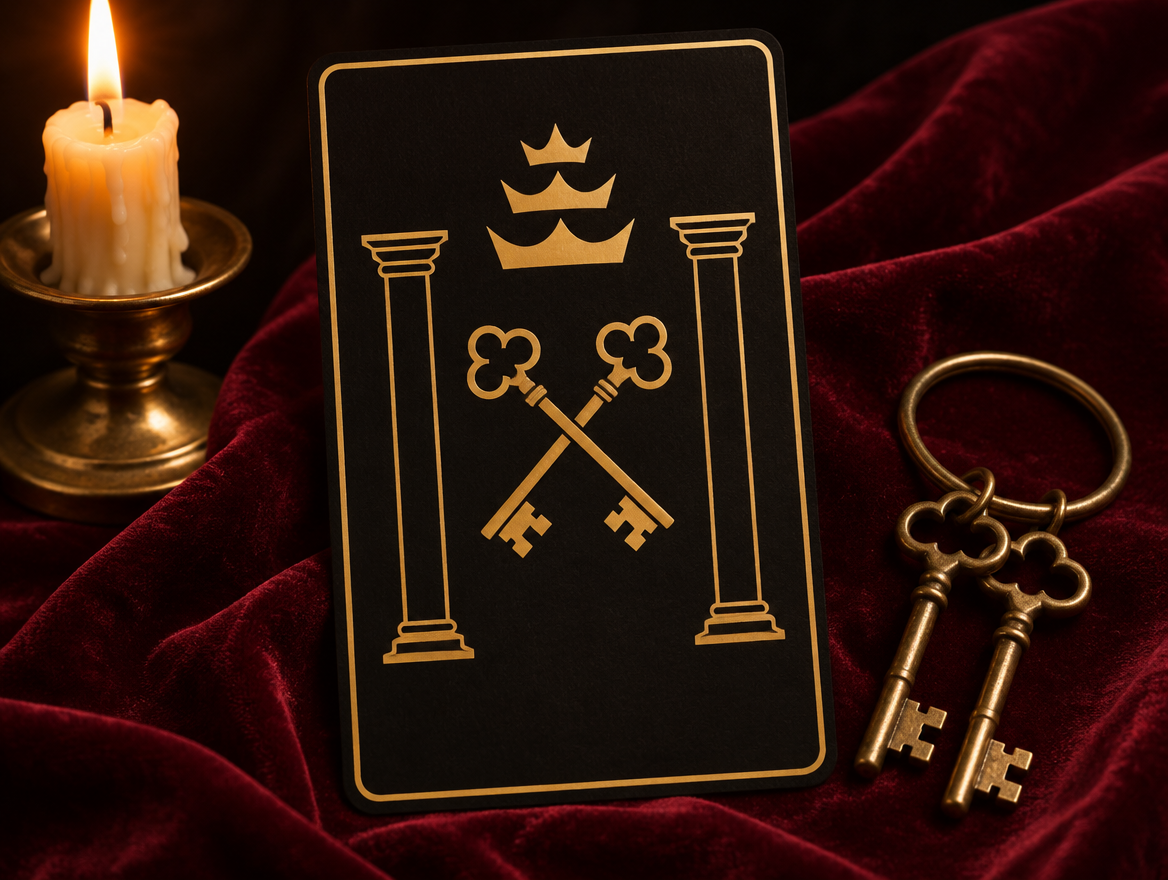
The Hierophant upright meaning
Waite’s list of divinatory meanings for the card opens with “Marriage, alliance, captivity, servitude,” and adds mercy, goodness, inspiration, and the person someone turns to for help (Waite, Pictorial Key, Part III §3, sacred-texts.com). Alliance and servitude sit side by side: the bond that holds you can also bind you.
Today, readers commonly take the upright Hierophant as a card of learning within a tradition. It can point to:
- Teaching and mentorship: finding a teacher, or becoming one.
- Belonging: a community, congregation, team or circle that shares your values.
- Proven paths: methods worth learning properly before you change them.
- Ritual and commitment: ceremonies, vows and public promises, including marriage.
Ask yourself: What tradition or teacher has made me better, and am I learning it well?
The Hierophant as a person
Many people take The Hierophant as a figure in their life: a teacher, a mentor, a faith leader, a coach or a parent. Any gender can carry this card. It describes a role, the one who keeps and hands on a body of knowledge. Sometimes that role is yours.
The Hierophant in love
In love, the upright Hierophant is often read as commitment spoken out loud: shared values, family traditions, ceremony. Waite’s list includes marriage, which is why many readers link the card with formal commitment.
The question it raises: Do we share these values, or are we both performing a script we were handed? The card doesn’t tell you whether to stay, go or marry. It asks you to look at the traditions each of you brings.
The Hierophant at work and with money
At work, the Hierophant is often read as institutions and learning: training, apprenticeships, mentors and professional standards.
With money, the card’s themes are the money habits you inherited: what your family taught you about saving and spending. That’s a reflection on habits, not financial advice. The useful question: Which of my money rules came from my own experience, and which came from someone else’s fears?
The Hierophant reversed meaning
Waite’s reversed meanings surprise modern readers: society, good understanding, concord, overkindness and weakness (Waite, Pictorial Key, Part III §3, sacred-texts.com). You could read that as the formal structure loosening into friendship, which can be warm, or into softness that won’t hold a line.
Most readers today use the reversed Hierophant for a strained relationship with rules, and it can lean in either direction:
- Too much obedience: following rules nobody can explain, staying quiet to stay accepted, letting an authority think for you.
- Too much rebellion: rejecting every teacher and tradition on principle, even the ones that would help.
- Outgrowing: a group, belief or method that once fit and no longer does.
- Doing it your own way: an unconventional path, which isn’t automatically a problem.
Ask yourself: When a rule is handed to me, do I obey it, fight it, or try to understand it?
The Hierophant reversed in love
Reversed in a love reading, the card can point to friction around expectations: families who want a certain kind of wedding, partners raised with different traditions, or a relationship that doesn’t fit the expected shape.
This isn’t a verdict. It’s a prompt: Which expectations are ours, and which belong to our families or culture?
Inherited rules vs chosen values
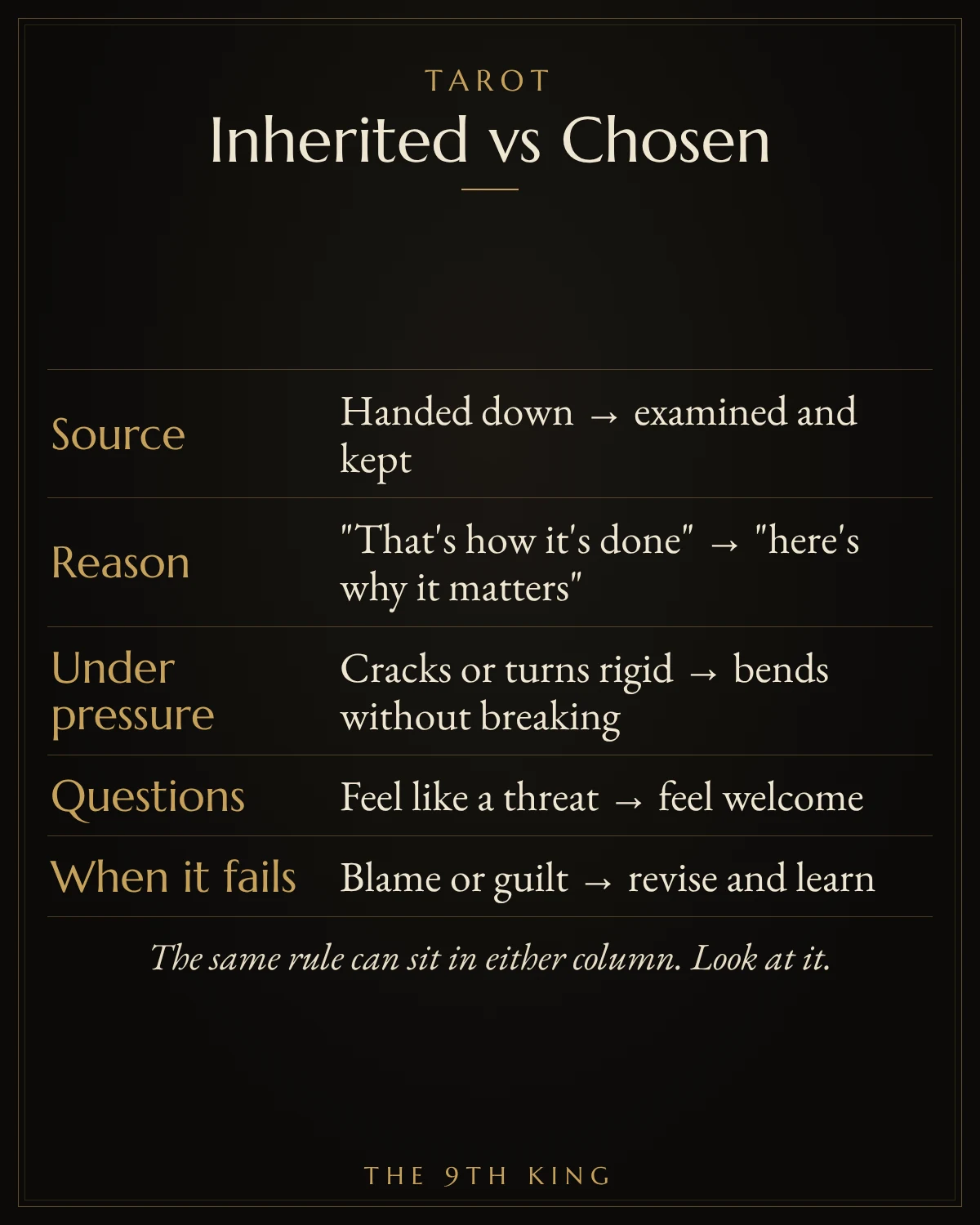
| Area | Inherited rule | Chosen value |
|---|---|---|
| Source | Handed down | Examined and kept |
| Reason | “That’s how it’s done” | “Here’s why it matters” |
| Under pressure | Cracks or turns rigid | Bends without breaking |
| Questions | Feel like a threat | Feel welcome |
| When it fails | Blame or guilt | Revise and learn |
The same rule can sit in either column. The Hierophant isn’t asking you to throw out what you were given. It’s asking you to look at it.
The Hierophant and Taurus: the astrology link
The Golden Dawn correspondence
The 9th King uses the Golden Dawn–derived correspondences, the tradition the Rider–Waite–Smith deck draws on. In Liber LXXVIII, which prints the Golden Dawn’s Book T, The Hierophant is titled “The Magus of the Eternal” and given the Hebrew letter Vau and the sign Taurus (Liber LXXVIII, sacred-texts.com).
Other schools differ. Not every card maps neatly to a single sign either; the court cards and the Pages work differently from the Major Arcana. Treat this as one tradition’s symbolic map, not a law. See Tarot & the Zodiac for the full system.
Why Taurus fits the Hierophant
Taurus is the fixed earth sign ruled by Venus (The Hierophant, Wikipedia). Our Taurus personality traits guide covers it in full: patience, loyalty, steadiness and a love of what lasts, with a shadow of stubbornness and resistance to change.
An earth sign and a robed teacher might seem an odd pair, but they share a lot:
- Both value what endures. Taurus builds slowly and keeps what works. The Hierophant guards what has lasted.
- Both learn through repetition. Taurus trusts habit; tradition passes on through ritual.
- Both share the same shadow. Fixed earth can dig in; a tradition can calcify.
For strong Taurus placements, the Hierophant’s gift is steadiness that stays teachable. Our birth chart guide shows how to find Taurus in your own chart. A card’s sign is a symbolic link, not a statement about your Sun sign.
The 9th King reading: inherited rules, chosen values
The traditional meanings tell you what readers usually see in the card. This section is about what to do with it.
The Hierophant’s tension
Every card holds a tension. The Hierophant’s is inherited rules versus chosen values.
Everyone starts with inherited rules. You didn’t pick your first language, your family’s holidays or your early ideas about money, work or love. Many of them are good. The question is whether you’ve ever examined them as an adult.
A chosen value can look exactly like an inherited rule from the outside. The difference is inside: Do I keep this because I understand it and agree with it, or because I’m afraid of what happens if I don’t?
Learning without handing over your judgment
Some knowledge only comes through a teacher. A craft, a language, a spiritual practice, a profession: you learn them by following, for a while, someone who knows more. That’s how skill is passed on.
The 9K line: you can give a teacher your attention without giving them your judgment. Learn the form fully. Ask why. And keep a quiet place inside you that is still checking: Does this match what I know to be good?
Waite’s warning helps here. A good teacher knows the office points beyond itself. One who forgets it starts treating questions as disloyalty.
The shadow side of the Hierophant
Shadow work means looking at the parts of yourself you’d rather not see. (If you’re new to the idea, Shadow Work, Plainly explains it simply.) The Hierophant’s shadow tends to show up in a few recognizable ways:
- Blind obedience. Following a rule, leader or group because questioning feels unsafe, not because you agree.
- Gatekeeping. Using knowledge or status to decide who’s allowed in, and enjoying the power of the door.
- Rebelling by reflex. Rejecting every tradition on principle, which can be just as automatic as obeying.
- The borrowed conscience. Letting a system decide what’s right so you never have to.
Some people meet this card and feel a flinch, because a family, school or faith community once used rules to shame or control them. If that’s you, go gently. Responsibility for coercion belongs to the people who used it, not to the person it was used on. Early experiences of rules and belonging can touch inner child work, and it’s worth going slowly.
Projection: the Hierophant you see in other people
A useful question: Which teachers, institutions or “rule people” make me react most strongly? Sometimes they really are rigid or dismissive. Sometimes we’re also reacting to a part of ourselves we haven’t owned: our own need for certainty, or our own longing to belong. That’s psychological projection, and The Hierophant is a clear mirror for it.
The point isn’t to excuse anyone. It’s to ask what the reaction shows you about your relationship with authority and belonging. Taurus placements have their own shadow pattern too; our zodiac shadow work guide covers it alongside every other sign.
The self-mastery lesson
The Hierophant’s lesson is this: become the keeper of your own keys. You can honor a tradition, sit at a teacher’s feet, belong to a community and still be the final authority on what you believe. Self-mastery here isn’t rejecting every rule. It’s knowing which rules you’ve signed with your own name.
A mature inner Hierophant does three things. It learns before it judges. It keeps what proves good. And it can say, calmly and without drama, “This one I don’t carry anymore.”
The Hierophant in a reading: two worked examples
Both examples below are fictional. They show how to turn the card into a question instead of a prediction.
Example 1 (fictional): upright Hierophant, “Should I keep teaching myself?”
The situation: Priya has spent two years learning ceramics from online videos and keeps hitting the same wall. She draws The Hierophant upright while asking what she’s missing.
Reading: the card points to a teacher and a lineage. Priya’s independence got her started, but some knowledge lives in a room with someone who has made thousands of pots. The card asks whether doing it her own way has become the wall.
The useful question: What would I learn if I let someone more experienced correct me for one season?
Example 2 (fictional): reversed Hierophant, “Why do I feel guilty about changing?”
The situation: Marcus grew up in a close family where everyone follows the same career path. He’s planning a different one and draws The Hierophant reversed while asking about his guilt.
Reading: the reversed card can point to outgrowing an inherited rule. The guilt isn’t proof he’s wrong; it may simply be how leaving a family script feels. The card also asks him to check: is he rejecting the path because it doesn’t fit, or only because it was expected?
The useful question: Which parts of my family’s way do I still respect, and want to carry with me?
Both are reflections to test, not verdicts. If you’re new to reading the cards this way, Code of Ascension’s Tarot for Beginners: How Tarot Really Works (Code of Ascension) covers the basics, and its guide to intuitive tarot (Code of Ascension) shows how to pair the traditional meanings with your own first impressions. For a simple layout to try this card in, see our three-card tarot spread.
Myths and misreadings about The Hierophant
- “The Hierophant is only about religion.” Waite treated the Pope title as one example of a broader office. The card covers any tradition with teachers and rituals.
- “The Hierophant tells you to conform.” Upright, it’s read as learning within a tradition. Learning and obeying are not the same thing.
- “Reversed means you’re rebelling, and that’s bad.” It can point to outgrowing a rule, which can be healthy, or to rebellion by reflex. Honest reflection tells you which.
- “If I’m not a Taurus, the card doesn’t apply to me.” The Taurus link is symbolic. The card’s questions belong to everyone.
Practice: the keys audit
Here is one practical exercise, plus journal prompts. The crossed keys at the Hierophant’s feet stand for the power to open and close. In this exercise, you look at the rules that currently hold those keys in your life.
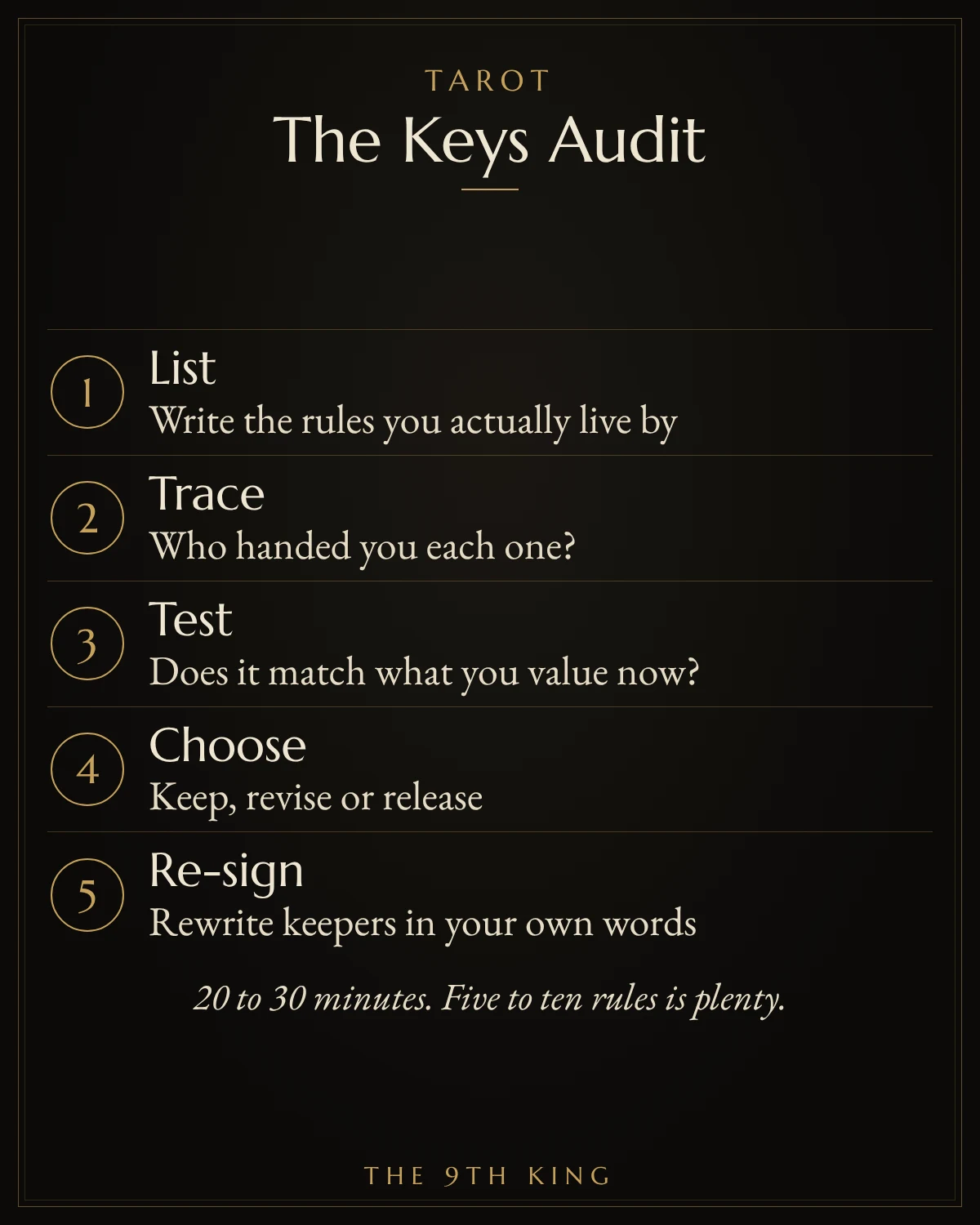
The exercise: the keys audit (20 to 30 minutes)
- List. Write down the rules you actually live by, not the ones you think you should. Five to ten is plenty: rest, money, work, family, love, faith. “Never ask for help.” “Don’t talk about money.”
- Trace. Next to each rule, write who handed it to you: a parent, a teacher, a tradition, a culture or your own experience.
- Test. For each rule, ask: Does this match what I value now, as an adult? Notice your answer without arguing with it.
- Choose. Mark each rule: keep, revise or release. Keeping a rule you inherited is a real choice. So is letting one go.
- Re-sign. Rewrite each rule you’re keeping or revising in your own words. “Never ask for help” might become “I ask for help when I’m stuck, and I offer it back.” This is the moment a rule becomes a value.
The test: Do these rules feel like mine now, or do I still hear someone else’s voice?
Journal prompts for The Hierophant
- Which rule in my life would I struggle to explain if someone asked me “why”?
- Who taught me what it means to be a good person, and what did I keep or leave behind?
- Where am I following a tradition out of love, and where out of fear?
- Which teacher or tradition have I rejected without really learning it first?
- When do I act as a gatekeeper, deciding who belongs and who doesn’t? (See our shadow work prompts for more like this.)
- What community or practice do I want to belong to, and what would it ask of me?
- If I were the teacher, what would I want my students to question?
A gentle note: these prompts can bring up memories of strict homes, schools or communities. It’s fine to stop any prompt that feels like too much. If you’re dealing with trauma, abuse, thoughts of self-harm or overwhelming distress, please work with a qualified therapist; reflective practice like this isn’t a replacement for that support. For a fuller session, our shadow work tarot spread pairs well with this card.

The Hierophant Tarot: FAQ
What does The Hierophant tarot card mean?
The Hierophant is card V of the Major Arcana, a card of tradition, teaching, belonging and shared values. Upright, readers often take it as learning within a tradition: a mentor, a community or a proven path. On The 9th King it’s read as a mirror for self-knowledge, asking which rules you inherited and which values you have actually chosen, rather than as a prediction about what will happen.
What does The Hierophant reversed mean?
Reversed, The Hierophant is commonly read as a strained relationship with rules. That can mean blind obedience, outgrowing a group or belief, or rebelling against every tradition by reflex. Waite’s own reversed meanings were gentler: society, concord, overkindness and weakness. A useful reflection is to ask whether your first move with a new rule is to obey it, fight it or understand it.
What does The Hierophant mean in love?
In love, the upright Hierophant can point to commitment spoken out loud: shared values, family traditions and ceremony. Waite’s list of meanings includes marriage. Reversed, it can point to friction over expectations from families or cultures. The card doesn’t tell you whether to stay, leave or marry. It asks which traditions each of you brings, and which ones you both want to keep.
What zodiac sign is The Hierophant?
In the Golden Dawn–derived correspondences The 9th King uses, The Hierophant is paired with Taurus, the fixed earth sign ruled by Venus. The Golden Dawn’s Book T, printed in Liber LXXVIII, gives the card the sign Taurus, the Hebrew letter Vau and the title “The Magus of the Eternal.” Other systems may differ.
Why was The Hierophant called the Pope?
Waite noted that the card had usually been called the Pope, and early decks such as the Tarot of Marseille used that name. Waite saw the Pope title as one particular example of a wider office: the keeper and teacher of a recognized tradition. Waite’s deck uses the title “The Hierophant,” and on The 9th King we read it as any tradition with teachers and rituals.
Is The Hierophant a yes or no card?
The 9th King doesn’t use tarot for yes-or-no answers or predictions. Instead of asking whether something will happen, try a reflective question: what tradition or teacher could help here, and which rule am I following without examining it? Those questions usually lead to a clearer decision than a yes or no would.
What is the difference between The Hierophant and The High Priestess?
Waite paired them directly. The High Priestess (card II) stands for the inward, hidden side of spiritual knowledge, and in his description she makes no sign. The Hierophant (card V) stands for the outward, public side: teaching, ritual and a recognized order, with his right hand raised in a sign. One is private knowing; the other is knowledge shared and handed on.

Your next step: do the keys audit this week using the exercise above, then read our Taurus personality traits guide to see how the Hierophant’s sign handles loyalty, habit and the pull to keep what feels familiar.
Explore Next
- The Hierophant’s sign in full: Taurus Personality Traits
- The card that comes before: The Emperor
- When other people mirror your rules: Psychological Projection
- New to shadow work: Shadow Work, Plainly
- The shadow side of every sign: Zodiac Shadow Work
- More tarot on The 9th King: Tarot Card Meanings · The Major Arcana · Tarot & the Zodiac · Shadow Work Tarot Spread
- More Major Arcana: The High Priestess · The Lovers · The Hermit

Final Thought: Learn the Form, Keep the Keys
The Hierophant isn’t asking you to bow, and it isn’t asking you to burn anything down. It’s asking you to learn well, belong where you’re truly at home, and look honestly at every rule you carry. Keep what proves good. Rewrite what doesn’t. Hold the keys yourself. Know your nature. Rule your life.
About the Author
King is the founder of The 9th King, where zodiac psychology, relationships and shadow work are explored as tools for self-knowledge rather than fortune-telling. He’s a Libra Sun, and writes about the personal side of astrology on King The Kemist. Astrology on The 9th King is interpretation and self-reflection, not prediction or established fact.
Leave a Reply