
Quick Answer: What Does The Hanged Man Tarot Card Mean?
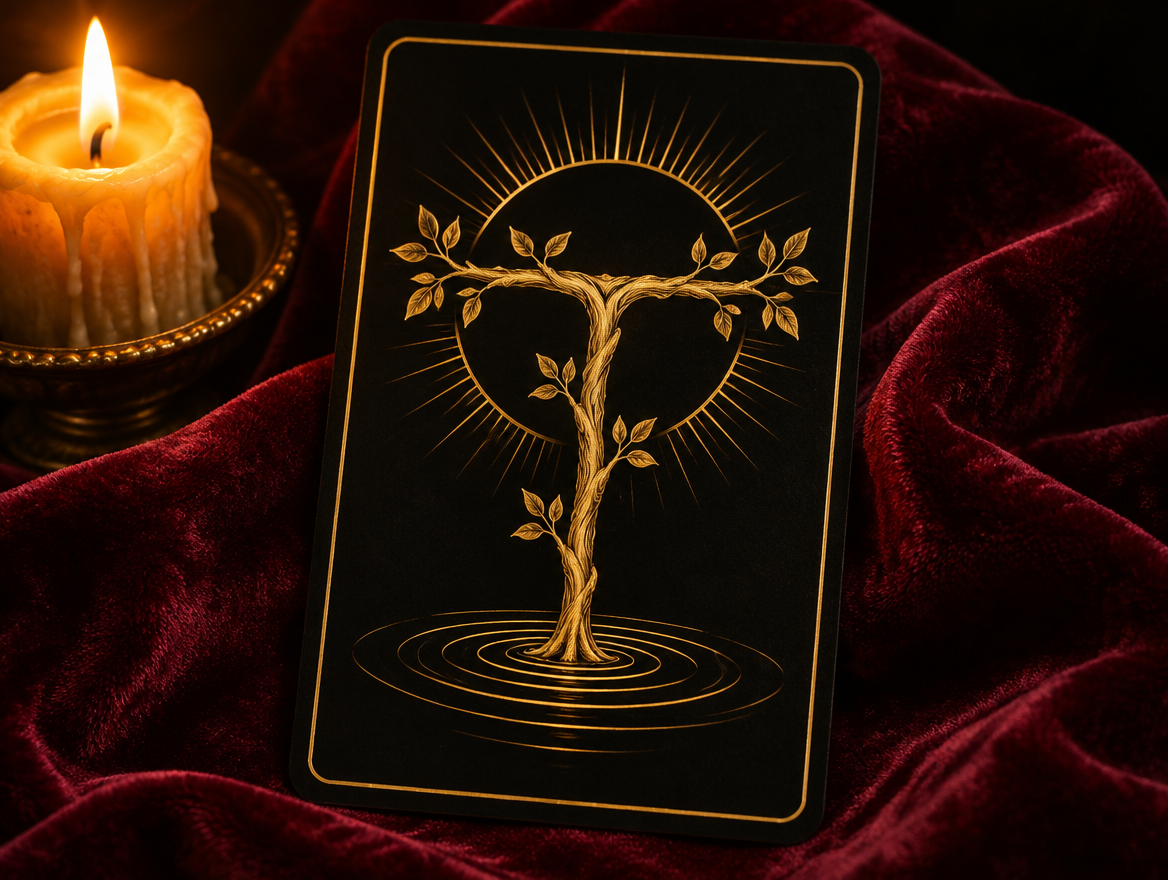
The Hanged Man is card XII (12) of the Major Arcana. On the traditional Rider–Waite–Smith card, a calm figure rests upside down, suspended by one foot from a living, leafy T-shaped tree, one leg crossed behind the other, with a halo around the head. It’s the card of the willing pause: stopping, letting go of the usual angle and seeing the situation from a new one.
Keywords: pause, surrender, new perspective, patience, letting go, insight, waiting with purpose.
- Upright, in one line: the card can point to a pause you choose, where loosening your grip lets you see what you couldn’t see before.
- Reversed, in one line: readers often take it as a pause that has turned into stalling, or as giving things up mainly to look good.
- Astrology link: in the Golden Dawn–derived correspondences The 9th King uses, The Hanged Man is paired with the element of Water (not a zodiac sign).
On The 9th King, tarot is a mirror for self-knowledge, not fortune-telling. The Hanged Man doesn’t say you’re stuck or that something is being taken from you. It asks a quieter question: what would I see if I stopped pushing and looked at this upside down?
Table of Contents
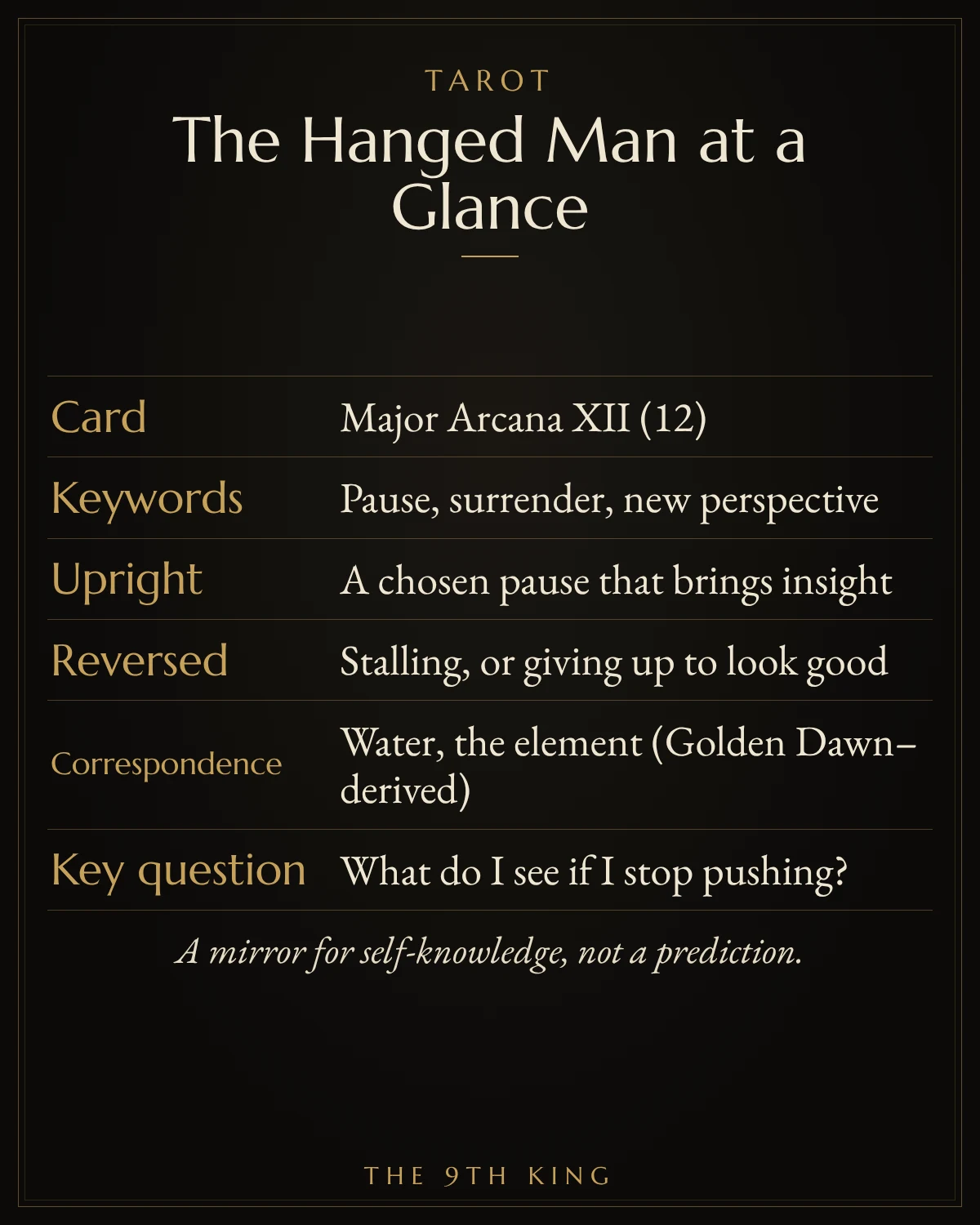
The Hanged Man tarot card at a glance
| The Hanged Man | |
|---|---|
| Number | XII (12), Major Arcana |
| Core theme | The willing pause, a new view |
| Upright | Surrender, patience, insight |
| Reversed | Stalling, or sacrifice for show |
| Correspondence (Golden Dawn–derived) | Water (element) |
| Hebrew letter | Mem |
| Golden Dawn title | The Spirit of the Mighty Waters |
| 9K tension | Willing pause vs stalling |
| Key question | What do I see if I stop pushing? |
What’s on the card: The Hanged Man tarot symbolism, piece by piece
Most modern decks follow the Rider–Waite–Smith design, illustrated by Pamela Colman Smith from A. E. Waite’s instructions and first published by William Rider & Son in December 1909 (Wikipedia: Rider–Waite Tarot). Waite explained each card in The Pictorial Key to the Tarot, now in the public domain (sacred-texts.com: Waite, The Hanged Man).
The name unsettles people, but Waite’s own description points the other way.
The living tree
The figure is suspended from a frame that Waite says forms a Tau cross, a T shape. He’s careful to add that this tree of sacrifice is living wood, with leaves on it (sacred-texts.com: Waite, The Hanged Man).
That detail matters. Living wood suggests growth still going on, even while everything looks still. The pause isn’t empty.
The upside-down figure and the crossed legs
The figure rests head-down, held by one ankle, with the arms behind the back and one leg crossed over the other (sacred-texts.com: Waite, Part I, The Trumps Major). Waite notes that the position of the legs forms a fylfot cross, an old four-armed symbol.
The inverted position is the heart of the card. Turn your head down and the world flips: what looked obvious looks strange, and what you’d overlooked comes into view.
The calm face
This is Waite’s most important note. He says the face expresses “deep entrancement, not suffering” (sacred-texts.com: Waite, The Hanged Man). The figure looks absorbed, as if listening to something inward. On The 9th King we read that stillness as the whole lesson: a pause held with patience, not a trap.
The halo
Waite describes a nimbus, a halo of light, around the figure’s head. Readers usually take it as insight: the reward of staying still long enough to see differently.
Life, not death
Waite sums the figure up as suggesting “life in suspension, but life and not death.” He also writes that the card has been called, wrongly in his view, a card of martyrdom, of prudence and of duty, and that he reads it instead as showing one aspect of the relation between the Divine and the Universe (sacred-texts.com: Waite, The Hanged Man).Waite himself pushes back against the martyr reading, which matters for the shadow section below.
What older decks showed instead
Waite records that the fortune-tellers of the eighteenth century who circulated tarot cards showed a different scene: a youth in a jerkin, standing upright on one foot and loosely attached to a short stake in the ground (sacred-texts.com: Waite, Part I, The Trumps Major). He notes that the prevailing reading in his time was sacrifice, and he thought little of it.
The Hanged Man tarot meaning: upright and reversed
The Hanged Man upright
Common upright themes:
- Surrender: loosening your grip on how things “should” go.
- New perspective: seeing the situation from an angle you hadn’t tried.
- Patience: letting something ripen instead of forcing it.
- Letting go: releasing a plan, a habit or a need to control the outcome.
- Insight: the clarity that sometimes arrives only when you stop pushing.
The useful upright message isn’t “you’re stuck.” It’s “stop for a moment on purpose, and look again.”
The Hanged Man reversed
Reversed, readers tend to go one of two ways:
- The pause has turned into stalling. You’re waiting, but not with purpose. “I’m giving it time” has quietly become “I’m avoiding the decision.”
- The surrender has turned into a show. You’re giving things up, but mostly so others will see you as patient, generous or good. The sacrifice is for the audience.
What Waite’s 1911 list said
Waite’s divinatory meanings for The Hanged Man included wisdom, circumspection, discernment, trials, sacrifice and intuition, along with divination and prophecy. Reversed, he gave selfishness, the crowd and the body politic (sacred-texts.com: Waite, Divinatory Meanings).
That’s the language of old fortune-telling. Britannica dates tarot to Italy in the 1430s, as a card game, and its adaptation for occult and fortune-telling purposes to France around 1780 (Britannica: Tarot). On The 9th King we turn Waite’s words into questions. Discernment becomes what am I seeing now that I couldn’t see while rushing? Waite’s reversed crowd becomes whose approval is my sacrifice really for?
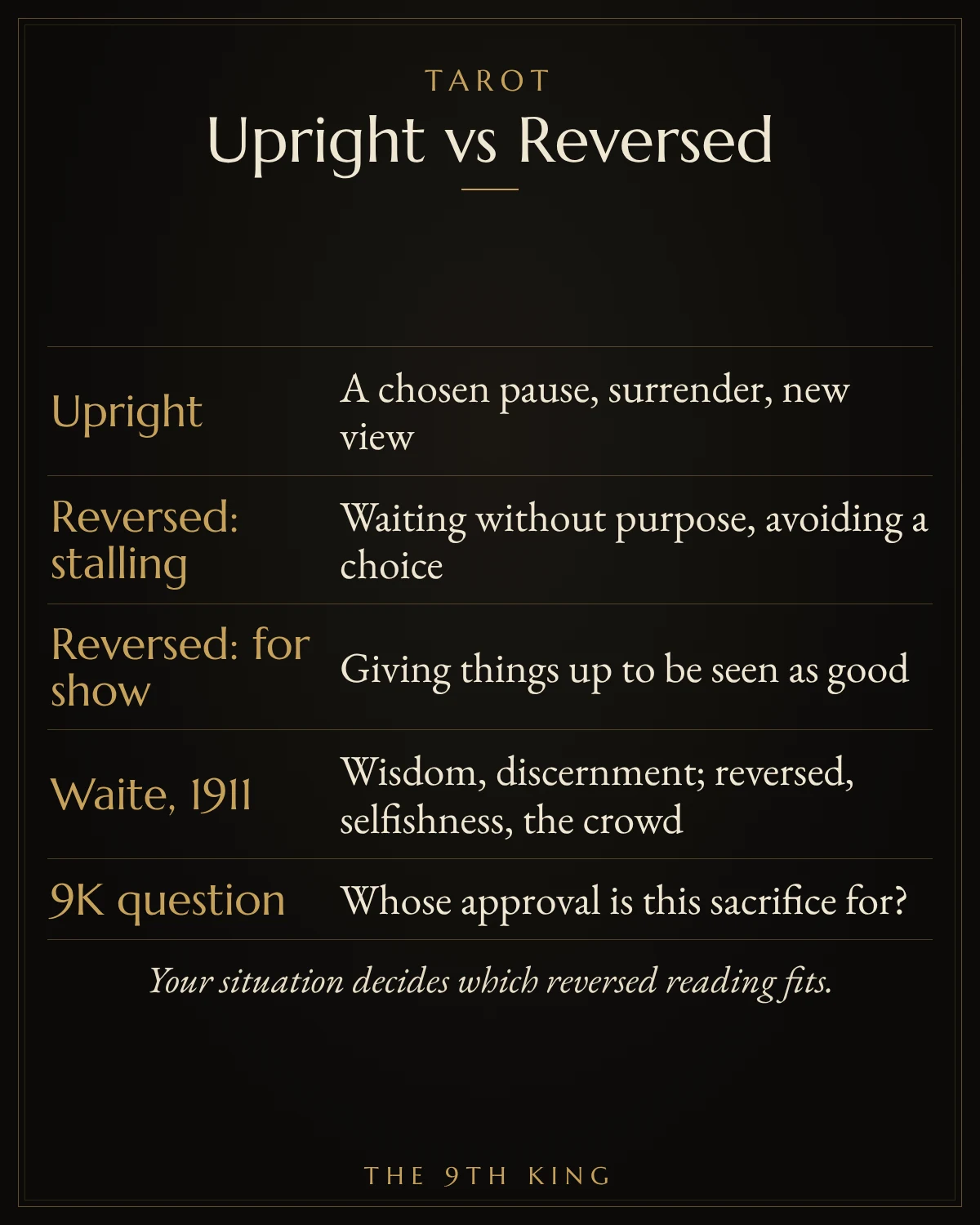
| Position | Common reading | Question to ask |
|---|---|---|
| Upright | A chosen pause, surrender, new view | What do I see if I stop? |
| Reversed (stalling) | Waiting without purpose, avoiding a choice | What am I putting off? |
| Reversed (for show) | Giving things up to be seen as good | Who is watching this? |
| Waite, 1911 | Wisdom, discernment; reversed, selfishness, the crowd | What do I actually know? |
| 9K question | A pause or sacrifice worth checking | Whose approval is this sacrifice for? |
The Hanged Man and Water: the Golden Dawn correspondence
Why an element, not a sign?
The astrology links on The 9th King are Golden Dawn–derived correspondences, the tradition The 9th King uses. Waite and Pamela Colman Smith were both members of the Hermetic Order of the Golden Dawn (Wikipedia: Rider–Waite Tarot), and their deck draws on that background.
In that system, the 22 Major Arcana are shared among the elements, the planets and the zodiac signs. The Hanged Man is one of the element cards. The Golden Dawn’s Book T, as printed in Liber LXXVIII, lists card 12, The Hanged Man, with the Hebrew letter Mem and the element Water, and gives it the title The Spirit of the Mighty Waters (Liber LXXVIII, sacred-texts.com). The same list pairs The Fool with Air, so The Hanged Man has company among the element cards.
Other schools differ
Other traditions use different attributions, and not every card maps to a single sign or planet (court cards and Pages work on a different scheme altogether). The Water pairing is a symbolic lens, not a law. If another system suits you, use it consistently. Our guide to tarot and the zodiac lays out the full set The 9th King uses.
What Water adds to the card
In astrology, Water is usually read as the element of feeling, receptivity and depth. Water doesn’t win by force. It yields, settles and finds a way around, and a still pool reflects things upside down, a neat image for this card.
The water signs as context
The card is paired with the element, not with a sign. But if Water themes speak to you, the three water signs are natural companions to read alongside it: Cancer, Scorpio and Pisces. That’s a shared-element link only. To see how much Water is in your own chart, our guide on how to read a birth chart shows how to find your planets by sign.
Between Justice and Death: the order of the cards
After the weighing
The Hanged Man comes straight after Justice (XI in the Rider–Waite–Smith order). Justice weighs things up. The Hanged Man lets what that weighing revealed sink in and change your angle.
Before the ending
After The Hanged Man comes Death (XIII), the card of endings and transformation. Read as a sequence, the pause comes before the change. The Hanged Man is the breath you take before you let something end, the stillness in which you realize what you’re ready to release. Waite closes his note by writing of a great awakening that is possible (sacred-texts.com: Waite, The Hanged Man). We read that symbolically: a pause, a letting go, then something new.
| Card | Movement | What it asks |
|---|---|---|
| Justice (XI) | Weighing | What’s actually true here? |
| The Hanged Man (XII) | Pausing | What do I see if I stop? |
| Death (XIII) | Releasing | What am I ready to let end? |
For a wider look at how the 22 cards build on one another, see our Major Arcana guide.
The 9K reading: the willing pause or the stall?
The tension: surrender vs stalling
The Hanged Man’s core tension is between a willing pause and stalling. From the outside they look the same: nothing seems to be happening.
- A willing pause is chosen. You stop because pushing isn’t working, stay curious while you wait, and move when it’s clear.
- Stalling is drift. You stop because moving feels hard, and the pause has no question inside it.
The figure on the card is calm, absorbed and alive. A real pause has attention in it. A stall usually has avoidance in it.
Honestly, most of us mix the two, and the line can blur from the inside. “I’m letting it unfold” can be wisdom, fear, or some of each. The point isn’t to judge yourself. It’s to notice which one is driving.
Surrender as a choice, not a defeat
The word “surrender” can sound like losing. In this card it means something closer to loosening your grip. You’re not giving up on what you care about. You’re giving up the belief that you can only get there by force.
That’s a choice, and it takes some strength. It can look like:
- Stepping back from an argument you keep trying to win, to understand the other side first.
- Putting down a plan that isn’t working long enough to ask whether it’s still the right plan.
You stay in charge of yourself the whole time. You’re just not wrestling the situation.
One line matters here: a pause you freely choose is not the same as waiting forced on you by fear or by someone else’s control. The Hanged Man’s pause is one you could end if you decided to. If you’re holding still because you’re scared of what happens if you move, or because someone is pressuring you to wait, that isn’t surrender in this card’s sense, and it’s worth naming plainly.
The shadow side: when the pause loses its purpose
The shadow of The Hanged Man is a pause, or a sacrifice, that has lost its point. It shows up in a few familiar ways:
- Martyrdom. Giving and giving, then quietly keeping score. The sacrifice becomes proof of how good you are, and resentment builds underneath. Notice that Waite himself said calling this a card of martyrdom was false.
- Stalling. Calling avoidance “patience.” The decision you need to make keeps getting pushed to some future when you’ll “know more.”
- Sacrificing to be seen as good. Giving things up mainly so others will see you as selfless, flexible or easygoing, rather than because it’s what you actually value.
None of these make you a bad person. They’re human ways of protecting yourself, worth noticing because they keep the pause from doing its job. Sometimes the selfless role hides needs we haven’t named, and our guide to psychological projection is a useful companion there.
The self-mastery lesson: stop on purpose, then look again
The self-mastery lesson of The Hanged Man is simple: a pause is only useful if you choose it and look around while you’re in it.
Self-mastery here means three things:
- Choose the pause out loud, at least to yourself: “I’m stopping on this for now.”
- Turn the picture over. Look at the situation from a different side: the other person’s view, the long view, the opposite of your first assumption.
- Set a check-in. Decide when you’ll look at it again, so the pause doesn’t quietly become a stall.
The Hanged Man tarot card in love and work
These are reflections, not predictions. The Hanged Man points at pause, perspective and what you’re willing to let go of.
The Hanged Man in love
In love readings, The Hanged Man often points to a pause in the pattern: a moment to step back and see the connection from a fresh angle. It can also point to who gives more, and why.
Questions worth asking:
- Where have I been pushing for an answer that might come if I gave it room?
- Am I giving because I want to, or so I’ll be seen as the patient one?
The Hanged Man doesn’t tell you to stay or leave. It invites you to see more clearly before you act.
The Hanged Man at work
At work, The Hanged Man can point to a project in pause, a decision waiting on information, or a moment to rethink an approach that isn’t landing. It can also point to over-giving to be seen as the reliable one.
A grounded approach when The Hanged Man shows up around work:
- Name one thing you’re waiting on, and write down what would actually let you move.
- Notice one task you took on mainly to look agreeable, and ask whether it fits your real priorities.
Nothing here is career or financial advice. For money or contract decisions, talk to a qualified professional.
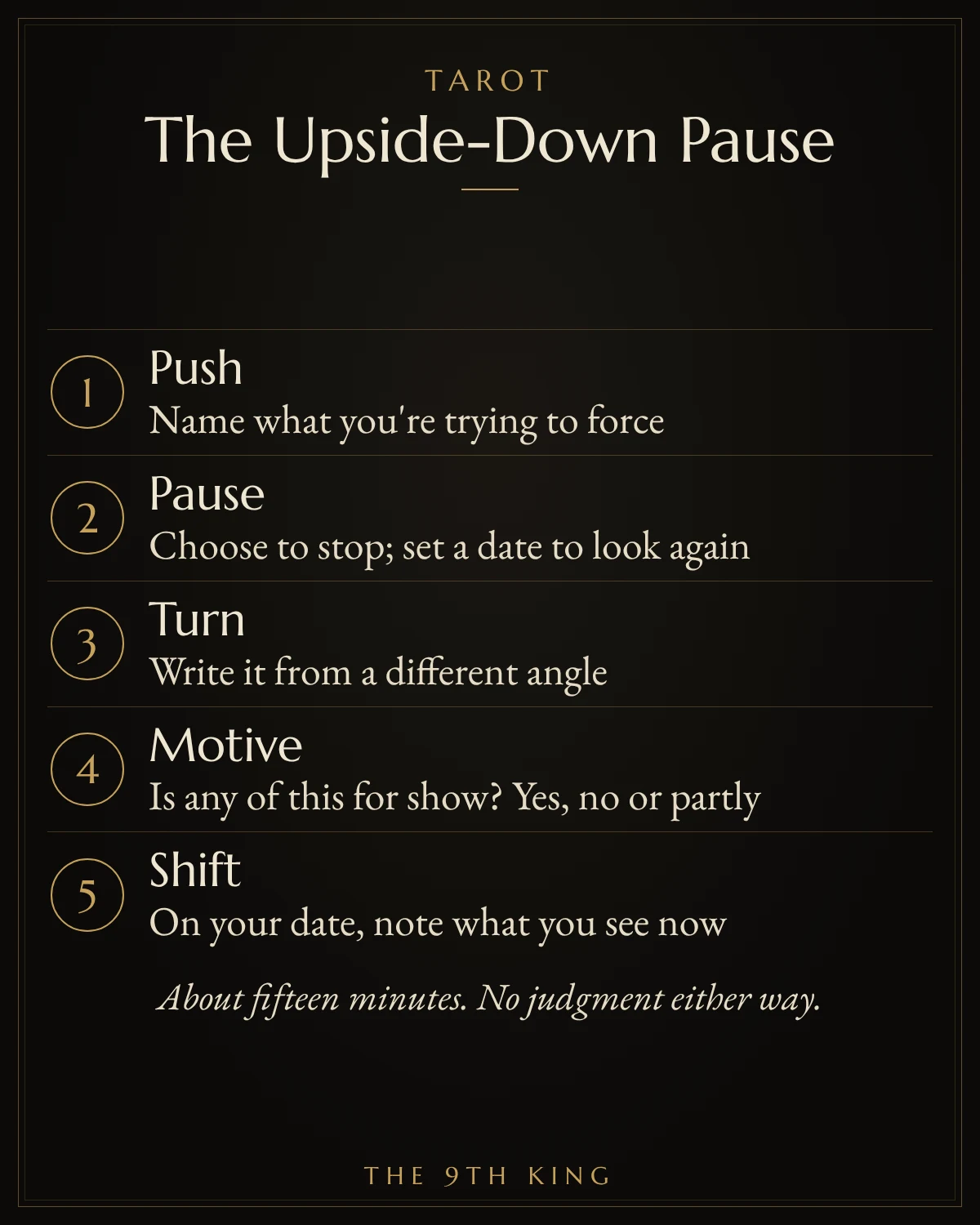
A practical exercise: the Upside-Down Pause
This takes about fifteen minutes, with or without a deck. You need a notebook and, if you like, The Hanged Man card in front of you (pulled on purpose). Pick one situation where you’re pushing hard.
The steps
- Name the push. Write one line about what you’re trying to force. “I keep trying to get my sister to agree with my plan for Mom’s birthday.”
- Choose the pause. Write a short sentence choosing to stop pushing for now, and a date to look at it again.
- Turn it over. Write the situation from a different angle: the other person’s view, or what it would look like if your first assumption were wrong.
- Check the motive. Ask whether any part of what you’re giving up is for show. Write yes, no or partly. No judgment either way.
- Note what shifted. On your check-in date, write one thing you see now that you didn’t see before, and what, if anything, you’re ready to do.
Worked example (fictional)
Dana (fictional) has spent two months pushing her team to adopt a new scheduling system. Her push line: “I’m trying to make everyone switch tools.”
She chooses a two-week pause. Turning it over, she writes the situation from her team’s side and realizes they aren’t against the tool. They’re tired of change after a busy quarter. Checking her motive, she writes “partly”: some of her push is wanting to be seen as the person who fixed things.
At her check-in she notes what shifted: the timing matters more than the tool. She brings it back next quarter as a trial. The pause didn’t cost her the goal. It changed the angle.
Using the exercise in a reading
If The Hanged Man comes up in a spread, run the Upside-Down Pause for the area of life you asked about. Our three-card tarot spread pairs well with it, and Code of Ascension’s guide to how tarot really works for beginners (Code of Ascension) covers the basics.
Journal prompts for The Hanged Man
Use one prompt per session. Write for ten minutes, somewhere quiet.
- Where in my life am I pushing hardest right now, and what happens when I imagine letting go a little?
- What does a good pause feel like for me, and how is it different from avoidance?
- When have I given something up mainly so people would think well of me?
- What would this situation look like if my first assumption were the wrong one?
- Who do I quietly wait on to decide for me, and what would it take to ask directly?
- What did I learn the last time I was forced to slow down?
- What am I ready to see differently, even if I’m not ready to act yet?
For more prompts, see our full list of shadow work prompts, and our zodiac shadow work guide for how over-giving or stalling can show up through your signs.
A gentle note: this is reflective practice, not therapy. If you’re dealing with trauma, abuse, thoughts of self-harm or distress that feels overwhelming, please work with a qualified therapist who can support you properly. And it’s always fine to stop a prompt that feels like too much.
Myths and misreadings about The Hanged Man
- “The Hanged Man is a scary card.” Its name sounds harsh, but Waite describes a calm, entranced face and a figure that is alive, not dead. On The 9th King it’s a card of pause and perspective.
- “The Hanged Man means you’re stuck.” It points to stillness, but the useful question is whether the stillness is chosen and alive, or drifting.
- “The Hanged Man is about martyrdom.” Waite called that reading false. Martyrdom is the card’s shadow, not its meaning: sacrifice turned into proof of goodness.
- “The Hanged Man is the Pisces card.” In the Golden Dawn–derived system its correspondence is Water, the element. Pisces is one of three water signs, linked only by shared element.

The Hanged Man Tarot: FAQ
What does The Hanged Man tarot card mean?
The Hanged Man, Major Arcana XII, is commonly read as a pause, surrender, patience and a new perspective. The traditional card shows a calm figure suspended upside down by one foot from a living, leafy tree, with a halo around the head. On The 9th King it’s read as a mirror, not a prediction: it invites you to stop pushing on purpose, look at your situation from a different angle and notice what that reveals.
What does The Hanged Man reversed mean?
Readers usually take The Hanged Man reversed in one of two ways. Either a pause has turned into stalling, with waiting that has no question inside it, or surrender has become a show, with sacrifices made mainly to look good. Waite’s reversed list gave selfishness and the crowd. Treat it as a question about how you’re waiting, not as a warning.
What element or zodiac sign is The Hanged Man?
In the Golden Dawn–derived correspondences The 9th King uses, The Hanged Man is paired with the element of Water and the Hebrew letter Mem, as listed in Book T printed in Liber LXXVIII. Its Golden Dawn title is The Spirit of the Mighty Waters. It isn’t assigned to a zodiac sign, though Cancer, Scorpio and Pisces share its element. Other tarot schools use different attributions.
What does The Hanged Man mean in love?
In love, The Hanged Man often points to a pause in the usual pattern and a chance to see the connection from a new angle. It can also prompt you to look at who gives more and why, and whether any of your giving is for show. It doesn’t tell you to stay or leave. It invites you to slow down and see more clearly before you decide anything.
Is The Hanged Man a yes or no card?
The 9th King doesn’t use tarot for yes or no answers. The Hanged Man is often called a “not yet” or “wait” card elsewhere, but treating it that way skips the useful part. A better approach is to ask what you’d see if you stopped pushing, whether your waiting is chosen or drifting, and what you’re ready to let go of in the situation.
Why is The Hanged Man upside down?
The upside-down position is the card’s central image of a changed perspective. When you hang head-down, the world flips, and things you took for granted look new. Waite notes that the figure’s crossed legs form a fylfot cross and that the tree is living wood with leaves. Many readers take the inversion as seeing life from a reversed angle, by choice, to gain insight.

Your next step: pick one situation you’ve been pushing on and run the Upside-Down Pause tonight, with a check-in date in your calendar. Then read our guide to shadow work, plainly explained to look at what might be underneath the push.
Explore Next
- The basics of looking inward: Shadow Work, Plainly
- Water signs to read alongside this card: Cancer · Scorpio · Pisces
- The card before this one: Justice Tarot Card
- Another element card: The Fool Tarot Card
- Reading by feel, not only the book: Intuitive Tarot (Code of Ascension)
- More tarot on The 9th King: Tarot Card Meanings · Major Arcana · Tarot & the Zodiac · Shadow Work Tarot Spread
- More Major Arcana: Death · Temperance · The Hermit · The Star

Final Thought: Stop on Purpose, and Look Again
The Hanged Man doesn’t ask you to suffer or to wait forever. It shows a calm figure on a living tree, upside down, with light around the head. Choose your pause, turn the picture over, check who your giving is for, and move when you can see clearly. Know your nature. Rule your life.
About the Author
King is the founder of The 9th King, where zodiac psychology, relationships and shadow work are explored as tools for self-knowledge rather than fortune-telling. He’s a Libra Sun, and writes about the personal side of astrology on King The Kemist. Astrology on The 9th King is interpretation and self-reflection, not prediction or established fact.
Leave a Reply