
Quick Answer: What Does the Page of Wands Mean?
The Page of Wands is the youngest court card in the suit of Wands, the tarot suit linked with fire, drive and desire. A.E. Waite describes the card as a young man standing “in the act of proclamation”: someone with news, and with something to say.
Keywords: eager exploration, the courage to try, a new spark, enthusiasm, a bold message, first steps.
- Upright, in one line: a fresh idea or desire lights up, and the card invites you to try it for real instead of only talking about it.
- Reversed, in one line: the same spark scatters into restlessness, false starts or a need for an audience, so the card asks what happens after the announcement.
On The 9th King, tarot is a mirror for self-knowledge, not fortune-telling. The Page of Wands doesn’t promise that a venture will work or that news is coming. It asks: Is this a spark I’ll tend, or one I’ll just show off?
Table of Contents
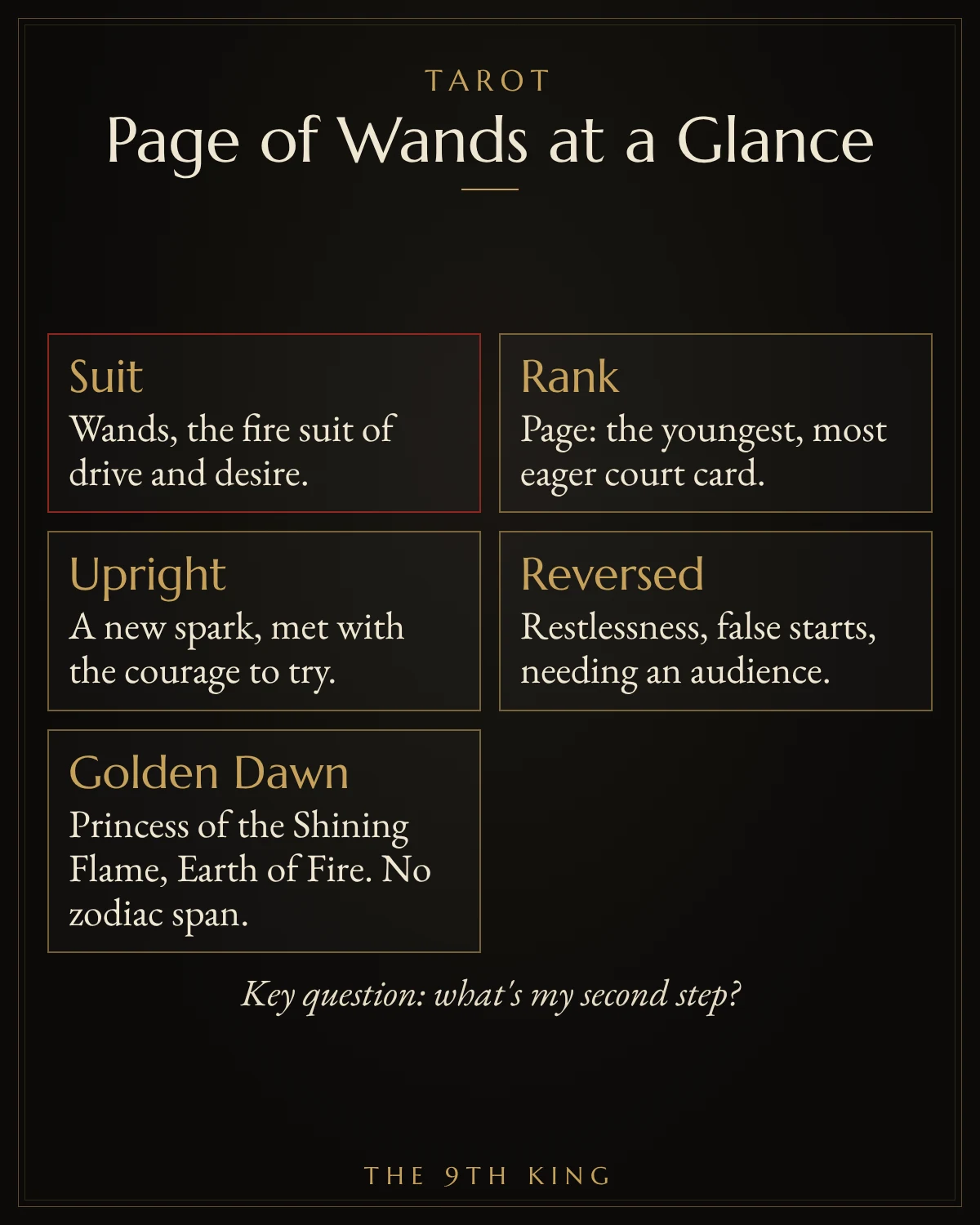
The Page of Wands at a glance
| Page of Wands | |
|---|---|
| Arcana | Minor Arcana, court card |
| Suit | Wands (fire) |
| Rank | Page, the youngest court card |
| Golden Dawn title | Princess of the Shining Flame |
| Element pairing | Earth of Fire |
| Zodiac span | None (Princesses don’t take one) |
| Upright themes | Enthusiasm, exploration, trying |
| Reversed themes | Restlessness, false starts, showing off |
| Key question | What’s my second step? |
What the Page of Wands shows: the traditional imagery
Most modern readers know the Page of Wands from the Rider–Waite–Smith deck, first published by William Rider & Son of London in 1909, with instructions by A.E. Waite and illustrations by Pamela Colman Smith, both members of the Hermetic Order of the Golden Dawn (Wikipedia: Rider–Waite Tarot). Britannica dates the first tarot decks to Italy in the 1430s and notes that tarot was adapted for fortune-telling and occult use in France around 1780 (Britannica: Tarot).
Waite’s own words
Waite’s description in The Pictorial Key to the Tarot is short. He says the scene is similar to the one before it in his book, the Knight of Wands, and that a young man stands making a proclamation. He calls the figure unknown but faithful, and adds that “his tidings are strange” (Waite, Pictorial Key, Page of Wands, sacred-texts.com).
That earlier scene is worth knowing. Waite describes the Knight of Wands passing mounds or pyramids on a journey, and reads the horse’s motion as a hasty, headlong mood (Waite, Pictorial Key, Knight of Wands). So the Page shares the Knight’s landscape, but without the horse. He isn’t riding off yet. He’s standing still and speaking.
That’s the heart of the card. A proclamation is a beginning said out loud: something has caught fire in him, and he’s telling the world before he has done anything with it.
What the 1909 card adds
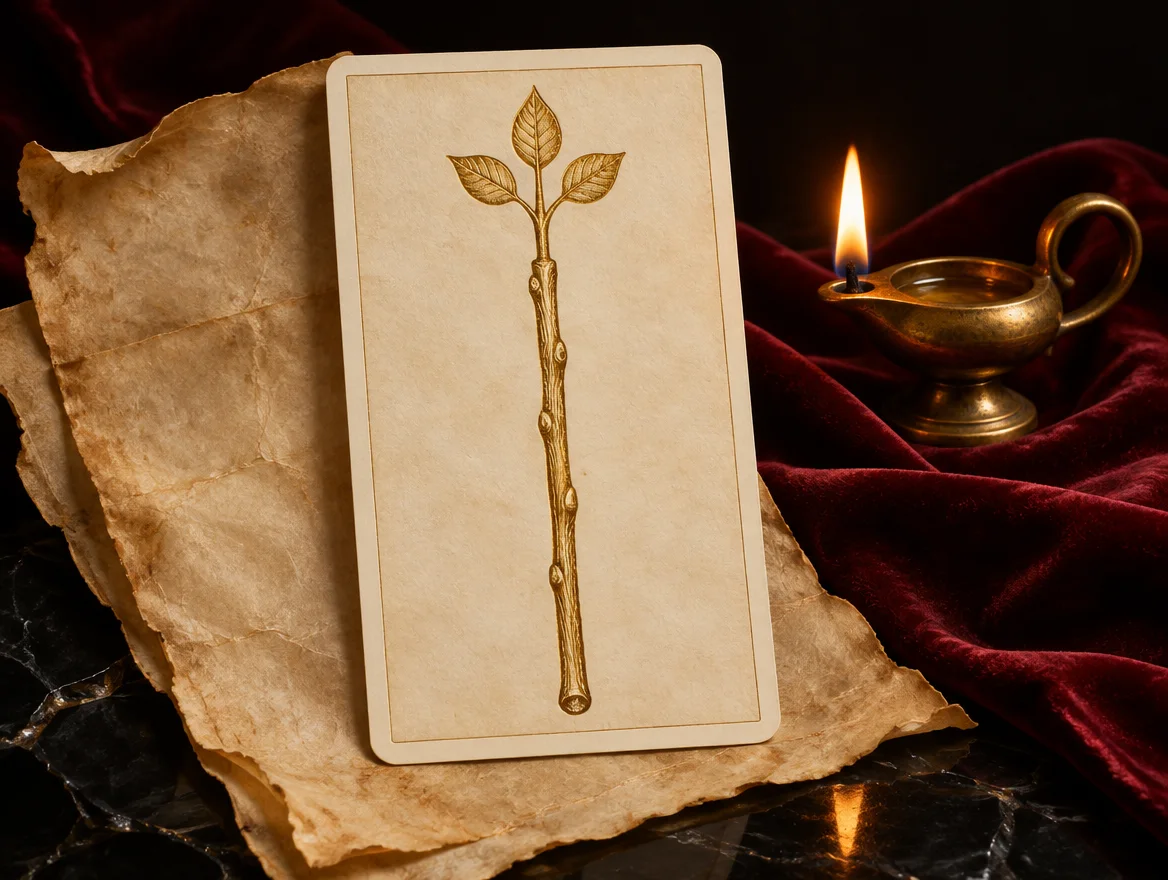
On the 1909 Smith card, which the sacred-texts page reproduces (card image via sacred-texts.com), the page holds a tall staff upright with both hands and looks up at its top, where small leaves are sprouting. He wears a feathered hat and a tunic patterned with salamander-like shapes, and the land behind him is bare, with mounds in the distance.
These details come from the 1909 card, not Waite’s text. On 9K, we take the sprouting staff as a living idea, still growing, and the upward gaze as fascination. That fascination is the card’s gift and its risk.
Page of Wands meaning upright
Upright, readers commonly take the Page of Wands as fresh enthusiasm and the willingness to explore. Waite’s divinatory notes list a faithful dark young man, a lover, an envoy and a postman, and say the card carries the main qualities of its suit and may signify family news (Waite, Pictorial Key). The chief qualities of Wands are fire’s qualities: drive, heat and desire.
On The 9th King, we read the upright card through five themes:
- A new spark. An idea, interest or desire that suddenly feels alive.
- The courage to try. Not mastery. Just the nerve to begin badly.
- Eager exploration. Curiosity with legs.
- A bold message. Readers often take it as news. On 9K it’s your urge to say something brave, not a prediction that someone will contact you.
- First steps. The early, clumsy, exciting stage of anything.
The upright card’s best quality is trying before you feel ready. When something lights you up, give it one real attempt before your inner critic writes the review.
Page of Wands reversed
Reversed, the fire scatters, stalls or turns into performance. Waite’s reversed keywords are anecdotes, announcements and bad news, and he adds indecision and the instability that comes with it (Waite, Pictorial Key). Modern readers often add impatience and burnout.
Notice Waite’s first two reversed words: anecdotes and announcements. All talk. On 9K, we read the reversed card through three patterns.
1. All spark, no follow-through
You start the course, the blog, the training plan, and by week three the excitement has moved on. The card can point to a habit of loving beginnings and dodging middles.
2. Restlessness dressed up as freedom
Waite’s note on indecision and instability fits here. You keep options open so long that you never commit to one. Exploration is healthy; perpetual exploration can be a way to avoid ever being tested.
3. The announcement replaces the action
This is the card’s biggest trap. The proclamation feels so good that it becomes the reward. You post the plan, enjoy the reaction, and the work never starts.
The check is simple: Would I still do this if nobody ever saw it? If the answer is yes, the spark is yours. If the answer is “not really,” you may be chasing the applause rather than the thing.
Wands, fire and the Golden Dawn: the card’s correspondences
The correspondences below are Golden Dawn–derived correspondences, the tradition The 9th King uses, which is the system the Rider–Waite–Smith deck draws on. Other schools differ, and not every card maps to a single sign; court cards, and Pages especially, work differently.
Wands are fire
In the Golden Dawn’s tarot text known as Book T, printed by Aleister Crowley as Liber LXXVIII, the Ace of Wands is called the Root of the Powers of Fire (Liber LXXVIII, sacred-texts.com).
The naming trap: Page, Knave, Princess
The Rider–Waite–Smith deck calls this card the Page. Liber LXXVIII lists it as the Knave of Wands and gives it the title “The Princess of the Shining Flame: the Rose of the Palace of Fire.” It also states that the four Princesses are the Knaves of the tarot pack (Liber LXXVIII).
The 9th King follows the court-card naming in Liber LXXVIII (the Golden Dawn’s Book T): Knights are fire of their suit, Queens water, Kings air, Pages earth. Matching that naming to the Rider–Waite–Smith cards is 9K’s convention, not something the source says about Waite’s deck, and other systems pair the court cards differently.
Element pairing: Earth of Fire
Liber LXXVIII lists the Princess of Wands as Earth of Fire, and as Princess and Empress of the Salamanders (Liber LXXVIII). Its character sketch is striking: brilliance, courage, beauty, force, enthusiasm and desire of power, sudden in anger or love. When ill dignified, it says, she is superficial, theatrical, unstable and domineering.
That list is this card in miniature: brilliance and courage upright, theatrical and unstable in shadow.
Earth is where things take form; fire is drive. So Earth of Fire is drive that has to land somewhere. Fire left alone flares and moves on. Fire given ground becomes a hearth or a lamp.
Why there’s no zodiac span
In the Golden Dawn system, the Kings, Queens and Princes rule spans of the zodiac, and Liber LXXVIII gives those spans from 20° of one sign to 20° of the next. The Princesses don’t take one. The text says the Princesses rule the four parts of the heavens around the North Pole and form the thrones of the four Aces. The Princess of Wands entry says she rules one quadrant of the heavens around the North Pole and is the Throne of the Ace of Wands (Liber LXXVIII).
In plain terms: the Page of Wands isn’t tied to birthday dates. She sits with the Ace, the raw seed of fire, and gives it a place to catch.
The fire signs, as element links
It can help to read the card alongside the three fire signs. This is an element link, not a claim that the card “is” any of them:
- Aries personality traits: fire as courage, starting first and acting fast.
- Leo personality traits: fire as self-expression, warmth and the wish to be seen.
- Sagittarius personality traits: fire as exploration, restlessness and the pull of the horizon.
Our zodiac shadow work guide covers the fire signs’ shadows, which overlap with this card.

The 9th King reading: tension, shadow and self-mastery
The 9K reading asks: What does this card show about how you handle your own fire?
The tension: the courage to try vs. the discipline to continue
The Page of Wands lives between starting and staying. Starting takes nerve: you risk looking foolish and being seen trying. The page has that nerve.
Staying takes patience with the boring middle, where the excitement fades and the work is still there. The page hasn’t been tested on that yet. Too much caution and you never begin; too much novelty and you never finish.
The shadow side
The card’s shadow shows up in a few familiar shapes:
- The serial starter. Ten half-finished projects, each abandoned the moment it got hard. I just lost interest.
- The announcer. Big plans shared widely, small actions taken quietly or not at all. The reaction becomes the reward.
- The novelty chaser. Always the next idea, never deep enough in one to be changed by it.
- The audience-dependent flame. Enthusiasm that only burns when someone’s watching, and dies when the likes stop.
If one of these stings, that’s information, not a verdict. Our Shadow Work, Plainly guide explains how to look at patterns like these without beating yourself up.
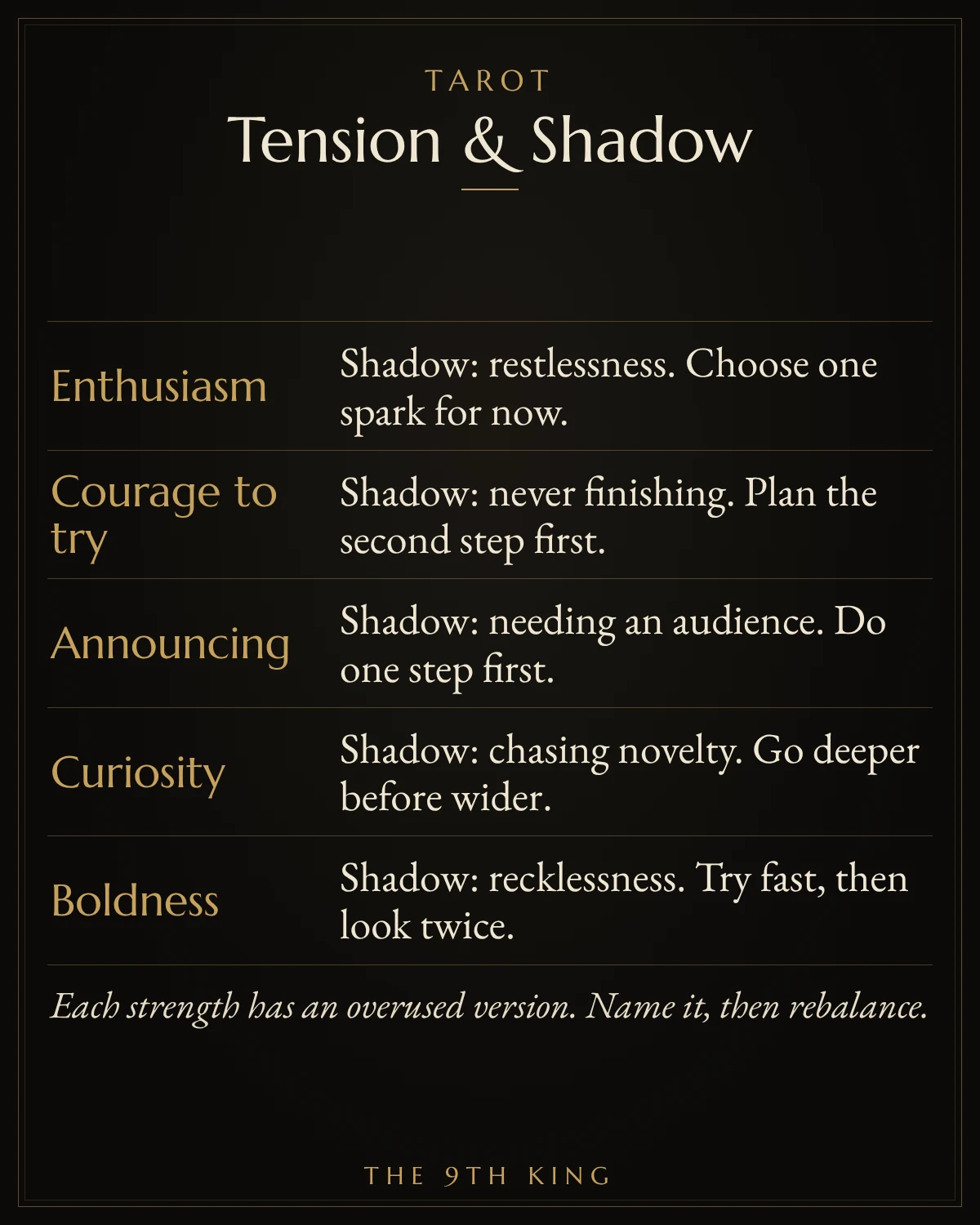
| Strength | Shadow version | The rebalance |
|---|---|---|
| Enthusiasm | Restlessness | Choose one spark for now |
| Courage to try | Never finishing | Plan the second step first |
| Announcing | Needing an audience | Do one step first |
| Curiosity | Chasing novelty | Go deeper before wider |
| Boldness | Recklessness | Try fast, then look twice |
The self-mastery lesson
The Page of Wands teaches one skill: honor the spark, then take the second step.
The first step is easy when you’re excited. The second step is the one you take when the rush has faded and nobody is clapping. That’s where the spark becomes a fire or goes out.
The Earth of Fire pairing says it plainly: fire needs ground. Give your enthusiasm a container: a set time, a small goal. You don’t have to commit to forever, just to again.
Other Wands cards show where that road leads. The Nine of Wands is fire that has been tested and keeps standing guard. The King of Wands is fire with a vision and the steadiness to lead. The Page is where both begin.
Page of Wands as feelings and in love
“Page of Wands as feelings” usually comes from someone wondering how another person feels about them. Here’s the honest 9K answer.
What readers commonly say
Readers often take the Page of Wands in a feelings position as excited, flirtatious, curious attraction: interest that’s warm and real but new, more spark than commitment.
What a card can and can’t tell you
A card can’t read another person’s mind. It can reflect the question you brought. A more useful question is: What is this card saying about my own fire? Are you the one with the staff, lit up by something new?
If you want to know how someone feels, ask them kindly and without pressure, and notice what they actually do over time.
Page of Wands in love
In a love reading, readers commonly associate the card with:
- New attraction. The early, electric stage of interest, or a playful, adventurous moment in a long relationship.
- Shared adventures and bold messages. Trying something new together, or saying the brave thing out loud.
Fire loves the chase. If a connection only feels alive while it’s new, ask whether you’re drawn to the person or to beginning. Our Moon vs Venus guide explains the difference between what you need and what you’re drawn to, and Fire and Water Relationships covers how fiery energy meets a more emotional partner.
The card doesn’t tell you to stay, leave, confess or wait. It offers a question: Is this a spark I want to tend, and am I being honest about what I want?
A worked example (fictional)
Devon (fictional) draws the Page of Wands after deciding, again, to start learning guitar. It’s the third attempt in two years.
Upright reading: the card can point to a real interest. Devon asks: What’s my second step? Devon books a practice time and picks one song. The spark gets ground.
If it had come up reversed: the reflection shifts to the announcer. Did Devon post about the guitar, enjoy the comments and leave it on the stand?
Neither reading predicts how Devon’s playing will go.
Page of Wands at work and in creative life
At work, readers often take the Page of Wands as a new idea, a pitch or an eager new role. Waite’s envoy fits: the person who carries the message and speaks first.
The card’s work lesson matches its self-mastery lesson. Pitch it, then build the first piece. A rough version you can show carries more weight than an idea you’ve only described. If you always have the exciting idea in the meeting, the card asks whether you also follow up.
Reversed, it often reflects scattered energy: too many projects open at once. Ask which one thing deserves your fire this month.
None of this is career or financial advice; it’s a prompt to notice where your enthusiasm is helping and where it’s running ahead of you.
Myths and misreadings about the Page of Wands
- “The Page of Wands means news is coming.” Waite lists an envoy and a postman, but a card isn’t a delivery notice. On 9K, read it as your own urge to announce or begin something.
- “It means someone is attracted to you.” It can reflect early interest, but it can’t tell you what’s in another person’s heart. Start with your own feelings.
- “It’s a lucky card for new ventures.” It’s about the courage to try, not a guarantee of success.
- “Reversed means bad news.” Waite’s reversed list includes bad news, but on 9K reversed cards point to a blocked or overused version of the same energy, not to misfortune.
- “The Page of Wands is an Aries card.” In the Golden Dawn system we use, Pages (Princesses) don’t take a zodiac span. Aries, Leo and Sagittarius are helpful fire-sign links, not official correspondences.
Journal prompts and a practical exercise
The prompts and exercise below are reflective practice, not therapy. If you’re working through trauma, abuse, thoughts of self-harm or distress that feels overwhelming, please work with a qualified therapist. And it’s always fine to stop a prompt that feels like too much and come back another day, or not at all.
Seven journal prompts for the Page of Wands
- What has lit me up in the last month, and what have I actually done about it?
- Which project or interest did I abandon at the second step, and what made me stop?
- When did I last try something new without needing to be good at it first?
- Who do I tell about my plans, and do I tell them before or after I act?
- Would I still pursue my current goal if no one ever saw it or praised it?
- Where is my restlessness protecting me from being tested?
- What’s my second step?
For more prompts in this style, see our shadow work prompts. If you want a card spread to go with them, try the Shadow Work Tarot Spread.
The exercise: Spark to Second Step
A short practice for the next time something new excites you. Use it on one small, real spark over about two weeks.
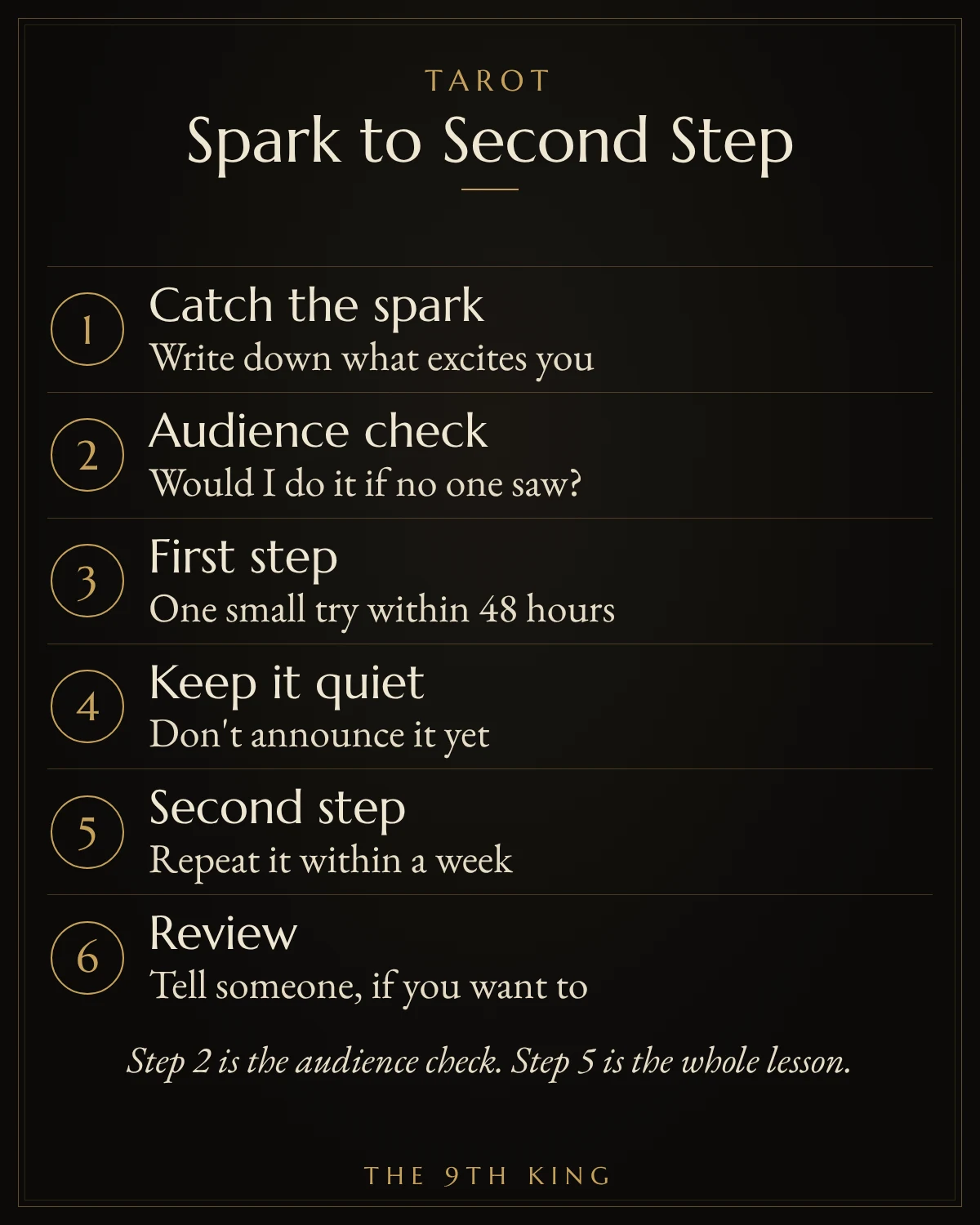
| Step | What to do | Example (fictional) |
|---|---|---|
| 1. Catch the spark | Write down what excites you | “I want to learn to cook Thai food.” |
| 2. Audience check | Would I do this if no one saw? | Yes, I’d cook it for myself |
| 3. First step | One small try within 48 hours | Make one simple curry |
| 4. Keep it quiet | Don’t announce it yet | No photos, no post |
| 5. Second step | Repeat it within a week | Try a second recipe |
| 6. Review | Tell someone, if you want to | Cook it for a friend |
- Step 2 is the audience check. If the honest answer is “not really,” that’s information, not failure. Ask whether you want the activity or the recognition.
- Step 4 protects the fire. Keeping a plan private for a week lets the action come first.
- Step 5 is the whole lesson. The second step matters more than the first.
- Not every spark needs a second step. Sometimes one try shows it isn’t for you. That’s exploration working.
If you like to read cards more intuitively, Code of Ascension’s guide to intuitive tarot (Code of Ascension) covers pairing card meanings with your first impressions.
Page of Wands: FAQ
What does the Page of Wands mean?
The Page of Wands is the youngest court card in the suit of Wands, the fire suit. Upright, readers commonly take it as fresh enthusiasm, eager exploration and the courage to try something new. On The 9th King it’s an invitation to honor a new spark and then take the second step, not a prediction that a venture will succeed.
What does the Page of Wands mean reversed?
Reversed, the Page of Wands often points to the same spark scattering into restlessness, false starts or a need for an audience. Waite’s reversed keywords include anecdotes, announcements and bad news, plus indecision and instability. The useful question is whether you’d still do the thing if nobody saw it. Reversed doesn’t mean bad luck; it means the fire needs ground.
What does the Page of Wands mean as feelings?
In a feelings position, readers often take the Page of Wands as excited, curious, flirtatious attraction: interest that’s warm and real but still new. A card can’t read another person’s mind, though. Ask what it says about your own fire, and if you want to know how someone else feels, ask them kindly and watch what they do over time.
What does the Page of Wands mean in love?
In love readings, the Page of Wands is commonly linked with new attraction, shared adventures and saying something bold. It doesn’t tell you to stay, leave, confess or wait; those choices are yours. Its shadow is loving the chase more than the person, so it asks whether you’re drawn to someone or to the thrill of beginning.
What element is the Page of Wands?
Wands are the fire suit. In the Golden Dawn system, the tradition The 9th King uses, the Page corresponds to the Princess of the Shining Flame, whose element pairing is Earth of Fire: the grounded part of fire, or drive that has to land somewhere. That’s the court-card naming this site uses throughout.
Does the Page of Wands have a zodiac sign?
Not in the Golden Dawn system. The Kings, Queens and Princes of that system rule spans of the zodiac, but the Princesses, which 9K matches to the Rider–Waite–Smith Pages, rule quadrants of the heavens around the North Pole and act as the thrones of the Aces. Because Wands are fire, Aries, Leo and Sagittarius are useful element links, but none is an official sign for this card.
Is the Page of Wands a person or a feeling?
It can be read either way. Court cards were traditionally read as people, and Waite described a faithful young man, a lover or an envoy. Many modern readers also treat them as parts of yourself. On The 9th King we start there: the Page of Wands is the eager, slightly restless part of you, and the question is whether you give it somewhere to grow.

Your next step: pick one thing that excites you right now and run Spark to Second Step over the next two weeks. Write down the date you take your second step. Then read the King of Wands to see where a well-tended fire can lead.
Explore Next
- Fire as courage and starting first: Aries Personality Traits
- Fire as self-expression: Leo Personality Traits
- Fire as exploration: Sagittarius Personality Traits
- New to tarot: Tarot for Beginners: How Tarot Really Works (Code of Ascension)
- More Wands on The 9th King: King of Wands · Nine of Wands
- More tarot: Tarot Card Meanings · Minor Arcana · Tarot & the Zodiac · Page of Cups · The Fool
- More cards in this set: Ace of Wands, Knight of Wands, Queen of Wands

Final Thought: Tend the Flame
Most of us are good at the first spark. The Page of Wands asks for something quieter and braver: keep going after the excitement fades, when nobody’s watching. You don’t have to finish everything you start. Just give the sparks that matter a second step. Know your nature. Rule your life.
About the Author
King is the founder of The 9th King, where zodiac psychology, relationships and shadow work are explored as tools for self-knowledge rather than fortune-telling. He’s a Libra Sun, and writes about the personal side of astrology on King The Kemist. Astrology on The 9th King is interpretation and self-reflection, not prediction or established fact.
Leave a Reply