
Quick Answer: What Does the Queen of Swords Mean?
The Queen of Swords is the queen of the suit of Swords, the tarot suit linked with air, the mind and the truth. In the classic Rider–Waite–Smith image, she sits on her throne holding a sword straight up, with her other hand held out, and her face shows someone who has known sorrow.
Keywords: clear perception, honesty, boundaries, independence, discernment, hard-won wisdom.
- Upright, in one line: you see a situation as it is, and the card invites you to speak plainly and set limits that come from experience, not from fear.
- Reversed, in one line: the same clarity turns sharp or shut, so the card asks whether you’re protecting yourself or cutting off feeling so you never have to hurt again.
On The 9th King, tarot is a mirror for self-knowledge, not fortune-telling. The Queen of Swords doesn’t predict a loss or a breakup. She points to how you use what you’ve learned: as a clear line, or as a wall.
Table of Contents
The Queen of Swords at a glance
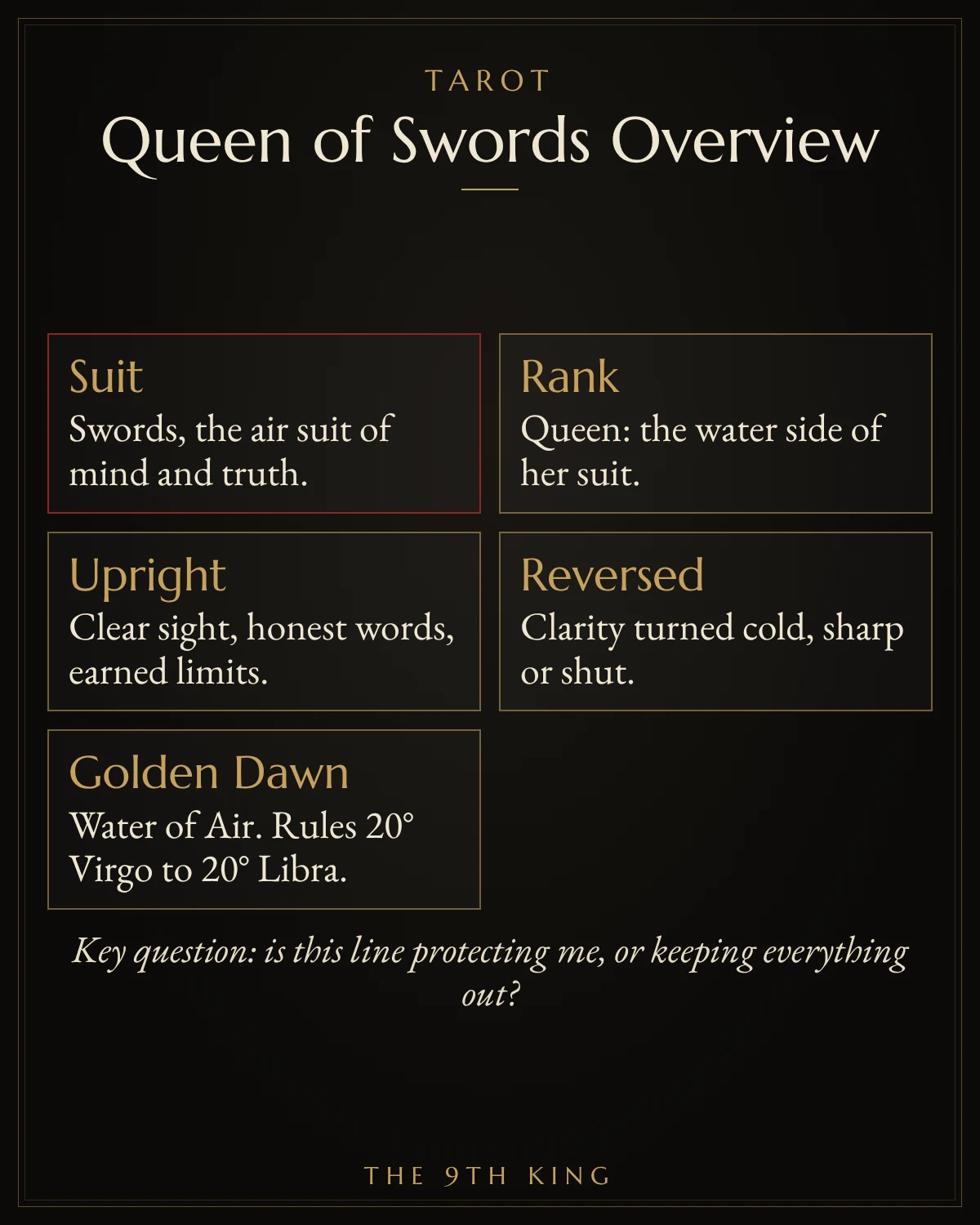
| Queen of Swords | |
|---|---|
| Arcana | Minor Arcana, court card |
| Suit | Swords (air) |
| Rank | Queen |
| Golden Dawn title | The Queen of the Thrones of Air |
| Element pairing | Water of Air |
| Zodiac span | 20° Virgo to 20° Libra |
| Upright themes | Clarity, honesty, earned boundaries |
| Reversed themes | Coldness, harshness, shutting feeling out |
| Key question | Is this line protecting me, or keeping everything out? |
What the Queen of Swords shows: the traditional imagery
Most readers know this card from the Rider–Waite–Smith deck, published by William Rider & Son in London in 1909. A.E. Waite gave the instructions and Pamela Colman Smith drew the cards; both were members of the Hermetic Order of the Golden Dawn (Wikipedia: Rider–Waite Tarot). Britannica dates the first tarot decks to Italy in the 1430s and their occult use to France around 1780 (Britannica: Tarot).
The upright sword and the open hand
Waite describes the scene simply. Her right hand raises the sword straight up, with the hilt resting on the arm of her royal chair. Her left arm is lifted and the hand held out (Waite, Pictorial Key, Queen of Swords, sacred-texts.com).
On 9K, we take those two hands as truth held firmly while still reaching toward people.
Her face
Waite says her expression is “severe but chastened; it suggests familiarity with sorrow” (Waite, Pictorial Key). He adds that she doesn’t stand for mercy, and that, despite her sword, she’s hardly a symbol of power.
Her authority isn’t force. It’s what remains after someone has been through something and come out seeing clearly.
On the 1909 Smith card
On the 1909 Smith card, her crown is decorated with butterflies, and clouds fill the sky around her, some bright and some darker. Modern readers often link the butterflies with the mind and the clouds with clarity and sorrow (Wikipedia: Queen of Swords). These details come from the card, not Waite’s text.
Queen of Swords meaning upright
Upright, readers commonly take the Queen of Swords as clear perception and honest speech: the ability to see what’s really going on and say it without cruelty. Modern readings often add self-sufficiency, independence and intelligence, along with very high standards for herself and others (Wikipedia: Queen of Swords).
On 9K, the Queen can be anyone, and most often she’s a part of you.
- Clear sight. You notice when a story doesn’t add up, including your own.
- Honest words. You’d rather say a kind, true thing than a comfortable, false one.
- Earned boundaries. Your limits come from what you’ve lived through, and you hold them calmly.
- Independence. You can stand on your own judgment.
Her best quality is clarity with warmth still in it.
Queen of Swords reversed
Reversed, the same gifts tip out of balance. Waite’s reversed list is short and blunt: malice, bigotry, artifice, prudery, bale and deceit (Waite, Pictorial Key). Liber LXXVIII, the Golden Dawn text this site follows, says that when she’s ill dignified (poorly placed in a reading) she can be cruel, sly and unreliable while keeping a pleasant surface (Liber LXXVIII, sacred-texts.com).
On 9K, we read the reversal through three patterns. None of them means bad luck, and none tells you anything about another person’s hidden motives.
1. The sword points outward: words that cut
Your sharp read on people comes out as criticism or sarcasm: honesty that has stopped caring whether it helps.
2. The hand closes: cutting people off to avoid feeling
Instead of a boundary, you build a wall. You end things fast, go quiet or decide you don’t need anyone, because being close once hurt too much. The reversed card asks: Am I stepping back because this person is unsafe, or because feeling anything again scares me?
Only you can sort them, and leaving can be exactly right.
3. The sorrow hardens: bitterness
Reversed, Waite’s sorrow can set like stone, and you meet new people as if they’re the one who hurt you. That’s where psychological projection is worth knowing about.
Waite’s 1911 reading: widowhood, sorrow and separation
Waite’s upright divinatory meanings for this card are some of the heaviest in the court: widowhood, female sadness and embarrassment, absence, sterility, mourning, privation and separation (Waite, Pictorial Key).
That’s his 1911 reading, written for a fortune-telling style of practice and in the gender language of his time. Modern summaries often carry it forward as the widow, crone or divorcée (Wikipedia: Queen of Swords).
The 9th King doesn’t read any of this as information about your life. A card can’t tell you about a death, a relationship ending, your body or your family. What we keep from Waite is the emotional core: this is a queen who has lost something and learned from it. Her clarity was paid for.
It can speak to any experience that taught you to see more clearly, from a friendship that ended to a job that showed you what you won’t accept again.
Swords, air and the Golden Dawn: the card’s correspondences
The correspondences below are Golden Dawn–derived correspondences, the tradition The 9th King uses, which is the system the Rider–Waite–Smith deck draws on. Other schools differ, and not every card maps to a single sign; court cards and Pages work differently from the numbered cards.
Swords are air
In the Golden Dawn’s tarot text known as Book T, printed by Aleister Crowley as Liber LXXVIII, the Ace of Swords is called the Root of the Powers of Air (Liber LXXVIII).
The court-card naming
The 9th King follows the court-card naming in Liber LXXVIII (the Golden Dawn’s Book T): Knights are fire of their suit, Queens water, Kings air, Pages earth. Matching those Golden Dawn titles to the Rider–Waite–Smith cards is 9K’s convention; other systems pair them differently, so check which naming a source uses.
For Queens the match is simple, because Liber LXXVIII prints this card’s name as “Queen of Swords.” It calls her “The Queen of the Thrones of Air” and lists her element pairing as Water of Air: the watery, receptive part of the mind (Liber LXXVIII).
She isn’t pure, cutting intellect. She’s a mind with feeling running underneath it.
What the Golden Dawn says about her
Liber LXXVIII’s own picture of her is different from Smith’s: a graceful crowned queen with wavy, curling hair, seated on a throne above grey cumulus clouds, with a winged child’s head as her crest. She holds a drawn sword, and in her other hand the severed head of a bearded man (Liber LXXVIII). On 9K we read that stark old image symbolically, as cutting away what deceives the mind.
Its character notes call her “intensely perceptive, keen observation,” subtle, quick, confident and fond of dancing and balancing (Liber LXXVIII). Balance is part of her nature.
Her zodiac span: 20° Virgo to 20° Libra
In Liber LXXVIII, the Kings, Queens and Princes each rule a span of the zodiac, running from 20° of one sign to 20° of the next, so that, in effect, they link one sign to the next. The Queen of Swords rules from 20° Virgo to 20° Libra (Liber LXXVIII). Aces and Princesses (the Pages) don’t take a span.
That span covers the last ten degrees of Virgo and the first twenty of Libra. Liber LXXVIII’s decan table assigns those three ten-degree slices to three numbered cards:
| Degrees | Decan ruler | Numbered card |
|---|---|---|
| 20°–30° Virgo | Mercury | Ten of Pentacles |
| 0°–10° Libra | Moon | Two of Swords |
| 10°–20° Libra | Saturn | Three of Swords |
Source: Liber LXXVIII. Liber titles the two Libra cards Peace Restored and Sorrow. Dates for these degrees shift slightly each year, so check your own placements by degree.
Virgo and Libra, as a pairing
Read the Queen alongside both signs as a reflection, not a personality claim:
- Virgo personality traits: the precise, discerning eye that notices what’s off and wants it right.
- Libra traits: the instinct for fairness, balance and weighing both sides.
Together: she sees exactly what happened and tries to judge it fairly. For the full map of cards and signs, see Tarot and the Zodiac. For the Major Arcana card most associated with fair judgment, see Justice.

The 9th King reading: tension, shadow and self-mastery
The 9K question: Did experience make you clear, or did it make you cold?
The tension: discernment vs. defense
The Queen of Swords lives between seeing clearly and shutting down. Discernment looks at a situation and decides what’s true and what you’ll accept. Defense decides in advance that nothing gets close enough to hurt.
From outside they look the same. The difference is inside: discernment still feels, and defense has stopped. The card asks for the upright sword and the open hand.
The shadow side
The card’s shadow tends to show up in a few familiar shapes:
- The critic. You see every flaw and say so, and call it honesty.
- The ice queen. You stop showing feeling so no one can use it against you.
- The exit artist. You leave people at the first sign of trouble, before they can leave you.
- The keeper of old wounds. Past hurt becomes the lens for everyone new.
If one stings, that’s information, not a verdict. Our zodiac shadow work guide covers the air and earth signs’ shadows, which overlap with this card.

| Strength | Shadow version | The rebalance |
|---|---|---|
| Clarity | Seeing every flaw | Name what’s good too |
| Honesty | Words that cut | Ask if it helps before you say it |
| Boundaries | Walls against feeling | Keep the line, open the hand |
| Independence | Needing no one | Let one person close |
| Experience | Bitterness | Let the past teach, not decide |
The self-mastery lesson
The Queen of Swords teaches one skill: let experience sharpen your sight without hardening your heart.
A boundary isn’t a punishment. It’s a clear sentence about what you’ll accept, based on what you’ve seen. It can sound like I’m not available for being spoken to that way, or I care about you, and I’m not lending money again. With some people, it can mean a permanent limit or leaving the relationship altogether. If anyone is harming you, your safety comes first, and responsibility for that harm belongs to the person causing it, never to you for not being forgiving enough.
The Queen asks whether a boundary is aimed at a real behavior or at the chance of ever feeling hurt again. The first is wisdom. The second slowly shrinks your life.
If your limits come out as silence or confusion, Privacy Without Mixed Signals can help. If the hardness started young, inner child work may help you meet the part of you that learned to armor up.
Queen of Swords as feelings and in love
What readers commonly say
Readers often take the Queen of Swords in a feelings position as clear-eyed, guarded feeling: care that wants honesty.
What a card can and can’t tell you
A card can’t read another person’s mind or tell you their motives. A more useful question: What is this card showing me about my own feelings? Are you the one holding the sword up, careful about who you let in?
If you want to know how someone feels, ask them, kindly and without pressure, and go by what they say and do over time.
Queen of Swords in love
In a love reading, readers commonly link the Queen of Swords with:
- Honest communication. Saying what you mean.
- Standards. Knowing what you’ll accept and what you won’t, often because you’ve learned the hard way.
- Independence inside closeness. Love that doesn’t require giving up your own judgment.
Reversed, it often turns to guardedness: testing a partner or ending things before you can be hurt. Ask: Am I being discerning, or am I refusing to risk anything?
The card doesn’t tell you to stay, leave, wait or confess. It asks whether your boundaries are clear and whether your heart is still in the room.
A worked example (fictional)
Marisol (fictional) draws the Queen of Swords after a new friend cancels plans for the third time. Her instinct is to stop replying.
Upright reading: the card can point to Marisol’s gift: she notices patterns. She asks: What do I actually know? She could tell the friend, “I’ve noticed plans keep falling through. Can we pick something we’ll both keep?” Or she can let it go. Both are honest choices.
If it had come up reversed: Marisol asks: Am I reacting to this friend, or to the last one who disappeared? Am I cutting this off so I don’t feel disappointed?
Neither reading explains why the friend cancelled.
Queen of Swords at work and in daily life
At work, readers often take the Queen of Swords as the clear thinker: the editor, the reviewer, the manager who gives direct feedback. The card’s work lesson: be accurate, and stay humane. Feedback lands better when it names what works too.
Reversed, it can point to being known as the harsh one.
None of this is career or financial advice.
Myths and misreadings about the Queen of Swords
- “The Queen of Swords means you’ll be widowed or divorced.” That comes from Waite’s 1911 list (Waite, Pictorial Key). On 9K, a card doesn’t predict a death, a divorce or any life event.
- “She’s a cold, bitter woman.” Cold and bitter is her reversed shadow, not her nature. Upright, she’s clear and still reaching out.
- “The Queen of Swords always means a woman.” Waite read court cards as people and often by gender. On 9K, the Queen can stand for anyone, and most often for a part of you.
- “The Queen of Swords is a Libra card.” In the Golden Dawn system we use, her span runs from 20° Virgo to 20° Libra, so it reaches into both signs.
Journal prompts and a practical exercise
The prompts and exercise below are reflective practice, not therapy. If you’re working through trauma, abuse, thoughts of self-harm or distress that feels overwhelming, please work with a qualified therapist. And it’s always fine to stop a prompt that feels like too much and come back another day, or not at all.
Seven journal prompts for the Queen of Swords
- What has experience taught me that I’m grateful to know?
- Which of my boundaries feel calm, and which feel like armor?
- When did I last say something true in a way that hurt more than it needed to?
- Who have I cut off, and was it about their behavior or about my fear?
- What old hurt am I still using to judge new people?
- What would it look like to hold a firm line and still be warm?
- Is this line protecting me, or keeping everything out?
For more prompts in this style, see our shadow work prompts. New to shadow work? Shadow Work, Plainly explains how to start safely.
The exercise: the Clear Line
Use it when you’re deciding whether to set a limit, pull back or end something.

| Step | What to do | Example (fictional) |
|---|---|---|
| 1. State the facts | What happened, with no guesses about motives | “Plans were cancelled three times.” |
| 2. Name the feeling | One word for what it stirred in you | Disappointed |
| 3. Name the lesson | What this has taught you before | “I stop trying when I feel unchosen.” |
| 4. Draw the line | One plain sentence about what you’ll accept | “I’ll make plans we both confirm.” |
| 5. Check the hand | Is this aimed at a behavior, or at feeling anything? | At the behavior. Hand still open. |
- Step 1 is the sword. Facts first. Only the other person can confirm why they acted.
- Step 3 is the sorrow Waite saw. Your history is real information. It just doesn’t get the final say.
- Step 4 can be private. You don’t have to announce a boundary. Telling the other person is a choice, when it’s safe and useful.
- Step 5 is the open hand. If the honest answer is “I want to feel nothing,” that’s worth noticing, not judging. If someone is unsafe, stepping away is the answer, and the line can be permanent.
To go deeper, try our Shadow Work Tarot Spread, or pull a quick three-card spread on one boundary you’re weighing. If you read intuitively, Code of Ascension’s guide to intuitive tarot (Code of Ascension) covers pairing card meanings with your first impressions.

Queen of Swords: FAQ
What does the Queen of Swords mean?
The Queen of Swords is the queen of the air suit, the suit of the mind and the truth. Upright, readers commonly take her as clear perception, honesty, independence and boundaries that come from experience. Her two hands are the key image: one holds the sword up, the other reaches out. On The 9th King, she’s a mirror for how you use what you’ve learned, not a prediction about anyone in your life.
What does the Queen of Swords mean reversed?
Reversed, the Queen of Swords often points to clarity out of balance: honesty that cuts, criticism that never lets up, or cutting people off so you never have to feel hurt again. It can also point to old sorrow hardening into bitterness. Reversed doesn’t mean bad luck, and it can’t reveal another person’s motives. It asks whether your boundaries still have a warm hand next to them.
What does the Queen of Swords mean as feelings?
In a feelings position, readers often take the Queen of Swords as clear-eyed, guarded feeling: care that comes with honesty and high standards. A card can’t read another person’s mind, though. Start by asking what it shows about your own feelings, especially how carefully you’re letting someone in. If you want to know how someone else feels, ask them directly and watch what they do over time.
What does the Queen of Swords mean in love?
In love readings, the Queen of Swords is commonly linked with honest communication, clear standards and independence within a relationship. Reversed, it often points to guardedness, sharpness or ending things before you can be hurt. It doesn’t tell you to stay, leave, wait or confess. It asks whether your limits are clear and whether you’re still willing to feel something.
What zodiac sign is the Queen of Swords?
In Liber LXXVIII, the Golden Dawn tarot text The 9th King follows, the Queen of Swords rules from 20° Virgo to 20° Libra. So she isn’t tied to one sign; her span links late Virgo with early and middle Libra. Other systems assign court cards differently, so check which tradition a source follows before comparing.
What element is the Queen of Swords?
Swords are the air suit, and Liber LXXVIII lists the Queen of Swords as Water of Air, the watery part of air. The 9th King follows that book’s court-card naming: Knights are fire of their suit, Queens water, Kings air and Pages earth. That makes the Queen of Swords a mind with feeling underneath it, not cold intellect alone.
Does the Queen of Swords mean widowhood?
Waite’s 1911 Pictorial Key lists widowhood, mourning and separation among her meanings, and many modern summaries repeat that. The 9th King reads it differently. A card can’t tell you anything about a death, a marriage or your family. We keep the emotional core of Waite’s reading: she is someone who has known sorrow and come out of it seeing clearly.

Your next step: the next time you feel the urge to pull away from someone, run the Clear Line above and write your answer to step 5. Then read Privacy Without Mixed Signals to practice holding a boundary clearly and kindly.
Explore Next
- Holding limits without confusion: Privacy Without Mixed Signals
- The precise, discerning eye: Virgo Personality Traits
- The instinct for balance: Libra Traits
- When old hurt colors new people: Psychological Projection
- Her water-suit sister: Queen of Cups
- New to tarot: Tarot for Beginners: How Tarot Really Works (Code of Ascension)
- More tarot on The 9th King: Tarot Card Meanings · Minor Arcana · Tarot & the Zodiac · Justice
- More cards in this set: Ace of Swords · Page of Swords · Knight of Swords · King of Swords
Final Thought: Keep the Sword Up and the Hand Open
You don’t have to go cold to stay safe. The Queen of Swords has lived through sorrow and come out seeing clearly, and she still holds one hand out. Let what you’ve been through sharpen your sight, draw your lines in plain words, and keep your heart in the room. Know your nature. Rule your life.
About the Author
King is the founder of The 9th King, where zodiac psychology, relationships and shadow work are explored as tools for self-knowledge rather than fortune-telling. He’s a Libra Sun, and writes about the personal side of astrology on King The Kemist. Astrology on The 9th King is interpretation and self-reflection, not prediction or established fact.
Leave a Reply