
Quick Answer: What Does the Wheel of Fortune Tarot Card Mean?
The Wheel of Fortune tarot card is trump X, the tenth card of the Major Arcana. It shows a great turning wheel marked with letters and symbols, a serpent and a jackal-headed figure moving around its rim, a sphinx at the top and four creatures in the corners. Readers most often take it as a card of cycles, turning points and change you didn’t choose.
- Keywords: cycles, turning points, change, momentum, the bigger pattern.
- Upright, in one line: something is turning, and the card asks where you’re standing as it moves.
- Reversed, in one line: resisting a turn, feeling stuck at the bottom, or repeating a loop you haven’t looked at yet.
- Astrology (Golden Dawn–derived, the tradition The 9th King uses): Jupiter.
On The 9th King, tarot is a mirror for self-knowledge, not fortune-telling. The Wheel doesn’t predict your luck. It asks: what is turning on its own, and what part is yours to move?
Table of Contents

The Wheel of Fortune tarot card at a glance
| Wheel of Fortune | |
|---|---|
| Number | X (10) |
| Arcana | Major |
| Golden Dawn title | The Lord of the Forces of Life |
| Core theme | Cycles and turning points |
| Upright | Change, momentum, a turn |
| Reversed | Resistance, a stuck loop |
| Golden Dawn planet | Jupiter |
| Key question | What’s turning, and what’s mine? |
One fact about wheels carries this card: the rim moves fast and the center barely moves. That’s the whole lesson.
What’s on the Wheel of Fortune card: the traditional imagery
The best-known version is the Rider–Waite–Smith card, explained in A.E. Waite’s 1911 The Pictorial Key to the Tarot. Here is the traditional card in words.
The wheel and its letters
At the center is a large wheel. Waite says he followed the reconstruction of the French occultist Éliphas Lévi, and that the letters of Taro, rearranged as Rota, are written on the wheel, alternating with the letters of the Divine Name (Waite, The Pictorial Key to the Tarot, X. Wheel of Fortune, at sacred-texts.com). Rota is Latin for “wheel,” and the four Hebrew letters are usually transliterated YHWH. The Rider–Waite wheel also carries alchemical symbols for the four elements (Wikipedia: Wheel of Fortune (tarot card)).
The serpent and the rising figure
On the left, a serpent slides down the rim. Waite identifies it as Typhon and chose to draw it as a serpent. Typhon is a monstrous serpent-giant from Greek myth who was later identified with Set, the Egyptian god of destruction (Wikipedia: Typhon). On the right, a jackal-headed figure modeled on the god Anubis rises with the wheel (Wikipedia: Wheel of Fortune (tarot card)).
The sphinx on top
A sphinx sits at the top of the wheel. Waite reads the sphinx as the point of balance inside all that motion. He also complains that some decks put the sphinx on a pedestal above the wheel, which he felt spoiled the point. The idea he wanted kept was stability in the middle of movement (Waite, X. Wheel of Fortune).
The four living creatures
In the four corners are a man (or angel), an eagle, a lion and a bull. Waite identifies them as the four Living Creatures of Ezekiel’s vision (Waite, X. Wheel of Fortune). Later occult readers matched them to the four fixed signs of the zodiac: Aquarius, Scorpio, Leo and Taurus (Wikipedia: Wheel of Fortune (tarot card)).
What Waite said the picture means
Waite was direct. With Lévi, he read the image as standing for “the perpetual motion of a fluidic universe and for the flux of human life.” He added that behind the symbol lies a denial of chance, and he was openly scornful of the grand occult meanings other writers had attached to the card (Waite, X. Wheel of Fortune).

The art on this page is an original 9K line-art interpretation: it keeps the wheel, its hub and four corner emblems, and leaves out the figures described above.
Where the Wheel of Fortune comes from
The wheel is much older than tarot. In ancient and medieval thought, the Wheel of Fortune, or Rota Fortunae, belonged to the goddess Fortuna, who turned it and raised or lowered the people on it. The Roman philosopher Boethius made the image famous around 520 in The Consolation of Philosophy, where Philosophy points out that a wheel which stops turning is no longer the wheel of chance (Wikipedia: Wheel of Fortune (medieval)).
Medieval artists often drew four people on it, labeled in Latin: regnabo (I shall reign), regno (I reign), regnavi (I have reigned) and sum sine regno (I am without a kingdom) (Wikipedia: Wheel of Fortune (medieval)).
According to Britannica, tarot decks were invented in Italy in the 1430s by adding a fifth suit of 21 illustrated trumps, plus an odd card called the fool, to the ordinary pack. Britannica lists the wheel of fortune as trump X and dates the use of tarot for fortune-telling to France around 1780.
The Morgan Library & Museum holds a hand-painted Wheel of Fortune from the Visconti-Sforza deck, probably by Bonifacio Bembo, made in Milan around 1450 to 1480 (The Morgan: The Wheel of Fortune). The Morgan notes that tarot began as an aristocratic card game and only centuries later became linked with “the power of fate” (The Morgan: Tarot cards).
Waite notes that the eighteenth-century card had a seven-spoked wheel with odd half-animal figures climbing and falling (Waite, Part I, The Trumps Major, at sacred-texts.com). The Egyptian figures came later, through Lévi and Waite. The card has always said that positions change. It never promised anything about your next spin.
Wheel of Fortune upright meaning
Upright, most readers take the Wheel of Fortune as a card of change, cycles and turning points.
Waite’s own short list of divinatory meanings was “destiny, fortune, success, elevation, luck, felicity” (Waite, Part III, at sacred-texts.com). In the same section he called fortune-telling meanings for the trumps artificial and arbitrary. On The 9th King, we focus on cycles rather than predicting luck, so we read the card as a turn in the cycle.
The upright themes readers commonly use:
- A turning point. Something in your situation has started to move. Ask what is turning and what part is yours.
- Cycles. Patterns that repeat across seasons, years or relationships.
- Momentum. Things picking up speed after a still period.
- Change you didn’t choose. Shifts in other people or circumstance that you respond to rather than control.
The 9K angle: find the hub
The rim is where the serpent falls and the figure rises. The center barely moves. Upright, the Wheel can point to a moment when the rim of your life is moving and you need to find your hub: the values, habits and choices that stay yours whatever position you’re in. Ask yourself:
- What’s turning here that I didn’t start and can’t stop?
- What stays mine no matter where the wheel lands?
Wheel of Fortune reversed meaning
Reversed, the relationship to the cycle has gone wrong. Waite’s reversed meanings were about increase and abundance, not doom (Waite, Part III). Modern readers commonly take it as:
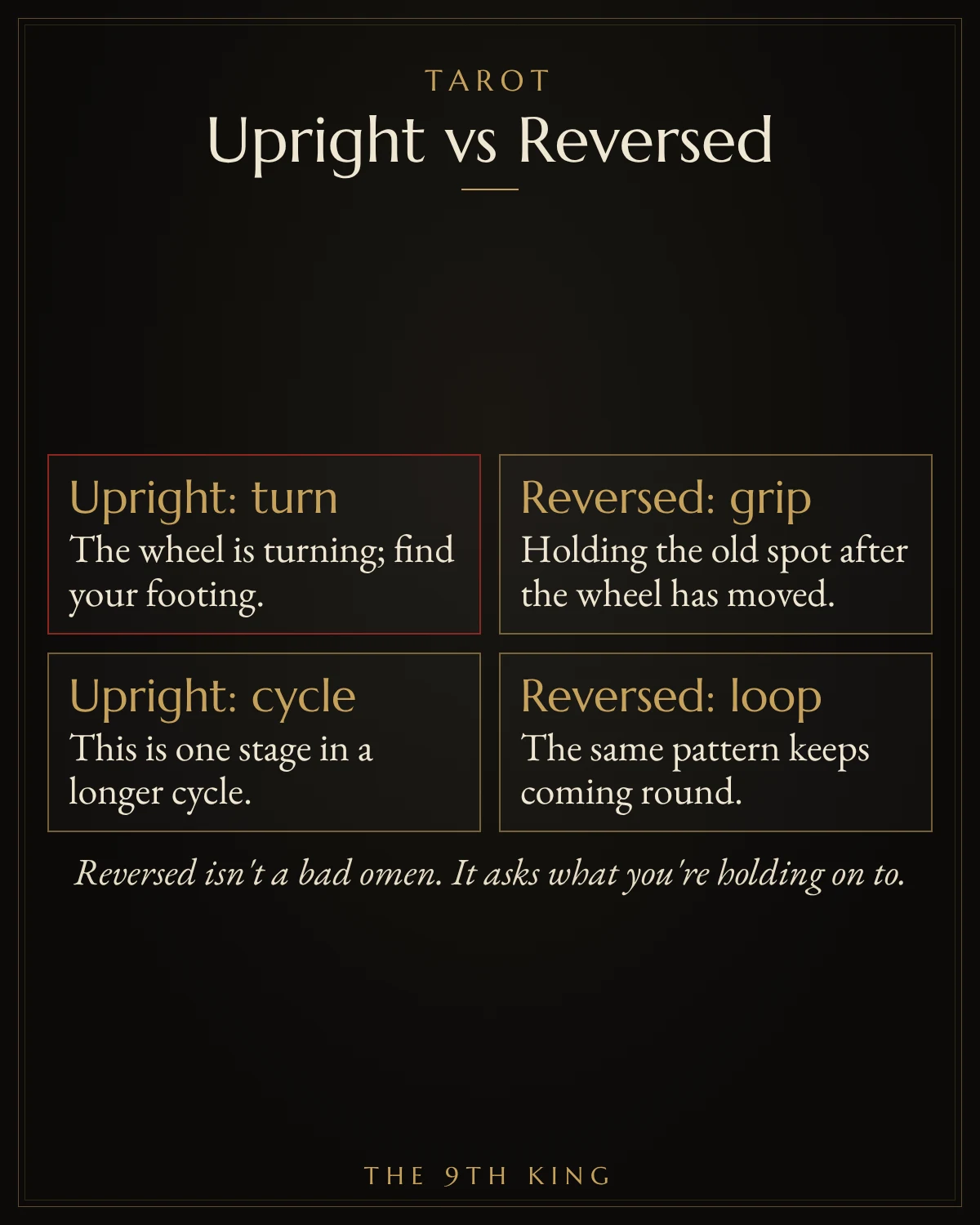
- Resisting the turn. Gripping the old position after the wheel has already moved.
- Feeling stuck at the bottom. A low point that seems permanent, even though wheels don’t stop.
- A repeating loop. The same kind of job, partner or argument coming round again.
- Outsourcing your agency. Waiting for “luck to change” instead of working on the part that’s yours.
| Upright | Reversed | Ask yourself |
|---|---|---|
| The wheel is turning | Gripping the old spot | What has already moved? |
| One stage of a cycle | “It’ll always be this way” | When did this last change? |
| Responding to change | Waiting for luck | What’s mine to do? |
| Seeing the pattern | Repeating the loop | Where have I seen this before? |
A reversed card isn’t a bad omen. The upright Wheel asks where are you standing as it turns? The reversed Wheel asks what are you holding on to that has already moved?
The Wheel of Fortune and Jupiter: the astrology correspondence
The Wheel’s astrology link comes from the Hermetic Order of the Golden Dawn, the late nineteenth-century magical order whose system the Rider–Waite–Smith deck draws on. These are Golden Dawn–derived correspondences, the tradition The 9th King uses. Other schools of tarot and astrology assign cards differently, and not every card maps to a single sign or planet.
What the Golden Dawn assigned
The Golden Dawn’s tarot text, Book T, was printed by Aleister Crowley as Liber LXXVIII. Its list of trumps gives card 10 as The Wheel of Fate, with the title The Lord of the Forces of Life, and the planet Jupiter (Liber LXXVIII, the Golden Dawn’s Book T, sacred-texts.com).
Notice the title: not the lord of luck, but of the forces of life, the currents no single person owns.
What Jupiter adds to the reading
Astrologers associate Jupiter with growth, expansion, belief and meaning; our Jupiter return guide covers those themes in depth. Before the modern planets were found, Jupiter was given rulership of two signs: Sagittarius and Pisces. Modern astrologers usually give Pisces to Neptune and keep Jupiter as its traditional ruler (Wikipedia: Domicile (astrology)).
With Jupiter in the picture, the Wheel reads less like a coin toss and more like growth that comes in seasons. The link doesn’t make the card “about” Sagittarians, Pisceans or your Sun sign. It’s a symbolic bridge between two languages.
The Jupiter return: a natural Wheel moment
Jupiter takes about 12 Earth years to orbit the Sun (NASA: Jupiter Facts). Astrologers call the moment it comes back to its birth position the Jupiter return, which falls roughly at ages 12, 24, 36, 48, 60 and so on. That guide explains how to find yours and reads it as a reflective season, not a guaranteed windfall.
If you’re near a Jupiter return, the Wheel makes a good companion: a prompt to ask what grew in the last cycle, not a forecast. A solar return chart marks each personal year, and natal chart vs transits explains how moving planets touch your birth chart. Neither is needed to read the card.
The Wheel and The World share four creatures
The same four creatures appear on the traditional Wheel and on The World. Waite places Ezekiel’s four Living Creatures in the corners of the Wheel, and describes the four living creatures of the Apocalypse and Ezekiel’s vision grouped around the garland of The World (Waite, X. Wheel of Fortune; Waite, Part I, The Trumps Major).
| Wheel of Fortune (X) | The World (XXI) | |
|---|---|---|
| Center | A turning wheel | A dancer in a wreath |
| Corners | Four living creatures | Four living creatures |
| Mood | Mid-cycle motion | A cycle completed |
| Golden Dawn | Jupiter | Saturn |
The 9K reading: tension, shadow and the self-mastery lesson
The tension: control vs surrender
The Wheel sits between two pulls:
- Control: If I plan hard enough, nothing will knock me off.
- Surrender: It’s all fate. Nothing I do matters.
Control pretends the rim is yours. Surrender pretends the hub isn’t. The Wheel asks for the harder middle: accept what’s turning, and own your response.
The shadow side of the Wheel of Fortune
The shadow is the overused or avoided version of the card’s gift. For the Wheel it often looks like this:
- Fatalism. Treating every setback as destiny, so nothing needs to change.
- Luck-chasing. Waiting for the next spin to rescue you instead of acting now.
- Victim storytelling. Telling the story of your life only from the bottom of the wheel.
- Taking all the credit. At the top, believing you got there purely on merit and that the wheel won’t turn for you.
If one of these stings, that’s information, not a judgment. Shadow Work, Plainly explains the idea, and our zodiac shadow work guide shows how patterns like these can show up in a chart. If you notice yourself blaming “the universe” for things another person chose, psychological projection is a useful lens.
The self-mastery lesson
Live from the hub. That’s the Wheel’s lesson in four words.
You can’t stop a season from changing, but you can decide who you are in every season. Mastery isn’t beating the wheel. It’s building a center steady enough that you don’t need to.
A brief, warm note before the exercises: this is reflective practice, not therapy. If you’re dealing with trauma, abuse, thoughts of self-harm or distress that feels overwhelming, please work with a qualified therapist. And it’s always fine to stop a prompt that feels like too much. When hard things happen, the responsibility for harm someone else caused belongs to them, never to you for “not responding well enough.”
The Wheel of Fortune in love and work
The Wheel in love
In love, the Wheel is often taken as a relationship entering a new phase or a familiar pattern showing up again. It doesn’t tell you whether to stay, leave, commit or wait. Those are your decisions. It can ask better questions:
- What season is this relationship in right now, and what does this season need?
- Is this a new turn, or an old loop I’ve been round before?
Reversed, it often points to repeating patterns: choosing the same kind of partner, or having the same argument in new clothes. For how charts describe relationship dynamics, see synastry for beginners.
The Wheel at work
At work, readers take the Wheel as a shift in conditions: a reorganization, a market change, a new manager, an unexpected opening. Practical ways to work with it:
- Separate the weather from your work. Note what changed around you and what you can still do well.
- Pick one controllable move. Update a skill, have one conversation, or finish one piece of work you’re proud of.
This isn’t career or financial advice, and the card doesn’t predict outcomes.
A practical exercise: The Hub Practice
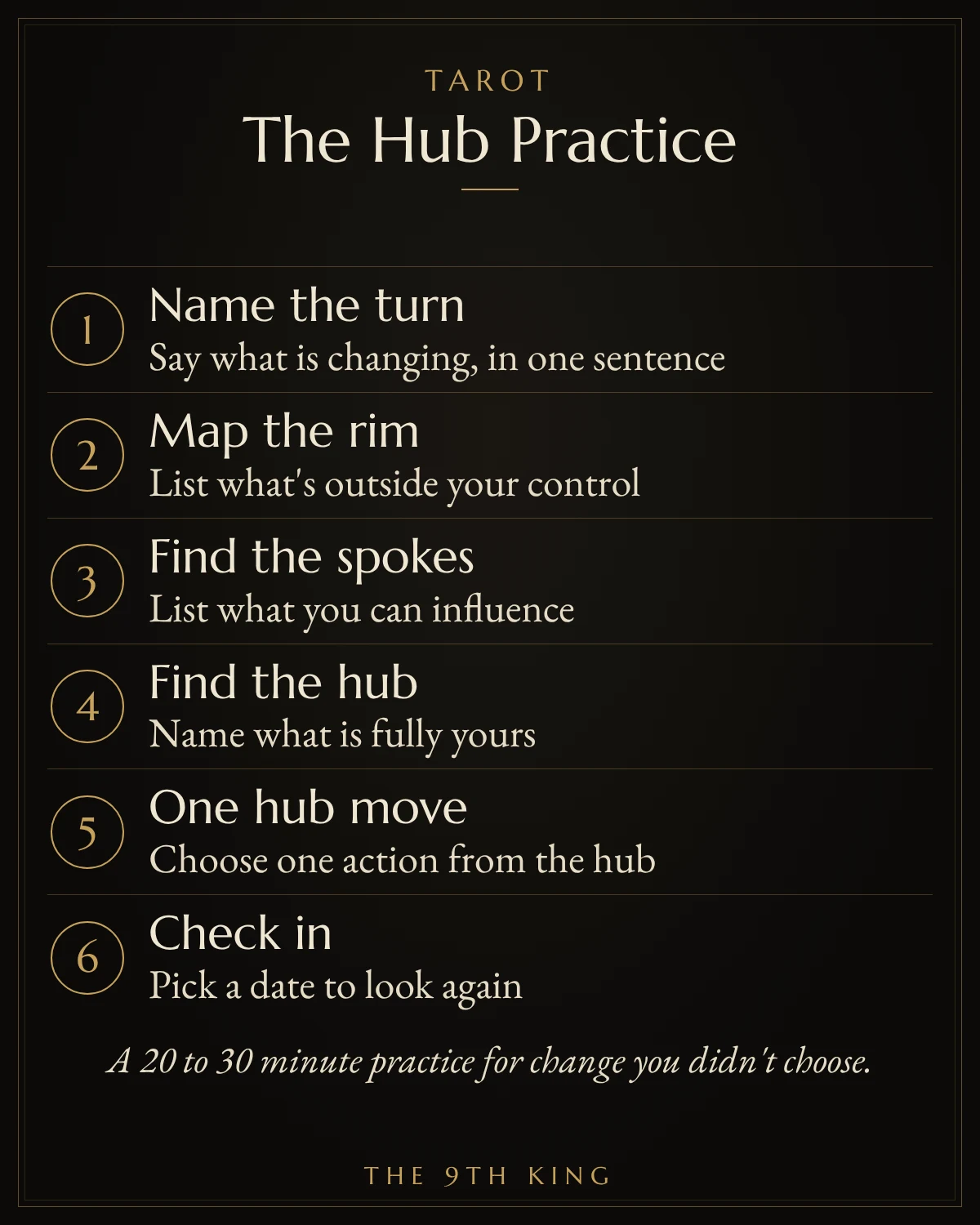
This takes 20 to 30 minutes. Use it for any situation where something is changing that you didn’t choose.
The six steps
- Name the turn. Write one sentence: “What’s changing is…” Be specific: “my team is being merged” beats “everything is chaos.”
- Map the rim. List what’s outside your control: other people’s choices, timing, the past.
- Find the spokes. List what you can influence but not decide: conversations, requests, preparation.
- Find the hub. Name what is fully yours: your values, effort, how you treat people, what you say yes and no to.
- One hub move. Choose one action that comes from the hub, small enough to do this week.
- Check in. Pick a date to look again. Wheels keep turning, and the map will change.
There’s no right ratio. Some weeks the hub feels tiny. That’s honest, and fine.
The worksheet
| Step | Your answer |
|---|---|
| Name the turn | |
| Map the rim | |
| Find the spokes | |
| Find the hub | |
| One hub move | |
| Check in |
A worked example (fictional)
Dev (fictional) finds out his company is being bought, and nobody knows yet which roles will stay. He’s been refreshing his inbox all week. He draws the Wheel and runs the practice.
- Name the turn: “My company is being acquired and my role is uncertain.”
- Map the rim: the buyer’s plans, the timeline, the job market.
- Find the spokes: asking his manager what she knows, keeping in touch with two former colleagues.
- Find the hub: doing good work, being decent to anxious teammates, keeping evenings for his family.
- One hub move: he updates his portfolio and checks email twice an evening, not twenty times.
- Check in: two weeks, or sooner if there’s an announcement.
The card predicted nothing about the acquisition. It gave Dev a way to stop living on the rim.
Journal prompts for the Wheel of Fortune
- What in my life is turning right now that I didn’t choose?
- When I’m at the bottom of a cycle, what story do I tell about myself?
- When I’m at the top, what do I forget?
- Which pattern keeps coming back to me, and what might it be asking me to learn?
- What would “living from the hub” look like for me this week?
- Looking back over the last twelve years, what has grown in me?
For more questions in this style, see our shadow work prompts.
Myths and misreadings about the Wheel of Fortune
- “The Wheel means good luck is coming.” Tarot on The 9th King doesn’t predict luck. Even Waite read the symbol as a denial of chance rather than a promise of it.
- “It’s a ‘yes’ card.” We don’t do yes/no readings here. Ask what’s mine to do while it turns?
- “Reversed means bad luck.” Waite’s own reversed meanings were increase and abundance. Modern readers take reversal as resistance or a repeating loop: information about your relationship to change, not a curse.
- “Everything is fate, so nothing matters.” The card shows motion and a sphinx holding steady. Change and choice sit on the same card.
- “Jupiter means guaranteed growth or money.” In this tradition Jupiter is a symbol of growth and meaning. It isn’t a promise of a windfall, and nothing here is financial advice.
New to tarot? Tarot for Beginners (Code of Ascension) explains how a reading works, and Intuitive Tarot (Code of Ascension) shows how to read a card’s imagery by feel.

Wheel of Fortune Tarot Card: FAQ
What does the Wheel of Fortune tarot card mean?
The Wheel of Fortune is trump X, the tenth card of the Major Arcana. Readers most often take it as a card of cycles, turning points and change you didn’t choose. On The 9th King it’s read as a mirror, not a prediction. It asks what in your situation is turning on its own, and what part of it, your values, effort and response, is actually yours to move.
What does the Wheel of Fortune reversed mean?
Reversed, the Wheel is commonly read as resisting a change that has already happened, feeling stuck at a low point, or repeating a familiar loop. Interestingly, A.E. Waite’s own reversed meanings were increase and abundance, so the reversal isn’t a curse. A useful way to read it is to ask what you’re gripping that has already moved, and which pattern keeps coming round.
What planet is the Wheel of Fortune linked to?
In the Golden Dawn system, the tradition The 9th King uses, the Wheel of Fortune is linked to Jupiter. The Golden Dawn’s Book T, printed as Liber LXXVIII, calls the card The Wheel of Fate and gives it the title The Lord of the Forces of Life. Jupiter traditionally rules Sagittarius and Pisces. Other tarot traditions may assign the card differently.
What does the Wheel of Fortune mean in a love reading?
In love, the Wheel is often read as a relationship entering a new phase, or an old pattern coming back round. Reversed, it can point to repeating the same dynamic with different people. It doesn’t tell you whether to stay, leave or commit. It invites you to name the season the relationship is in and notice whether this is a new turn or a familiar loop.
Is the Wheel of Fortune a yes or no card?
Some readers treat the Wheel as a “yes,” but The 9th King doesn’t use tarot for yes/no answers or predictions. A more useful question is “what’s turning here, and what’s mine to do?” Framed that way, the card gives you something to act on, like one small move from your values, rather than a guess about how the next spin will land.
How are the Wheel of Fortune and The World connected?
On the traditional Rider–Waite–Smith cards, both show four living creatures in the corners: a man or angel, an eagle, a lion and a bull. Waite links them to Ezekiel’s vision. Many readers see the Wheel as a cycle in motion and The World as a cycle completed. In the Golden Dawn system, the Wheel is linked to Jupiter and The World to Saturn.
Does the Wheel of Fortune mean my Jupiter return is happening?
No. The card doesn’t tell you anything about your chart. Your Jupiter return depends on where Jupiter was when you were born, and it comes round roughly every 12 years. The Wheel and the Jupiter return simply share a theme: growth that comes in cycles. If you happen to be near a return, the card makes a good reflective companion.

Your next step: pick one situation in your life that’s changing without your permission, and run the Hub Practice on it this week. Then look up when your next (or last) Jupiter return falls with our Jupiter return guide, and ask what has grown in you since the last turn of that 12-year wheel.
Explore Next
- Jupiter’s traditional signs: Sagittarius Personality Traits · Pisces Traits
- Cycles and turning points: Jupiter Return · Natal Chart vs Transits · Solar Return Chart
- Go deeper into the shadow: Shadow Work Prompts · Zodiac Shadow Work
- More tarot on The 9th King: Tarot Card Meanings · Major Arcana · Tarot & the Zodiac · The World · Justice · Three-Card Tarot Spread · Shadow Work Tarot Spread
- More new cards: The Fool · The Sun · Judgement · The Devil

Final Thought: The Rim Turns, the Hub Is Yours
The Wheel of Fortune isn’t a slot machine. On the traditional card, it’s a wheel in constant motion, a serpent falling and a figure rising, and a sphinx sitting calmly on top of it all. You won’t stop the turning, and you don’t have to. Find what stays yours in every position, and act from there. Know your nature. Rule your life.
About the Author
King is the founder of The 9th King, where zodiac psychology, relationships and shadow work are explored as tools for self-knowledge rather than fortune-telling. He’s a Libra Sun, and writes about the personal side of astrology on King The Kemist. Astrology on The 9th King is interpretation and self-reflection, not prediction or established fact.
Leave a Reply