
Quick Answer: Natal Chart vs Transits
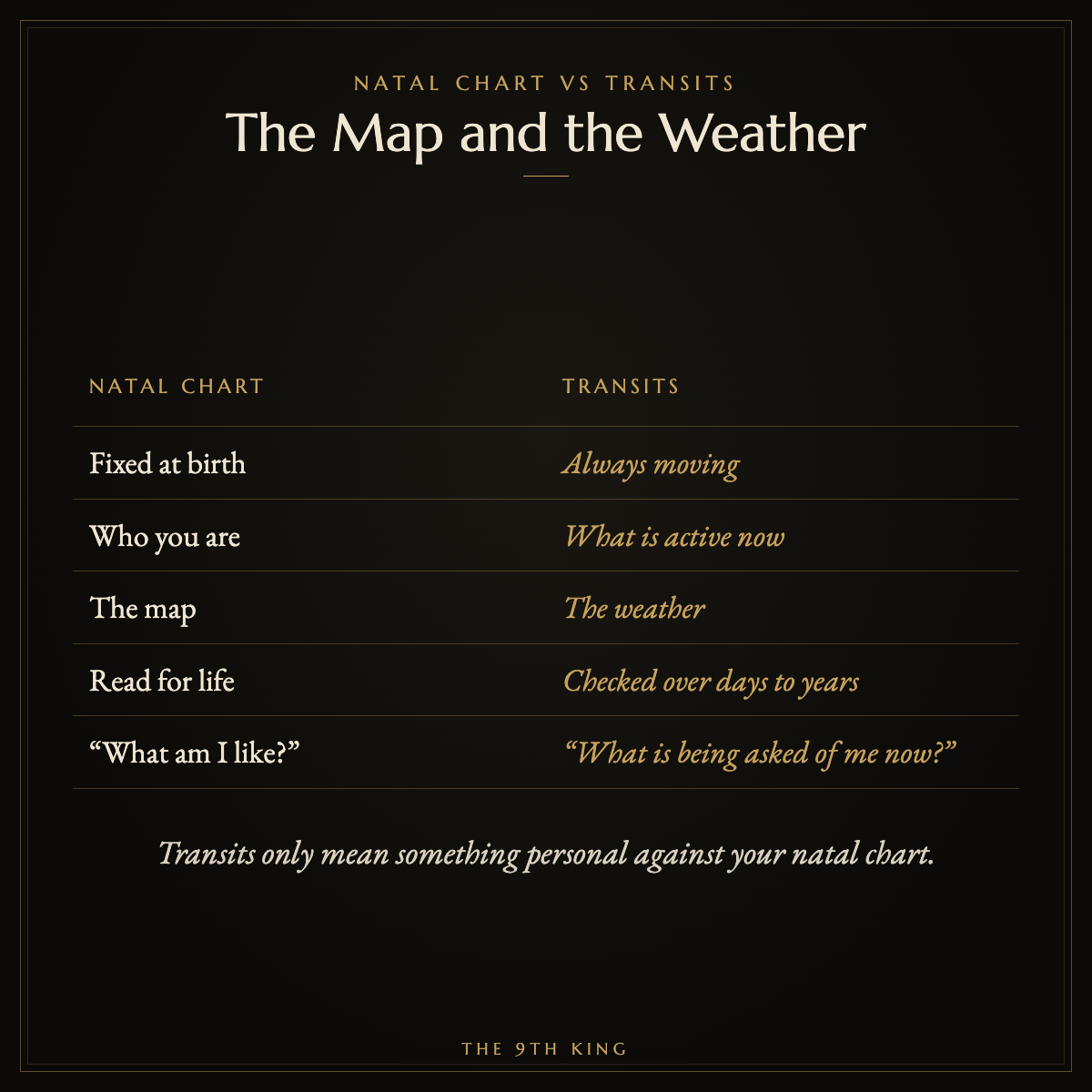
Natal chart vs transits is the difference between a fixed map and the changing weather that moves across it.
- Your natal chart (birth chart) is a snapshot of the sky at the moment and place you were born. It never changes. Astrologers read it as a description of your temperament, needs and patterns.
- Transits are where the planets are right now, and how their current positions line up with the planets in your natal chart. They change every day.
The natal chart answers “What am I like?” Transits answer “What themes are active for me at the moment?” Most astrologers read transits against the natal chart: a transit only means something personal because of the natal point it touches.
Astrology isn’t a proven way to predict events. On The 9th King, transits are used as prompts for reflection and timing your attention, not as forecasts.
Table of Contents
The natal chart: your map
Your natal chart is calculated from your date, time and place of birth. It shows where the Sun, Moon and planets were in the zodiac at that moment, and how they were arranged across the twelve houses.
Astrologers read it as a kind of map of your inner landscape:
- Planets describe different parts of you: the Moon your emotional needs, Mercury your thinking, Venus what you love, and so on.
- Signs describe the style each planet works in.
- Houses describe the areas of life where each planet shows up most.
- Aspects describe how the planets relate to each other.
If you’re new to reading a chart, start with our guide on how to read a birth chart. The 12 houses and astrology aspects guides go deeper into the two pieces you’ll need most for transits.
Your natal chart doesn’t change. You do. Many astrologers say the chart describes potentials, and life is how you grow into them.
What transits are: the weather
The planets keep moving after you’re born. A transit is the current position of a planet and the angle it makes to a point in your natal chart.
For example, if Saturn is currently moving through the same degree of the zodiac as your natal Moon, an astrologer would say “transiting Saturn is conjunct your natal Moon.” If Jupiter is opposite your natal Sun, that’s “transiting Jupiter opposite your natal Sun.”
Transits are read in two main ways:
- Transits to natal planets and points. A moving planet forms an aspect (conjunction, square, opposition, trine or sextile) to one of your natal planets, or to your Ascendant or Midheaven.
- Transits through houses. A moving planet travels through one of your natal houses, and astrologers read that area of life as more active for a while.
The same sky affects everyone in the sense that Saturn is in one sign for all of us. What makes a transit personal is the natal chart it lands on.
How natal charts and transits work together
Think of it like this: the natal chart is the house you live in, and transits are the visitors who come through the door. The same visitor feels different in different houses.
Transiting Mars squaring someone’s natal Sun might show up as a burst of drive in one person and as conflict or impatience in another. The transit describes the theme. The natal chart describes how that particular person tends to meet it.
That’s why most astrologers recommend getting to know your natal chart well before paying much attention to transits. Without the map, the weather report doesn’t tell you much.
How long transits last

How long a transit lasts depends on how fast the planet moves. These are approximate times for each planet to pass through one sign:
- Moon: about 2.5 days.
- Sun: about a month.
- Mercury: roughly 3 to 8 weeks, depending on retrogrades.
- Venus: about 4 weeks, much longer in a retrograde year.
- Mars: about 6 to 7 weeks, much longer in a retrograde year.
- Jupiter: about a year.
- Saturn: about two and a half years.
- Uranus: about seven years.
- Neptune: about fourteen years.
- Pluto: anywhere from about twelve to more than thirty years, because its orbit is very uneven.
These are astronomical facts about the planets’ movement. What they mean is astrological interpretation.
Fast and slow planets
Astrologers often sort transits into two groups.
Fast-moving (personal) planets: the Moon, Sun, Mercury, Venus and Mars. Their transits pass quickly, from hours to a few weeks. They’re usually read as the texture of daily life: moods, conversations, energy levels, social plans. Most astrologers don’t make big decisions based on them.
Slow-moving (outer) planets: Jupiter, Saturn, Uranus, Neptune and Pluto. Their transits can last months or years, especially when retrogrades cause a planet to cross the same degree up to three times. They’re read as the big chapters of life: growth, responsibility, change, uncertainty and transformation.
If you’re new to transits, focus on the slow planets first. They’re fewer, they last longer, and they’re the ones people tend to recognise looking back.
What each slow planet tends to bring
These are the traditional and modern interpretations astrologers most often give for the outer-planet transits:
- Jupiter: growth, opportunity, learning, travel, optimism. It can also mean excess: too much of a good thing. Jupiter is usually read as opening doors rather than walking through them for you.
- Saturn: structure, effort, limits, responsibility, maturity. Saturn transits are often described as heavy while they happen and rewarding in hindsight, as long as the work gets done.
- Uranus: sudden change, freedom, breakthroughs, disruption. Uranus is often linked with the urge to break out of whatever has become too small.
- Neptune: dreams, inspiration, compassion, spirituality, but also confusion, idealising and blurred boundaries. Neptune transits are commonly read as times when things are hard to see clearly.
- Pluto: deep transformation, power, endings and rebirth. Pluto transits are the slowest and are usually described as changing something at the root.
Each of these is a theme, not a script. The same Saturn transit might mean a new job for one person, a breakup for another, and a quieter internal shift for a third.
Transits through the houses
When a slow planet moves through one of your natal houses, astrologers read that area of life as more active for the length of its stay. A quick guide:
- 1st house: identity, appearance, new beginnings.
- 2nd house: money, possessions, self-worth.
- 3rd house: communication, learning, siblings, local life.
- 4th house: home, family, roots, emotional foundations.
- 5th house: romance, creativity, children, play.
- 6th house: work routines, health, daily habits.
- 7th house: partnerships, marriage, close one-to-one relationships.
- 8th house: intimacy, shared resources, endings and transformation.
- 9th house: travel, study, beliefs, the big picture.
- 10th house: career, reputation, direction.
- 11th house: friends, groups, hopes for the future.
- 12th house: rest, solitude, the unconscious, closing chapters.
Our full guide to the 12 houses in astrology explains each house in more depth.
Reading a transit in four steps
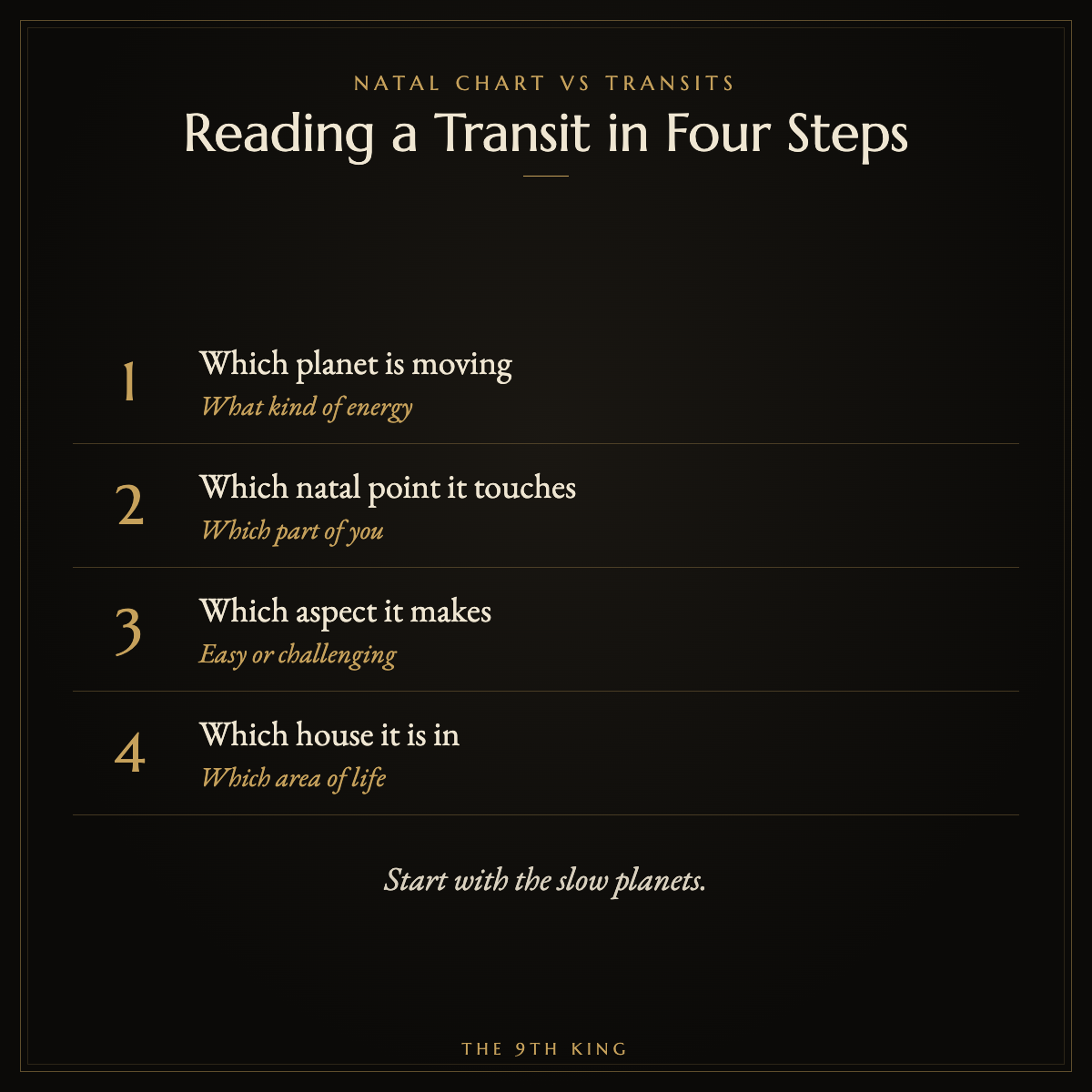
Step 1: Which planet is moving? This tells you the kind of theme. Jupiter tends to be read as expansion, Saturn as structure and testing, Uranus as change, Neptune as dissolving and dreaming, Pluto as deep transformation.
Step 2: Which natal point does it touch? This tells you which part of you is involved. A transit to your natal Moon is about emotional life. A transit to Venus is about love and values. A transit to your Midheaven is about career and direction.
Step 3: Which aspect does it make? Conjunctions are read as intense and focusing, squares and oppositions as challenging, and trines and sextiles as easier and more supportive.
Step 4: Which house is it moving through? This tells you the area of life where the theme is likely to show up: home, work, relationships, health and so on.
Put together: “Transiting Saturn (structure, testing) is square (challenge) my natal Venus (love, values), moving through my 7th house (partnership).” An astrologer would read that as a period of testing commitments and getting real about what you value in relationships. A reflective question to go with it: What in my relationships needs a stronger foundation?
Big life transits
Some transits happen to almost everyone at roughly the same age, because the planets return to the positions they held at your birth.
- Jupiter return (about every 12 years): around ages 12, 24, 36, 48, 60. Often read as a new cycle of growth and opportunity.
- Saturn return (about every 29 to 30 years): around ages 29, 58 and 87. Often read as a period of maturity, responsibility and taking stock. Code of Ascension’s guide to the meaning of the Saturn return (Code of Ascension) covers it in depth.
- Uranus opposition (around age 40 to 42): often linked with the so-called midlife reassessment.
- Saturn opposition (around age 44 to 45) and Chiron return (around age 50) are also commonly discussed.
It’s worth noting that these ages also line up with common life transitions for social reasons: finishing education, settling into careers, midlife changes. Astrology offers one symbolic lens on these stages, not a cause.
What about retrogrades?
A planet is called retrograde when, seen from Earth, it appears to move backwards through the zodiac for a while. It isn’t really moving backwards. It’s an optical effect caused by the relative speeds of Earth and the other planet.
Astrologers usually read retrogrades as times to review, revisit and slow down in the area the planet rules. Mercury retrograde, which happens three or four times a year, is the most famous. Code of Ascension explains the meaning of Mercury retrograde (Code of Ascension), and our guide to Mercury signs covers Mercury in your natal chart.
Retrogrades also matter for transits because they can make a slow planet cross the same natal point up to three times. Many people find the second pass, during the retrograde, the most reflective.
How to look up your transits
- Get your natal chart from a free chart calculator using your birth date, time and place.
- Find a transit chart for today’s date. Most calculators offer a “transits” or “bi-wheel” option that shows the current planets around the outside of your natal chart.
- Look for the slow planets first. Where are Jupiter, Saturn, Uranus, Neptune and Pluto in your natal houses? Are any of them within a few degrees of your natal Sun, Moon, Ascendant or Midheaven?
- Write down one or two active themes. Don’t try to read everything at once.
- Check back in a few months and notice whether the themes felt relevant.
Two worked examples (fictional charts)
Example 1: Saturn crossing the 10th house
The transit: Saturn moves through the 10th house of career and public life for around two and a half years, and then conjoins the natal Midheaven.
A common reading: a period of hard work, responsibility and getting serious about direction. Effort may feel heavy, but it tends to be read as building something lasting.
The reflective question: What would I need to commit to now for my work to feel solid in five years?
Example 2: Jupiter trine natal Venus
The transit: Jupiter forms a trine to natal Venus for a few weeks, possibly three times because of retrograde.
A common reading: a warm, generous period for love, friendship, creativity or enjoying life. Astrologers often call this an “easy” transit, which can also mean it passes unnoticed if you don’t use it.
The reflective question: Where could I say yes to more pleasure, connection or creativity right now?
Both are illustrations of how astrologers interpret transits, not predictions.
Using transits for reflection, not prediction
The healthiest way to use transits is as a calendar of questions. Instead of asking “What will happen to me?”, ask “What is this period inviting me to pay attention to?”
A few practical ways to do that:
- Keep a transit journal. Note the major slow transits each year and write a few lines each month about what’s going on in that area of life. Over time you’ll see for yourself whether the themes feel relevant.
- Use transits to plan reflection time. A Saturn transit might be a good prompt to review commitments. A Jupiter transit might be a prompt to say yes to learning something new.
- Look back before looking forward. Find the slow transits that were active during important past years. That tells you more about how transits feel for you than any general description.
- Hold it lightly. If a transit description doesn’t match your life, trust your life.
This approach keeps astrology in its place: a symbolic mirror that can help you notice and reflect, not a set of instructions.
Common mistakes with transits
- Reading transits without knowing your natal chart. The weather means little without the map.
- Treating “hard” transits as bad news. Squares and Saturn transits are often read as the periods where people grow the most.
- Fear-based prediction. No transit guarantees an event. Be cautious of anyone who says it does, especially if they’re selling something.
- Tracking every fast transit. Daily Moon and Mercury transits are background noise for most decisions.
- Blaming the planets. “It’s my Saturn return” can explain a mood, but it shouldn’t excuse choices. Our guide to zodiac shadow work looks at how to use astrology to take more responsibility, not less.
- Making major decisions on transits alone. Use real-world information, professional advice and your own judgment first.
Five journal prompts
- Which slow planet is moving through your chart right now, and which house is it in? Does that area of life feel active?
- Think about your late twenties (or look ahead to them). What was being asked of you? Does the Saturn return description fit?
- Which of your natal planets feels most “under construction” at the moment?
- Look back at a difficult year. What were the slow transits? What did you learn during that time?
- If a transit is a question rather than a prediction, what question is your current sky asking you?

Natal Chart vs Transits: FAQ
What is the difference between a natal chart and transits?
Your natal chart is fixed at the moment of your birth. Transits are where the planets are now and how they line up with your natal chart. The natal chart is the map, and transits are the weather.
Which is more important, the natal chart or transits?
Most astrologers start with the natal chart, because transits only have personal meaning in relation to it.
How do I find my current transits?
Use a free chart calculator to create your natal chart, then choose a transit or bi-wheel view for today’s date.
How long does a transit last?
It depends on the planet. Moon transits last hours, Mars transits a few days to weeks, and outer-planet transits can last months or, with retrogrades, more than a year.
What is a Saturn return?
The time when Saturn comes back to the position it held at your birth, about every 29 to 30 years. It’s commonly read as a period of maturity and taking stock.
Are hard transits bad?
Not necessarily. Astrologers often read challenging transits as times of growth, effort and change. How you respond matters more than the transit.
What are progressions?
Progressions are a separate technique in which the natal chart is moved forward symbolically, often one day after birth for each year of life. They’re another way astrologers track change over time.
Can transits predict the future?
There’s no scientific evidence that they can. On The 9th King, transits are a reflective tool for noticing themes and timing your attention, not a forecast.
Is any of this scientifically proven?
The planets’ positions and cycles are astronomy. Their meaning is astrology, which is not established science. On The 9th King, astrology is interpretation and self-reflection.

Explore Next
- Start with the map: How to Read a Birth Chart
- Where transits land: The 12 Houses in Astrology
- The angles transits make: Astrology Aspects Explained
- Your emotional baseline: Moon Sign Meaning
- The big one at 29: Meaning of the Saturn Return (Code of Ascension)
- Going deeper: Robert Hand, Planets in Transit (1976)
Final Thought: Read the Weather, Live Your Life
Your natal chart tells you what kind of ground you’re standing on. Transits tell you what kind of weather is passing over it. Neither one decides your life. Learn your map, notice the weather, and choose how you want to move through it.

About the Author
King is the founder of The 9th King, where zodiac psychology, relationships and shadow work are explored as tools for self-knowledge rather than fortune-telling. Astrology on The 9th King is interpretation and self-reflection, not prediction or established fact.