Quick Answer: What Does The World Tarot Card Mean?
The World tarot card is trump XXI, the last numbered card of the Major Arcana. It shows a dancing figure inside an oval wreath, with four creatures in the corners. Readers most often take it as a card of completion, integration and wholeness: a cycle that has come full circle.
- Keywords: completion, integration, fulfillment, wholeness, a finished chapter, the next threshold.
- Upright, in one line: something has come together, and the card asks you to recognize it, honor it and close it well.
- Reversed, in one line: a cycle that’s stuck or left unfinished, often because you haven’t let it end.
- Astrology (Golden Dawn–derived, the tradition The 9th King uses): Saturn, with an extra attribution to the element Earth in some tables.
On The 9th King, tarot is a mirror for self-knowledge, not fortune-telling. The World doesn’t promise that something will finish. It asks what is already complete in you, and whether you’re willing to say so.
Table of Contents

The World tarot card at a glance
| The World | |
|---|---|
| Number | XXI (21) |
| Arcana | Major, the final trump |
| Other names | The Universe (Thoth deck) |
| Core theme | Completion and integration |
| Upright | Wholeness, a chapter fulfilled |
| Reversed | Stalled endings, loose threads |
| Golden Dawn planet | Saturn (Earth also given) |
| Hebrew letter | Tav, the last letter |
| Key question | What is complete, and have I let it be? |
Almost everything people read into The World grows from its position at the end of the sequence: after one journey, before the next.
What’s on The World card: the traditional imagery
In the Rider–Waite–Smith deck and the older Tarot de Marseille pattern, the picture has stayed remarkably stable. Here’s what you’ll see, described in words.
The dancing figure
At the center is a figure, usually read as a woman, moving in a dance. A light scarf wraps around her and she holds a wand in each hand. In his 1911 guide to the deck, A.E. Waite described her as dancing with a wand in each hand and wearing nothing but that scarf (Waite, The Pictorial Key to the Tarot, Part I, at sacred-texts.com). He read the image as “joy attained in the body”: spirit and earthly life finally at ease with each other.
Many readers take the two wands as balance: holding two forces at once.
The wreath
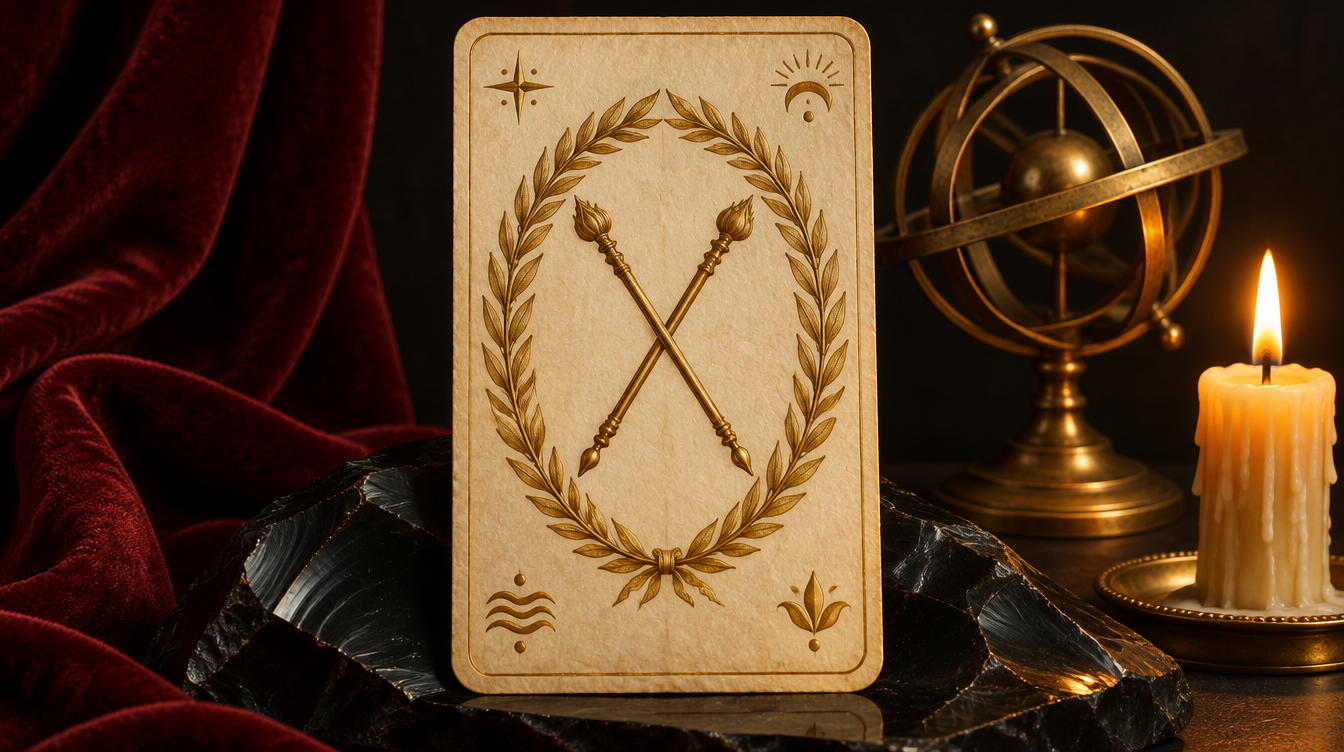
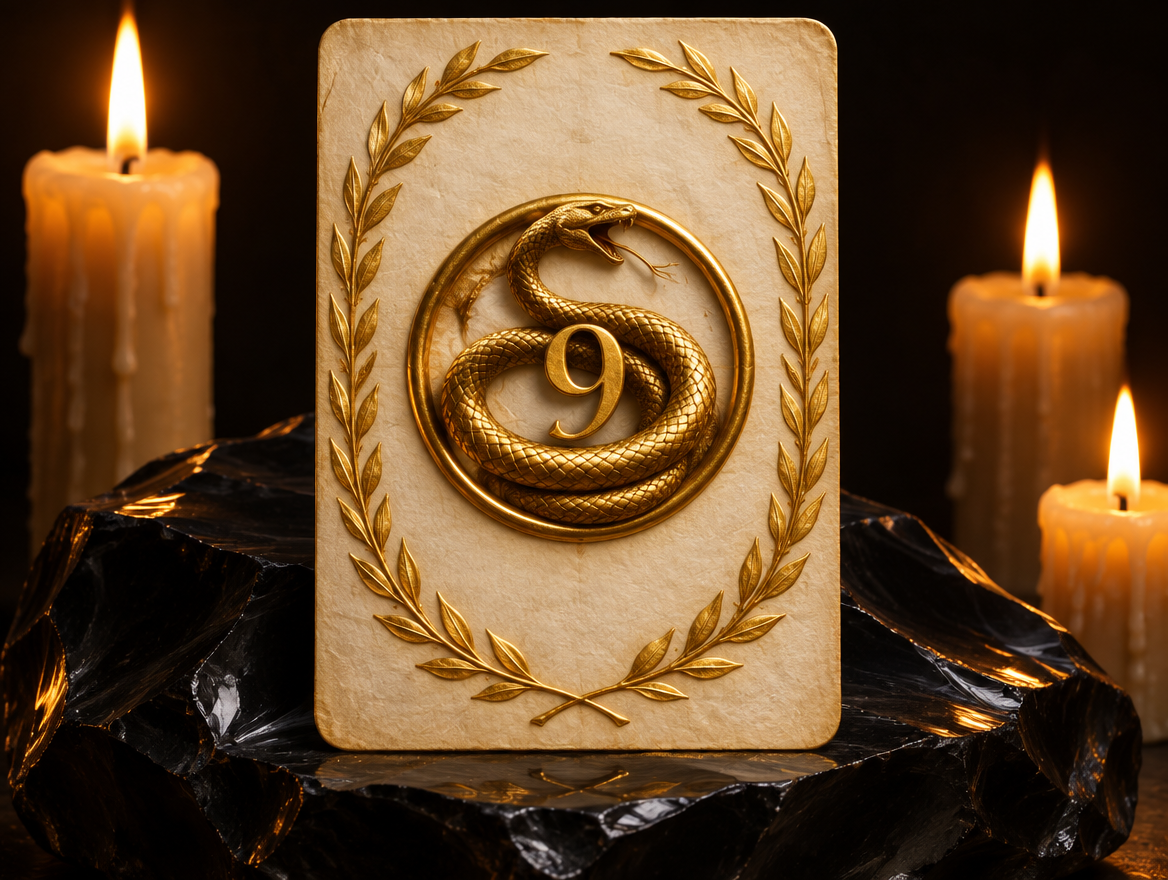
She’s framed by an oval garland. Waite read it as an oval chain of flowers standing for everything the senses can perceive. In some modern decks the wreath becomes an ouroboros, the serpent swallowing its own tail (Wikipedia: The World (tarot card)). Either way, it’s a closed loop: the shape of a cycle. The original 9K art on this page keeps only the wreath, with crossed wands or small emblems, and leaves out the dancer.
The four creatures
In the corners are a human (or angel), an eagle, a lion and a bull. Waite connected them to the four living creatures of Ezekiel and Revelation, which Christian art assigns to the four Evangelists. Occult readers later matched them to the four fixed signs of the zodiac: the man to Aquarius, the eagle to Scorpio, the lion to Leo and the bull to Taurus, and through them to the four elements (Wikipedia: The World (tarot card)).
So the image has three layers: a moving center, a closed circle around it, and four steady guardians holding the corners. That combination, motion held inside stability, is the heart of the card.

Where The World comes from
Tarot didn’t begin as a spiritual tool. According to Britannica, tarot decks were invented in Italy in the 1430s, when card makers added a fifth suit of 21 illustrated cards, plus an unnumbered Fool, to the ordinary four-suit pack. That extra suit outranked the others, which is why the cards were called trumps. They’re the cards we now call the Major Arcana. Britannica dates the occult and fortune-telling uses of tarot to France around 1780.
The Morgan Library & Museum holds one of the most complete fifteenth-century decks to survive, the hand-painted Visconti-Sforza tarot, and notes that tarot was created “as a card game” for the Italian aristocracy before it was linked with divination and fate (The Morgan: Tarot cards).
That history matters. The World wasn’t designed as a prophecy. It was a high trump in a game, and only later became a symbol of spiritual completion: a picture to think with, not a verdict.
Aleister Crowley’s Thoth deck calls the card The Universe (Wikipedia: The World (tarot card)). Same theme: the whole, seen at once.
The World upright meaning
Upright, most readers take The World as a card of completion and integration.
Waite’s own short list of divinatory meanings for the card included success and reward, along with travel and a change of place (Waite, Part III, at sacred-texts.com). Modern readers tend to lean on the first part of that list and read The World less as “a trip is coming” and more as “a cycle is finishing.”
The upright themes readers commonly use:
- Completion. A project, a season, a relationship stage or a long piece of inner work has reached its natural end.
- Integration. Lessons from earlier cards, earlier years or earlier versions of you finally fit together.
- Wholeness. Feeling at home in your life because the pieces make sense.
- Recognition. Seeing, and letting others see, what you’ve actually done.
- A threshold. The end of one loop is the doorway to the next. The wreath is a circle, not a wall.
The 9K angle: completion is a skill
Completion isn’t something that just happens to you. Plenty of chapters reach their end and never get closed: the project ships but nobody says “this is done”; the relationship changes shape but nobody names it; the old habit fades but you still introduce yourself as the person who has it.
Upright, The World can point to a moment when you’re ready to close a cycle on purpose instead of drifting out of it. Ask yourself:
- What in my life is already finished, even if I haven’t said so?
- What would it look like to mark this ending, not just survive it?
The World reversed meaning
Reversed, The World is still about completion, but completion that’s blocked or avoided. Waite gave the reversed meanings as inertia, fixity, stagnation and permanence (Waite, Part III, at sacred-texts.com). The reversed card isn’t the opposite of success. It’s what happens when a loop can’t close. Readers commonly take it as:
- Loose ends. The last 10 percent of something left undone.
- Fear of finishing. Staying in a chapter because the next one is unknown.
- Premature closure. Declaring something “done” to escape it, when it isn’t integrated yet.
- Not seeing your own progress. You’ve come further than you admit.

| Upright | Reversed | Ask yourself |
|---|---|---|
| A cycle completes | The loop stays open | What’s the last step? |
| Lessons integrate | Lessons get skipped | What haven’t I digested? |
| Rest in the whole | Restless “not yet” | What would “enough” be? |
| Clear threshold | Clinging to the old room | What am I afraid to start? |
A reversed card isn’t a bad omen. The upright World asks can you see the whole? The reversed World asks what’s stopping the circle from closing?
The World tarot card and Saturn: the astrology correspondence
The World’s astrology link comes from the Hermetic Order of the Golden Dawn, the late-nineteenth-century magical order whose system the Rider–Waite–Smith deck draws on. These are Golden Dawn–derived correspondences, the tradition The 9th King uses. Other schools of tarot and astrology assign cards differently, and not every card maps to a single sign or planet.
What the Golden Dawn assigned
In the Golden Dawn’s scheme, each of the 22 trumps is matched to a letter of the Hebrew alphabet and a path on the Kabbalistic Tree of Life. The World, which the order called The Universe, sits on the 32nd path with the letter Tav, and its astrological attribution is Saturn. Joseph Gurney’s history of Golden Dawn tarot, in the Journal of the Western Mystery Tradition, reproduces the order’s table from its knowledge lectures: Tau, path 32, The Universe, Saturn (Gurney, “The Tarot of the Golden Dawn”). Tarot Elements makes the same point, noting that this is the trump Book T, the order’s tarot text, “links to Saturn” (Tarot Elements).
Why some sources also say Earth
You’ll sometimes see The World linked to Earth as well. Golden Dawn color tables, following Crowley’s Liber 777, list a second entry for the same path of Tav (often written “32 bis”) attributed to the element Earth (steve-p.org, Golden Dawn card color tables). Saturn is the main attribution and Earth a secondary one. Both point toward form, matter and the finished result.
There’s a neat logic to Tav, too. It’s the last letter of the Hebrew alphabet, and The World is the last trump. The Golden Dawn’s grade system even placed the path of Tav at the very start of the climb back up the Tree, just above Malkuth, the sphere of the physical world (Gurney; Museum of Witchcraft and Magic). The end of the descent is the beginning of the return.
What Saturn adds to the reading
Saturn is the planet astrologers associate with time, structure, limits, maturity and endings. It was the most distant planet the ancients could see, and in traditional astrology it was given the rulership of both Capricorn and Aquarius (Wikipedia: Domicile (astrology)). Modern astrologers usually give Aquarius to Uranus and keep Saturn as its traditional ruler.
That link reshapes The World. Instead of a sparkly “you’ve won,” it reads as the reward of finishing what you started, through time, effort and accepted limits. Saturn says a thing is real when it has edges. The World says a cycle is real when it closes.
The Saturn link doesn’t make the card “about” Capricorns or your Sun sign. It’s a symbolic bridge between two languages.
Saturn cycles as natural World moments
Astrologers often describe the Saturn return, when Saturn comes back to its birth position, as a turning point. It happens roughly every 29.5 years, with the first around ages 27 to 31 and the second around 56 to 60 (Wikipedia: Saturn return). If you’re in one of those windows, The World makes a good companion card: a prompt to ask what chapter is ending, not a forecast.
A solar return chart marks the turn of each personal year, a progressed chart tracks slower inner seasons, and natal chart vs transits explains how passing planets, Saturn included, touch your birth chart. None are needed to read the card; they’re other ways to notice a cycle turning.
The 9K reading: tension, shadow and the self-mastery lesson
The tension: wholeness vs the next thing
The World celebrates completion, but the wreath is a loop and the figure is dancing, not resting. So the card sits between two pulls:
- Arrival: I made it. Let me feel that.
- Departure: What’s next? Don’t get comfortable.
Some people never let themselves arrive, jumping to the next goal before the last one lands. Others arrive and refuse to leave, turning a finished chapter into a museum they live in. The World asks for both, in order: arrive fully, then step through.
The shadow side of The World
Every card has a shadow: the overused or avoided version of its gift. For The World it tends to look like this:
- The endless almost. Being “90 percent done” with everything, so nothing can be judged.
- Perfection as a hiding place. Refusing to call something complete until it’s flawless, which means never.
- Drifting out. Letting chapters end by neglect instead of decision.
- Wholeness as performance. A polished “I’ve got it together” life hiding the unintegrated parts.
- Spiritual bypassing. Using big-picture language (“everything happens for a reason”) to skip the grief, credit or accountability that a real ending needs.
If one stings, that’s information, not a judgment. Shadow Work, Plainly explains the idea, and our zodiac shadow work guide shows how to spot patterns like these in your chart.
The self-mastery lesson
Close the cycle on purpose. That’s The World’s lesson in five words.
Mastery isn’t finishing everything. It’s knowing which things are finished, saying so, keeping what you learned and leaving the rest. A cycle you close on purpose becomes part of you. One you drift out of tends to follow you around.
A brief, warm note before the exercises: this is reflective practice, not therapy. If you’re dealing with trauma, abuse, thoughts of self-harm or distress that feels overwhelming, please work with a qualified therapist. And it’s always fine to stop a prompt that feels like too much.
The World tarot card in love, work and self-knowledge
The World in love
In love, The World is often taken as a relationship chapter reaching wholeness: a new level of commitment, a shared goal completed, or a hard season finally understood. It doesn’t tell you whether to stay, leave, commit or wait. Those are your decisions. It can ask better questions:
- What chapter of this relationship has already ended, even if we haven’t named it?
- What have we built together that deserves recognition?
Reversed, it often points to unfinished business: an old relationship not fully closed, a postponed conversation, or a pattern that repeats because the last lesson wasn’t integrated. For how charts show these dynamics, try synastry for beginners.
The World at work
At work, readers take The World as a project, role or career stage reaching completion. Practical ways to honor it:
- Formally end projects with a short “what worked, what didn’t, what’s next” review.
- Claim credit by adding the finished work to your portfolio or record.
- Hand over well by documenting what you know before you move on.
This isn’t career or financial advice, and the card doesn’t predict outcomes. It’s a prompt to notice what’s done.
The World as a self-knowledge card
As a mirror, The World asks: what parts of me have finally come together? Maybe two sides that felt opposed, ambition and rest, independence and closeness, have found a working truce. That’s integration, and it’s worth naming.
A practical exercise: The Closing Ceremony
This takes about 30 minutes and works for anything that’s ending: a project, a year, a habit, a role or a version of yourself.

The six steps
- Name it. Write one sentence: “The chapter that is ending is…” Be specific. “My twenties” is vague; “the years I said yes to every request at work” is usable.
- Gather. List three things this chapter taught you and three things it gave you.
- Credit. Write down what you actually did. Then name anyone who helped. The World’s dancer is watched over by four guardians; you didn’t get here alone either.
- Release. Name one thing you won’t carry into the next cycle: a belief, a habit, a grudge, an identity.
- Mark it. Do one small physical act: close the notebook, archive the folder, light and put out a candle, take a walk to a place you haven’t been. The body likes a clear ending.
- Threshold. Write one sentence: “What I’m stepping into is…” It doesn’t need to be a plan. A direction is enough.
The worksheet
| Prompt | Your answer |
|---|---|
| What is ending? | |
| What I learned (3) | |
| What I gained (3) | |
| What I did, and who helped | |
| What I’m releasing | |
| How I’ll mark it | |
| What I’m stepping into |
A worked example (fictional)
Maya (fictional) spent three years building a community garden. Someone else is ready to lead it, but she still “checks in” weekly and feels oddly flat. She draws The World and runs the ceremony. Name it: “My chapter as the garden’s founder is ending.” Gather: she learned to organize volunteers and that she prefers building to maintaining. Credit: her own work, and the three neighbours who came every Saturday. Release: the belief it will fall apart without her. Mark it: she plants one last tree and hands over her keys in person. Threshold: “I’m stepping into building something new.”
The card predicted none of this. It gave Maya a frame to finish what was already finished.
Journal prompts for The World
- What in my life is already complete, and have I let it be?
- Where am I “almost done” with something, and what’s the real last step?
- Which ending did I drift out of instead of closing, and what would closing it look like now?
- What two parts of me have finally learned to work together?
- What am I afraid will happen if I let this chapter end?
For more questions in this style, see our shadow work prompts.
Myths and misreadings about The World
- “The World means everything will work out.” Tarot on The 9th King doesn’t guarantee outcomes. It’s a mirror, not a promise.
- “The World is a ‘yes’ card.” Some readers use it that way, but we don’t do yes/no readings here. A better question than will it? is what is already whole?
- “Reversed means failure.” Reversed points to something unfinished or rushed: information about the process, not a verdict on you.
- “The World is the end, so nothing comes after.” The wreath is a loop. Most readers see The World as a completion and a threshold.
- “Saturn makes the card heavy or bad.” Here Saturn is about time, form and finishing properly.
- “If I draw The World, I must be enlightened.” Waite himself dismissed some of the grander claims made about the figure, such as the idea that it shows a magician at the highest degree of initiation (Waite, Part II, at sacred-texts.com). You don’t need to have “arrived” spiritually to work with the card.
New to tarot? Tarot for Beginners (Code of Ascension) explains how a reading works, and Intuitive Tarot (Code of Ascension) shows how to read imagery by feel.

The World Tarot Card: FAQ
What does The World tarot card mean?
The World tarot card is trump XXI, the final card of the Major Arcana. Readers most often take it as a card of completion, integration and wholeness: a cycle that has come full circle. On The 9th King it’s read as a mirror rather than a prediction. It asks what in your life is already complete, and whether you’ve let yourself recognize that and close the chapter on purpose instead of drifting out of it.
What does The World reversed mean?
Reversed, The World is commonly read as completion that’s blocked or avoided: loose ends, fear of finishing, a last step you keep postponing, or a chapter you’ve declared “done” before it’s really integrated. A.E. Waite listed inertia and stagnation among its reversed meanings. It isn’t a bad omen. It’s a prompt to ask what’s stopping the circle from closing, and what the real final step would be.
What planet is The World tarot card linked to?
In the Golden Dawn system, the tradition The 9th King uses, The World (called The Universe by the order) is linked to Saturn, through the Hebrew letter Tav and the 32nd path of the Tree of Life. Some Golden Dawn tables, following Crowley’s Liber 777, also give a secondary attribution to the element Earth. Other tarot traditions may assign the card differently.
What does The World mean in a love reading?
In love, The World is often read as a relationship chapter reaching wholeness: a stage that has done its work, a shared goal completed, or a hard season finally understood. Reversed, it can point to unfinished business or an old pattern repeating. It doesn’t tell you whether to stay, leave or commit. It invites you to name which chapter has ended and what you’ve built together.
Is The World a yes or no card?
Some readers treat The World as a “yes,” but The 9th King doesn’t use tarot for yes/no answers or predictions. A more useful question is “what is already whole here?” or “what’s the last step to finishing this?” Framed that way, the card gives you something to act on rather than a guess about the future.
Why is The World the last card of the Major Arcana?
The World is numbered XXI, the highest numbered trump. Tarot began in fifteenth-century Italy as a card game in which the trumps outranked the ordinary suits. In the Golden Dawn system it also pairs with Tav, the last letter of the Hebrew alphabet. Symbolically, its final position is why readers link it with completion, and with the threshold to the next cycle.

Your next step: pick one chapter in your life that’s already finished but never formally closed, and run the Closing Ceremony on it this week. If you want to see which cycles your chart is moving through right now, start with our guide to natal chart vs transits and look for where Saturn is touching your birth chart.
Explore Next
- Saturn’s traditional signs: Capricorn Personality Traits · Aquarius Personality Traits
- Cycles and turning points: Natal Chart vs Transits · Solar Return Chart · Progressed Chart
- Go deeper into the shadow: Shadow Work Prompts · Zodiac Shadow Work
- More tarot on The 9th King: Tarot Card Meanings · Major Arcana · Tarot & the Zodiac · The Moon · The Emperor · Three-Card Tarot Spread · Shadow Work Tarot Spread
- Where the journey starts and turns: The Fool · Wheel of Fortune · Judgement
Final Thought: Finish the Circle, Then Step Through
The World isn’t a trophy. On the traditional card, it’s a dancer inside a loop, held by four steady corners, moving because the work underneath her is finally done. Read it as permission to stop calling everything “almost,” to name what’s whole, and to walk out of the old room on your own terms. Know your nature. Rule your life.
About the Author
King is the founder of The 9th King, where zodiac psychology, relationships and shadow work are explored as tools for self-knowledge rather than fortune-telling. He’s a Libra Sun, and writes about the personal side of astrology on King The Kemist. Astrology on The 9th King is interpretation and self-reflection, not prediction or established fact.
Leave a Reply