Quick Answer: What Are the Major Arcana?
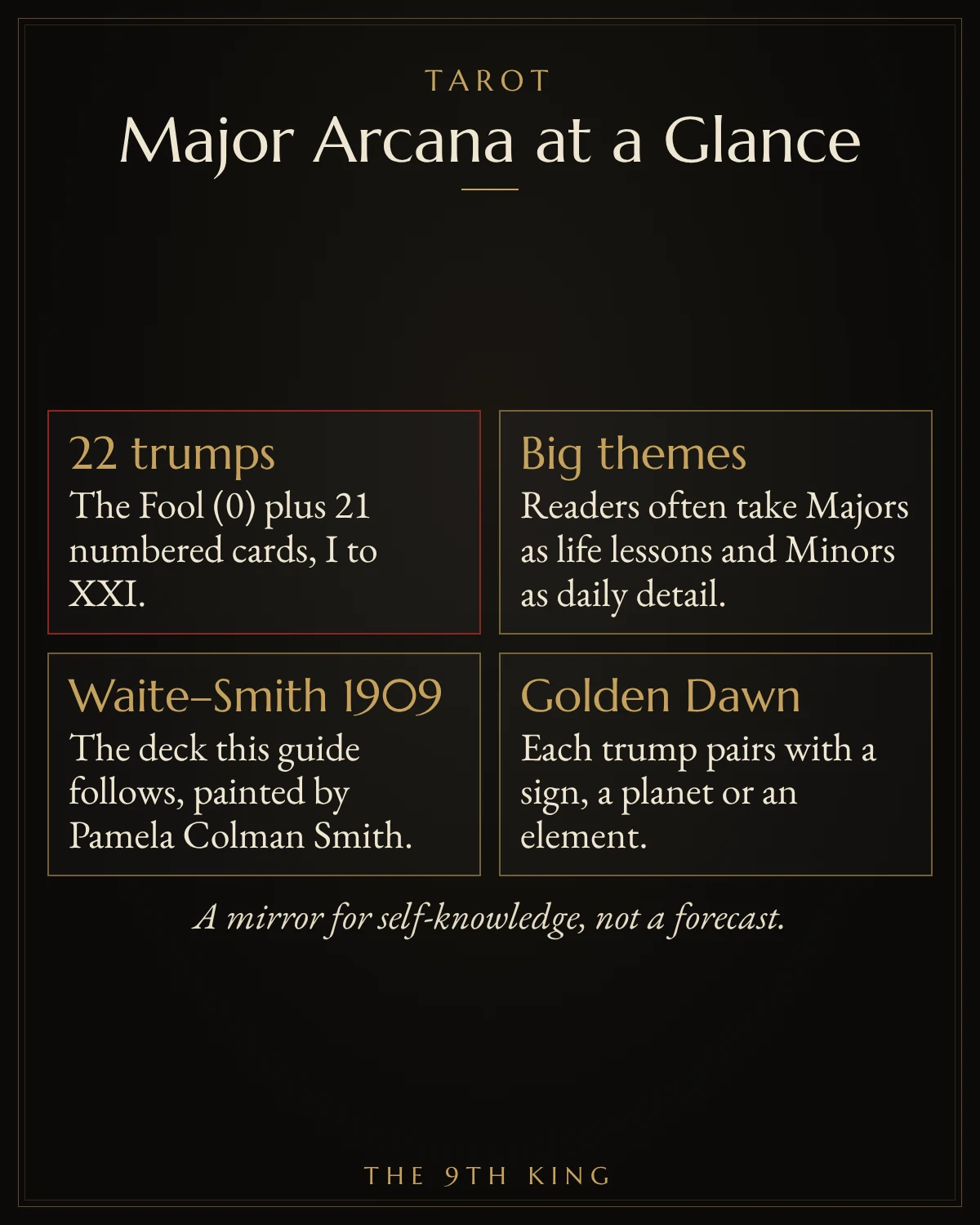
The Major Arcana are the 22 “trump” cards of a 78-card tarot deck, numbered 0 (The Fool) to XXI (The World). The other 56 cards are the Minor Arcana, the four suits.
- 22 cards: The Fool plus 21 numbered trumps, from The Magician (I) to The World (XXI).
- Origin: tarot began as a card game in 15th-century Italy. Occult and fortune-telling uses came centuries later.
- The deck this guide follows: the Rider–Waite–Smith deck of 1909, designed by Pamela Colman Smith to A.E. Waite’s direction.
- Strength is VIII and Justice is XI in that deck. Marseille decks reverse them.
- Astrology: in the Golden Dawn tradition The 9th King uses, each trump is paired with a sign, a planet or an element.
Readers often take a Major as pointing to a bigger life theme, where a Minor points to day-to-day detail. On The 9th King, the Majors are a mirror, not a forecast: 22 stages of self-mastery, each with a gift and a shadow.
Table of Contents
What the Major Arcana are
A full tarot deck has 78 cards. Fifty-six of them, the Minor Arcana, look a lot like ordinary playing cards: four suits (Wands, Cups, Swords and Pentacles), each running from Ace to Ten with four court cards. The remaining 22 are the Major Arcana, sometimes called the trumps.
The Fool and the 21 trumps
Britannica describes the original Italian trumps as 21 numbered cards plus an unnumbered card called il matto, “the fool” (Britannica: Tarot). In most modern decks the Fool carries the number 0, so it can stand at the start of the sequence or outside it.
What makes a card “Major”
Each Major carries one large idea: a figure (The Hermit), a force (Strength), an event (The Tower) or a heavenly body (The Star). The Minors describe how life feels this week. The Majors describe the themes you keep circling for years.
If you’re brand new to tarot, Code of Ascension’s Tarot for Beginners (Code of Ascension) covers the basics of decks, spreads and first readings.
A short history: from card game to mirror
15th-century Italy: a game for the court
According to Britannica, tarot decks were invented in Italy in the 1430s, when a fifth suit of trump cards, the trionfi, was added to the four-suited pack (Britannica). The Morgan Library holds one of the most complete 15th-century decks to survive, the Visconti-Sforza tarot, probably painted by Bonifacio Bembo for the Visconti-Sforza family. The Morgan notes that the deck was made as a card game for the aristocracy and only became associated with divination centuries later (The Morgan Library: Tarot cards).
Around 1780: the occult turn
Britannica dates the first use of tarot for occult and fortune-telling purposes to France, around 1780. From then on, occult writers layered the trumps with new meanings, and later systems added Hebrew letters, Kabbalah and astrology. Those correspondences arrived centuries after tarot began as a game (Angelorum), but they gave the cards the symbolic depth most readers use today.
1909: the Rider–Waite–Smith deck
The Rider–Waite–Smith deck appeared in December 1909, published by William Rider & Son of London (Wikipedia: Rider–Waite Tarot). The scholar and mystic A.E. Waite directed the symbolism, and the artist Pamela Colman Smith painted all 78 cards. The Whitney Museum notes that Waite commissioned the designs and that Smith belonged to the Golden Dawn (Whitney Museum).
The Major Arcana list: all 22 cards and their themes
Here is the full Major Arcana list in Rider–Waite–Smith order, with a one-phrase theme for each as The 9th King reads it. These are our own interpretive keys for self-reflection, not predictions.
| No. | Card | 9K theme |
|---|---|---|
| 0 | The Fool | The leap before you’re ready |
| I | The Magician | Using what you already have |
| II | The High Priestess | Trusting quiet inner knowing |
| III | The Empress | Growth that is nourished, not forced |
| IV | The Emperor | Building structure and self-command |
| V | The Hierophant | Learning from tradition and teachers |
| VI | The Lovers | Choosing by your values |
| VII | The Chariot | Directing drive and holding opposites |
| VIII | Strength | Gentle courage with your instincts |
| IX | The Hermit | Solitude that finds its own light |
| X | Wheel of Fortune | Living with cycles you can’t control |
| XI | Justice | Truth, consequence and accountability |
| XII | The Hanged Man | Seeing differently by letting go |
| XIII | Death | Endings that make room |
| XIV | Temperance | Patience, blending and balance |
| XV | The Devil | Seeing what binds you |
| XVI | The Tower | When a false structure falls |
| XVII | The Star | Hope and renewal after upheaval |
| XVIII | The Moon | Walking through uncertainty |
| XIX | The Sun | Clarity, vitality and being seen |
| XX | Judgement | The call to wake up |
| XXI | The World | Integration and a completed cycle |
A note on the hard-sounding cards: Death points to an ending or transition, The Devil to an attachment, and The Tower to the collapse of something that wasn’t built on truth. None of them describes literal harm.
Why Strength is VIII and Justice is XI
If you’ve used more than one deck, you may have noticed that Strength and Justice trade places. In the older Tarot de Marseille tradition, Justice is VIII and Strength is XI. In the Rider–Waite–Smith deck, it’s the other way round.
The change was deliberate. Waite wrote in The Pictorial Key to the Tarot that “for reasons which satisfy myself, this card has been interchanged with that of justice” (Waite, Pictorial Key, sacred-texts.com). That’s the only reason he gives. The usual explanation, from later writers, is the Golden Dawn’s system: the eighth trump corresponds to Leo and the eleventh to Libra, and Strength’s lion fits Leo while Justice’s scales fit Libra (Wikipedia: Major Arcana; Bill Heidrick, Magical Correspondences).
What this means for you in practice:
- The meaning stays with the card, not the number. Strength means Strength whether it’s printed VIII or XI.
- Check your deck. Marseille-style decks keep the older order, so check the number on your own cards.
Major Arcana and astrology: the Golden Dawn correspondences
The astrological links below are Golden Dawn–derived correspondences, the tradition The 9th King uses, and the system the Rider–Waite–Smith deck draws on. They’re symbolic pairings, not ancient facts about the cards. Other schools differ: the French occult tradition following Éliphas Lévi placed the Fool and the Hebrew letters differently, and Aleister Crowley’s Thoth deck later swapped the letters of The Emperor and The Star (Angelorum: Why magical systems disagree).
The Golden Dawn system gives each of the 22 trumps one of the 22 Hebrew letters, and through it one of three kinds of correspondence:
- 12 zodiac signs
- 7 classical planets
- 3 elements: Air, Water and Fire
| Card | Golden Dawn correspondence | Read next on 9K |
|---|---|---|
| 0 The Fool | Air (element) | The element of ideas |
| I The Magician | Mercury (planet) | Mercury in your chart |
| II The High Priestess | The Moon (planet) | Moon Sign Meaning |
| III The Empress | Venus (planet) | Moon vs Venus |
| IV The Emperor | Aries (sign) | Aries traits |
| V The Hierophant | Taurus (sign) | Taurus traits |
| VI The Lovers | Gemini (sign) | Gemini traits |
| VII The Chariot | Cancer (sign) | Cancer traits |
| VIII Strength | Leo (sign) | Leo traits |
| IX The Hermit | Virgo (sign) | Virgo traits |
| X Wheel of Fortune | Jupiter (planet) | Jupiter Return |
| XI Justice | Libra (sign) | Libra traits |
| XII The Hanged Man | Water (element) | The element of feeling |
| XIII Death | Scorpio (sign) | Scorpio traits |
| XIV Temperance | Sagittarius (sign) | Sagittarius traits |
| XV The Devil | Capricorn (sign) | Capricorn traits |
| XVI The Tower | Mars (planet) | Mars in your chart |
| XVII The Star | Aquarius (sign) | Aquarius traits |
| XVIII The Moon | Pisces (sign) | Pisces traits |
| XIX The Sun | The Sun (planet) | Birth chart guide |
| XX Judgement | Fire (element) | The element of will |
| XXI The World | Saturn (planet) | The planet of structure |
Sources for every row: Bill Heidrick’s Magical Correspondences and the World of Playing Cards’ Attributes of the Egyptian Tarot, checked against the Golden Dawn’s own Book T as Crowley printed it, Liber LXXVIII. It also gives The World a second attribution, Earth.
Two cards named for the sky
The Moon card corresponds to Pisces, not to the Moon; the planet Moon belongs to The High Priestess. The Sun card does correspond to the Sun.
How to use the correspondences without overreaching
The pairings work best as a bridge. If The Emperor keeps appearing, read our Aries guide and ask where you’re building, or resisting, structure. Use the link to deepen the question, never to make a prediction. If you want to see where these signs and planets sit for you, start with how to read a birth chart.
The Fool’s Journey: a modern way to read the sequence
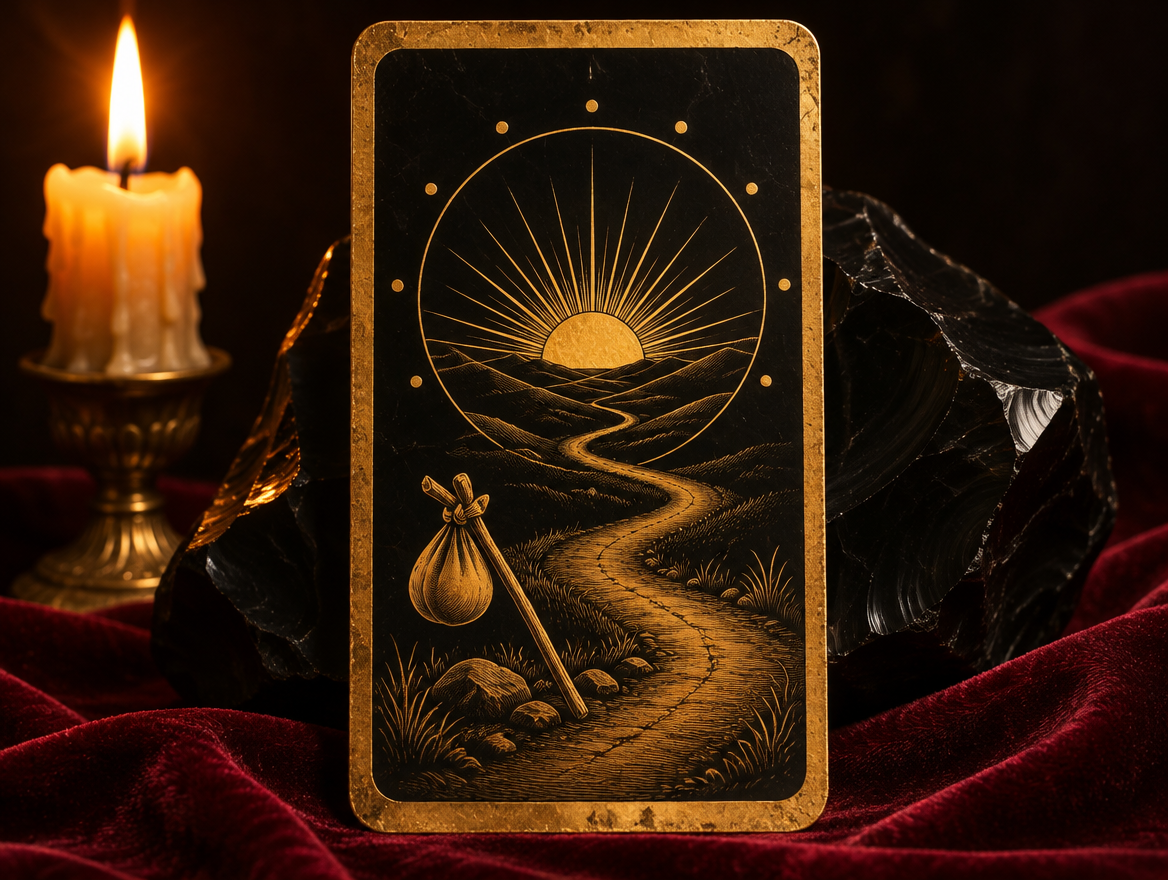
Many readers learn the Major Arcana as a story. The Fool, card 0, sets out with nothing but trust, meets each trump as a teacher or a test, and arrives at The World, card XXI, changed. That story is called the Fool’s Journey.
It’s worth knowing that this is a modern teaching frame, not something printed on the 15th-century cards. The tarot historian Mary K. Greer credits the author Eden Gray with coining the term, as the title of the epilogue to her 1970 book A Complete Guide to the Tarot, building on a hint in her 1960 Tarot Revealed (Mary K. Greer: Eden Gray’s Fool’s Journey). As Greer quotes her, Gray wrote that “the Fool represents the soul of everyman.”
Useful, but not literal
The frame turns 22 images into a sequence you can locate yourself in. Instead of what will happen?, it asks which stage am I in, and what is it teaching me? But life isn’t a straight line from 0 to XXI: you can be a Fool in one area and a Hermit in another. Treat it as a map of recurring lessons, not a ladder.
The 9K reading: 22 stages of self-mastery and their shadows
At The 9th King, we read the Major Arcana as stages of self-mastery. Each card holds a capacity you can grow into, and a shadow: the same energy overused, avoided or turned against yourself. Naming it isn’t a judgment; it’s how you notice when a strength has started running you.
We group the 22 cards into three movements. The grouping is our own reading of the sequence.
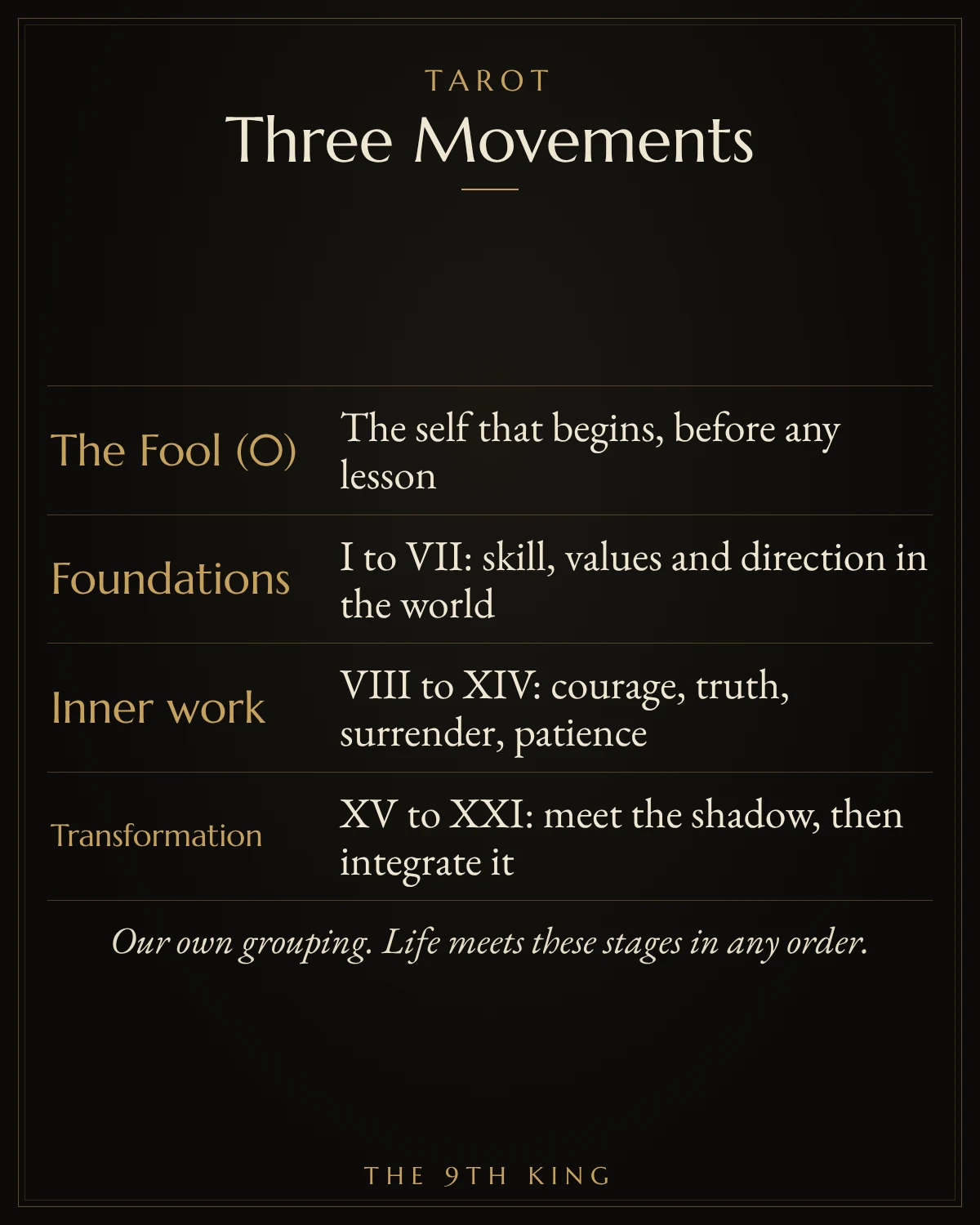
Foundations: The Fool to The Chariot (0 to VII)
Building a self that can act in the world: skill, intuition, care, structure, learning, values and direction.
| Card | Shadow line |
|---|---|
| The Fool | Leaping to avoid ever committing |
| The Magician | Performing skill instead of using it honestly |
| The High Priestess | Silence used as power or a hiding place |
| The Empress | Over-giving until care becomes smothering |
| The Emperor | Control that rules instead of leads |
| The Hierophant | Handing your conscience to an authority |
| The Lovers | Choosing to be chosen, not by your values |
| The Chariot | Winning at any cost, driving over people |
Inner work: Strength to Temperance (VIII to XIV)
Here the Majors turn inward, toward courage, solitude, honesty, surrender and patience.
| Card | Shadow line |
|---|---|
| Strength | Self-control that hardens into self-denial |
| The Hermit | Withdrawal dressed up as wisdom |
| Wheel of Fortune | “It’s just luck” as a reason not to act |
| Justice | Righteousness and keeping score |
| The Hanged Man | Waiting forever; sacrifice as identity |
| Death | Clinging to what has already ended |
| Temperance | Moderation as a way to avoid feeling |
Transformation: The Devil to The World (XV to XXI)
The last movement goes through the shadow, not around it: seeing attachments, surviving the fall of false structures, coming back whole.
| Card | Shadow line |
|---|---|
| The Devil | Denying the chain while blaming others for it |
| The Tower | Tearing everything down, or dreading all change |
| The Star | Hoping to be rescued instead of healing |
| The Moon | Treating your fears as facts |
| The Sun | Performing happiness; forced positivity |
| Judgement | A harsh verdict on yourself, on repeat |
| The World | Comfort that won’t risk a new beginning |
Turning a shadow line into practice
Pick the shadow line that stung a little. That reaction is useful information. Our zodiac shadow work guide shows how the same pattern can appear in your chart, and psychological projection explains why the shadow is often easiest to spot in other people first. If shadow work is new to you, Shadow Work, Plainly is the gentlest place to start.
A warm note before you go deeper: this is reflective practice, not therapy. If you’re dealing with trauma, abuse, thoughts of self-harm or distress that feels overwhelming, please work with a qualified therapist. And it’s always fine to stop a prompt that feels like too much.
How to read a Major Arcana card in a spread
Majors vs Minors: scale, not power
A rule many readers use: a Minor describes the weather, a Major describes the season. The Three of Cups might reflect a good evening with friends; The Lovers, a choice about what you value in relationships. Neither is “stronger.”
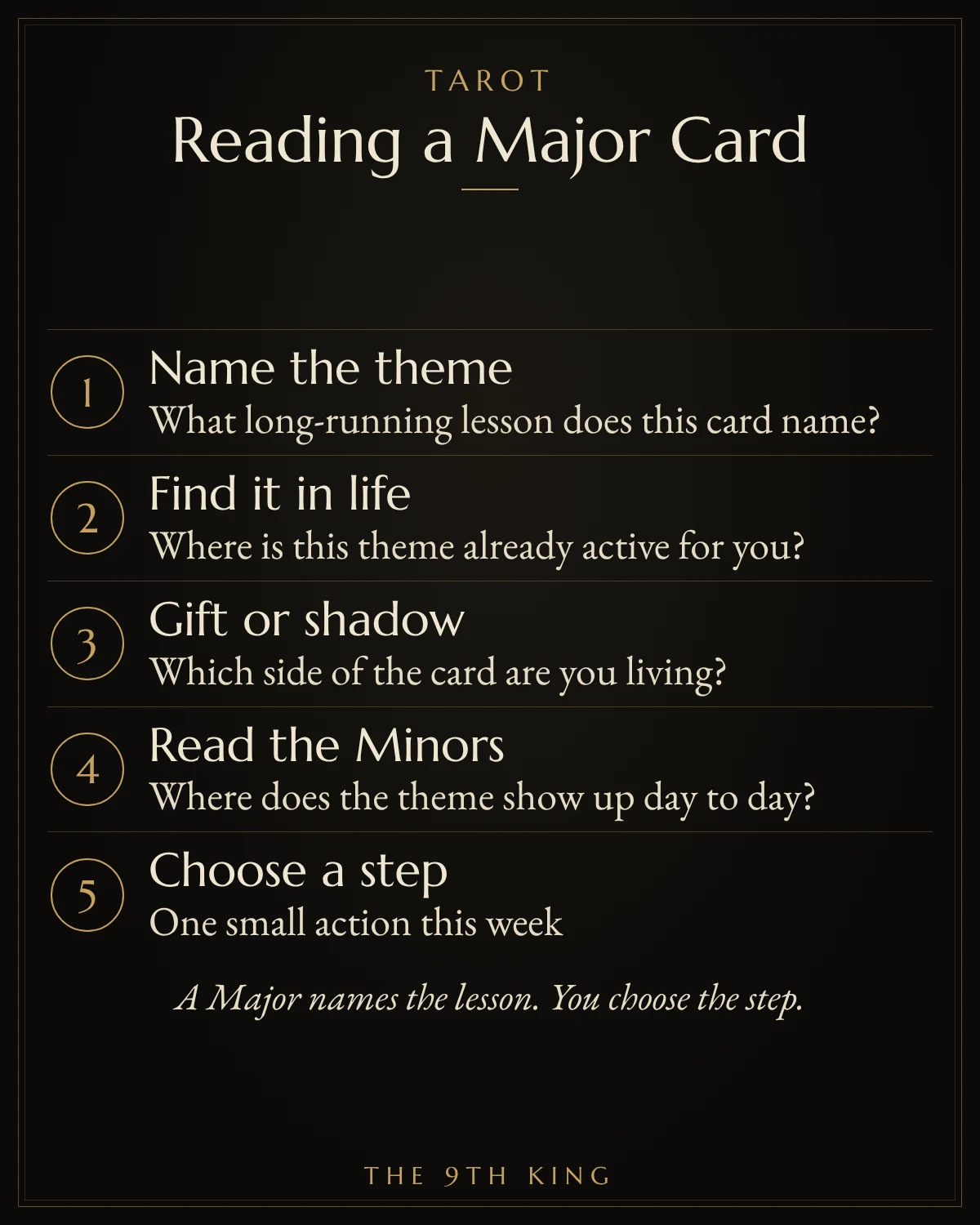
When a Major lands, ask:
- What long-running theme does this card name?
- Where in my life is this theme already active?
- Am I living the gift or the shadow? Read both lines honestly.
- What do the Minors around it add? They often show where the theme plays out day to day.
- What’s one small action this week? A Major names the lesson; you choose the step.
Many Majors in one spread
Readers often take a spread full of Majors as a sign that the question touches something larger than one decision: is this really about the email, or about how I handle authority? A spread with no Majors can simply mean the question is practical.
Reversed Major Arcana cards
If you read reversals, a reversed Major can point to the theme being blocked, delayed, internalized or overdone. A reversed Emperor can be read as rigid control or as structure that’s missing. Ask which fits. Many readers skip reversals, and that’s fine.
A worked example (fictional)
The question: Maya (fictional) asks, “What do I need to understand about feeling stuck at work?” She draws three cards for situation, challenge and next step: the Eight of Pentacles, The Hanged Man and the Page of Swords.
Reading: the Eight of Pentacles reflects steady, repetitive work. The Hanged Man is the only Major, so it carries the big theme: a pause that asks for a new perspective rather than more effort. Its shadow line, waiting forever; sacrifice as identity, gives Maya a sharp question: is she waiting for permission to change something? The Page of Swords suggests the next step is curiosity: asking questions, gathering information.
The useful question: What would I see differently if I stopped trying to push through?
The reading doesn’t say Maya will quit or get promoted. It hands her a better question. For a more intuitive approach, Code of Ascension’s Intuitive Tarot (Code of Ascension) walks through reading from first impressions.
A practical exercise: find your current stage
About 20 minutes. No deck needed; the tables above are enough.
Step 1: Scan the 22 themes. Mark the one theme that feels most alive in your life right now. Don’t pick the one you wish were true.
Step 2: Read its shadow line. Find the card in the three movements above. Write one specific sentence about where that shadow showed up this month.
Step 3: Find the card before and after. The one before is often a lesson you’re still finishing; the one after, what this stage is preparing you for.
Step 4: Check the correspondence. If it’s a sign, read that sign’s page. If it’s a planet or element, find it in your own chart.
Step 5: Choose one action. One small step this week that practices the gift, not the shadow.
Journal prompts to go with it:
- Which Major Arcana card feels like my current chapter, and why that one?
- What does the shadow of this card look like when I’m tired or scared?
- Which card in the sequence do I most avoid, and what might it be asking of me?
- Where am I a Fool, beginning again, and where am I near The World, ready to complete something?
For more prompts, see our shadow work prompts.
Myths and misreadings about the Major Arcana
- “The Major Arcana are ancient secrets.” Britannica dates tarot’s invention to 1430s Italy, as a card game. The occult meanings came later, starting in France around 1780.
- “A Major Arcana card means something big will happen.” On The 9th King, no card predicts events. A Major points to a bigger theme worth reflecting on.
- “Death means someone will die.” Death is a card of endings and transitions, not harm.
- “The numbering is fixed, so my deck is wrong.” Decks differ. Strength and Justice swap between traditions, and the meaning travels with the card.
- “The astrology is built into the cards.” Occult writers added correspondences centuries after the cards existed, and systems differ. They’re a lens, not a hidden code.

Major Arcana: FAQ
How many Major Arcana cards are there?
There are 22 Major Arcana cards in a standard tarot deck. They run from The Fool, numbered 0, through The Magician (I) to The World (XXI). The other 56 cards are the Minor Arcana. In the original Italian game, the Fool was unnumbered and the 21 others were the trump cards.
What is the difference between the Major and Minor Arcana?
The Major Arcana are 22 named trump cards, each carrying one large symbolic theme, such as Strength or Judgement. The Minor Arcana are 56 cards in four suits that describe everyday situations, moods and actions. Many readers treat Majors as long-running life lessons and Minors as where those lessons show up day to day.
Why are Strength and Justice numbered differently in some decks?
Older decks, like the Tarot de Marseille, number Justice VIII and Strength XI. A.E. Waite swapped them for the 1909 Rider–Waite–Smith deck, saying only that he had his reasons. The usual explanation is the Golden Dawn system, where the eighth trump corresponds to Leo and the eleventh to Libra. The meaning stays with the card whichever number it carries.
What is the Fool’s Journey?
The Fool’s Journey is a modern way of reading the Major Arcana as a story. The Fool, card 0, travels through each trump as a stage of growth and arrives at The World. The tarot historian Mary K. Greer credits Eden Gray with coining the term in 1970. It’s a teaching frame, not part of the original cards.
Which zodiac sign goes with each Major Arcana card?
In the Golden Dawn tradition The 9th King uses, twelve trumps correspond to signs: The Emperor (Aries), The Hierophant (Taurus), The Lovers (Gemini), The Chariot (Cancer), Strength (Leo), The Hermit (Virgo), Justice (Libra), Death (Scorpio), Temperance (Sagittarius), The Devil (Capricorn), The Star (Aquarius) and The Moon (Pisces). The other ten correspond to planets or elements. Other systems differ.
Can the Major Arcana predict the future?
On The 9th King, no. We use tarot as a mirror for self-knowledge, not fortune-telling. A card can point to a theme worth reflecting on and sharpen a question you’re already asking. It doesn’t decide what happens; your choices matter far more than any card.
Who created the Rider–Waite–Smith deck?
The deck was published in December 1909 by William Rider & Son of London. A.E. Waite, a scholar and mystic, directed its symbolism, and the artist Pamela Colman Smith painted all 78 cards. Both were members of the Hermetic Order of the Golden Dawn, whose ideas shaped the deck’s symbolism.
Your next step: pick the Major Arcana card that matches your current chapter, then read its correspondence. If it’s a sign, start with that sign’s page on The Zodiac Signs and its shadow in Zodiac Shadow Work. One card, one honest question, one small action this week.
Explore Next
- The shadow side of every sign: Zodiac Shadow Work
- Start shadow work gently: Shadow Work, Plainly
- Questions to take further: Shadow Work Prompts
- Find the signs and planets in your own chart: How to Read a Birth Chart
- Reading cards by feel: Intuitive Tarot (Code of Ascension)
- More tarot on The 9th King: Tarot Card Meanings · Minor Arcana · Tarot & the Zodiac · The Emperor · The Chariot · Justice · The Moon · The World · Three-Card Tarot Spread · Shadow Work Tarot Spread
- Newly added Major cards: The Fool · Wheel of Fortune · The Devil · The Sun · Judgement

Final Thought: The Journey Goes Round, Not Up
The Fool doesn’t graduate. After The World comes another beginning, with more skill and fewer illusions. Read the Major Arcana as a map of lessons you’ll meet again and again, each time a little wiser, and let every shadow you name become a stage you’ve learned to master. Know your nature. Rule your life.
About the Author
King is the founder of The 9th King, where zodiac psychology, relationships and shadow work are explored as tools for self-knowledge rather than fortune-telling. He’s a Libra Sun, and writes about the personal side of astrology on King The Kemist. Astrology on The 9th King is interpretation and self-reflection, not prediction or established fact.