
Quick Answer: What Does the Eight of Pentacles Mean?
The Eight of Pentacles (also written 8 of Pentacles) is a Minor Arcana card from Pentacles, the earth suit of work, money, body and home. In the traditional image, a craftsman works on pentacles at his bench and shows the finished ones like trophies. On The 9th King, it’s the card of the workbench: getting better at something by doing it, one piece at a time.
- Keywords: practice, skill, craftsmanship, learning, steady effort, attention to detail, apprenticeship, repetition.
- Upright, in one line: a prompt to notice what you’re learning by doing right now, if you want your practice to build skill without turning into a grind.
- Reversed, in one line: effort that has lost its point, polishing that never ends, or skill turned toward cutting corners; a prompt to check what your work is actually for.
On The 9th King, tarot is a mirror for self-knowledge, not fortune-telling. The Eight of Pentacles doesn’t say your hard work is about to pay off. It asks how you practice, and whether you let yourself stop.
Table of Contents

The Eight of Pentacles at a glance
| Eight of Pentacles | |
|---|---|
| Arcana | Minor Arcana, a pip (number) card |
| Suit and element | Pentacles, linked with earth |
| Number | Eight |
| Golden Dawn title | Lord of Prudence |
| Astrology (Golden Dawn) | Sun in Virgo |
| Upright | Work, craft, skill in progress |
| Reversed | Vanity, voided ambition, cunning |
| Key question | What am I practicing for? |
What the Eight of Pentacles looks like
Most people know this card from the Rider–Waite–Smith deck, first published in London by William Rider & Son in December 1909. A.E. Waite wrote the instructions and Pamela Colman Smith drew the art, and both were members of the Hermetic Order of the Golden Dawn (Wikipedia: Rider–Waite Tarot).
Waite’s whole description of the scene in The Pictorial Key to the Tarot is one sentence: “An artist in stone at his work, which he exhibits in the form of trophies” (sacred-texts.com: Waite, Eight of Pentacles).
The artist in stone
Stone doesn’t hurry. You work it a little at a time, and a slip is hard to undo. On The 9th King, that’s the heart of the card: skill built by patient, repeated effort on something that pushes back.
The work shown as trophies
The finished pieces aren’t hidden away. On The 9th King, we read Waite’s word “trophies” as a record of progress: proof to yourself that the hours went somewhere, not a contest with anyone else.
The apprentice
Waite links this card to the Three of Pentacles. There, he writes, the apprentice or amateur of the Eight has received his reward and is now working in earnest (sacred-texts.com: Waite, Three of Pentacles). So in Waite’s own scheme, the Eight is the learning stage, and the Three of Pentacles is the skill put to real use.
On the early Smith card
On the 1909 Smith card (Wikimedia Commons: 1909 Eight of Pentacles scan), the craftsman sits at a bench working on a single pentacle with a hammer and chisel, and finished pentacles are displayed on an upright post beside him. Apart from the artist at work and the pieces shown as trophies, none of this is in Waite’s text.

The Golden Dawn version of the card
The Golden Dawn’s teaching text on the tarot, Book T, as printed by Aleister Crowley in Liber LXXVIII, describes a different design: an angelic hand from a cloud holds a rose branch whose four white roses touch only the four lower pentacles; only leaves touch the four upper ones. The eight pentacles are arranged like the geomantic figure Populus, with the symbols of the Sun and Virgo above and below (Liber LXXVIII, sacred-texts.com).
Eight of Pentacles meaning (upright)
Waite’s upright meanings are practical: work, employment, commission, craftsmanship, and skill in craft and business, possibly at the preparatory stage (sacred-texts.com: Waite, Eight of Pentacles). The Eight isn’t the finished masterwork. It’s the stage where you’re still getting good.
Book T is cooler about it. Under the title Lord of Prudence, it describes someone “Over-careful in small things at the expense of great,” and lists small, steady gains of ready money, industry and the cultivation of land, alongside meanness, hoarding and a lack of enterprise (Liber LXXVIII, sacred-texts.com). So the Golden Dawn’s version carries a built-in warning: care for detail is a strength until it crowds out the bigger picture.
On The 9th King, we read the upright card as skill in the making. It has three layers.
Learning by doing
The card can point to a season where you’re learning something and the only way through is repetition. Ask yourself: What am I learning right now that only practice will teach me?
Attention to the piece in front of you
The craftsman works on one pentacle at a time. The card can point to giving this piece your attention without rushing to the end. Ask yourself: Can I give the next small piece my full attention, without needing it to be the last?
Progress you can see
The trophies on display are a record. The card can point to tracking how far you’ve come, so the effort doesn’t vanish into a blur. Ask yourself: Where can I see my own progress, and have I looked lately?
Eight of Pentacles reversed
Some readers read reversals as the opposite meaning, some as blocked energy, and some don’t use them. Waite’s reversed list is sharp: voided ambition, vanity, cupidity, exaction and usury. He adds that it may also mean skill itself, used by an ingenious mind for cunning and intrigue (sacred-texts.com: Waite, Eight of Pentacles). Cupidity is strong wanting, especially for money; exaction is demanding more than is fair; usury is lending at unfair interest.
In his additional meanings, Waite gives an upright reading of a young man in business connected to the person asking, and a reversed reading about trouble in a matter of money-lending (sacred-texts.com: Waite, Additional Meanings of the Lesser Arcana). He warns on that page that these extra meanings are “very often in disagreement with those previously given.” On The 9th King, we treat them as history, not predictions.
On The 9th King, the reversed card usually points to one of three patterns.
Effort that has lost its point
Waite’s “voided ambition” can describe work that keeps going after the reason for it has gone: practicing a skill you no longer want, or grinding at something out of habit. Ask yourself: If I started this today, would I choose it again?
Polishing that never ends
On The 9th King, we read Waite’s word “vanity” here as caring more about how the work looks than what it’s for. One version is reworking a piece so it never has to be judged. Ask yourself: Is this extra pass making the work better, or just keeping it from being finished?
Skill turned to cutting corners
Waite’s last line, the ingenious mind turned to cunning and intrigue, points to skill used to get around the work rather than do it. A card can’t tell you whether anyone else does this; it can prompt you to check your own habits. Ask yourself: Am I using what I know to do the job well, or to look like I did?
| Pattern | Upright tone | Reversed tone |
|---|---|---|
| Effort | Steady, chosen | Habit with no point |
| Detail | Care for the piece | Polish without end |
| Skill | Used to do the work | Used to dodge it |
| Progress | Tracked and seen | Ignored or hidden |
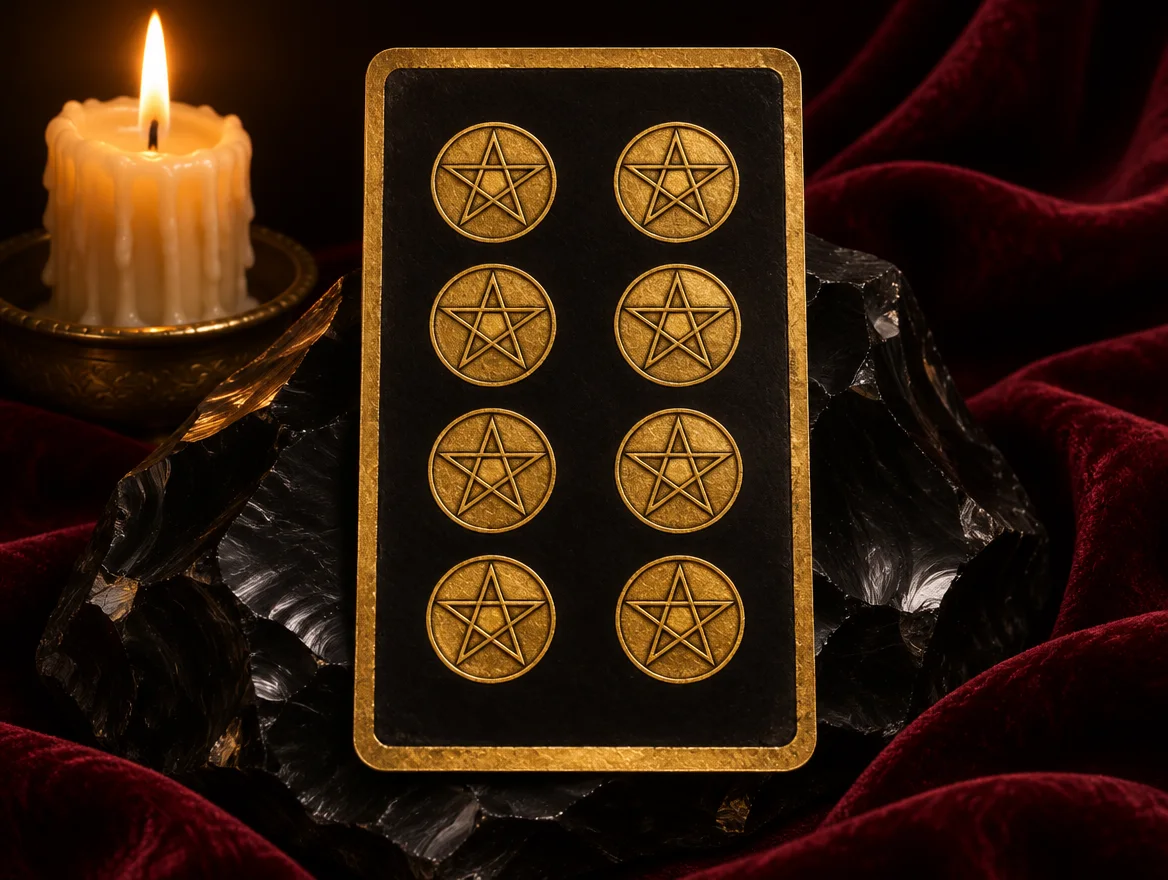
Eight of Pentacles astrology: Sun in Virgo
The 9th King uses Golden Dawn–derived correspondences, the tradition the Rider–Waite–Smith deck draws on. Other schools use different systems, and not every card maps to a single sign: the court cards and Pages are handled differently. This is one traditional framework, offered as symbolism.
How the number cards get their planets
In the Golden Dawn system, the 36 small cards (Twos through Tens) are matched to the 36 decans of the zodiac: ten-degree thirds of a sign, each given a planet. Book T‘s table lists the Eight of Pentacles, Prudence, under Sun in Virgo (Liber LXXVIII, sacred-texts.com), and the card’s own entry names the Sun and Virgo as its decan symbols. It’s the first of the three Virgo cards in that table, followed by the Nine of Pentacles (Venus in Virgo) and the Ten of Pentacles (Mercury in Virgo). Liber prints no degrees for it.
Book T places all four Eights in Hod on the Kabbalistic Tree of Life. For this card it sums up that placement as skill, prudence and cunning: the same mix of craft and cleverness that runs through Waite’s meanings.
What the Sun brings
On The 9th King, the Sun stands for identity, vitality and the will to shine. It’s the traditional ruler of Leo, so our Leo Personality Traits page shows the Sun’s style in a person. On this card, the Sun is the part of you that wants your work to be something you can stand behind.
What Virgo brings
Virgo is mutable earth, ruled by Mercury: the sign of craft, service, method and detail. Our Virgo Personality Traits page covers Virgo’s skill and its self-critical shadow. On this card, Virgo is the careful hand at the bench.
The tension in the pairing
The Sun wants to shine. Virgo wants to get it right. The card sits where the two meet: pride in doing something well. At its best, Virgo gives the Sun real skill to stand on, and the Sun reminds Virgo that the work is allowed to be seen before it’s flawless.
The 9K reading: craft or the grind?
The card’s tension
The Eight of Pentacles holds two true things at once: practice builds skill and practice can become a treadmill. The card asks whether your effort serves you, or you serve it.
The shadow side
The shadow of the Eight of Pentacles is making your worth depend on your output. It can look like:
- Never finished. Reworking a piece so many times that it never gets shared, used or judged.
- Rest as guilt. Feeling that any hour not spent improving is an hour wasted.
- Only the flaws. Seeing every mistake in your work and none of the progress.
- Comparing benches. Measuring your early practice against someone else’s finished work.
- Busy, not better. Repeating what you can already do instead of the part that would stretch you.
These patterns are often learned early. If that rings true, inner child work is a gentle, related place to look, and our zodiac shadow work guide covers each sign’s shadow.
Rest is part of the craft
Rest isn’t failure. A craftsman who never puts down the chisel gets tired hands, not better work. Rest is a pause that meets a need, whether it lasts an evening or much longer, and rest that illness or exhaustion requires is never laziness. Stepping away is part of how skill gets built.
Avoidance is something different: steering around the one hard part of the work while staying busy with the rest. The useful test is behavior: what you return to, and what you keep steering around.
| Craft | Endless polish |
|---|---|
| Work gets finished and shared | The same piece is redone again and again |
| Mistakes get noted and used | Mistakes get hidden or dwelt on |
| Feedback is asked for | Feedback is put off |
| Rest is planned, without guilt | Rest is skipped or apologized for |
| Progress is measured against your past | Progress is measured against others |

This table is a starting point, not a test.
The self-mastery lesson
The lesson of the Eight of Pentacles is to practice without making yourself the project you can never finish. You can care about quality and still call a piece done. You can track your progress and still take a day off.
Eight of Pentacles as feelings, in love and at work
Eight of Pentacles as feelings
As feelings, we often read the card on The 9th King as steady commitment: patient effort rather than rushing. A card can’t tell you what someone feels or will do; their words and actions can. About your own feelings, ask: Am I invested in this, or just used to working at it? Both can be true at once.
Eight of Pentacles love meaning
In a love reading, the upright card can point to the quiet work of a relationship: showing up consistently and getting better at hard conversations. Reversed, it can point to treating a relationship like a project to perfect, or working so hard elsewhere that little is left for the people close to you.
Tarot can’t tell you whether to stay or leave, and this page won’t either. Useful questions instead:
- What do we each actually do, week to week, to look after this relationship?
- Am I trying to improve myself for my partner, or with them?
To compare two people’s styles, synastry for beginners shows how astrologers read two charts, as reflection, not a verdict.
Eight of Pentacles at work and with money
This page doesn’t give career or financial advice, only reflection.
At work and in your own projects, we often read the card as practice and close attention to the task. The question isn’t what job to take; it’s how you relate to effort. Ask yourself: Is the way I work building skill I care about, or wearing me down?
With money, Book T‘s warning about minding small sums at the cost of large ones still applies. Ask yourself: Is my carefulness with money helping me, or making me anxious about small things? For actual decisions, talk to a qualified professional.
The Ace of Pentacles is where the earth suit begins, and the Page of Pentacles is the suit’s student, the first spark of wanting to learn.
Practical exercise: the practice log
This is a short, repeatable log for any skill: an instrument, a craft, writing, a language. It’s not a tool for pushing harder. It’s a way to see your progress and plan your rest. Filling it in takes a few minutes.
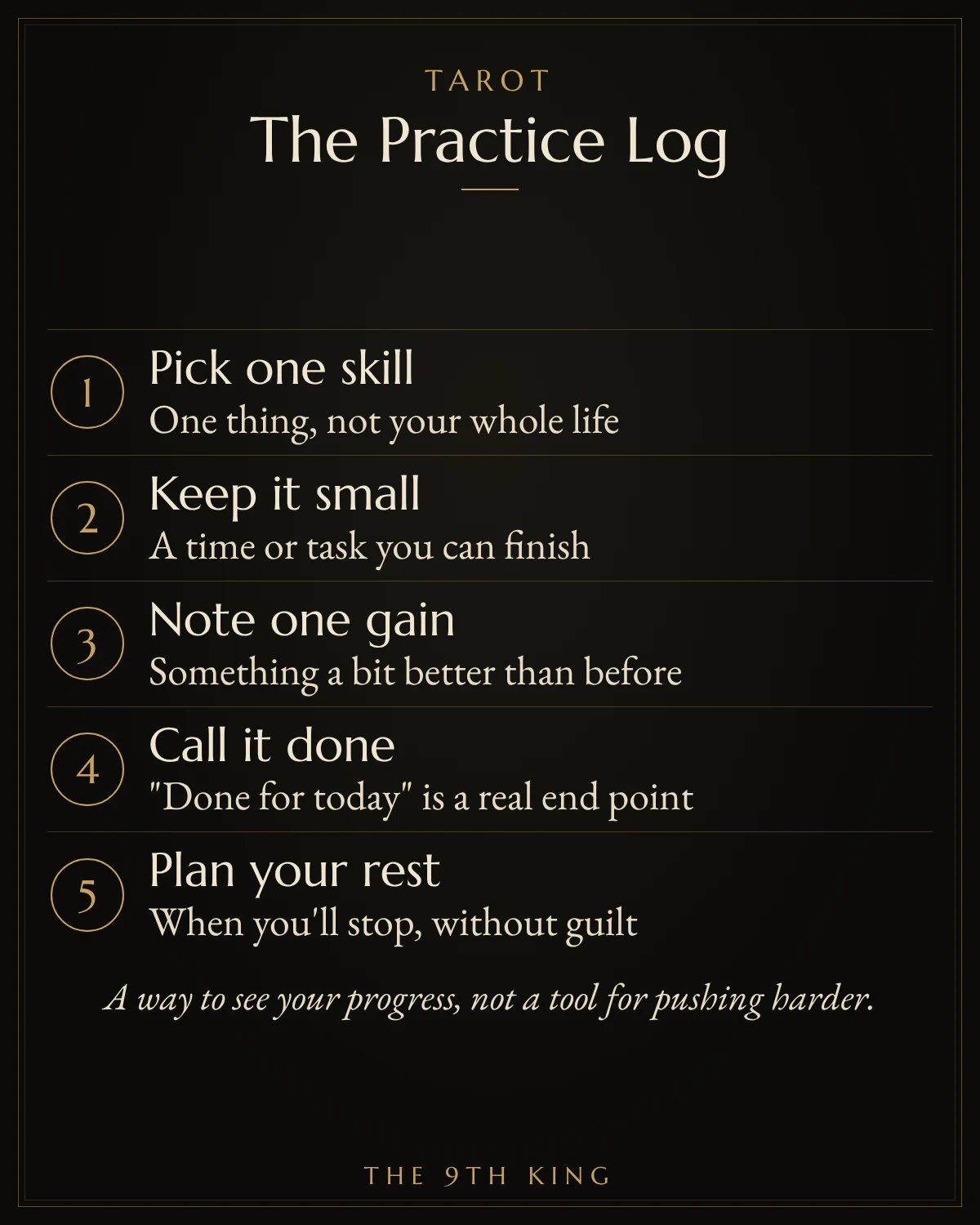
Step 1: Pick one skill
Choose one thing you’re practicing. Write it at the top of the page.
Step 2: Keep it small
Decide on a session you can actually finish: a set time, or a clear task like one page, one song, one drawing. Small is the point.
Step 3: Note one gain
After the session, write one thing that went a little better, even if it’s tiny. You can note a mistake too, as something to try differently, not a verdict.
Step 4: Call it done
Write “done for today” and mean it. Finishing a session is a skill of its own.
Step 5: Plan your rest
Write when you’ll stop and what rest looks like, whether that’s an evening or a few days off. If your body or energy needs more rest than you planned, that counts as part of the log, not a failure of it.
A worked example (fictional)
Marcus (fictional) draws the Eight of Pentacles after a month of teaching himself guitar and feeling stuck. He tries the log for one week.
He picks one skill: switching cleanly between two chords. He keeps it small: ten minutes a day. He practices on five of the seven days and rests on the other two, which he plans in advance to give his hands a break.
Over five sessions, he notes five gains, one per session, including “fewer buzzing strings on the second chord” and “switched without looking twice.” On day three he also writes a mistake: he was rushing, so he’ll slow down.
By the end of the week, he notices he’s been comparing himself to musicians with years of practice. He decides to measure himself against last week’s log instead.
Journal prompts for the Eight of Pentacles
- What am I learning right now that I can only learn by doing?
- When do I let myself call something finished? Who taught me where that line is?
- Where do I see my own progress, and where do I only see flaws?
- How do I feel about resting when there’s still work I could do?
- Is there a skill I keep practicing that I no longer actually want?
For more, our shadow work prompts go deeper, and Shadow Work, Plainly explains how to start safely.
A warm note: this is reflective practice, not therapy. If you’re dealing with trauma, abuse, thoughts of self-harm or distress that feels overwhelming, please work with a qualified therapist who can walk with you. It’s always fine to stop a prompt that feels like too much.
Myths and misreadings of the Eight of Pentacles
- “The Eight of Pentacles means a promotion or new job is coming.” No. On The 9th King, tarot doesn’t predict outcomes. The card is a mirror for how you practice and work.
- “It means you should work harder.” Not necessarily. The card is about how you work, and rest is part of that.
- “The Golden Dawn calls it Prudence, so it’s simply a good card.” Book T‘s meanings for this card are mixed, from industry and small gains to meanness and hoarding. On The 9th King, we read it as a mirror, not a grade.
- “Sun in Virgo means this card is about Virgo people.” No. The correspondence describes the card’s symbolism in the Golden Dawn tradition. Anyone can draw it, whatever their sign.

Eight of Pentacles: FAQ
What does the Eight of Pentacles mean?
The Eight of Pentacles is a Minor Arcana card in the earth suit. Waite describes an artist in stone at work, showing his finished pieces as trophies, with meanings of work, craftsmanship and skill. On The 9th King, we read it as practice and steady effort: a mirror for how you learn and work, not a prediction about your career.
What does the Eight of Pentacles reversed mean?
Reversed, Waite lists voided ambition, vanity, cupidity, exaction and usury, and adds skill turned to cunning and intrigue. On The 9th King, we often read it as effort that has lost its point, polishing that never ends, or cutting corners. Treat it as a prompt to check what your work is for and whether you let yourself finish and rest.
What does the Eight of Pentacles mean as feelings?
As feelings, we often read the Eight of Pentacles on The 9th King as steady commitment: someone putting in patient effort rather than rushing. A card can’t tell you what another person feels or will do; their words and actions can. About your own feelings, it can prompt you to ask whether you’re truly invested in something, or simply used to working at it.
What does the Eight of Pentacles mean in love?
In love, the upright card can point to the everyday work of a relationship: showing up consistently and learning how to care for each other well. Reversed, it can point to treating love like a project to perfect, or pouring so much into work that little is left over. The card doesn’t tell you to stay or leave. It invites you to look at what each of you actually does.
What zodiac sign is the Eight of Pentacles?
In the Golden Dawn system, the tradition The 9th King uses, the Eight of Pentacles corresponds to the Sun in Virgo, the first of the three Virgo decans in Book T’s table, where it’s called the Lord of Prudence. It’s a planet in a sign, not a sign on its own. Other schools use different correspondences, so treat this as one traditional framework.
Is the Eight of Pentacles a yes or no card?
The 9th King doesn’t do yes or no readings, because tarot here is for self-reflection, not fortune-telling. Instead, ask what the card shows you: what you’re practicing, how you measure your progress, and whether your effort includes room to finish a piece and rest before the next one.
Is the Eight of Pentacles a good or bad card?
Neither, on The 9th King. Waite gives it upright meanings of work and craftsmanship, while the Golden Dawn’s Book T calls it the Lord of Prudence and mixes industry with warnings about being over-careful in small things. Read it as a mirror for how you work, learn and rest, not as a good or bad omen.

Your next step: start the practice log above with one skill and one small session, and plan your rest before you begin. Then find your own Sun with our guide on how to read a birth chart: the planet of identity and vitality that the Golden Dawn tied to this card.
Explore Next
- Craft, method and the self-critical shadow: Virgo Personality Traits
- The Sun’s style in a person: Leo Personality Traits
- Where the earth suit begins: Ace of Pentacles
- The learner’s skill put to real use: Three of Pentacles
- The suit’s patient grower: Seven of Pentacles
- Reading by feel: Intuitive Tarot (Code of Ascension)
- New to the cards: Tarot for Beginners: How Tarot Really Works (Code of Ascension)
- More tarot on The 9th King: Tarot Card Meanings · Minor Arcana · Tarot & the Zodiac · Knight of Pentacles · Shadow Work Tarot Spread
- More cards in this set: Nine of Pentacles, Ten of Pentacles, Two of Pentacles
Final Thought: Work the Stone, Then Set Down the Chisel
The artist in the Eight of Pentacles isn’t a master yet, and that’s the point. Skill comes from ordinary sessions, clumsy ones included, and from the rest between them. Pick one piece, give it your attention, call it done for today, and let yourself stop. Know your nature. Rule your life.
About the Author
King is the founder of The 9th King, where zodiac psychology, relationships and shadow work are explored as tools for self-knowledge rather than fortune-telling. He’s a Libra Sun, and writes about the personal side of astrology on King The Kemist. Astrology on The 9th King is interpretation and self-reflection, not prediction or established fact.
Leave a Reply