
Quick Answer: What Does The Devil Tarot Card Mean?
The Devil is card XV (15) of the Major Arcana. In the traditional Rider–Waite–Smith design, a horned, bat-winged figure stands on a block, holding a torch pointed at the ground, while two smaller figures, a man and a woman, stand chained to a ring below him.
Keywords: attachment, appetite, habit, temptation, materialism, control, the shadow.
- Upright, in one line: the card can point to something you feel bound to, a habit, a craving, a pattern or a dynamic, and asks what it gives you and what it costs.
- Reversed, in one line: readers often take it as loosening the grip and seeing the chain clearly, or as a pattern going underground where it’s harder to see.
- Astrology link: in the Golden Dawn–derived correspondences The 9th King uses, The Devil is paired with Capricorn.
On The 9th King, tarot is a mirror for self-knowledge, not fortune-telling. The Devil doesn’t say you’re bad or doomed. It asks a quieter question: what am I holding onto, and how tight is the chain, really?
Table of Contents
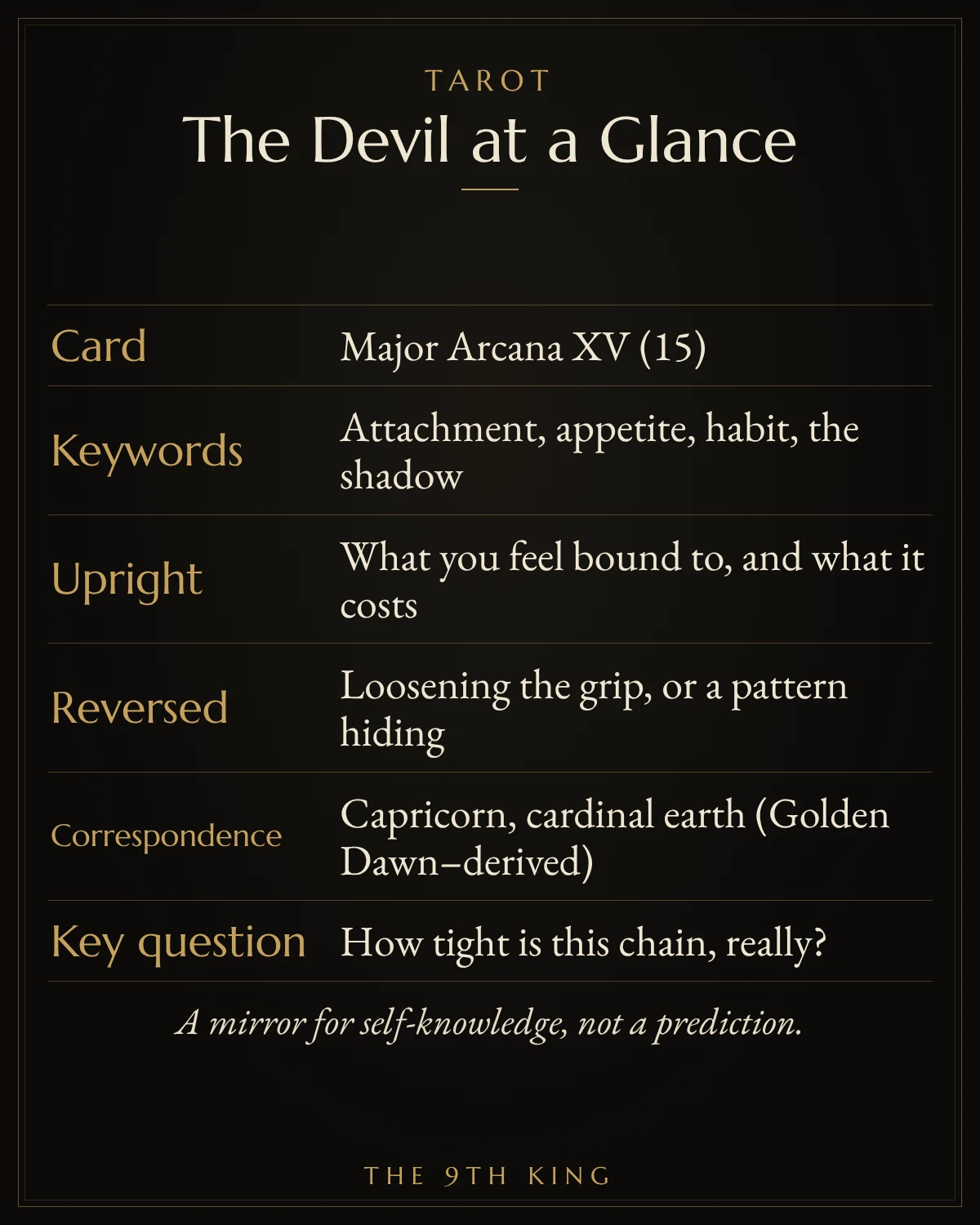
The Devil tarot card at a glance
| The Devil | |
|---|---|
| Number | XV (15), Major Arcana |
| Core theme | Attachment and appetite |
| Upright | Habit, craving, feeling stuck |
| Reversed | Loosening, or a pattern hiding |
| Correspondence (Golden Dawn–derived) | Capricorn |
| Hebrew letter (Golden Dawn) | Ayin |
| 9K tension | Desire vs dependence |
| Key question | How tight is this chain, really? |
Below: the imagery, the common meanings, why Capricorn, then the 9K reading and an exercise.
What’s on the card: The Devil tarot symbolism
Most modern decks follow the Rider–Waite–Smith design, published by William Rider & Son in 1909 to A. E. Waite’s instructions and illustrated by Pamela Colman Smith, both members of the Hermetic Order of the Golden Dawn (Wikipedia: Rider–Waite Tarot). Waite described each trump in The Pictorial Key to the Tarot, now in the public domain (sacred-texts.com: Waite, XV. The Devil).
The horned figure
Waite calls the central figure the horned goat of Mendes, with wings like a bat’s, standing on an altar. The Rider–Waite–Smith figure draws in part on Éliphas Lévi’s famous 1855 drawing of Baphomet (Wikipedia: The Devil (tarot card)). Older decks drew him differently: in the Tarot of Marseille he has a face on his belly and eyes on his knees, with two horned, tailed creatures bound to his pedestal (same source).
The raised hand and the lowered torch
His right hand is raised, which Waite reads as the reverse of the blessing given by The Hierophant, card V. His left hand holds a great flaming torch turned down toward the earth. Readers often take it as desire pointed only at getting more.
Waite also notes a reversed pentagram on the forehead and the sign of Mercury at the pit of the stomach: readers often take them as a mind turned upside down, intelligence serving the gut instead of guiding it.
The two chained figures
In front of the altar is a ring, and from it two chains run to the necks of a man and a woman. Waite gives them tails to show the animal nature, but notes they still have human intelligence in their faces. He calls the scene “the chain and fatality of the material life,” and he compares the pair to Adam and Eve after the Fall. On The 9th King we read that as a picture of being caught by appetite, not as a judgment on anyone’s body, desire or worth.
The detail that changes everything
Look at Smith’s drawing (reproduced on Waite’s Devil page at sacred-texts.com) and many readers notice the collars look loose, as if the figures could lift them off. Waite’s text doesn’t say that. What he does say is just as hopeful: the figure above them is “not to be their master for ever.” He adds that the Devil is himself a bondsman. Nobody on this card is free yet. Nobody is permanently trapped, either.
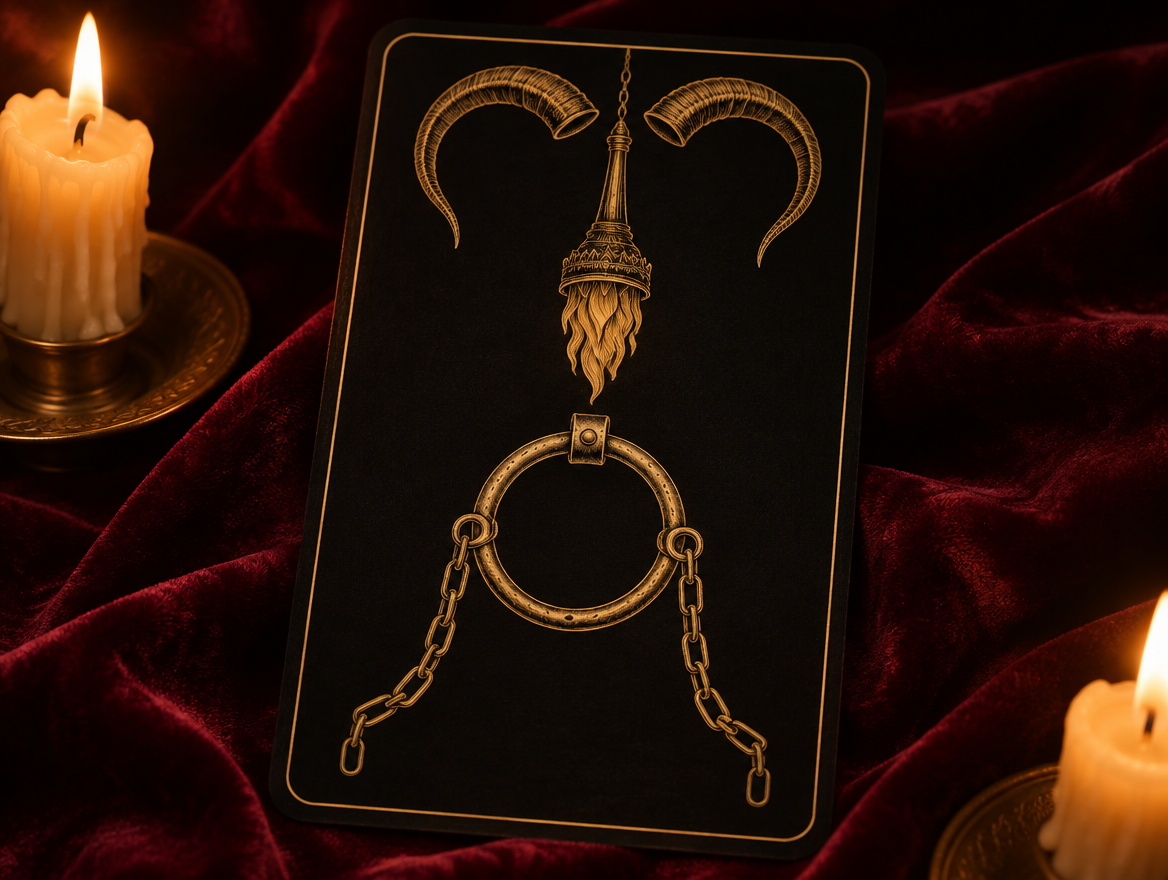
The Devil tarot meaning: upright and reversed
Below are the meanings readers commonly use, then Waite’s older list. The 9K reading follows later.
The Devil upright
Upright, readers usually take The Devil as attachment: something you keep going back to even when part of you wants to stop. Common themes:
- Habit and compulsion: a pattern on autopilot, from late-night scrolling to overworking.
- Appetite and pleasure: desire itself, which isn’t bad. The card asks who’s steering.
- Materialism: measuring your worth by money, status or possessions.
- Feeling stuck: in a job, a role, a dynamic or a story about yourself that seems fixed.
- Control: either feeling controlled, or holding on to control too tightly.
The useful upright message isn’t “you’re doing something wrong.” It’s “look clearly at what’s holding you and what you’re holding.”
The Devil reversed
Reversed, readers tend to go one of two ways:
- The grip loosens. You see the pattern for what it is, take a first step away from it, or reach out for help. Many readers call this the card of release.
- The pattern hides. The attachment goes underground: secret, denied or explained away, which makes it harder to work with.
Honesty usually decides which fits. A reversed Devil is a question, not a prize.
What Waite’s 1911 list said
Waite’s list was dramatic. Upright, he gave ravage, violence, vehemence, extraordinary efforts, force and fatality, and then a striking line: that which is predestined but is not for this reason evil. Reversed, he gave evil fatality, weakness, pettiness and blindness (sacred-texts.com: Waite, Divinatory Meanings).
That’s old fortune-telling language. Britannica dates tarot’s adaptation to fortune-telling to France around 1780; the cards began as an Italian card game in the 1430s (Britannica: Tarot). We don’t read “fatality” as fate. We read “force” as raw energy that can drive a habit or break one, and “blindness” as a question: what am I refusing to look at?
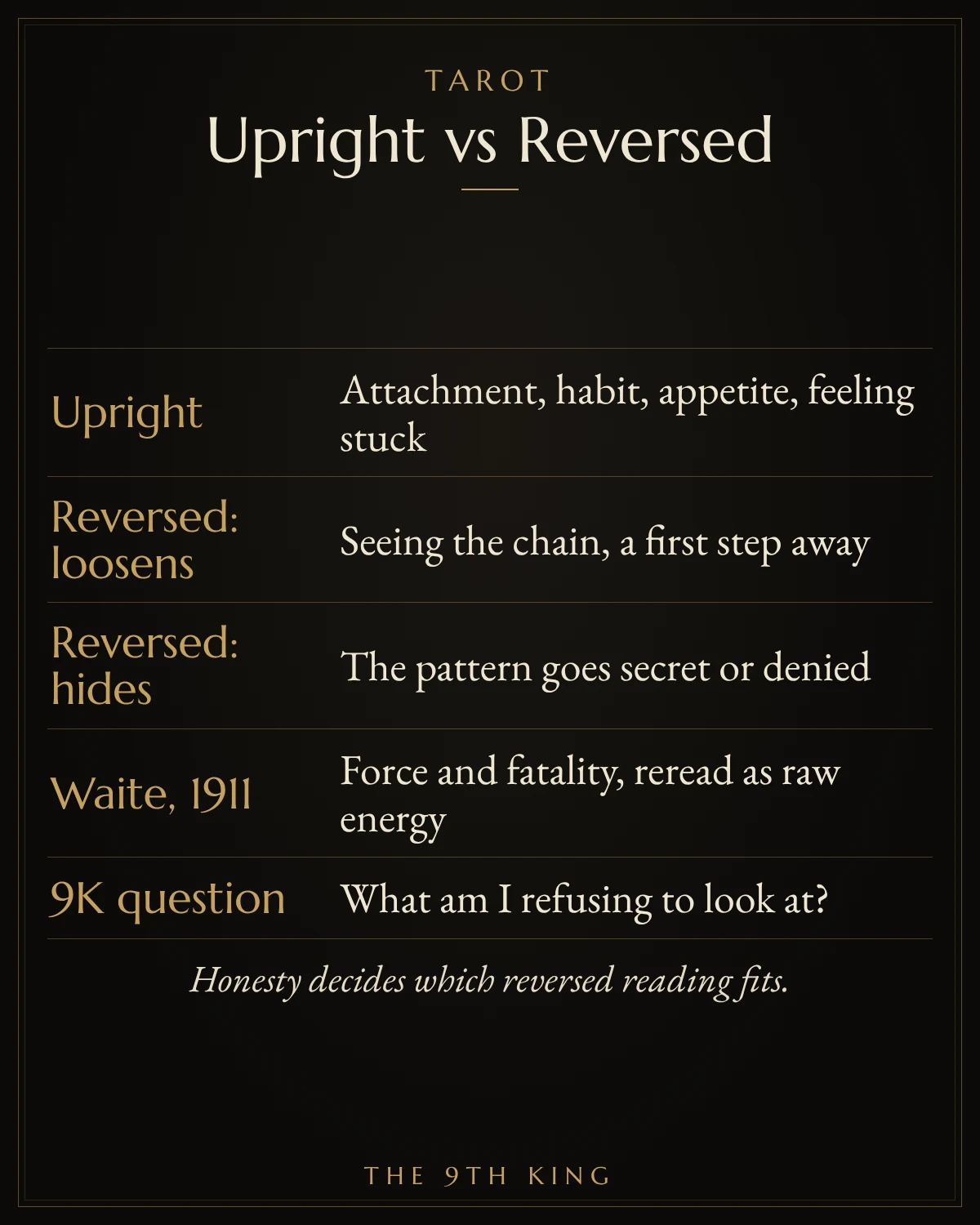
| Position | Common reading | Question to ask |
|---|---|---|
| Upright | Attachment, habit, appetite | What’s holding me, and what am I holding? |
| Reversed (loosening) | Seeing the chain, first step away | What just became visible? |
| Reversed (hiding) | Pattern denied or kept secret | What am I refusing to look at? |
The Devil and Capricorn: the Golden Dawn correspondence
Why Capricorn?
The astrology links on The 9th King are Golden Dawn–derived correspondences, the tradition The 9th King uses and the one the Rider–Waite–Smith deck draws on. The Golden Dawn’s Book T, as printed in Aleister Crowley’s Liber LXXVIII, lists card 15, The Devil, with the Hebrew letter Ayin and the sign Capricorn, and gives it the title The Lord of the Gates of Matter: the Child of the Forces of Time (Liber LXXVIII, sacred-texts.com).
That title is worth sitting with. “Gates of Matter” points to the physical world: bodies, money, work, things. “Forces of Time” suggests time, patience and limits, themes astrologers give to Saturn, Capricorn’s traditional ruler; the card is commonly linked with both Saturn and Capricorn (Wikipedia: The Devil (tarot card)).
Other schools differ
Other traditions use different attributions, and not every card maps to a single sign; court cards, for instance, work on a different scheme. The Capricorn pairing is a symbolic lens, not a law, and it says nothing about Capricorn people being “devilish.” If another system suits you better, use it consistently. Our Tarot & the Zodiac guide shows the full set of pairings.
What Capricorn adds to the card
Capricorn is the cardinal earth sign, the Goat. Astrologers associate it with ambition, discipline, responsibility, patience and a strong sense of what’s real and practical. Our Capricorn personality traits guide covers the sign in depth.
Read The Devil through Capricorn and the card becomes more than “temptation.” Capricorn’s gift is commitment, the ability to stay with something for years. Its shadow is that gift pointed the wrong way: staying with a job, role or way of coping long after it stopped serving you, because leaving feels like failure. The Goat climbs. The Devil’s goat stands still.
The Devil and The Emperor
If The Emperor is structure that protects, The Devil is structure that confines. Both cards ask about power: is it working for you, or on you?
The 9K reading: desire, dependence and the loose chain
The tension: wanting vs needing to have
The Devil’s core tension is between desire and dependence. Desire is human and healthy. You’re allowed to want pleasure, money, comfort, closeness and rest. Dependence is when the thing you want starts to decide for you: when you reach for it not because you choose it, but because not having it feels unbearable.
From the inside, the two can feel similar. A useful test isn’t how strong the pull is, but whether it fits alongside the things you care about or keeps pushing them out.
The shadow side: the chain you don’t look at
The shadow of The Devil isn’t wanting things. It’s the part of us that would rather not look at what we want, or at the price. It shows up in familiar ways:
- “I could stop anytime.” A story that keeps the pattern safe from examination.
- Shame as fuel. Feeling bad about a habit, then using the habit to soothe the feeling.
- “It’s just how things are.” Sometimes true, sometimes a way of not testing the slack.
- Seeing the chain only in others. It’s easy to spot someone else’s dependence and miss your own. Our guide to psychological projection explains why the patterns we judge loudest are sometimes our own.
None of this makes you a bad person. Waite gives the two figures human intelligence in their faces: people who can see, if they look.
The self-mastery lesson: test the slack
The self-mastery lesson of The Devil is this: a chain you’ve looked at honestly is already looser than one you haven’t.
It doesn’t mean white-knuckling or punishing yourself. It means three things:
- Name the chain plainly, without shame words.
- Count the trade: what it gives you and what it takes.
- Test the slack in one small, safe way, and get support for anything you can’t safely test alone.
That last part matters. Some chains are heavy, and asking for help isn’t the chain winning; it’s often how the collar comes off.
When the chain isn’t yours
Sometimes The Devil comes up when the chain is another person’s control: a partner, family member or boss who limits, monitors or frightens you. Be clear about this: responsibility for control or abuse belongs to the person doing it, never to the person living with it. The “loose chain” idea isn’t a suggestion that you should simply walk away from something dangerous, and staying or going is your call to make, safely. If this is your situation, please reach out to someone you trust and to a qualified professional or advocate who can help you plan for your safety. Getting support, or leaving, is never a personal failing.
The Devil tarot card in love, work and self-growth
These are reflections, not predictions.
The Devil in love
In love readings, The Devil often points to intensity: strong attraction, obsession, jealousy, or a bond that feels impossible to step back from. It can also point to unbalanced power, or simply to desire, which can be a lovely, alive thing.
Ask yourself:
- Do I feel free in this connection, or do I feel watched, managed or afraid?
- Am I staying out of love, or out of fear of what leaving would mean about me?
- What do I keep doing in relationships that I promised myself I’d stop?
The Devil doesn’t tell you to stay or leave. If the picture is about someone controlling or frightening you, please see the note above and reach out for qualified support. If it’s about your own patterns, our guide to inner child work can help you trace where they began.
The Devil at work and with money
At work, The Devil can point to golden handcuffs: a job you stay in for the pay or title while it costs your health or time. It can also point to overwork as identity, or to spending and saving driven by anxiety rather than choice.
A grounded approach when The Devil shows up around work:
- List what this job or pattern gives you and what it costs, in two honest columns.
- Notice which “I have to” statements are facts and which are fears.
- Make no sudden, irreversible decision from a single reading.
Nothing here is career or financial advice. For money, debt or contract decisions, talk to a qualified professional.
The Devil in self-growth
For personal growth, The Devil is about befriending your appetites instead of fighting them in the dark. The more honestly you can say “I want this, and here’s why,” the less that want runs you in secret. If you’re new to this kind of work, Shadow Work, Plainly is a gentle place to start.
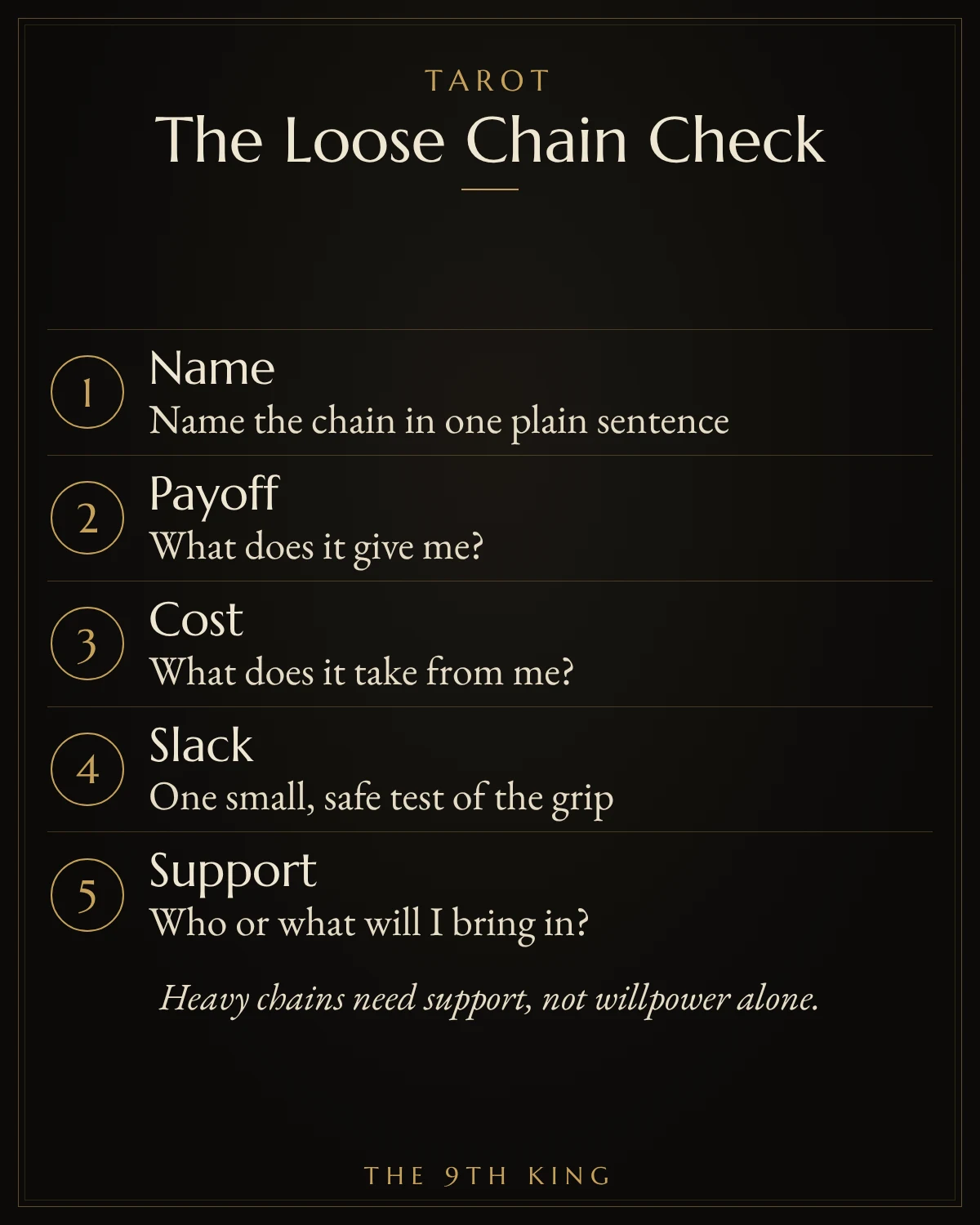
A practical exercise: the Loose Chain Check
This takes about 15 minutes, with or without a deck. You need paper, a pen and, if you like, The Devil card in front of you. Pick one everyday, low-stakes pattern the first time.
Before you start: if the chain you have in mind involves alcohol, drugs, gambling, self-harm or anything you feel you can’t stop, use this only as a way to see it more clearly, not as a plan to change it alone. Bring it to a doctor, counselor or support group who can help you safely. If the chain is another person’s control over you, skip the “slack” step and go straight to support.
The steps
- Name. Write the chain in one plain sentence, with no shame words. “I check work messages in bed every night.”
- Payoff. Write what it gives you. Be generous; every habit pays something. Relief from worry. Feeling on top of things. Something to do with my hands.
- Cost. Write what it takes. Sleep. Calm mornings. Attention for my partner.
- Slack. Choose one small, safe test of the grip: notice it without changing it for a day, delay it by ten minutes, or change one condition around it. Write down what you’ll try and what you noticed.
- Support. Write one person, practice or resource you’ll bring in. A friend who knows, a professional, a group, or simply a note on your phone that reminds you why.
Worked example (fictional)
Jordan (fictional) pulls The Devil while journaling about burnout. The chain: answering work messages in bed every night. The payoff list surprises him: it’s not ambition, it’s relief. If he checks, he can stop wondering whether something went wrong. The cost list is longer: poor sleep, short temper in the mornings, a partner who’s stopped saying goodnight.
For the slack test, he charges his phone in the kitchen for three nights. The first night is hard. The second, he notices the worry peak and fade on its own. Nothing at work goes wrong. For support, he tells his partner what he’s trying and asks his manager what response time is actually expected.
The chain didn’t vanish, but Jordan has felt how much slack it had. There’s a Capricorn flavor here: he’d confused being reachable with being responsible.
Using the exercise in a reading
If The Devil comes up in a spread, run the Loose Chain Check on your question. For a layout built around the hidden self, try our Shadow Work Tarot Spread. To read by feel as well as by the book, see intuitive tarot (Code of Ascension).
Journal prompts for The Devil
Use one prompt per session. Write for ten minutes, then put it away until tomorrow.
- What do I reach for when I feel anxious, lonely or bored, and what does it actually give me?
- Where in my life do I say “I have to” when the truer words might be “I’m afraid not to”?
- Which of my habits would I feel embarrassed to describe to someone I respect, and why?
- What did I learn early about wanting things: that it was safe, shameful, greedy or normal?
- Where do I hold power over someone else, and how do I use it?
- If one chain in my life were looser than I think, which would I most want it to be?
- Who could I tell the truth to about a pattern I’m carrying alone?
For more prompts on desire, shame and the hidden self, see our full list of shadow work prompts, and our zodiac shadow work guide if you want to explore the Capricorn shadow specifically.
A gentle note: this is reflective practice, not therapy. If you’re dealing with addiction, coercive control, trauma, abuse, thoughts of self-harm or distress that feels overwhelming, please work with a qualified therapist or counselor who can support you properly. Reaching out is a strength, not a failure. And it’s always fine to stop a prompt that feels like too much.
Myths and misreadings about The Devil
- “The Devil means you’re evil.” No card judges your character. The Devil describes a pattern of attachment that almost everyone meets in some form.
- “The Devil predicts addiction or cheating.” Tarot on The 9th King doesn’t predict events or diagnose anything. The card can point to attachment as a theme worth reflecting on, nothing more.
- “The Devil is a religious warning.” The imagery borrows older symbolism, including Lévi’s Baphomet and Waite’s Eden reference. Here it’s read psychologically, not as a statement about any faith.
- “The Devil reversed always means you’re free.” That’s one reading. Another is that the pattern has gone underground. Honesty decides which fits.
- “Capricorns are The Devil.” The Capricorn link is a symbolic correspondence in one tradition, not a sign’s morality. Capricorn’s patience is exactly what loosening a chain takes.

The Devil Tarot Card: FAQ
What does The Devil tarot card mean?
The Devil tarot card, Major Arcana XV, is commonly read as attachment, appetite, habit, materialism and feeling stuck. The traditional image shows two figures chained beneath a horned figure. On The 9th King it’s a mirror, not a prediction: it asks what you feel bound to, what that gives and costs you, and whether the chain is looser than it feels.
What does The Devil reversed mean?
Readers usually take The Devil reversed in one of two ways. Either the grip is loosening, as you see a pattern clearly, take a first step away or reach out for help, or the pattern is going underground and becoming secret or denied. Your own situation and honesty decide which fits. Treat it as a question about what you’re willing to look at, not as a verdict.
What zodiac sign is The Devil tarot card?
In the Golden Dawn–derived correspondences The 9th King uses, The Devil is paired with Capricorn, the cardinal earth sign, and the Hebrew letter Ayin. The Golden Dawn’s Book T, printed as Liber LXXVIII, calls it the Lord of the Gates of Matter. Other schools of tarot use different attributions, so treat the pairing as a symbolic lens, not a statement about Capricorn people.
Is The Devil a bad card?
No card is bad on The 9th King. The Devil can feel heavy because it points at habits, cravings and power dynamics we’d rather not look at. But naming a pattern is the first step to changing it, which makes the card useful rather than threatening. Many readers also see the chains in the traditional image as loose.
What does The Devil tarot card mean in love?
In love, The Devil often points to intensity: strong attraction, obsession, jealousy or a bond that feels hard to step back from. It can also point to unbalanced power. It doesn’t tell you to stay or leave. If you feel controlled or afraid in a relationship, that’s not your fault, and reaching out to someone you trust and a qualified professional is a wise step.
Is The Devil a yes or no card?
The 9th King doesn’t use tarot for yes or no answers. The Devil is about attachment and choice, which makes a simple verdict unhelpful. A better approach is to ask what you’re holding onto, what it gives you, what it costs, and what one small, safe step would show you how much freedom you have.
Why are the chains loose on The Devil card?
Many readers notice that the collars in Pamela Colman Smith’s drawing look loose enough to lift off, and take that as the card’s hidden message: the bond is partly held in place by belief and habit. Waite’s text doesn’t describe the chains as loose, but he does write that the figure above them won’t be their master forever, which supports the same hopeful reading.

Your next step: pick one everyday pattern this week and run the Loose Chain Check above, slack step and all. Then read our Capricorn personality traits guide to see how the card’s sign handles commitment, ambition and the pull to stay put.
Explore Next
- The sign behind the card: Capricorn Personality Traits
- When we see our patterns in other people: Psychological Projection
- Questions for the hidden self: Shadow Work Prompts
- Every sign’s shadow side: Zodiac Shadow Work
- Structure that protects, not confines: The Emperor Tarot Card
- More tarot on The 9th King: Tarot Card Meanings · Major Arcana · Tarot & the Zodiac · Shadow Work Tarot Spread
- More new cards: The Sun · Judgement · The Fool · Wheel of Fortune
Final Thought: Name the Chain, Then Get Help with the Heavy Ones
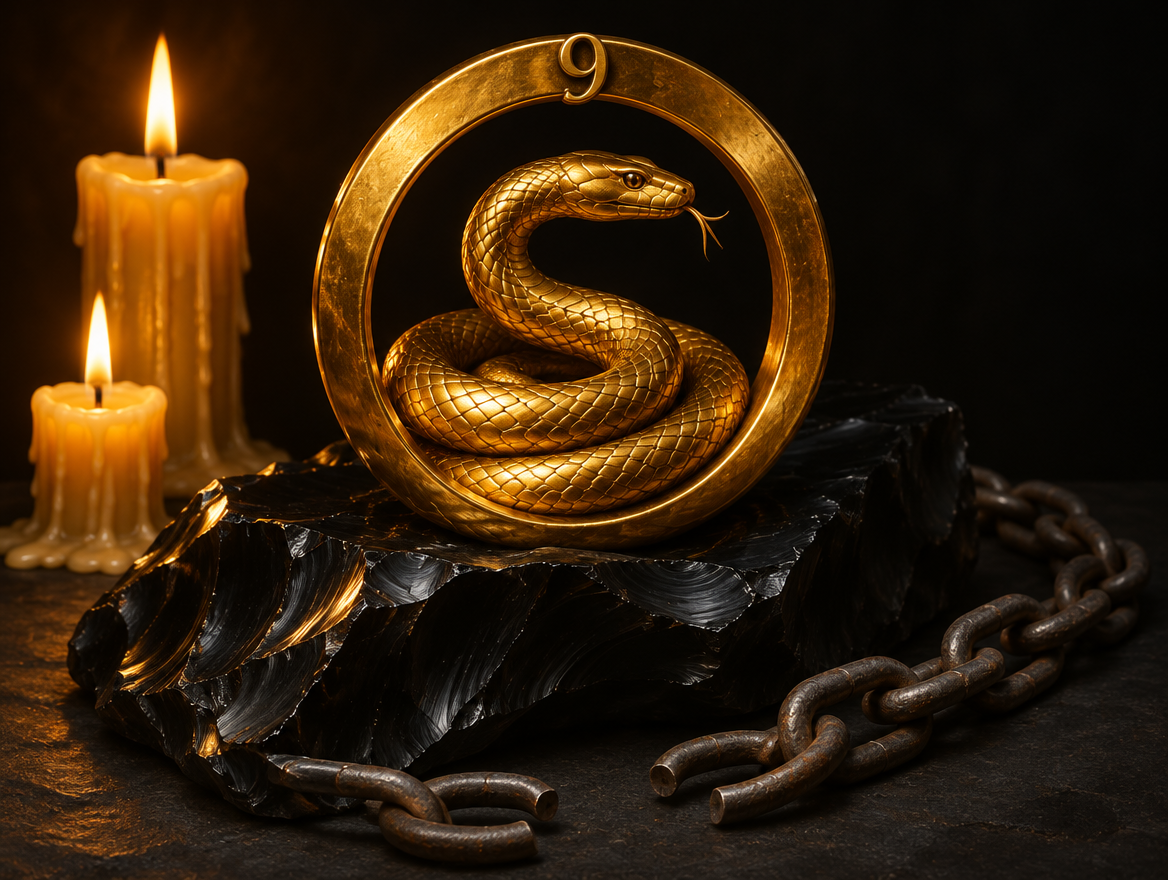
The Devil shows two figures held by chains that some readers see as looser than they look. Some chains are; some aren’t, and the ones tied to addiction, control or danger aren’t meant to be tested alone. You don’t have to be ashamed of what you want, and you don’t have to face your patterns in the dark. Name the chain, count the trade, test what’s safe to test, and bring in support for the rest. Know your nature. Rule your life.
About the Author
King is the founder of The 9th King, where zodiac psychology, relationships and shadow work are explored as tools for self-knowledge rather than fortune-telling. He’s a Libra Sun, and writes about the personal side of astrology on King The Kemist. Astrology on The 9th King is interpretation and self-reflection, not prediction or established fact.
Leave a Reply