
Quick Answer: What Is a 3 Card Tarot Spread?
A 3 card tarot spread is a layout where you draw three cards and give each one a job, called a position. The classic version is past, present, future. On The 9th King we read it as reflection instead of prediction, so a favorite layout here is:
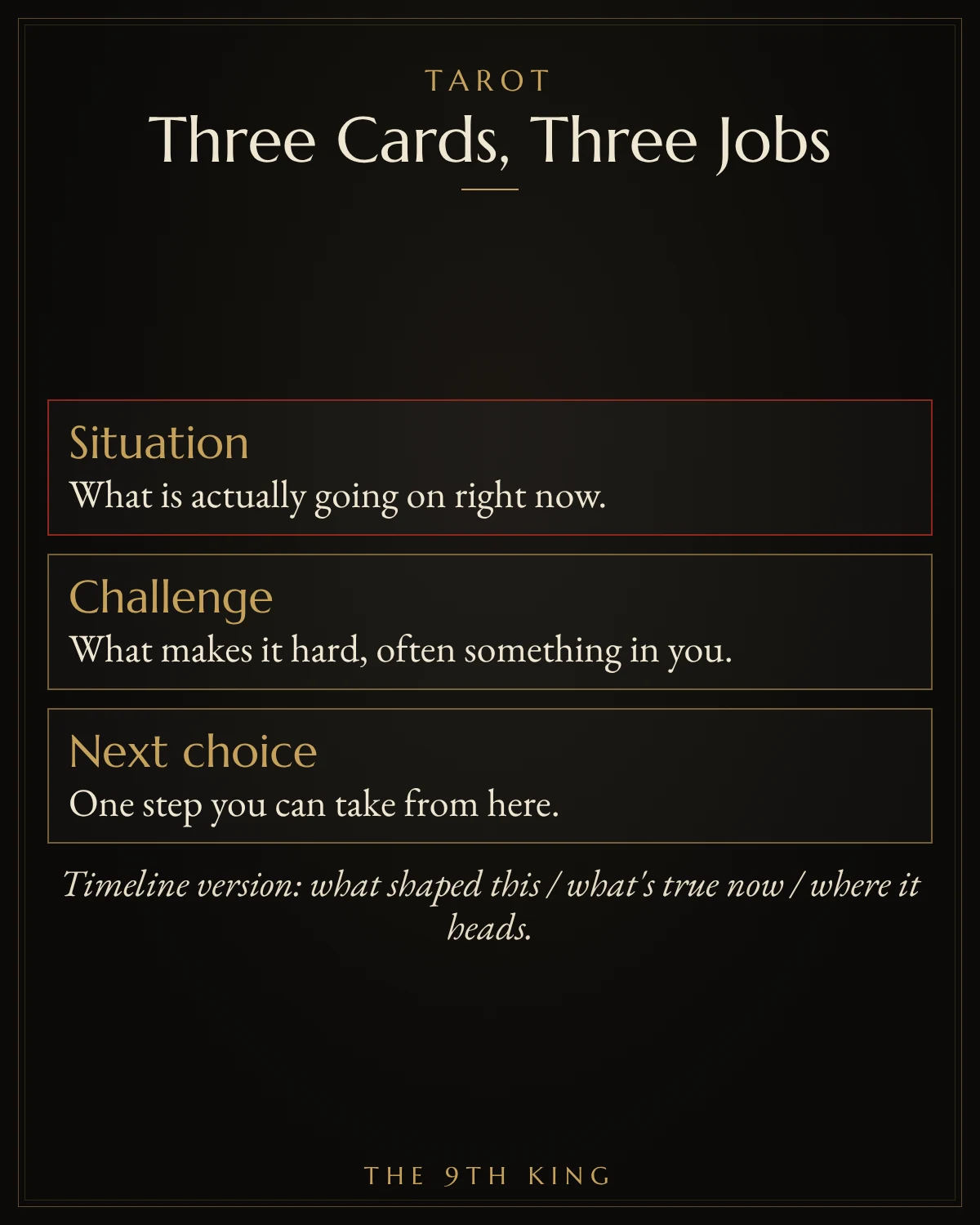
- Card 1, Situation: what is actually going on.
- Card 2, Challenge: what is making it hard, often something in you.
- Card 3, Next choice: one step you can take from here.
How to read it in one minute:
- Ask an open question about yourself, not a yes/no or a “when will…”.
- Shuffle until it feels done, then draw three cards left to right.
- Read each card in its position, then join the three into one sentence.
- Write the sentence down and pick one small action.
The cards don’t decide anything. They give you something to look at while you decide.
Table of Contents
What a three-card spread is, and why it suits beginners
A tarot deck has 78 cards: 22 Major Arcana (the trumps, like The Moon) and 56 Minor Arcana in four suits of 14, each with ten numbered cards and four court cards (Britannica: tarot). A spread is simply the pattern you lay the cards in, with a meaning assigned to each spot.
Big spreads exist. The Celtic Cross became famous partly through A.E. Waite’s The Pictorial Key to the Tarot, published with Pamela Colman Smith’s illustrations in 1910 (Wikipedia: The Pictorial Key to the Tarot). But a beginner facing a big spread often ends up reading none of the cards well.
Waite himself admitted the methods are many and some are very involved, and he set the most complicated aside on the principle that “the way of simplicity is the way of truth” (Waite, Pictorial Key, Part III §6, sacred-texts.com). Three cards honor that.
Three is also the smallest number that tells a story. One card is a snapshot; three have movement: this, then this, so this. And three images are few enough to hold in your head at once.
A short note on history
Tarot didn’t start as a fortune-telling tool. Decks were first made in Italy in the 1430s for a card game, with an extra illustrated suit of trumps. Using tarot for divination came much later, in France around 1780 (Britannica: tarot).
Past, present, future, reframed
The past present future tarot spread is the one most people meet first. The trouble is the third card: read as “the future,” it tempts you to treat cardboard as a verdict. Here’s the reframe we use:
- Past becomes what shaped this: the habit, history or decision that brought you here.
- Present becomes what’s true now, including what you’d rather not admit.
- Future becomes where this is heading if nothing changes, a direction, not a destiny. If you don’t like the direction, the reading has shown you where to steer.
Eight three-card layouts for self-reflection
Every layout uses the same mechanics: three cards, left to right. Only the position names change. Pick one before you shuffle and stick with it.
| Layout | Positions (1 / 2 / 3) | Good for |
|---|---|---|
| Situation | Situation / Challenge / Next choice | Any stuck decision |
| Honest mirror | What I know / What I’m avoiding / What I can do | Shadow work, procrastination |
| Whole self | Mind / Body / Spirit | Burnout, check-ins |
| Reframed timeline | What shaped this / What’s true now / Where it’s heading | Patterns that repeat |
| Strength map | My strength / My blind spot / How to use both | Work, confidence |
| Relationship (self-focused) | What I bring / What I need / What I can say | Love and friendship |
| Release | What to keep / What to release / What to welcome | Endings, new chapters |
| Daily | Notice / Watch for / Do | A morning pull |
Choosing between them
- Stuck on a decision? Use Situation. It always ends on something you can do.
- Suspect you’re part of the problem? Use Honest mirror. The middle card is the point.
- Tired and don’t know why? Use Whole self, so not every problem gets treated as a thinking problem.
- Thinking about another person? Use the self-focused Relationship layout.
A word on the Relationship layout
None of its positions are “what they feel” or “what they’ll do.” Reading another person’s private thoughts through cards is guessing, and guessing about people we love often turns into anxiety or psychological projection. Whether you stay, leave or wait is your call, not the deck’s.
How to phrase a good tarot question
The question does more work than the shuffle. A loaded question gets a loaded reading, because you’ll read the cards through it.
Four rules for a good question
- Make it open. Start with what, how or where. “Will I get the job?” wants a yes or no tarot can’t honestly give. “What do I need to understand about this job search?” invites a reading.
- Make it about you. You can’t read someone else’s mind, but you can read your reaction to them. “Why is she ignoring me?” becomes “What is this silence bringing up in me?”
- Leave other people’s private choices alone. Questions like “Is he cheating?” or “Does my coworker hate me?” put a card in place of a conversation. The honest route is to ask the person, or ask yourself what you’ll do with the uncertainty.
- Skip the timing. “When will I meet someone?” has no answer in the cards. “What would make me more open to meeting someone?” does.
Rewrites that work
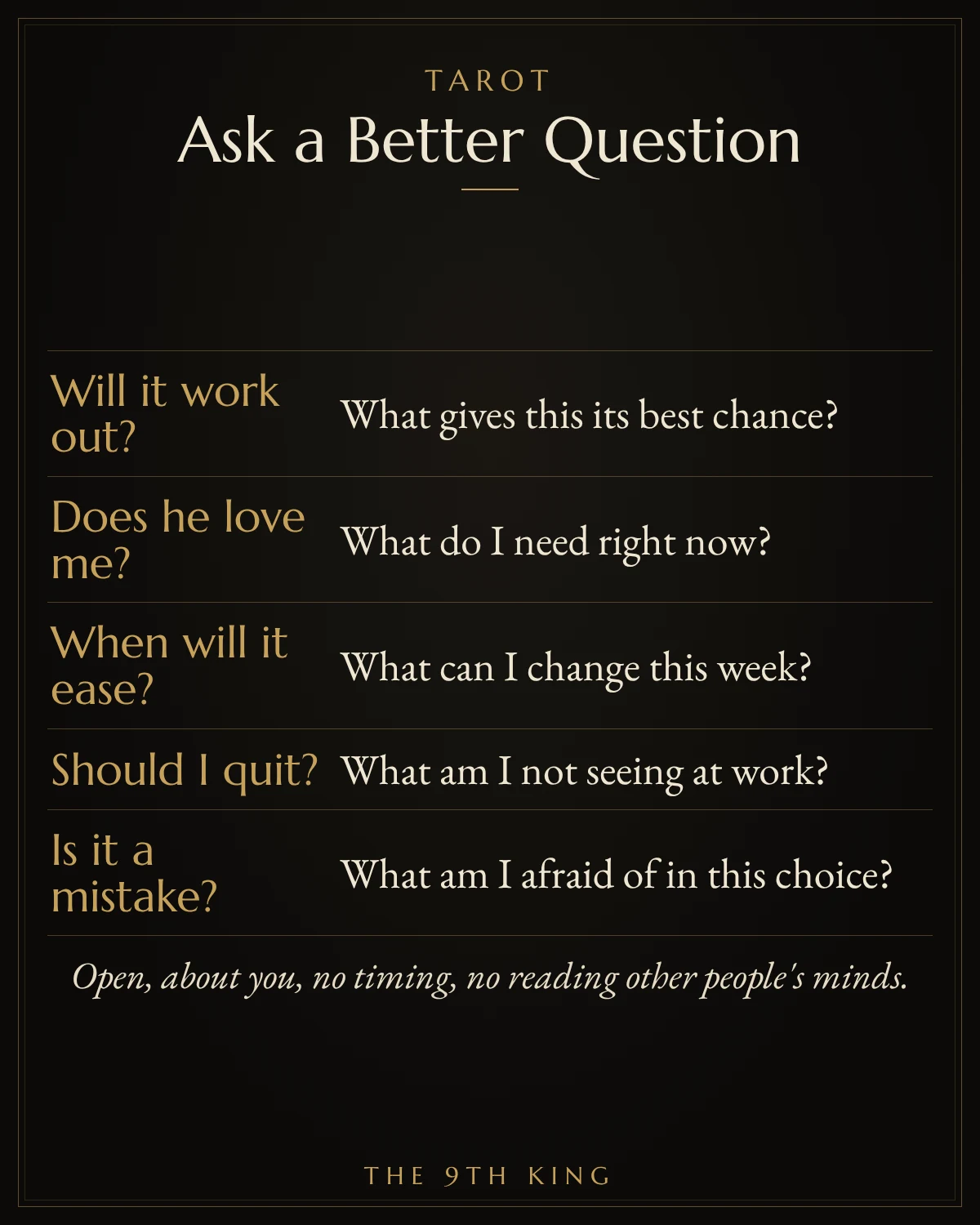
| Instead of | Try |
|---|---|
| Will this work out? | What can I do to give this its best chance? |
| Does he still love me? | What do I need in this relationship right now? |
| When will things get better? | What’s one thing I can change this week? |
| Should I quit? | What am I not seeing about my work? |
| Am I making a mistake? | What am I afraid of in this choice? |
If you keep reshuffling for a different answer, stop. You already know what you want the cards to say. Write that down instead.
How to shuffle tarot cards (plainly)
There’s no single correct way to shuffle. Any method that mixes the cards and feels comfortable is fine.
Three common methods
- Overhand: hold the deck in one hand and drop small packets into the other, over and over. Gentle on the cards, and easy to do while you think about your question.
- The wash: spread the cards face down on a table, swirl them with both hands, then gather them up. It mixes thoroughly and turns some cards upside down, which matters if you read reversals.
- Riffle: split the deck and riffle the halves together like playing cards. Quick, but it can crease larger, stiffer tarot cards.
Cutting and stopping
Cut the deck into two or three piles and restack them if you like; it’s a pause, not a requirement. Stop when it feels done. Then draw from the top and lay the cards left to right.
Upright and reversed
A reversed card comes out upside down. Readers have listed upright and reversed meanings since at least the 1780s, when the French cartomancer Etteilla tabulated both (Wikipedia: Tarot card reading). For a beginner, either choice is fine:
- No reversals: turn every card upright and read it straight. Simpler.
- With reversals: read an upside-down card as the same energy blocked, turned inward, overdone or just beginning. Not as “bad.”
Decide before you shuffle, and keep the same rule for the whole reading.
How to read a three-card spread, step by step
This method is ritual-free. No candles, crystals or special words are needed. Your attention is what makes it work.
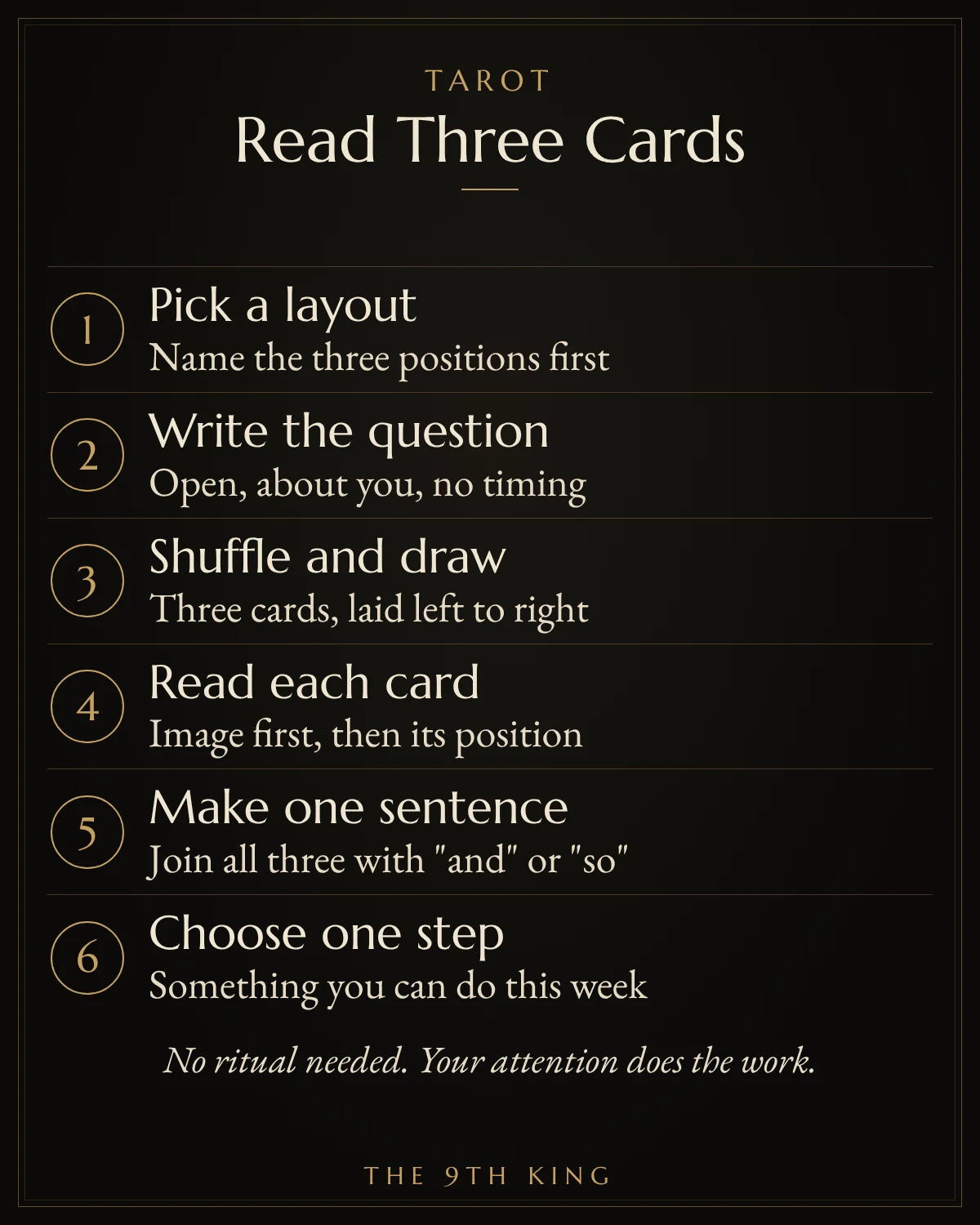
Step 1: Pick your layout
Write the three position names at the top of a page. Doing this first keeps you from bending the positions to fit the cards later.
Step 2: Write the question
One sentence, open, about you. Read it back. If it contains “will,” “when” or another person’s name as the subject, rewrite it.
Step 3: Shuffle and draw
Draw three cards from the top, lay them face down left to right, then turn them over one at a time.
Step 4: Read each card, image first
Spend thirty seconds just looking at each card. What do you notice first: a color, a gesture, a face turned away? Code of Ascension’s guide to intuitive tarot (Code of Ascension) goes deeper on reading from first impressions. Write down one word per card before you open any guidebook.
Then bring in the traditional meaning and filter it through the position. A card of effort in the Challenge spot might point to exhaustion; in the Next choice spot, to one more push.
Step 5: Make one sentence
Join the three cards into a single sentence. The next section shows how.
Step 6: Choose one step
End with something you can do in the next seven days. A reading that leads to no choice, conversation or change is entertainment. That’s allowed, but it isn’t self-mastery.
How to read three cards as one sentence
Beginners often read three cards as three separate fortune cookies. Three card spread meanings come alive when you read them as one statement.
The sentence frame
Fill in a short phrase for each card:
Right now [card 1], and what makes it hard is [card 2], so my next step is [card 3].
For the Honest mirror layout:
I know [card 1], I’ve been avoiding [card 2], and what I can do is [card 3].
Keep each phrase short. If your sentence needs a paragraph, you’re reading the guidebook, not the cards.
Patterns to notice
- Several Major Arcana cards. Readers often take two or three Majors as a sign the question touches a life theme, not a passing mood.
- All court cards. Court cards often point to roles, personalities or ways of behaving. Ask which role you’re playing, or need to play.
- Repeated suits. These can show where the energy is: Wands for drive, Cups for feelings, Swords for thoughts and conflict, Pentacles for body, work and practical life.
When the cards seem to contradict each other
They usually don’t. A “hopeful” card beside a “hard” one often shows a tension you’re living with. Instead of choosing which card is right, ask what would need to be true for both to be true at once.
Two worked readings (fictional)
Both readings are invented to show the method. The card descriptions follow the Rider–Waite–Smith imagery, in words.
Reading 1: Situation / Challenge / Next choice (fictional)
The question: “What do I need to see about the side project I keep starting and stopping?”
Card 1, Situation: The Chariot. In Smith’s picture, an armored, princely figure holds a wand, and two sphinxes sit before his chariot (the card on Wikimedia Commons). Waite’s text mentions a drawn sword, but the drawing shows a wand (Waite, Pictorial Key: The Chariot, sacred-texts.com). Readers often take The Chariot as willpower and direction. In the Situation spot: I do have drive. When I’m on, I’m really on.

Card 2, Challenge: Nine of Wands. A figure leans on his staff with an expectant look, as if awaiting an enemy, while eight more staves stand behind him like a fence. Waite sums it up as “strength in opposition,” and lists delay and suspension among its meanings (Waite, Pictorial Key: Nine of Wands, sacred-texts.com). As a Challenge, it can point to defensiveness and fatigue: every restart feels like bracing for the next failure.
Card 3, Next choice: Page of Pentacles. A young figure moves slowly, gazing at a pentacle that hovers above his raised hands. Waite links the card with application, study and reflection (Waite, Pictorial Key: Page of Pentacles, sacred-texts.com). As a Next choice, it suggests small, patient, hands-on steps.
One sentence: I have real drive, but I’ve been bracing for failure instead of building, so my next step is to treat this like a beginner and practice in small pieces.
One step: twenty minutes on the project three times this week, with no goal except showing up. The reading moves from a charging Chariot to a slow, curious Page. That shift is the advice.
Reading 2: What I know / What I’m avoiding / What I can do (fictional)
The question: “What’s underneath my unease about a friendship that’s changed?”
Card 1, What I know: The Moon. A waxing moon shines over a path that runs between two towers into the unknown, with a dog and a wolf below and a creature stirring at the water’s edge. Waite reads the dog and wolf as the fears of a mind lit only by reflected light (Waite, Pictorial Key: The Moon, sacred-texts.com). Readers often take it as uncertainty and imagination. In the What I know spot: I know I’m unsure, and I’ve been filling the gaps with worst-case stories.
Card 2, What I’m avoiding: Page of Cups, reversed. Upright, a young figure looks at a fish rising from a cup: curiosity and emotional openness. Waite’s reversed meanings include attachment and artifice (Waite, Pictorial Key: Page of Cups, sacred-texts.com). In this position, the reversal can point to a feeling kept hidden: I’m avoiding saying, simply, that I miss them.
Card 3, What I can do: Justice. A figure holds golden scales and a sword (Wikipedia: Justice (tarot card)). Readers often take Justice as fairness, honesty and cause and effect. As an action: say the true thing, fairly, and let the response be what it is.
One sentence: I’ve been filling the silence with stories, avoiding the simple feeling that I miss my friend, so what I can do is say it honestly and listen to what comes back.
One step: one short, honest message this week. The reading doesn’t say whether the friendship will recover. It points to the only part this person controls.
A note on astrology in these readings
In the Golden Dawn–derived correspondences, the tradition The 9th King uses (the system the Rider–Waite–Smith deck draws on), The Chariot is matched with Cancer and The Moon with Pisces (Angelorum: Golden Dawn astro-tarot table). Justice is numbered XI in the Rider–Waite–Smith deck. Waite says only that he swapped Justice and Strength for reasons that satisfied him (Waite, Pictorial Key: Strength, sacred-texts.com). Other sources explain the swap through the Golden Dawn’s pairing of the eighth card with Leo and the eleventh with Libra (Wikipedia: Justice (tarot card)). Other schools assign some cards differently, and not every card maps to a single sign: court cards, Pages included, work differently.
If you know your chart, this adds a layer. A Chariot can be a cue to reread Cancer’s strengths and shadow; The Moon pairs with Pisces traits, and Justice with Libra. Our guide to how to read a birth chart shows where those signs sit for you. Treat it as a second mirror, not proof.
Practice: a one-week three-card worksheet
The seven-day practice
- Day 1: Pick one layout from the table. Use only that layout all week.
- Days 1 to 7: Each morning, ask the same open question, or a small variation of it. Draw three cards.
- Write four lines:
– Card 1, 2 and 3 (name, and upright or reversed)
– One word per card from your first impression
– The one-sentence reading
– One step for today
- Day 7: Read all seven sentences together. What repeats? What step did you actually take?
The point is to notice which ideas keep resonating, and what you keep not doing.
Journal prompts for any three-card reading
- Which of the three cards did I want to skip, and why?
- If the middle card is about me, what am I doing to keep this situation the way it is?
- What would I tell a friend who drew these three cards?
- Which card feels most like an old pattern, and when did I first learn it?
- What is the smallest honest step this reading points to?
Our shadow work prompts pair well with the Honest mirror layout, and Zodiac Shadow Work links each sign’s shadow to the patterns these readings tend to surface.
Go gently
Three cards can open more than you expect. If something heavy comes up, it’s fine to stop and put the deck away. Tarot is a reflective practice, not therapy. If you’re dealing with trauma, abuse, thoughts of self-harm or overwhelming distress, please work with a qualified therapist. Shadow Work, Plainly covers how to keep this kind of inner work safe and steady.
Myths and misreadings about three-card spreads
- “The third card is your future.” In the reflective approach, the third card is a direction or a choice. Nothing in the deck fixes what happens next.
- “Scary cards mean something bad will happen.” Cards like Death or The Tower usually point to change, endings and things falling away, symbolically. They aren’t literal warnings.
- “Reversed cards are bad cards.” A reversal can mean blocked, inward, early or overdone. Plenty of reversals are gentle.
- “Your first deck has to be a gift, and you need a ritual.” You can buy your own deck and read it at a kitchen table.
- “Three cards are too simple for serious questions.” Simple doesn’t mean shallow.
- “Tarot can tell you what someone else is thinking.” It can’t. It can show you what you’re projecting onto them.
New to the deck itself? Code of Ascension’s Tarot for Beginners: How Tarot Really Works (Code of Ascension) covers the basics.
Three-Card Tarot Spread: FAQ
What is a 3 card tarot spread?
A 3 card tarot spread is a layout where you draw three cards and assign each one a position, such as Situation, Challenge and Next choice. You read each card in its position, then join the three into a single sentence. It’s a favorite simple tarot spread for beginners because it’s quick, easy to journal and flexible enough for almost any open question about yourself.
What does past, present, future mean in a tarot spread?
In the classic version, card one shows the past, card two the present and card three the future. On The 9th King we reframe it: the first card is what shaped the situation, the second is what’s true now, and the third is where things are heading if nothing changes. That keeps the reading about choice, not prediction.
How do I shuffle tarot cards?
Use whatever method mixes the cards and feels comfortable. The overhand shuffle drops small packets from hand to hand and is gentle on the cards. The wash swirls them face down on a table. A riffle is fast but can bend larger tarot cards, so go lightly. Stop when it feels done, cut if you like, then draw from the top.
What questions should I ask in a three-card reading?
Ask open questions about yourself that start with “what” or “how,” such as “What do I need to understand about this choice?” Avoid yes/no questions, questions about when something will happen, and questions about other people’s private thoughts or choices. If a question names someone else as the subject, rewrite it around your own feelings, needs or next step.
Should I read reversed cards as a beginner?
Either way works. Reading every card upright is simpler while you learn the deck. If you use reversals, treat an upside-down card as the same energy blocked, turned inward, overdone or just beginning, rather than as a bad omen. The key is to decide before you shuffle and keep the same rule for the whole reading so you don’t change it to suit the cards.
What if the three cards don’t make sense together?
Look for the tension instead of forcing harmony. Two cards that seem to contradict each other often show a conflict you’re already living with. Ask what would need to be true for both to be true at once. If it still feels unclear, write down your first impression of each card and come back later; meaning often shows up after a day or two.
Can a three-card spread predict the future?
Not in the way The 9th King uses tarot. Tarot began as a card game in fifteenth-century Italy and was only later used for fortune-telling. Here, the cards are a mirror for reflection: they help you notice patterns, name what you’re avoiding and choose a next step. Nothing in the cards fixes what will happen, and you remain the one who decides.
Your next step: pick one layout from the table, write one open question about yourself, and draw three cards tonight. Write the one-sentence reading and one step for this week. Then try the Honest mirror layout alongside our shadow work prompts to go a layer deeper.
Explore Next
- Turn your reading into deeper questions: Shadow Work Prompts
- The shadow side of every sign: Zodiac Shadow Work
- New to shadow work: Shadow Work, Plainly
- Add your chart as a second mirror: How to Read a Birth Chart
- When a reading is really about someone else: Psychological Projection
- Read from first impressions: Intuitive Tarot (Code of Ascension)
- More tarot on The 9th King: Tarot Card Meanings · Major Arcana · Minor Arcana · Tarot & the Zodiac · The Chariot · The Moon · Nine of Wands · Page of Pentacles · Shadow Work Tarot Spread
Final Thought: Three Cards, One Honest Sentence
You don’t need a big spread or a perfect ritual. You need a good question, three cards and the willingness to write down the sentence they make, even when it’s not the one you wanted. The deck doesn’t choose for you. It shows you what you’re choosing. Know your nature. Rule your life.
About the Author
King is the founder of The 9th King, where zodiac psychology, relationships and shadow work are explored as tools for self-knowledge rather than fortune-telling. He’s a Libra Sun, and writes about the personal side of astrology on King The Kemist. Astrology on The 9th King is interpretation and self-reflection, not prediction or established fact.
Leave a Reply