Quick Answer: What Does The Sun Tarot Card Mean?
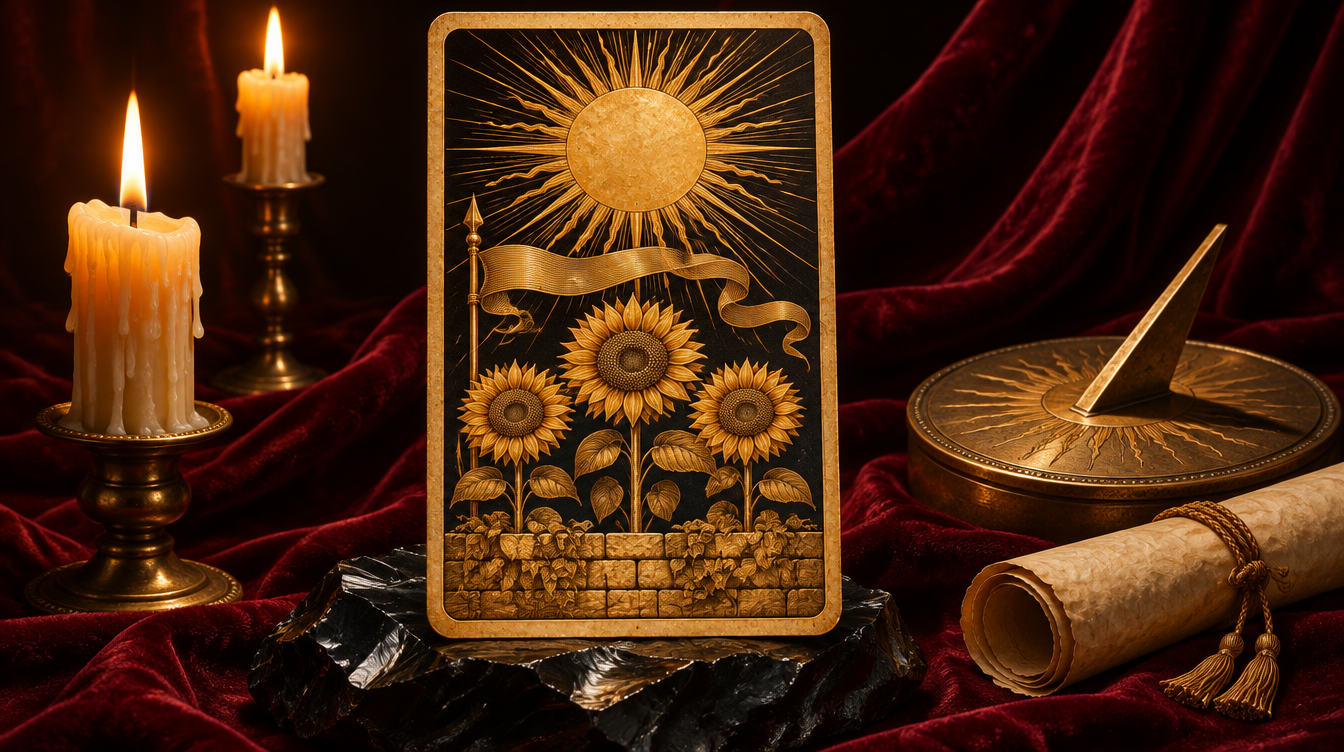
The Sun is card XIX (19) of the Major Arcana. On the traditional Rider–Waite–Smith card, a naked child rides a white horse under a large, smiling Sun, holding a red banner, with sunflowers and a wall behind. It’s the card of direct light: warmth, clarity and nothing left to hide.
Keywords: joy, vitality, clarity, warmth, simplicity, confidence, being seen.
- Upright, in one line: the card can point to plain, honest joy and the freedom of being seen as you are, with nothing to prove.
- Reversed, in one line: readers often take it as joy that’s dimmed or delayed, or as brightness that has turned into a performance.
- Astrology link: in the Golden Dawn–derived correspondences The 9th King uses, The Sun is paired with the Sun itself, the planet (not a zodiac sign).
On The 9th King, tarot is a mirror for self-knowledge, not fortune-telling. The Sun doesn’t promise that good things will happen. It asks a quieter, braver question: can I let myself be seen, and enjoy it, without putting on a show?
Table of Contents

The Sun tarot card at a glance
| The Sun | |
|---|---|
| Number | XIX (19), Major Arcana |
| Core theme | Joy, clarity and direct light |
| Upright | Warmth, vitality, being seen |
| Reversed | Joy dimmed, or joy performed |
| Correspondence (Golden Dawn–derived) | The Sun (planet) |
| Golden Dawn title | The Lord of the Fire of the World |
| 9K tension | Being seen vs performing |
| Key question | Can I be seen without performing? |
What’s on the card: The Sun tarot symbolism, piece by piece
Most modern decks follow the Rider–Waite–Smith design, illustrated by Pamela Colman Smith to A. E. Waite’s instructions and first published by William Rider & Son in 1909 (Wikipedia: Rider–Waite Tarot). Waite explained the card himself in The Pictorial Key to the Tarot, now in the public domain (sacred-texts.com: Waite, The Sun).
The Sun overhead
A large Sun fills the top of the card, rayed and smiling down on the scene (Wikipedia: The Sun (tarot card)). Waite notes that on older cards the Sun was drawn with wavy and straight rays in turn, and that it seemed to shed dew on the earth as well as light and heat (sacred-texts.com: Waite, Part I, The Trumps Major).
The detail that matters most is Waite’s own: this Sun stands for consciousness, “the direct as the antithesis of the reflected light.” The Moon only reflects. The Sun is the source.
The child on the white horse
The central figure is a naked child riding a white horse, bareback. Waite reads the child as a picture of simplicity and innocence, and describes the scene as the mind leading the animal nature in perfect agreement (sacred-texts.com: Waite, The Sun).
There’s no saddle, no armor, no costume. The child isn’t trying to look like anything. That’s the heart of the card.
The red banner
The child carries a large red banner, or standard. Waite mentions it as part of what he calls the better form of the card’s symbolism. Readers often take it as life force and energy carried openly, like a flag you don’t need to explain.
The wall and the sunflowers
Behind the child is a wall, with tall sunflowers rising over it. Waite describes the child as leaving a walled garden, which he links to the life of the senses, and setting off on the journey home (sacred-texts.com: Waite, The Sun). The sunflowers, which turn toward the light, are usually read as growth and abundance (Wikipedia: The Sun (tarot card)).
What older decks showed instead
Waite records that older Sun cards showed two children, naked or lightly dressed, playing or running hand in hand inside a walled enclosure. He adds that Éliphas Lévi mentioned other versions, including the naked child on a white horse with a scarlet standard, which Waite judged the better symbol and used for his own deck (sacred-texts.com: Waite, Part I, The Trumps Major).

The Sun tarot meaning: upright and reversed
The Sun upright
Upright, readers usually take The Sun as one of the warmest cards in the deck. Common upright themes:
- Joy: simple gladness that doesn’t need a reason or an audience.
- Vitality: energy, health of spirit, feeling alive in your body.
- Clarity: seeing a situation plainly, as if the lights came on.
- Confidence: being comfortable in your own skin.
- Visibility: being seen, known and recognized for who you actually are.
The useful upright message isn’t “everything will go well.” It’s “let yourself be seen in the light.”
The Sun reversed
Reversed, readers tend to go one of two ways, and your own situation usually decides which fits:
- The light is dimmed. Joy feels out of reach, delayed or clouded. You may be hiding your brightness, or not letting yourself enjoy what’s already good.
- The light is forced. Brightness has turned into performance: the smile for the camera, positivity used to cover a problem, needing to be seen more than wanting to be known.
What Waite’s 1911 list said
Waite’s divinatory meanings for The Sun were short and cheerful: “Material happiness, fortunate marriage, contentment.” Reversed, he gave simply the same in a lesser sense (sacred-texts.com: Waite, Divinatory Meanings).
That’s the language of old fortune-telling. Britannica dates tarot to Italy in the 1430s, as a card game, and its adaptation for fortune-telling to France around 1780 (Britannica: Tarot). On The 9th King we turn Waite’s list into questions. Contentment becomes what already makes me glad? The reversed “lesser sense” becomes where am I letting only a little light in?

| Position | Common reading | Question to ask |
|---|---|---|
| Upright | Plain joy, clarity, being seen | What makes me glad? |
| Reversed (dimmed) | Joy hidden, held back or delayed | What am I hiding? |
| Reversed (forced) | Brightness turned into a show | Who am I performing for? |
| Waite, 1911 | Contentment; reversed, the same in a lesser sense | What’s already good? |
| 9K question | Light let in only partly | Where am I letting only a little light in? |
The Sun and the Sun: the Golden Dawn correspondence
Why the planet, not a sign?
The astrology links on The 9th King are Golden Dawn–derived correspondences, the tradition The 9th King uses. Waite and Pamela Colman Smith were both members of the Hermetic Order of the Golden Dawn, and their deck reflects that background (Wikipedia: Rider–Waite Tarot).
In that system, the 22 Major Arcana are split among the elements, the planets and the zodiac signs. The Sun is one of the planetary cards. (Astrology counts the Sun among the classical “planets,” the seven moving lights of the old sky; astronomy classifies it as a star.) The Golden Dawn’s Book T, as printed in Liber LXXVIII, lists card 19, The Sun, with the Hebrew letter Resh and the planet Sun, and gives it the title The Lord of the Fire of the World (Liber LXXVIII, sacred-texts.com).
Here, unlike The Moon (whose sign is Pisces), the name and the correspondence match.
Other schools differ
Other traditions use different attributions, and not every card maps to a single sign or planet (court cards work on a different scheme altogether). The Sun pairing is a symbolic lens, not a law. If another system suits you, use it consistently.
What the Sun adds to the card
In astrology, the Sun is usually read as your core identity: vitality, sense of self, the part of you that wants to be recognized. Through that lens the card’s themes line up neatly: warmth, life force and being visible.
The Leo connection
The Sun card is paired with a planet, not with Leo. But the Sun has a home sign: as our Leo personality traits guide notes, Leo is ruled by the Sun in traditional and modern astrology alike, and it’s the only sign the Sun rules. So if the Leo themes of warmth, generosity and the wish to be seen speak to you, they’re a natural companion to this card. That’s a planet-to-ruler link, not a claim that The Sun is “the Leo card.”
The Sun card vs your Sun sign
Your Sun sign is the sign the Sun was in when you were born; the Sun card is a symbol for joy and being seen. If the card keeps appearing, look at where the Sun sits in your own chart. Our guide on how to read a birth chart walks through finding it, along with its house and aspects.
From The Moon to The Sun: the order of the cards
After the night road
The Sun comes straight after The Moon, and the two read well as a pair. The Moon is a night road lit by reflected light, where fear and imagination fill the gaps. The Sun is broad daylight. Waite makes the contrast himself, calling the Sun’s light direct rather than reflected (sacred-texts.com: Waite, The Sun).
As a map for self-knowledge: first you walk through not knowing, then things become plain. The Sun is what it feels like when you no longer need the fog.
On toward the end of the journey
After The Sun come Judgement (XX) and then The World (XXI), the card of completion. Joy of this kind often shows up after some hard walking, not as a shortcut around it.
| Card | Light | What it asks |
|---|---|---|
| The Moon (XVIII) | Reflected, partial | What do I actually know? |
| The Sun (XIX) | Direct, full | Can I be seen as I am? |
The 9K reading: being seen or performing?
The tension: visibility vs display
The Sun’s core tension is between being seen and performing. From the outside, they can look alike. Both involve light, attention and a bright face.
- Being seen means letting people notice who you actually are: your gladness, your opinions, your work, your quirks. The attention is a side effect.
- Performing means managing how you look so people will react a certain way. The attention is the goal.
The child on the card has no audience. They’re simply out in the open, glad, with nothing to hide and nothing to sell. That’s the standard The Sun sets.
Honestly, most of us do both, and the line isn’t always obvious from the inside. Sharing good news can be joy, a bid for approval, or a mix. The point isn’t to judge yourself; it’s to notice which one is driving.
The shadow side: when the light becomes a show
The shadow of The Sun is brightness that’s lost its source. It shows up in a few familiar ways:
- Joy on display. Enjoying something mostly for how it will look when you share it.
- Forced positivity. Using cheerfulness to cover a problem you’d rather not look at, in yourself or others.
- Needing the spotlight. Feeling flat or invisible whenever attention moves elsewhere.
- Hiding your light. The quieter shadow: shrinking your gladness so no one thinks you’re showing off, or because being seen once felt unsafe.
Not everyone’s Sun problem is too much shine. For many it’s too little permission. If being noticed once brought trouble, the work isn’t to perform more. It’s to be seen in small, safe doses. Our guide to inner child work is a gentle place to start with that, and the child on this card is a good image to hold while you do it.
The self-mastery lesson: joy you don’t have to prove
The self-mastery lesson of The Sun is simple: real joy doesn’t need a witness, and real visibility doesn’t need a costume.
Self-mastery here means three things:
- Notice your gladness before you decide whether to share it.
- Let it count even if nobody sees it.
- Let yourself be seen as you are, in rooms where it feels safe, a little more than you’re used to.
You don’t earn The Sun by working harder at looking happy. You let it in by dropping some of the effort.
The Sun tarot card in love, work and self-growth
These are reflections, not predictions. The Sun points at warmth, honesty and what it means to be seen.
The Sun in love
In love readings, The Sun often points to warmth and openness: easy affection, playfulness, feeling known. It can also point to how much of yourself you let a partner see.
Questions worth asking:
- Do I feel free to be glad, silly or honest in this connection?
- Am I showing the real me, or the version I think will be liked?
- Where could I let a little more light in, safely?
The Sun doesn’t tell you to stay or leave. It invites honesty in daylight. If your Sun or Leo themes are showing up in how you love, the warmth-and-depth dynamics in our guide to fire and water relationships may be worth a read.
The Sun at work
At work, The Sun can point to recognition and visibility: being credited and letting people see what you’re good at. It can also point to the pressure to always look upbeat.
A grounded approach when The Sun shows up around work:
- Name one piece of work you’re quietly proud of, and let one person know about it plainly.
- Notice where you’re performing enthusiasm you don’t feel, and whether a straighter answer would serve you better.
Nothing here is career or financial advice. For money or contract decisions, talk to a qualified professional.
A practical exercise: the Unperformed Joy Log
This takes about ten minutes a day for one week, with or without a deck. You need a notebook and, if you like, The Sun card in front of you (pull it on purpose; no random draw needed).
The steps
- Catch one glad moment. Each evening, write down one moment from the day that made you genuinely glad, however small. “The light on the kitchen floor at 7 am.”
- Note the urge. Did you want to share it, post it or tell someone? Write yes or no. No judgment either way.
- Name the audience. If yes, who did you picture seeing it, and what did you hope they’d think?
- Let it stand alone. Write one sentence about the moment that’s only for you, as if no one will ever read it.
- Choose one small reveal. Once during the week, let one safe person see something real about you: a joy, an opinion, a piece of work. Afterward, note how it felt.
Worked example (fictional)
Marcus (fictional) starts the log on a Monday. His first glad moment is finishing a sketch he likes. His urge to share is an instant yes, and the audience he pictures is a group chat where people tend to compliment each other’s work. He notices the hope underneath: he wants someone to say he’s talented.
His sentence for himself: “I liked the way the shadows came out.” By Thursday he notices that the moments he shares for fun feel brighter than the ones he shares for the reaction.
His small reveal: he shows one sketch to his sister, in person, and tells her he’s been drawing again. She’s glad for him. He notes that being seen by one person felt warmer than being liked by twelve.
Using the exercise in a reading
If The Sun comes up in a spread, run the log for the area of life you asked about. For a simple spread structure, Code of Ascension’s guide to how tarot really works for beginners (Code of Ascension) covers the basics.

Journal prompts for The Sun
Use one prompt per session. Write for ten minutes, ideally in daylight.
- What made me genuinely glad as a child, before I knew anyone was watching?
- When do I feel most like myself in front of other people, and who am I with?
- Where do I perform happiness, and what would happen if I stopped for a day?
- What part of me do I keep hidden so I won’t seem “too much”?
- When did being seen first start to feel risky, and is it still risky now?
- What joy have I been postponing until I’ve earned it?
- What would it look like to let one person see me a little more clearly this week?
For more prompts on visibility and the hidden self, see our full list of shadow work prompts, and our zodiac shadow work guide if you want to explore how the wish to be seen plays out through your Sun sign.
A gentle note: this is reflective practice, not therapy. If you’re dealing with trauma, abuse, thoughts of self-harm or distress that feels overwhelming, please work with a qualified therapist who can support you properly. And it’s always fine to stop a prompt that feels like too much.
Myths and misreadings about The Sun
- “The Sun means everything will work out.” On The 9th King, no card predicts outcomes. The Sun points to warmth and clarity you can notice and choose, not a guarantee.
- “The Sun is always about success and attention.” Its deeper theme is simplicity. The child has no audience, no costume and nothing to prove.
- “The Sun reversed is a bad omen.” Readers usually take it as joy dimmed, delayed or performed. It’s still a card about light.
- “The Sun is the Leo card.” In the Golden Dawn–derived system, its correspondence is the Sun, the planet. Leo is linked through rulership: the Sun rules Leo.

The Sun Tarot Card: FAQ
What does The Sun tarot card mean?
The Sun tarot card, Major Arcana XIX, is commonly read as joy, vitality, clarity, warmth and confidence. The traditional card shows a naked child on a white horse under a smiling Sun, with sunflowers behind a wall. On The 9th King it’s read as a mirror, not a prediction: it invites you to notice what genuinely makes you glad and to let yourself be seen as you are, without turning that joy into a performance.
What does The Sun reversed mean?
Readers usually take The Sun reversed in one of two ways. Either joy is dimmed, delayed or hidden, perhaps because you’re holding back your brightness, or it’s being forced, with positivity covering something or attention becoming the goal. Waite himself gave the reversed meaning as the upright one in a lesser sense. Treat it as a question about how much light you’re letting in, not as a warning.
What planet or zodiac sign is The Sun tarot card?
In the Golden Dawn–derived correspondences The 9th King uses, The Sun is paired with the Sun itself, the planet, and the Hebrew letter Resh. Its Golden Dawn title is The Lord of the Fire of the World. It isn’t assigned to a zodiac sign, though the Sun rules Leo, so many readers feel a Leo echo in the card. Other tarot schools use different attributions.
What does The Sun tarot card mean in love?
In love, The Sun often points to warmth, playfulness and feeling free to be yourself with someone. It can also prompt you to ask how much of the real you a partner sees, and whether you’re performing a version you think will be liked. It doesn’t tell you to stay or leave. It invites openness and honesty in daylight, in ways that feel safe for you.
Is The Sun a yes or no card?
The 9th King doesn’t use tarot for yes or no answers. The Sun is often called a “yes” card elsewhere, but treating it that way skips the useful part. A better approach is to ask what in the situation genuinely brings you joy, what you can see clearly now, and where you could let yourself be seen a little more honestly.
What does the child on The Sun card mean?
Waite describes the child as a picture of simplicity and innocence, riding a white horse without a saddle, mind and instinct in full agreement. Many readers see the child as your inner child, the part of you that was glad before you learned to perform. On The 9th King, the child is the card’s standard: seen in the open, with nothing to hide and nothing to prove.
How are The Moon and The Sun connected in tarot?
The Sun follows The Moon in the Major Arcana, card XIX after XVIII. The Moon is a night road lit by reflected light, full of uncertainty and imagination. The Sun is full daylight; Waite contrasts its direct light with reflected light. Read as a pair, they describe moving from not knowing into clarity, and from hiding in the fog to being comfortable in plain view.

Your next step: start the Unperformed Joy Log tonight with one glad moment from today. Then read our guide to inner child work to explore where your first sense of joy, and your first wish to hide it, came from.
Explore Next
- The child within the card: Inner Child Work
- The sign the Sun rules: Leo Personality Traits
- Find your Sun in your chart: How to Read a Birth Chart
- The card before this one: The Moon Tarot Card
- The end of the journey: The World Tarot Card
- Reading by feel, not only the book: Intuitive Tarot (Code of Ascension)
- More tarot on The 9th King: Tarot Card Meanings · Major Arcana · Tarot & the Zodiac · Shadow Work Tarot Spread
- More new cards: Judgement · The Fool · Wheel of Fortune

Final Thought: Let the Light Find You as You Are
The Sun doesn’t ask you to shine harder. It shows a child out in the open, glad, with no saddle, no costume and no crowd. Notice what makes you glad, let it count even when no one’s watching, and let yourself be seen a little more, as you are. Know your nature. Rule your life.
About the Author
King is the founder of The 9th King, where zodiac psychology, relationships and shadow work are explored as tools for self-knowledge rather than fortune-telling. He’s a Libra Sun, and writes about the personal side of astrology on King The Kemist. Astrology on The 9th King is interpretation and self-reflection, not prediction or established fact.
Leave a Reply