

Quick Answer: What Does the Ten of Pentacles Mean?
The Ten of Pentacles (also written 10 of Pentacles) is a Minor Arcana card from Pentacles, the earth suit of work, money, body and home. In the traditional image, a man, a woman and a child stand under an archway that leads into a house and its grounds, while two dogs greet an old man seated in front. On The 9th King, it’s the card of the household: what lasts, what gets handed down, and what you choose to pass on.
- Keywords: home, family in every form, legacy, roots, lasting security, belonging, what endures, tradition.
- Upright, in one line: a prompt to notice what you’ve built or been given that lasts, if you’re thinking about home, roots or what you want to leave behind.
- Reversed, in one line: chance, loss in part, or the weight of what was handed down; a prompt to look at which inheritances you want to keep and which you’re ready to set down.
On The 9th King, tarot is a mirror for self-knowledge, not fortune-telling. The Ten of Pentacles doesn’t say wealth is coming. It asks what you mean by “lasting,” and whether that meaning is yours.
Table of Contents

The Ten of Pentacles at a glance
| Ten of Pentacles | |
|---|---|
| Arcana | Minor Arcana, a pip (number) card |
| Suit and element | Pentacles, linked with earth |
| Number | Ten |
| Golden Dawn title | Lord of Wealth |
| Astrology (Golden Dawn) | Mercury in Virgo |
| Upright | Gain, family matters, home |
| Reversed | Chance, loss, games of hazard |
| Key question | What do I want to pass on? |
What the Ten of Pentacles looks like
Most people know this card from the Rider–Waite–Smith deck, first published in December 1909 by William Rider & Son of London. A.E. Waite wrote the instructions and Pamela Colman Smith drew the art, and both were members of the Hermetic Order of the Golden Dawn (Wikipedia: Rider–Waite Tarot).
Waite’s description in The Pictorial Key to the Tarot is three short sentences (sacred-texts.com: Waite, Ten of Pentacles).
The archway and the domain
Waite describes a man and a woman beneath an archway that gives entrance to a house and its domain. On The 9th King, the arch is a threshold and the card’s first question: what are you standing at the entrance of?
The elder and the dogs
In the foreground sits what Waite calls an ancient personage, an old man, and two dogs are greeting him. On The 9th King, he stands for whoever came before you: the people, near or far, related or not, whose choices shaped the ground you walk on.
The child
Waite says the couple’s child looks curiously at the dogs and has a hand on one of them. On The 9th King, the child is the part of you that’s still curious about where you came from, and still deciding what to make of it.
On the early Smith card
On the 1909 Smith card (Wikimedia Commons: 1909 Ten of Pentacles scan), ten pentacles are laid over the whole scene in three columns: three down the left side, four down the middle and three down the right. The white-haired old man wears a patterned robe, with what look like bunches of grapes near its hem. Both dogs are white, and a tall tower and a building stand beyond the arch. Apart from the archway, the house, the couple, the child, the two dogs and the seated old man, none of this is in Waite’s text.

The Golden Dawn version of the card
The Golden Dawn’s teaching text on the tarot, Book T, as printed by Aleister Crowley in Liber LXXVIII, describes a different design: an angelic hand holds a branch by its lower end, the branch’s roses touch all ten pentacles, and no buds are shown. The symbols of Mercury and Virgo appear above and below (Liber LXXVIII, sacred-texts.com). On The 9th King, we read “no buds” as everything on the branch having already flowered.
Ten of Pentacles meaning (upright)
Waite’s upright meanings are short: gain, riches, family matters, archives, extraction, and “the abode of a family” (sacred-texts.com: Waite, Ten of Pentacles). “Extraction” is an old word for ancestry or lineage, and “archives” are the records a family or household keeps.
Book T is broader. Under the title Lord of Wealth, it describes the completion of material gain and fortune with nothing further beyond it, and adds old age, slothfulness, great wealth with sometimes loss in part, heaviness and dullness of mind, yet cleverness and prosperity in money matters (Liber LXXVIII, sacred-texts.com). Even here, arriving at the top has its own weight.
On The 9th King, we read the upright card as what lasts. It has three layers.
What you were given
The card can point to what reached you from others: a skill, a recipe, a name, a faith, a sense of humor, sometimes money or a home. Not everyone receives money or property, and that says nothing about anyone’s worth. Ask yourself: What did the people who raised me, or helped raise me, hand me that I still use?
What you’re building
The card can also point to what you’re putting together now: a home, a body of work, a circle of people who show up for each other. Ask yourself: What am I building that I’d want to still be standing in twenty years?
Where you belong
Family on this card isn’t one shape: born, adoptive, foster, married or chosen, friends who became kin, or a community that took you in. Ask yourself: Where do I belong, and who belongs with me?
Ten of Pentacles reversed
Some readers use reversals as opposites, some as blocked energy, some not at all. Waite’s reversed list is a mix: chance, fatality, loss, robbery, games of hazard, and sometimes gift, dowry or pension (sacred-texts.com: Waite, Ten of Pentacles). “Fatality” here is an old word for fate, or what feels fated. “Games of hazard” are games of chance.
In his additional meanings, Waite writes that the upright card represents a house or dwelling and “derives its value from other cards,” and that the reversed card shows an occasion which may be fortunate or otherwise (sacred-texts.com: Waite, Additional Meanings of the Lesser Arcana). He notes on that page that these extra meanings are very often in disagreement with his main ones.
A card can’t tell you what anyone else has done. On The 9th King, the reversed card usually points to one of three patterns, offered as questions, not predictions.
What you can’t control
On 9K, we read Waite’s chance, fatality and games of hazard as a reminder that security is built in a world that can still shift. Ask yourself: Which parts of my sense of safety are in my hands, and which were never fully mine to hold?
Loss in part
Book T says great wealth can come with loss in part. The reversed card can point to a season when something lasting has a crack in it: a family that’s changed shape, a home you’ve left, a tradition that no longer fits. Loss in part can be grieved without deciding the whole thing is gone. Ask yourself: What’s changed, and what’s still here?
The weight of what was handed down
Waite’s reversed list ends with gift, dowry and pension: things handed from one person or generation to another. On 9K, we read that as inheritance’s double edge. What you’re given can steady you, and it can also come with expectations, old rules or patterns you never chose. Ask yourself: What did I inherit that I’d like to keep, and what would I like to set down?
| Pattern | Upright tone | Reversed tone |
|---|---|---|
| Security | Built and shared | Shaken by chance |
| Family | A place to belong | Changed shape, or strained |
| Inheritance | Held with choice | Carried without choosing |
| The future | Something to build | Something to fear |
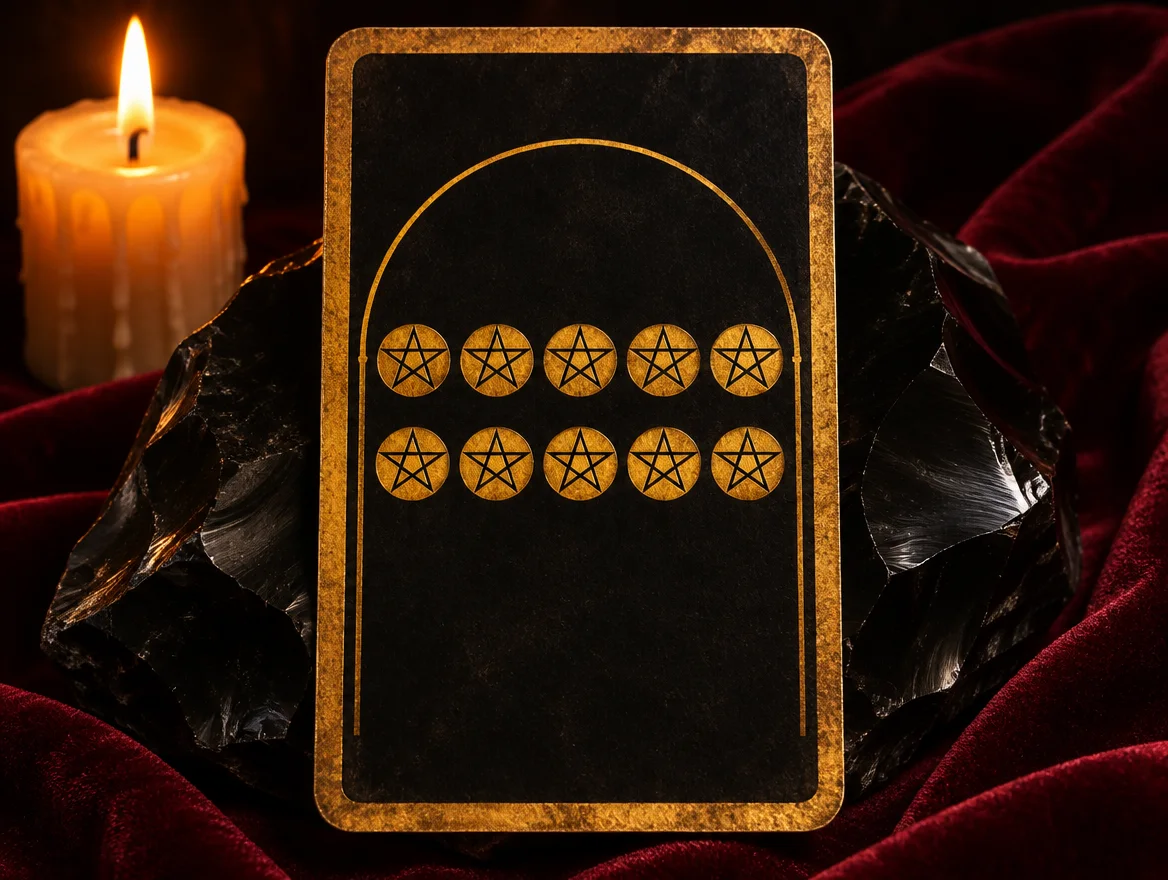
Ten of Pentacles astrology: Mercury in Virgo
The 9th King uses Golden Dawn–derived correspondences, the tradition the Rider–Waite–Smith deck draws on. Other schools use different systems, and not every card maps to a single sign: the court cards and Pages are handled differently. This is one traditional framework, offered as symbolism.
How the number cards get their planets
In the Golden Dawn system, the 36 small cards (Twos through Tens) are matched to the 36 decans: ten-degree thirds of a sign, each given a planet. Book T‘s table lists the Ten of Pentacles, Wealth, under Mercury in Virgo (Liber LXXVIII, sacred-texts.com), and the card’s own entry places the symbols of Mercury and Virgo above and below the design.
In that table, the three Virgo decans run in this order: the Eight of Pentacles (Sun in Virgo), the Nine of Pentacles (Venus in Virgo) and the Ten of Pentacles (Mercury in Virgo). So by table order, this is the last of the Virgo decans. The next entry after it is the Two of Swords (Moon in Libra). Liber prints no degrees for the Ten of Pentacles.
Book T places all four Tens in Malkuth, one of the spheres of the Kabbalistic Tree of Life, and describes them as “Fixed, culminated, complete Force, whether good or evil.” For this card, it adds riches and wealth.
What Mercury brings
On The 9th King, Mercury is the planet of thinking, records and exchange. It traditionally rules Gemini and Virgo; our Gemini Personality Traits page shows its quick, curious side. On this card, Mercury fits Waite’s word “archives”: the stories and know-how a household passes along.
What Virgo brings
Virgo is mutable earth: the sign of care, craft and daily upkeep. Our Virgo Personality Traits page covers its devotion to useful work and its critical shadow. On this card, Virgo is the quiet maintenance that keeps a home standing.
The tension in the pairing
Mercury wants to record and pass things on; Virgo wants to tend what’s already here. Together they make a legacy kept by attention: Mercury makes sure the stories get told, Virgo makes sure the roof gets fixed.
The 9K reading: legacy beyond money
The card’s tension
The Ten of Pentacles holds two true things at once: what lasts can hold you up and what lasts can hold you in. A family name can be a root or a fence. The card asks whether you’re living in what you inherited, or only living up to it.
The shadow side
The shadow of the Ten of Pentacles is treating legacy as a scoreboard. It can look like:
- Measuring worth by what’s owned. Treating a house or a bank balance as proof of who matters.
- Living for the image. Keeping up how a family looks from outside.
- Carrying rules no one questions. “This is how we do things” passed on without anyone asking whether it still helps.
- Feeling lesser for starting from less. Believing that because you weren’t handed much, you’re behind. You’re not; you’re building.
These patterns are often learned early. If that rings true, inner child work is a gentle, related place to look.
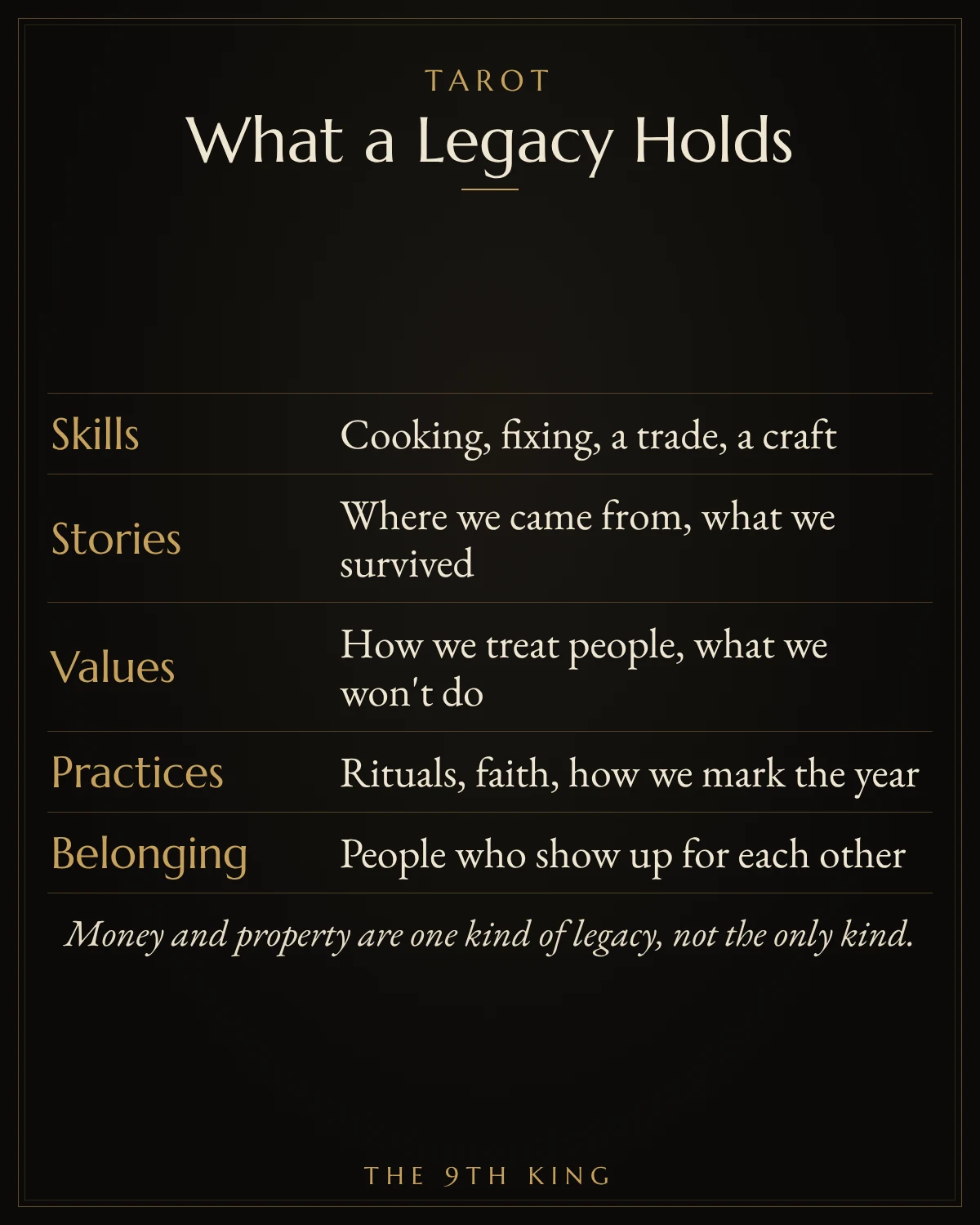
What a legacy actually holds
Money and property are one kind of legacy, not the only kind.
| Kind of legacy | What it can look like |
|---|---|
| Skills | Cooking, fixing, a trade, a craft |
| Stories | Where we came from, what we survived |
| Values | How we treat people, what we won’t do |
| Practices | Rituals, faith, how we mark the year |
| Belonging | People who show up for each other |
Not every family is safe, and nothing on this card asks you to stay close to people who harmed you. Responsibility for harm belongs to the person who caused it. You can honor what you value from your history and still keep distance, for a while or for good, from anyone you aren’t safe with.
The self-mastery lesson
The lesson of the Ten of Pentacles is to choose what you pass on. You can’t pick what you were handed. You can sort it with Virgo’s care, keep what helps, set down what doesn’t, and build something worth inheriting.
Ten of Pentacles as feelings, in love and at work
Ten of Pentacles as feelings
As feelings, readers often take the card as a wish for something lasting: steadiness, commitment, a sense of home with someone. A card can’t tell you what another person feels or plans; their words and actions over time can. About your own feelings, ask: Am I wanting a life with this person, or wanting the picture of a settled life? Both can be true at once.
Ten of Pentacles love meaning
In a love reading, the upright card can point to building something together: a shared home, routines, or blending two families’ ways. The reversed card can point to strain over family expectations, money, or different ideas of what “settled” means.
Tarot can’t tell you whether to stay or leave. Useful questions instead:
- What did each of us learn about home growing up, and where do those lessons clash?
- Which family traditions do we want to keep, and which do we want to make new?
Ten of Pentacles at work and with money
None of this is financial, legal or career advice, only reflection. For real decisions about money, property or inheritance, talk to a qualified professional.
At work, readers often take the card as long-term building: a business, a reputation, or knowledge you’ll hand on. Ask yourself: If I left tomorrow, what would I want the next person to find?
With money, the lesson is about meaning, not amounts. Ask: What is security for, in my life? What would “enough” actually look like? The King of Pentacles covers steady stewardship of resources, and the Four of Pentacles looks at the urge to hold on tight.
The Ace of Pentacles is where the earth suit begins. The Ten is the seed grown into a whole household.
Practical exercise: the legacy inventory
This is a quiet look at what you carry, not a judgment of the people who raised you. You need about half an hour and a notebook.

Step 1: What you received
Write down what reached you from the people who raised or shaped you: skills, stories, values, habits, objects. Include people outside your family.
Step 2: Keep or set down
Next to each item, write one of three words: keep, set down or not sure yet. “Not sure yet” is a real answer.
Step 3: What you built
List a few things you made, learned or chose for yourself. These count as legacy too.
Step 4: One to pass on
From either list, choose one thing you’d want someone to receive from you: a child, a relative, a friend, a coworker or a neighbor.
Step 5: One small step
Do one small thing this week: write it down, teach it, tell it or practice it. Sharing it with someone is your choice, only if it feels safe and useful.
A worked example (fictional)
Marcus (fictional) draws the Ten of Pentacles reversed after a tense family holiday.
Under “received,” he lists four things: his grandmother’s cornbread recipe, his uncle’s habit of never asking for help, the way his foster mom always set an extra plate for whoever turned up, and a neighbor teaching him to fix bikes.
Marking them, he puts the recipe and the extra plate under keep. He puts “never asking for help” under set down. The bike repair goes under not sure yet, since he hasn’t touched a bike in years. That’s four items: two to keep, one to set down, one not sure yet.
Under “built,” he writes the reading group he started at work. To pass on, he picks the extra plate. His small step: this week, he invites two coworkers who live far from their families to Sunday dinner.
Journal prompts for the Ten of Pentacles
- What did I learn about money and security growing up, and which of those lessons do I still believe?
- Who, in or outside my family, gave me something I still carry?
- What family story do I want to make sure gets told?
- What expectation have I been living up to that I never chose?
- If someone inherited my habits, which one would I want them to have?
For more, our shadow work prompts go deeper, and Shadow Work, Plainly explains how to start safely.
A warm note: this is reflective practice, not therapy. If you’re dealing with trauma, abuse, thoughts of self-harm or distress that feels overwhelming, please work with a qualified therapist who can walk with you. It’s always fine to stop a prompt that feels like too much.
Myths and misreadings of the Ten of Pentacles
- “The Ten of Pentacles means you’ll inherit money.” No. On The 9th King, tarot doesn’t predict outcomes. The card is a mirror for what you carry and what you’re building.
- “It’s only for people from wealthy families.” No. Waite lists family matters, archives and lineage beside riches, and none of those depend on a bank balance. Starting with little doesn’t make anyone less.
- “Family here means a married couple with kids.” Waite describes one household, but on The 9th King, family includes chosen family, foster and adoptive family, single-parent homes, friends who became kin and anyone who builds a home together.
- “Reversed means someone will steal from you.” No. Waite lists robbery, but a card can’t establish facts about other people. On 9K, the reversed card points to chance, change and what you carry.
Ten of Pentacles: FAQ
What does the Ten of Pentacles mean?
The Ten of Pentacles is a Minor Arcana card in the earth suit. Waite describes a man, a woman and a child under an archway leading to a house, with two dogs greeting a seated old man. His meanings include gain, riches, family matters and the abode of a family. On The 9th King, it’s a mirror for what lasts in your life, not a prediction of wealth.
What does the Ten of Pentacles reversed mean?
Reversed, Waite lists chance, fatality, loss, robbery and games of hazard, and sometimes gift, dowry or pension. Readers often take it as instability, family change, or the weight of what was handed down. A card can’t tell you what anyone else has done. On The 9th King, treat it as a prompt to sort what you inherited: what to keep and what to set down.
What does the Ten of Pentacles mean as feelings?
As feelings, readers often take the Ten of Pentacles as a wish for something lasting: steadiness, commitment, a sense of home with someone. A card can’t tell you what another person feels or plans; their words and actions over time can. About your own feelings, it can prompt you to ask whether you want a life with someone, the picture of a settled life, or both.
What does the Ten of Pentacles mean in love?
In love, the upright card can point to building a shared life: a home, routines and blended family ways. Reversed, it can point to strain over family expectations, money or different ideas of what settled means. The card doesn’t tell you to stay or leave. It invites you to look at what each of you actually does to build together, and which traditions you both want.
What zodiac sign is the Ten of Pentacles?
In the Golden Dawn system, the tradition The 9th King uses, the Ten of Pentacles corresponds to Mercury in Virgo, the last of the three Virgo decans in Book T’s table. Book T calls it the Lord of Wealth. Other schools use different correspondences, so treat this as one traditional framework for symbolism, not a statement about Virgo people.
Is the Ten of Pentacles a yes or no card?
The 9th King doesn’t do yes or no readings, because tarot here is for self-reflection, not fortune-telling. Instead, ask what the card shows you: what you’ve received, what you’re building, and what you’d want to pass on to whoever comes after you.
Does the Ten of Pentacles mean I’m missing out if my family isn’t wealthy?
No. On The 9th King, the card is about what lasts, and much of that isn’t money: skills, stories, values and people who show up. Waite’s own list puts family matters and lineage beside riches. Whatever you started with, you choose what you build and pass on.
Your next step: do the legacy inventory above, and take your one small step before the week is out. Then find where Mercury falls in your own chart with our guide on how to read a birth chart: the planet of records and exchange that the Golden Dawn tied to this card.
Explore Next
- Virgo’s care, craft and critical shadow: Virgo Personality Traits
- Mercury’s curious, talkative side: Gemini Personality Traits
- Where the earth suit begins: Ace of Pentacles
- The next card in Book T’s decan table: Two of Swords
- Reading by feel: Intuitive Tarot (Code of Ascension)
- New to the cards: Tarot for Beginners: How Tarot Really Works (Code of Ascension)
- More tarot on The 9th King: Tarot Card Meanings · Minor Arcana · Tarot & the Zodiac · The World · Shadow Work Tarot Spread
- More cards in this set: Two of Pentacles, Eight of Pentacles, Nine of Pentacles
Final Thought: Build Something Worth Inheriting
The old man in the Ten of Pentacles sits at the front of the scene, but the child is the one reaching out. Whatever you were handed, rich or thin, kind or heavy, you’re the one who decides what happens to it now. Keep what helps, set down what doesn’t, and build something worth passing on. Know your nature. Rule your life.
About the Author
King is the founder of The 9th King, where zodiac psychology, relationships and shadow work are explored as tools for self-knowledge rather than fortune-telling. He’s a Libra Sun, and writes about the personal side of astrology on King The Kemist. Astrology on The 9th King is interpretation and self-reflection, not prediction or established fact.
Leave a Reply