Quick Answer: Are There 13 Zodiac Signs?
It depends on which zodiac you mean. Ophiuchus, the Serpent-Bearer, is a real constellation, and the Sun does pass in front of it every year, roughly from November 30 to December 18 under modern astronomical boundaries. But most astrology doesn’t use constellations to define signs.
The short version, system by system:
- Tropical astrology (most Western apps and horoscopes): twelve equal signs measured from the March equinox. Ophiuchus is not a sign, and your sign doesn’t change.
- Conventional sidereal astrology (including most Vedic astrology): twelve equal signs anchored to the stars. Usually no Ophiuchus either.
- Constellation-based or 13-sign approaches: signs follow the actual constellations the Sun crosses. Ophiuchus is included, with unequal dates.
- Astronomy: Ophiuchus is one of 88 official constellations. Astronomy says nothing about personality.
- No agreed rules: Ophiuchus has no universally agreed ruler, element, modality or compatibility scheme.
So the useful question isn’t “Am I secretly an Ophiuchus?” It’s “Which system am I reading, and does it count Ophiuchus?” This guide is about chart literacy: how to answer that question cleanly. For the spiritual meaning and a full personality reading of the Serpent-Bearer, Code of Ascension’s Ophiuchus meaning guide (Code of Ascension) is the place to go.
Everything here is symbolic interpretation, not a personality test, a prediction or a claim that astrology is science.
Table of Contents
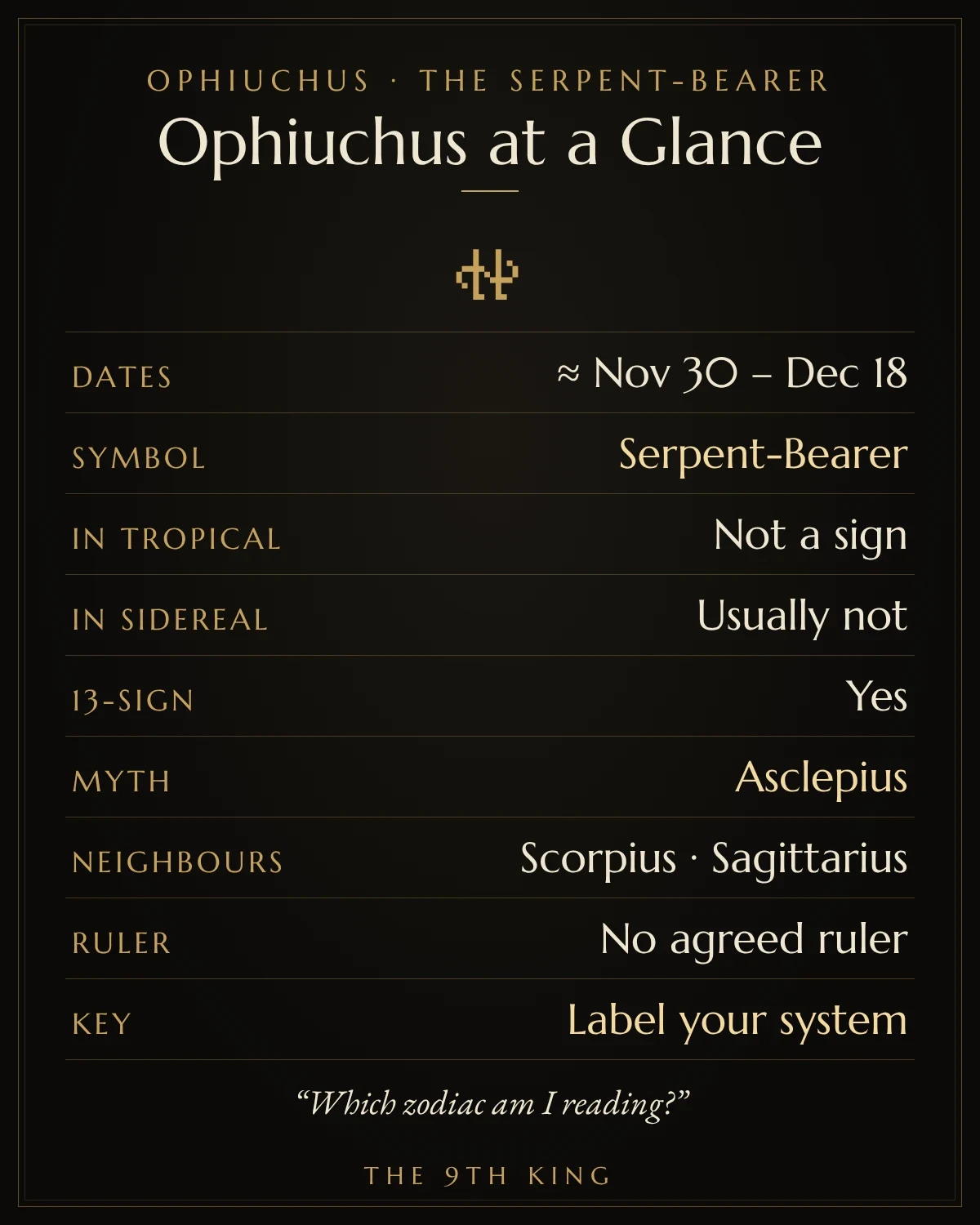
Ophiuchus at a glance
| Ophiuchus | |
|---|---|
| What it is | A constellation, one of the IAU’s 88 |
| Sun in Ophiuchus (sky) | About November 30 to December 18 |
| Symbol and glyph | The Serpent-Bearer, ⛎ |
| Myth | Asclepius, the healer of Greek myth |
| Neighbours on the Sun’s path | Scorpius before, Sagittarius after |
| In tropical astrology | Not a sign |
| In conventional sidereal astrology | Usually not a sign |
| In 13-sign astrology | A sign, with unequal dates |
| Ruler, element, modality | None universally agreed |
| House link (modern) | None agreed |
| Key question | Which zodiac am I actually reading? |
Notice how many rows say “not agreed.” That’s the honest state of the subject: Ophiuchus as a sign is a modern proposal, and different writers fill in its details differently. On the house row: the modern teaching convention that pairs each sign with a “natural” house (Aries with the 1st, through Pisces with the 12th) only covers twelve signs, and in any case a sign and a house are different things. There’s no agreed house for Ophiuchus.
Ophiuchus dates: when is the Sun in Ophiuchus?
Here’s where most of the confusion starts, so let’s separate the two calendars.
The constellation dates. Using the constellation boundaries set by the International Astronomical Union, approved in 1928 and published in 1930, the Sun appears in front of Ophiuchus for a little under three weeks each year. Sources give slightly different ranges:
- EarthSky’s Bruce McClure (2026): the Sun is in front of Ophiuchus “from about November 30 to December 18 each year”.
- Astronomy magazine: November 30 to December 17, with the Sun spending 18 days in Ophiuchus and only seven in Scorpius.
- Ian Ridpath’s Star Tales: the Sun passes through the constellation’s southern regions “in the first half of December”.
- Many astrology sites list November 29 to December 17; Code of Ascension notes the range varies by source (Code of Ascension).
The Sun’s crossing times shift a little each year, and writers round differently. So for 2026, by the IAU-boundary method, the safest statement is “about November 30 to December 18.” If your birthday is on November 29–30 or December 17–18, a source that simply lists dates can’t settle it; you’d need a calculation for your exact birth year and time.
The tropical dates for the same days. In the tropical zodiac, the Sun entered Sagittarius at 2:23 am EST on November 22, 2026 and enters Capricorn at 10:03 am EST on December 21, 2026 (times from Cafe Astrology’s Sun enters Sagittarius 2026 and Sun enters Capricorn 2026 pages). The whole Ophiuchus window sits inside tropical Sagittarius.
The key fact: someone born on December 5 is a tropical Sagittarius and was born with the Sun in front of Ophiuchus. Both are true, because they describe different things.
And there isn’t even one 13-sign calendar. In 1970, Steven Schmidt’s Astrology 14 proposed a fourteen-sign, equal-length zodiac that added Cetus as well, with Ophiuchus running from December 6 to 31. Constellation-based charts use different dates again. Whenever you see “Ophiuchus dates,” look for the year and the method. If neither is given, treat the dates as approximate.
The Ophiuchus symbol: why the Serpent-Bearer?
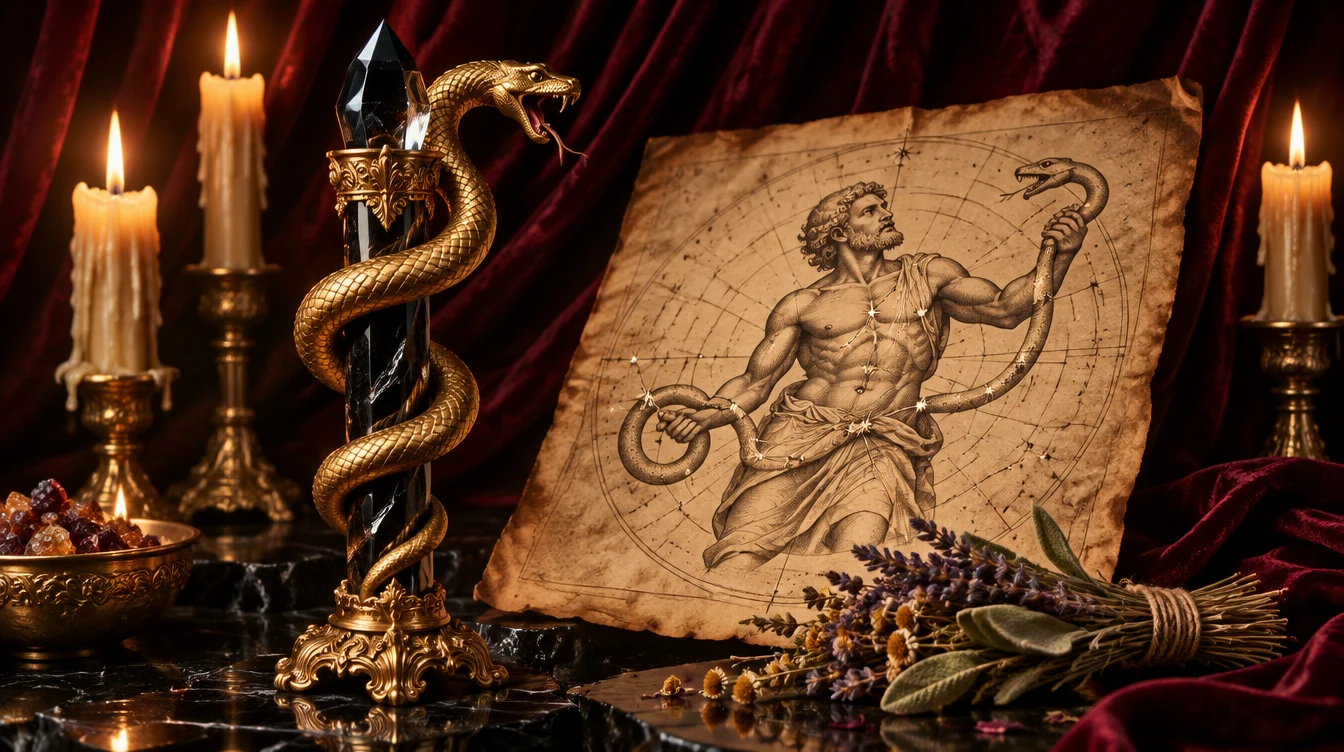
The Ophiuchus symbol is a man holding a great snake, and the name is Greek for “serpent-bearer.” The glyph ⛎ is a modern addition, a simple stylised serpent; unlike ♈ or ♓, it doesn’t come down from ancient astrology.
The figure is old even though the sign isn’t. Ian Ridpath’s Star Tales: Ophiuchus is the source for everything in this section:
- It’s one of the classical constellations. Ophiuchus is one of the 48 Greek constellations Ptolemy listed in the Almagest.
- The Greeks saw him as Asclepius, the god of medicine (Aesculapius in Latin), son of Apollo and raised by the centaur Chiron.
- The snake taught him a secret. As Asclepius stood over the dead Glaucus, a snake slid towards the body. He killed it with his staff; a second snake brought a herb that revived the first, and Asclepius used the herb to revive Glaucus. Hyginus says this is why Ophiuchus holds a snake.
- He went too far. Asclepius became so skilled that he could raise the dead. Hades complained to Zeus that the flow of souls to the Underworld would dry up, and Zeus struck Asclepius down with a thunderbolt. He was later placed among the stars.
- The serpent is its own constellation. Serpens is the only one of the 88 constellations split into two halves, head on one side of Ophiuchus and tail on the other.
- One foot on the Scorpion. Ridpath notes the Serpent-Bearer’s left foot stands on Scorpius, which is why the Sun’s path clips the bottom of Ophiuchus between the Scorpion and the Archer.
One sky detail: the bright star at his head is Rasalhague, from the Arabic for “head of the serpent bearer.”
Ptolemy knew all of this and still didn’t make Ophiuchus a sign. As Astronomy magazine explains, his tropical system measured signs from the equinox rather than from the stars, so a thirteenth constellation on the Sun’s path didn’t create a thirteenth sign.
What the symbol teaches, read as symbolism: knowledge that heals, and the question of limits. The snake is dangerous and medicinal at once. Asclepius learns from it, saves lives, and is punished when he refuses every boundary, even death’s: skill, care, and knowing when to stop.

Tropical, sidereal and 13-sign: why astrology reads Ophiuchus this way
The whole “13 zodiac signs” debate turns on one distinction: a sign is not a constellation. Once you see how each system defines a sign, the answer to “is Ophiuchus a zodiac sign?” falls out on its own.
Tropical: signs from the seasons
Tropical astrology divides the ecliptic, the Sun’s apparent yearly path, into twelve equal 30-degree signs, starting from the March equinox. As the Swiss Ephemeris documentation from Astrodienst puts it, Western astrology mostly uses the tropical zodiac, “in which 0° Aries is fixed at the vernal point.” Signs are slices of the year, tied to the seasons. There’s no thirteenth slice, so Ophiuchus isn’t included and your tropical sign doesn’t change.
Conventional sidereal: signs from the stars, still twelve
Sidereal astrology uses a zodiac “whose initial point is defined relative to the fixed stars,” and the difference between the two zodiacs is called the ayanamsha. Sidereal astrologers don’t agree on exactly where that starting point is: the Swiss Ephemeris offers more than forty ayanamshas. Astrodienst’s own sidereal ephemeris uses the Lahiri ayanamsha, defined by N.C. Lahiri in 1939 and the one most used in Indian astrology.
What sidereal astrology generally keeps is the twelve equal signs. It shifts the whole wheel; it doesn’t redraw it around the constellations. Astronomy magazine notes that most sidereal astrologers exclude Ophiuchus, with a small minority counting it. So “sidereal” and “13 signs” are not the same thing, even though they’re often mixed up.
Constellation-based: signs from the sky itself
Constellation-based or 13-sign approaches take the constellations the Sun actually crosses, using the IAU boundaries, and treat each as a sign. Since constellations are different sizes, the signs are unequal: NASA’s 2016 explainer notes the Sun spends about 45 days in front of Virgo but only 7 in front of Scorpius. The best-known popular version is Walter Berg’s The 13 Signs of the Zodiac (1995).
What NASA actually said
NASA did not add a sign. Its September 2016 post explained how the sky has shifted over thousands of years and how the Sun passes through thirteen constellations, then said plainly: “We didn’t change any zodiac signs, we just did the math.” The same post calls astrology “not considered a science,” and suggests the Babylonians chose twelve constellations to fit a twelve-month calendar and left Ophiuchus out. A similar wave of headlines followed a 2011 comment by Minnesota planetarium astronomer Parke Kunkle. Both times, astronomy described the sky; it didn’t rewrite anyone’s horoscope.
Where each system stands
| System | Is Ophiuchus included? | What it means for your chart |
|---|---|---|
| Tropical | No | Your sign is set by the equinox and doesn’t change. |
| Conventional sidereal | Usually no | Twelve star-anchored signs; your sign may differ, but not because of Ophiuchus. |
| Constellation-based (13-sign) | Yes | Unequal dates; Sun in Ophiuchus about Nov 30 – Dec 18. |
| Schmidt’s 14-sign (1970) | Yes, plus Cetus | A historical proposal with its own dates. |
| Astronomy (IAU) | A constellation, not a sign | Says where the Sun appears, nothing about personality. |
Important: “Am I an Ophiuchus?” has no single answer. It is only true inside a system that counts Ophiuchus. Your tropical chart, the one most Western astrology uses, is unaffected, and nothing about the rest of your chart (Moon, Rising, houses) moves because Ophiuchus exists. Ophiuchus also has no traditional dignities: no ruler, exaltation, detriment or fall from the Ptolemaic scheme, because it was never one of the signs that scheme was built on. Schmidt and Berg both suggested Pluto as a ruler, but that’s an individual proposal, not a consensus.
Ophiuchus traits: strengths and the shadow side
Because no tradition agrees on Ophiuchus traits, anything here is an interpretive framework: a reading drawn from the Serpent-Bearer image and the Asclepius myth, not from an agreed rulership or element. Use it as a lens for reflection, whatever system you use, and label it that way. (Code of Ascension’s Ophiuchus meaning guide (Code of Ascension) offers a fuller spiritual reading.)
Five themes stand out, each with an overused version.
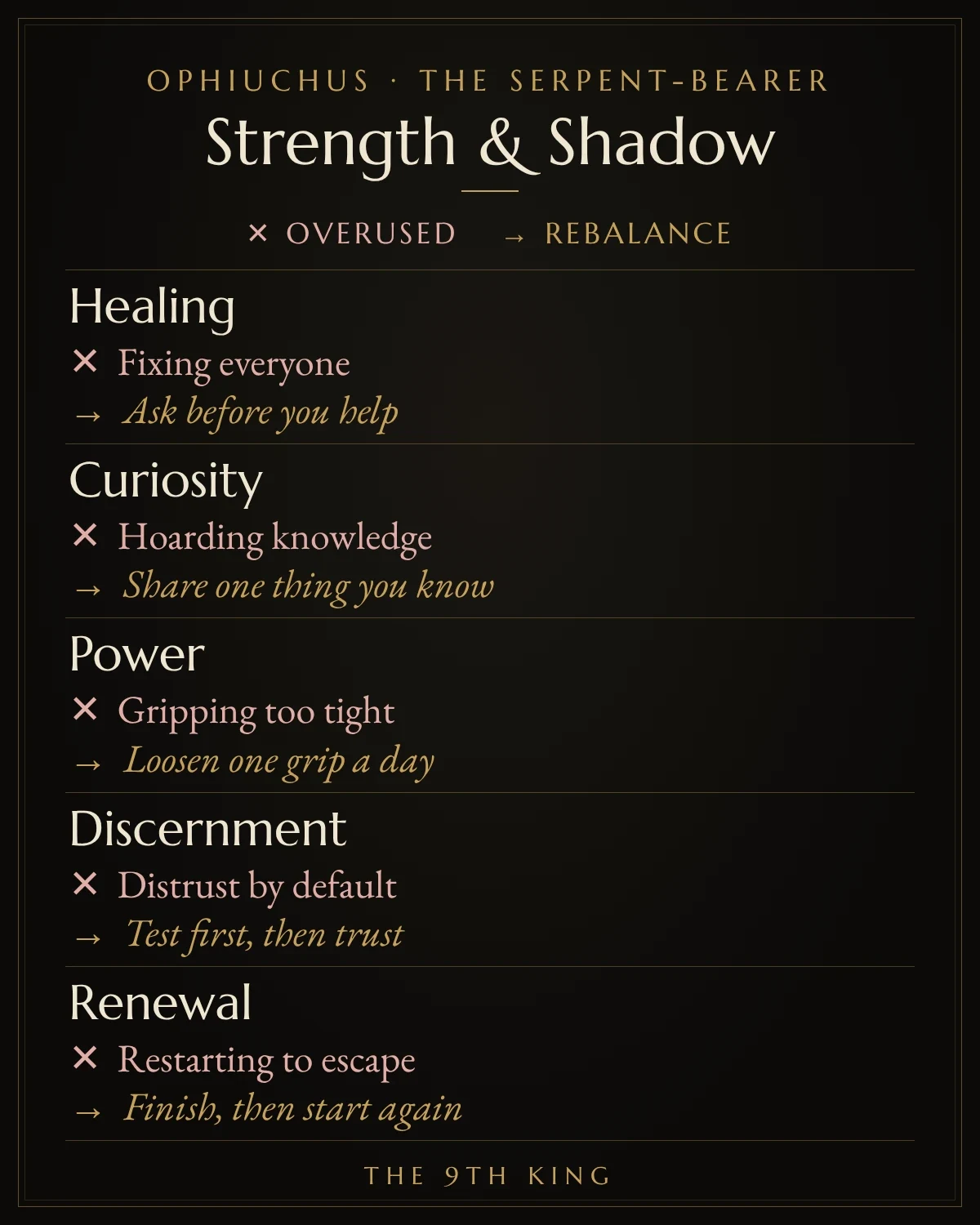
| Strength | When it’s overused | One way to rebalance |
|---|---|---|
| Healing | Fixing people who didn’t ask | Ask before you help |
| Curiosity | Hoarding knowledge as armour | Share one thing you know |
| Power | Gripping control too tightly | Loosen one grip a day |
| Discernment | Distrusting everyone by default | Test first, then trust |
| Renewal | Restarting to escape the hard part | Finish, then start again |
- Healing: Asclepius is a healer first. Overused, care becomes the reflex to fix or rescue when nobody asked.
- Curiosity: the healer learns by watching the snake closely. The shadow is knowledge kept as a fortress.
- Power: holding a serpent means handling something that could bite, without dropping it or crushing it. Overused, that’s control.
- Discernment: a healer has to tell medicine from poison. Overused, it hardens into suspicion of everyone.
- Renewal: the Glaucus story is a return from the edge. The shadow is constant reinvention to avoid finishing anything hard.
None of these is a fact about people born in early December. They’re questions anyone can use.
Ophiuchus traits in love and relationships
In relationships, the myth’s lesson is about care and consent: the healer’s gift is real, and so is the temptation to treat a partner as a patient.
As an interpretive reading, the image values depth, trust that’s earned slowly, and a relationship that makes both people healthier. Where it can go wrong: choosing partners who need saving, knowing your partner’s inner life while hiding your own, and turning discernment into tests nobody agreed to take.
A consent example: your partner describes a hard week. The overextended healer jumps straight to a plan. The balanced version asks first: “Do you want help solving it, or do you just want me to listen?” Same care, better medicine.
There’s no agreed Ophiuchus compatibility scheme, so be careful with any chart that pairs it with other signs as if it were settled. For tropical Sun-sign pairings, Code of Ascension’s zodiac compatibility chart (Code of Ascension) covers the twelve signs. For two whole charts, see synastry for beginners and Moon vs Venus.
Ophiuchus traits at work and in healing practice
As an interpretive lens, the Serpent-Bearer points towards work built on knowledge and care: medicine, nursing, research, teaching, emergency response, anywhere expertise protects people. That’s a theme in a symbol, not a career prediction tied to a birth date.
The myth also carries a warning: Asclepius was brilliant and ignored every limit. A practice for skilled work that keeps the gift and respects the limit:
- Know your scope. Write down what you’re qualified to do. Healing outside your scope isn’t generosity; it’s risk.
- Study the snake. Each week, learn one thing about the hardest part of your work.
- Share the herb. Teach one colleague something you’ve figured out.
- Rest the healer. Book recovery time the way you’d book it for someone else.
The question to keep asking: Am I helping, or am I trying to be the one who saves everyone?
Ophiuchus and your Sun, Moon and Rising: how to check your chart
Here’s the chart-literacy part. To see whether Ophiuchus shows up for you, work through these steps in order.

| Step | What to check | What it tells you |
|---|---|---|
| 1. Name your system | Tropical, sidereal (which ayanamsha?) or 13-sign | Which rules apply |
| 2. Find your tropical Sun | Sign and degree in a Western chart | Your standard Sun sign |
| 3. Check sidereal, if you use it | The Sun’s sign under your ayanamsha | Usually twelve signs, no Ophiuchus |
| 4. Check the constellation | Was the Sun within Ophiuchus’ IAU boundaries? | Your 13-sign “Sun sign” |
| 5. Label the reading | e.g. “tropical Sagittarius, constellation Ophiuchus” | A clear note you can’t misread later |
Step 5 is the one most people skip, and it ends the confusion.
A few chart notes:
- Your Sun. Only the Sun’s position on your birthday matters for the “am I an Ophiuchus?” question, and only in a constellation-based system. Most people born from about November 30 to December 18 are tropical Sagittarius.
- Your Moon. The Moon crosses the same stretch of sky every month for a day or two, so in a 13-sign chart anyone could have an “Ophiuchus Moon.” In tropical astrology, it changes sign every two to three days, so your birth date is usually enough to know your Moon sign, unless it changed signs on the day you were born; then your birth time decides it. Our Moon sign guide covers the twelve.
- Your Rising. The Rising sign changes roughly every two hours, so it always needs an exact birth time, in any system. Some 13-sign software can place an Ascendant in Ophiuchus, but there’s no agreed way to read it or a chart ruler to follow.
Our birth chart guide walks through the standard tropical chart from the ground up.
Two worked examples (fictional charts)
Example 1: Leah, born December 5 (fictional)
The charts: in a tropical chart, Leah’s Sun is in mid-Sagittarius, because the Sun enters Sagittarius around November 22. In a constellation-based chart, her Sun was in front of Ophiuchus. In a conventional sidereal chart, where the wheel sits more than twenty degrees behind the tropical one, an early-December Sun usually lands in sidereal Scorpio; she’d confirm it with her software’s ayanamsha setting.
Reading: none of these cancels the others. Her tropical Sagittarius Sun is the one most Western astrologers read: direction through meaning, teaching and big questions. The Serpent-Bearer can be a labelled symbolic layer: How do I turn what I learn into help? What she shouldn’t say is that she’s “not really a Sagittarius.” In tropical astrology, she is.
The useful question: Which system am I using right now, and have I said so?
Example 2: Marcus, born December 4 (fictional, Whole Sign houses)
The chart (fictional, Whole Sign houses): tropical Sun in Sagittarius in the 10th house, Pisces Rising, Jupiter in Virgo in the 7th house.
Reading: a direction around meaning and teaching (Sagittarius Sun) aimed at career (10th house). With Pisces Rising, Jupiter is his traditional chart ruler and also rules his Sun, so its placement matters twice: Virgo, a sign of detail and service, in the house of partners and clients. Read together: someone who meets the world gently and does his best work one-to-one. He works in public health.
Where Ophiuchus fits: his Sun was also in front of Ophiuchus. 13-sign approaches share no agreed house method, so he keeps the tropical Whole Sign chart for houses and rulers, and adds a labelled note: tropical Sagittarius Sun, constellation Ophiuchus; theme: knowledge that heals. It doesn’t move a single house.
The useful question: Where does my knowledge help people, and where am I trying to fix what isn’t mine to fix?
Both readings are hypotheses to test against real life, not verdicts.
Ophiuchus shadow work: when the healer needs healing
Shadow work means looking at the parts of yourself you’d rather not see. Our zodiac shadow work guide covers the twelve signs; here’s how the Serpent-Bearer image can support it, as an interpretive tool rather than a sign placement.
Common shadow patterns the myth points to:
- The saviour complex. Needing to be needed.
- No limits. Like Asclepius, pushing past every boundary because you can.
- Secret wounds. Caring for everyone while hiding your own pain.
- Special-status thinking. “I’m the hidden thirteenth sign, so the rules don’t apply to me.” Part of the appeal of the 13th zodiac sign is feeling rare. That’s human, and worth noticing.
A simple practice, the herb and the bite: at the end of the day, write two short lists. On the left: where my help actually healed something today. On the right: where my help was really control, or crossed a line. Then write one sentence about a limit you’ll keep tomorrow.
If you’re new to the idea, Shadow Work, Plainly explains what Jung meant and how to start safely.
Myths about Ophiuchus and the 13 zodiac signs
- “NASA added a 13th sign.” It didn’t. NASA’s 2016 post said, “We didn’t change any zodiac signs, we just did the math.”
- “Ophiuchus changes everyone’s sign.” It changes nothing in tropical astrology, and conventional sidereal astrology usually doesn’t count it either.
- “Ophiuchus was secretly removed.” Ptolemy knew the constellation and still built a twelve-sign tropical system: a choice of method, not a cover-up.
- “Sidereal astrology means 13 signs.” Most sidereal systems still use twelve equal signs; they just start the wheel at a different point.
- “Ophiuchus has fixed dates.” Dates depend on the year and the method: about November 30 to December 18 by IAU boundaries in 2026, December 6 to 31 in Schmidt’s 1970 system.
- “Ophiuchus has an official ruler and element.” No ruler, element, modality or compatibility scheme is universally agreed.
Five journal prompts for Ophiuchus symbolism
- When I first heard about the 13th zodiac sign, what did I hope or fear it would say about me?
- Where in my life am I the healer, and who looks after me?
- What knowledge do I have that could help someone if I shared it?
- Where am I pushing past a limit that exists for a good reason?
- Which zodiac am I actually reading, and have I labelled it?
Ophiuchus, the 13th Sign: FAQ
Are there 13 zodiac signs?
Only in constellation-based or 13-sign systems. Tropical astrology, which most Western astrology uses, has twelve equal signs, and conventional sidereal astrology usually has twelve too. Astronomically, the Sun passes in front of thirteen constellations, including Ophiuchus.
Is Ophiuchus a zodiac sign?
It’s a zodiac constellation in the sense that the Sun’s path crosses it. Whether it’s a sign depends on the system: no in tropical, usually no in sidereal, yes in 13-sign approaches.
What are the Ophiuchus dates?
By IAU constellation boundaries, the Sun is in front of Ophiuchus from about November 30 to December 18 (EarthSky, 2026). Other sources give November 29 or 30 to December 17. Other 13- or 14-sign systems use different dates.
If I was born in early December, am I an Ophiuchus?
In a constellation-based chart, probably. In a tropical chart, you’re a Sagittarius, and that doesn’t change. In a sidereal chart, an early-December Sun is usually in Scorpio. Label which one you mean.
What’s the difference between tropical and sidereal astrology?
Tropical astrology starts its twelve equal signs at the March equinox, so signs follow the seasons. Sidereal astrology starts them relative to the fixed stars, using an ayanamsha, so its dates currently run a few weeks later. Neither one automatically includes Ophiuchus.
What are Ophiuchus traits?
There’s no agreed list. Interpretive readings draw on the Asclepius myth: healing, curiosity, power, discernment and renewal. Code of Ascension’s Ophiuchus meaning guide (Code of Ascension) goes deeper into the spiritual reading.
Is astrology scientifically proven?
No. There’s no evidence that the Sun’s position at birth shapes personality, in any zodiac. On The 9th King, astrology is a symbolic language for self-reflection, not established science.
Your next step: pull up your birth chart, note your tropical Sun sign and degree, and write the system next to it. If you were born from about November 30 to December 18, add “constellation Ophiuchus” as a separate, labelled note. Then follow our How to Read a Birth Chart guide to read the rest of the chart in one consistent system.
Explore Next
- The spiritual meaning of the Serpent-Bearer: Ophiuchus Meaning (Code of Ascension)
- Read your whole chart in one system: How to Read a Birth Chart
- Your emotional needs: Moon Sign Meaning
- The shadow side of every sign: Zodiac Shadow Work
- The full zodiac series: Aries · Taurus · Gemini · Cancer · Leo · Virgo · Libra · Scorpio · Sagittarius · Capricorn · Aquarius · Pisces · All signs and charts
Final Thought: Name the Map
Ophiuchus didn’t take anyone’s sign. It’s the healer with the serpent, standing on the Sun’s path between the Scorpion and the Archer. Tropical, sidereal and 13-sign astrology are different maps. Say which one you’re holding, take the Serpent-Bearer’s lesson about knowledge and limits, and keep your chart clear. Know your nature. Rule your life.

About the Author
King is the founder of The 9th King, where zodiac psychology, relationships and shadow work are explored as tools for self-knowledge rather than fortune-telling. He’s a Libra Sun, and writes about the personal side of astrology on King The Kemist. Astrology on The 9th King is interpretation and self-reflection, not prediction or established fact.
Leave a Reply