Quick Answer: What Are Aspects in Astrology?
Astrology aspects are the angles between planets in a birth chart. When two planets sit a meaningful distance apart on the wheel, astrologers say they “aspect” each other, and read the two planets’ energies as linked.
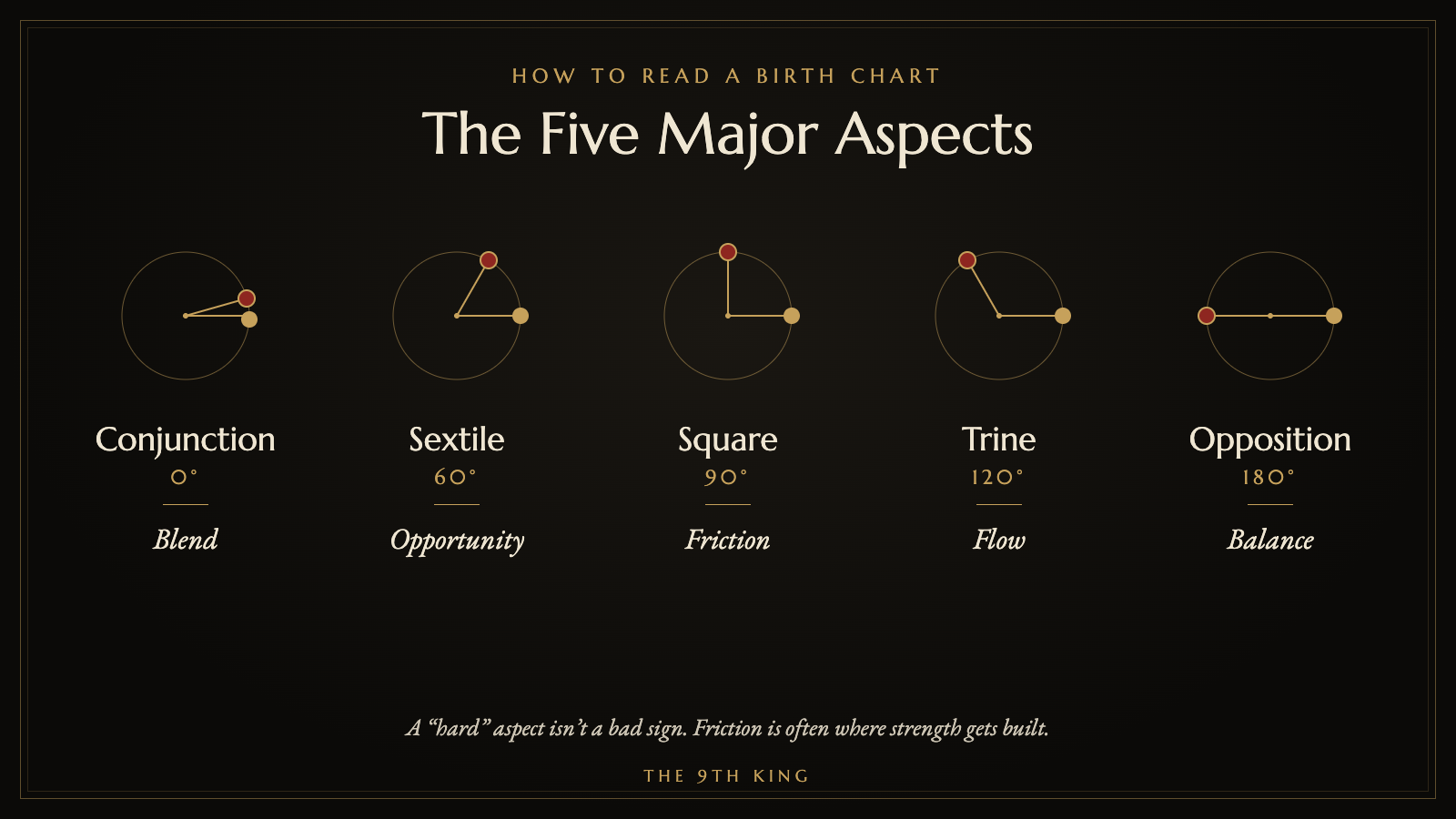
- Conjunction (0°): blended. The two planets act as one.
- Sextile (60°): cooperative. An opportunity you have to act on.
- Square (90°): tense. Friction that pushes you to grow.
- Trine (120°): easy. A natural flow, sometimes taken for granted.
- Opposition (180°): polarised. A balancing act between two sides.
If planets are the what, signs the how and houses the where, aspects describe the relationships: which parts of you work together, which argue, and which pull in opposite directions.
Table of Contents
How aspects work
A birth chart is a circle of 360 degrees. Every planet has a position on that circle. Measure the distance between any two planets and you get an angle.
Most angles mean nothing in particular. But certain angles, found by dividing the circle by whole numbers, have been treated as significant since antiquity:
- Divide by 1 and you get 0°, the conjunction.
- Divide by 2 and you get 180°, the opposition.
- Divide by 3 and you get 120°, the trine.
- Divide by 4 and you get 90°, the square.
- Divide by 6 and you get 60°, the sextile.
These five are called the major or Ptolemaic aspects, after the 2nd-century astronomer Claudius Ptolemy, who set them out in his astrological work, the Tetrabiblos. They’re the backbone of almost every modern chart reading.
There’s also a simpler way to see them, using the signs. Signs of the same element (for example Aries, Leo and Sagittarius, all fire) sit 120° apart, so they trine each other. Signs of the same modality (for example the cardinal signs Aries, Cancer, Libra and Capricorn) sit 90° or 180° apart, so they square or oppose each other. That’s one reason trines are read as easy: the two planets share an element. Squares are read as tense because the signs share a mode of action but want different things.
If you’re new to the wheel itself, start with our guide to how to read a birth chart, and our guide to the 12 houses for where each planet lands.
The five major aspects, one by one
For each aspect you’ll find its angle, its traditional character, and how it’s commonly read. As with everything on The 9th King, treat these as a vocabulary for reflection, not as rules or predictions.
Conjunction (0°): blended
Angle: the planets sit at the same point, or very close.
Character: fusion. Neither planet acts alone.
Common reading: the two energies are hard to tell apart in your life. A Sun–Mercury conjunction can describe someone whose identity is bound up with how they think and speak. A Venus–Mars conjunction can describe someone for whom affection and desire arrive together.
Conjunctions are neither easy nor hard on their own. Whether they feel smooth or intense depends on the planets involved. Venus with Jupiter is usually read as warm and generous. Mars with Saturn is usually read as effort meeting restriction, which can mean frustration or, with maturity, real discipline.
Sextile (60°): an opening
Angle: two signs apart, usually between compatible elements (fire with air, earth with water).
Character: friendly, cooperative, opportunistic.
Common reading: the two planets support each other, but the benefit tends to need a small effort to switch on. Astrologers often describe sextiles as doors that are unlocked but not open. A Moon–Mercury sextile might describe someone who can put feelings into words easily, once they choose to.
Square (90°): friction
Angle: three signs apart, in the same modality.
Character: tension, challenge, pressure.
Common reading: the two planets want different things and can’t easily ignore each other. Squares are traditionally the most uncomfortable aspect, and also among the most productive. Friction creates heat. Many astrologers say the squares in a chart point to where a person works hardest and grows most. A Sun–Saturn square might describe someone who feels they have to earn their place, and who ends up very capable because of it.
Trine (120°): flow
Angle: four signs apart, in the same element.
Character: harmony, ease, natural talent.
Common reading: the two planets cooperate without much effort. Trines often describe gifts that feel so natural you barely notice them. The catch is that ease can become complacency. A Venus–Neptune trine might describe a gentle, artistic sensitivity that the person never develops because it never asks anything of them.
Opposition (180°): the see-saw
Angle: directly across the wheel, six signs apart.
Character: polarity, awareness, projection.
Common reading: the two planets sit at opposite ends of an axis and pull in different directions. Oppositions are often felt through other people: you identify with one end and meet the other end in partners, rivals or circumstances. The work is integration, learning to hold both sides. A Moon–Saturn opposition might describe someone who swings between needing comfort and refusing to ask for it.
Orbs: how close counts
Planets rarely sit at an exact angle. Two planets 87° apart are still read as a square. The allowed margin is called the orb.
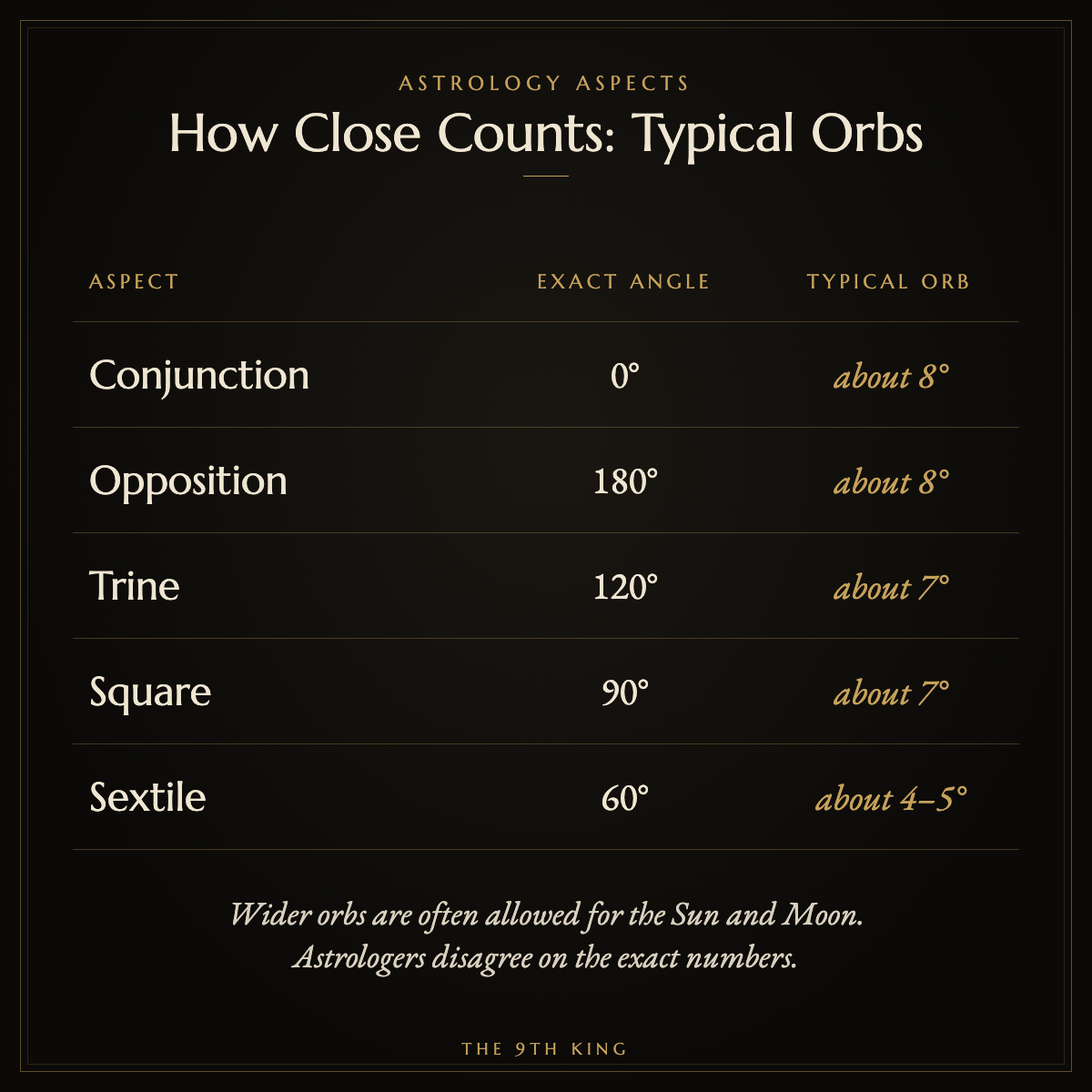
There’s no single agreed rule for orbs, and you’ll see different numbers in different books and apps. Common modern practice looks something like this:
- Conjunctions and oppositions: up to about 8°, sometimes 10° if the Sun or Moon is involved.
- Squares and trines: up to about 7°.
- Sextiles: up to about 4° to 5°.
- Minor aspects: usually 1° to 2°.
Two working rules matter more than the exact numbers:
- The tighter the orb, the stronger the aspect. An aspect within 1° (often called “exact” or “partile”) is usually read as one of the loudest themes in a chart.
- The Sun and Moon get more room. Traditionally the two lights are given wider orbs than the other planets.
If two apps disagree about whether an aspect exists, check their orb settings first.
Hard and soft aspects
Astrologers often sort aspects into two families.
- Hard aspects: the square and the opposition, and often the conjunction when it involves Mars or Saturn. They’re associated with tension, effort, conflict and growth.
- Soft aspects: the trine and the sextile. They’re associated with ease, support and talent.
Older astrology tended to call hard aspects “bad” and soft aspects “good.” Most modern astrologers have moved away from that. A chart full of trines can describe someone who struggles to push themselves. A chart with strong squares can describe someone who is driven and resilient. The usual modern reading is that soft aspects show what comes easily and hard aspects show what you build through effort. Most people need both.
Minor aspects
Beyond the five majors there are smaller angles, used by some astrologers and ignored by others. Johannes Kepler, the astronomer, proposed several of them in the early 17th century.
- Semi-sextile (30°): one sign apart. Read as mild awkwardness between neighbours.
- Semi-square (45°): half a square. Read as low-level irritation.
- Quintile (72°): a fifth of the circle. Linked with creativity and talent.
- Sesquiquadrate (135°): a square plus a semi-square. Read as restless tension.
- Quincunx or inconjunct (150°): five signs apart. Read as two energies that don’t understand each other and need constant adjustment.
If you’re just starting out, focus on the five major aspects. The quincunx is the minor aspect you’ll see most often in modern apps, and it’s worth knowing. The rest can wait.
Applying and separating aspects
Planets move at different speeds. The Moon crosses the whole zodiac in about a month; Saturn takes about 29 years. So at any moment, an aspect between two planets is either getting closer or drifting apart.
- An applying aspect is one where the faster planet is moving toward the exact angle.
- A separating aspect is one where the faster planet has already passed it.
Many astrologers read applying aspects as building and forward-looking, and separating aspects as already familiar, like a lesson learned early. In a birth chart it’s a fine detail. Learn it once you’re comfortable with the basics.
Out-of-sign aspects
Usually an aspect matches the signs. A trine links two signs of the same element; a square links two signs of the same modality. But orbs can stretch across sign boundaries.
For example, a planet at 28° Aries and a planet at 2° Leo are 94° apart. That’s within orb of a square, even though Aries and Leo are both fire signs and would normally trine. This is called an out-of-sign or dissociate aspect. Astrologers read it as a real aspect with a mixed flavour: the angle says square, the elements say harmony. Note it, and read it gently.
Aspect patterns
Sometimes three or more planets link up into a recognisable shape. These aspect patterns are often read as major themes in a chart.
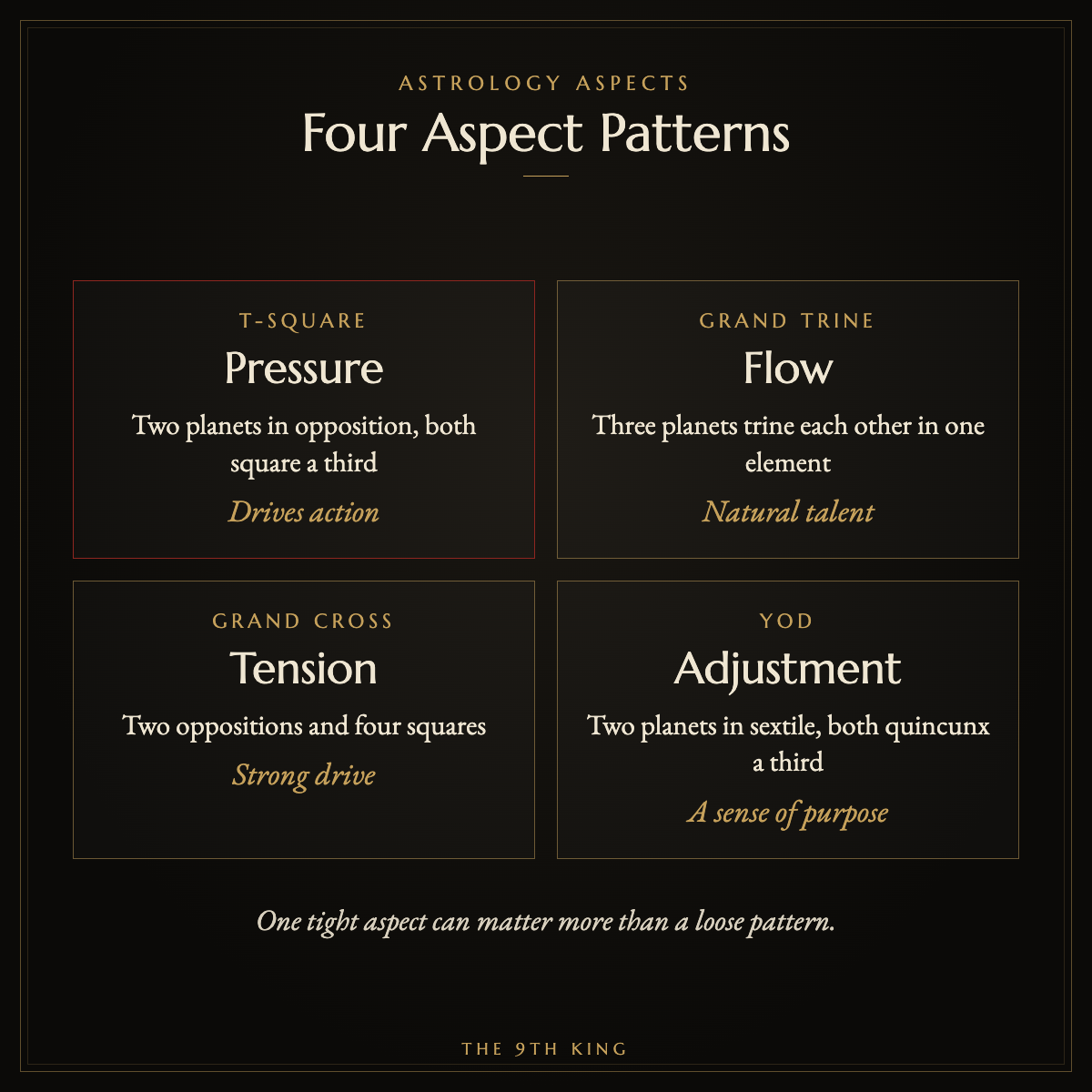
- T-square: two planets in opposition, both square a third planet. The third planet, called the apex, is often read as the pressure point, where tension in the chart gets released through action. T-squares are one of the most common patterns and are often read as a source of drive.
- Grand trine: three planets roughly 120° apart, usually all in one element. Read as a closed loop of ease and talent in that element. The traditional caution is the same as for any trine: gifts that never get tested.
- Grand cross: four planets forming two oppositions and four squares. Rare. Read as a lot of tension pulling in every direction, and a lot of energy once a person learns to direct it.
- Yod: two planets in sextile, both quincunx a third planet. Sometimes nicknamed the “finger of God.” Read as a feeling of special purpose, or of constantly adjusting around one part of the self.
- Stellium: strictly a cluster rather than an aspect pattern. Three or more planets conjunct in one sign or house. Read as a strong focus on that area.
Aspect patterns are memorable, but don’t let them dominate a reading. A single tight aspect between your Sun and Moon may matter more than a loose grand trine.
How to read an aspect
Use the sentence method from our birth chart guide, extended to two planets. Combine planet one, the aspect, and planet two:
[Planet one] [aspect] [planet two].
“This part of me relates to that part of me in this way.”
Then add the signs and houses for detail.
Example: Moon square Mars.
- Planet one: the Moon, emotional needs and safety.
- Aspect: square, friction and pressure.
- Planet two: Mars, drive, anger and assertion.
Reading: “When my feelings are stirred, I go to action, sometimes too fast. Anger can show up where hurt is underneath. When I slow down, that same energy makes me brave about protecting what matters to me.”
Then test it against your life. If it fits, keep it. If it doesn’t, drop it. A chart is a set of hypotheses, not a verdict.
Which aspects to read first? Start with aspects to the Sun, Moon and Ascendant ruler, then the tightest aspects in the chart (within 2° or 3°). That will usually give you the main story.
Two worked examples (fictional charts)
Example 1: Sun trine Moon, Moon square Saturn
The chart: Sun in Leo trine Moon in Sagittarius (both fire). Moon also square Saturn in Virgo.
Reading: a natural harmony between identity and feelings. This person usually knows what they want and feels fine about wanting it (Sun trine Moon, same element). But the Moon–Saturn square adds a strain: feelings may have been met with criticism or cool distance early on, so they may hold back emotionally, or feel they need to be useful before they’re allowed to rest.
The useful question: Where did I learn that my feelings need to be earned?
Example 2: Venus opposite Pluto, Venus sextile Jupiter
The chart: Venus in Taurus opposite Pluto in Scorpio. Venus also sextile Jupiter in Cancer.
Reading: love that runs deep and can swing between devotion and fear of loss (Venus opposite Pluto), often played out through intense partners. The Venus–Jupiter sextile offers an opening: generosity and warmth that steady things when the person chooses to lean on them.
The useful question: Do I trust love more when it’s calm, or when it’s intense?
Both are hypotheses to test, not verdicts. Saturn themes like the one in Example 1 often come into sharper focus around a person’s late twenties. Code of Ascension’s guide to the meaning of a Saturn return (Code of Ascension) covers that cycle.
Using aspects in love, work and shadow work
For love, look at aspects between your Moon, Venus and Mars, and between those planets and your Descendant ruler. Moon–Venus aspects describe how comfort and affection fit together. Venus–Mars aspects describe how affection and desire relate. Comparing two people’s charts by aspect is called synastry, and it will have its own guide on The 9th King soon. For a quick sign-to-sign view, Code of Ascension’s Zodiac Compatibility Chart (Code of Ascension) is a good place to start.
For work, look at aspects to Mars (drive), Saturn (discipline) and the ruler of your 10th house (career direction). A Mars–Jupiter trine can describe easy confidence. A Mars–Saturn square can describe someone who works slowly and carefully, and builds things that last.
For shadow work, your squares and oppositions are good places to start. They often point to the parts of yourself you argue with, or that you see more easily in other people. Our guide to shadow work, plainly explains the projection idea in more depth. Read hard aspects gently. The aim is understanding, not self-criticism.
Common mistakes with aspects
- Calling squares “bad” and trines “good.” Modern astrology reads them as effort and ease, and both have value.
- Ignoring orbs. A 9° square and a 1° square are not the same strength.
- Comparing apps without checking settings. Different orb settings mean different aspect lists.
- Reading every minor aspect. Start with the five majors and the tightest aspects.
- Reading an aspect without the planets. A Venus–Jupiter square and a Mars–Saturn square feel very different.
- Forgetting signs and houses. The aspect tells you the relationship; the signs and houses tell you how and where it plays out.
- Using a guessed birth time. Most aspects between planets don’t depend on birth time, but aspects to the Ascendant and Midheaven do, and the Moon moves about 13° a day.
Five journal prompts for aspects
- What’s the tightest aspect in your chart? How does that relationship between two parts of you show up day to day?
- Find one square. When do you feel those two planets arguing, and what has that friction taught you?
- Find one trine. What comes so easily to you that you’ve never developed it on purpose?
- Look at any opposition. Which end do you identify with, and where do you meet the other end in other people?
- If you have a T-square, look at the apex planet. What would healthy action through that planet look like this week?
Astrology Aspects: FAQ
What are aspects in astrology?
They’re the angles between planets in a birth chart. Certain angles, such as 0°, 60°, 90°, 120° and 180°, are read as linking the two planets’ energies.
What are the five major aspects?
The conjunction (0°), sextile (60°), square (90°), trine (120°) and opposition (180°). They’re also called the Ptolemaic aspects, after Claudius Ptolemy.
Which aspect is the most powerful?
The conjunction and the opposition are often read as the strongest, along with any aspect that’s very close to exact. In practice, how tight the orb is matters as much as which aspect it is.
Are squares bad?
No. Squares are read as tension and challenge, but many astrologers see them as the aspects that build strength, skill and resilience.
What is an orb in astrology?
The margin of error allowed for an aspect. Two planets 86° apart are still read as a square because they’re within the orb. Typical orbs range from about 8° for conjunctions to about 4° for sextiles.
What is a quincunx?
An aspect of 150°, also called an inconjunct. It links two signs with nothing in common, and it’s read as an awkward relationship that needs ongoing adjustment.
Do I need my birth time for aspects?
Not for most of them. Aspects between planets are mostly the same across a whole day, except for the fast-moving Moon. Aspects to the Ascendant and Midheaven do need an accurate birth time.
What is a T-square?
A pattern where two planets oppose each other and both square a third planet. The third planet is read as the focal point where the tension gets expressed.
What does it mean if a planet has no major aspects?
It’s called an unaspected planet. It’s often read as working independently from the rest of the chart, sometimes very strongly and sometimes in an all-or-nothing way.
Is any of this scientifically proven?
No. There’s no evidence that the angles between planets shape personality or events. On The 9th King, astrology is a symbolic language for self-reflection, not established science.
Explore Next
- Start with the wheel: How to Read a Birth Chart
- Where each planet lives: The 12 Houses in Astrology
- Your emotional needs: Moon Sign Meaning
- A big Saturn cycle: Meaning of Saturn Return (Code of Ascension)
- Comparing two charts: Synastry for Beginners
- What you need vs what you want: Moon vs Venus
- The map and the weather: Natal Chart vs. Transits
- Going deeper: Sue Tompkins, Aspects in Astrology
Final Thought: The Conversation Inside You
A birth chart isn’t a list of separate traits. It’s a conversation. Your needs talk to your drive, your mind talks to your fears, your affection talks to your ambition. Some of those conversations are easy and some are arguments. Aspects show you which is which. You don’t get to choose the voices, but you can choose how you listen to them.
About the Author
King is the founder of The 9th King, where zodiac psychology, relationships and shadow work are explored as tools for self-knowledge rather than fortune-telling. Astrology on The 9th King is interpretation and self-reflection, not prediction or established fact.