Quick Answer: What Are the 12 Houses in Astrology?
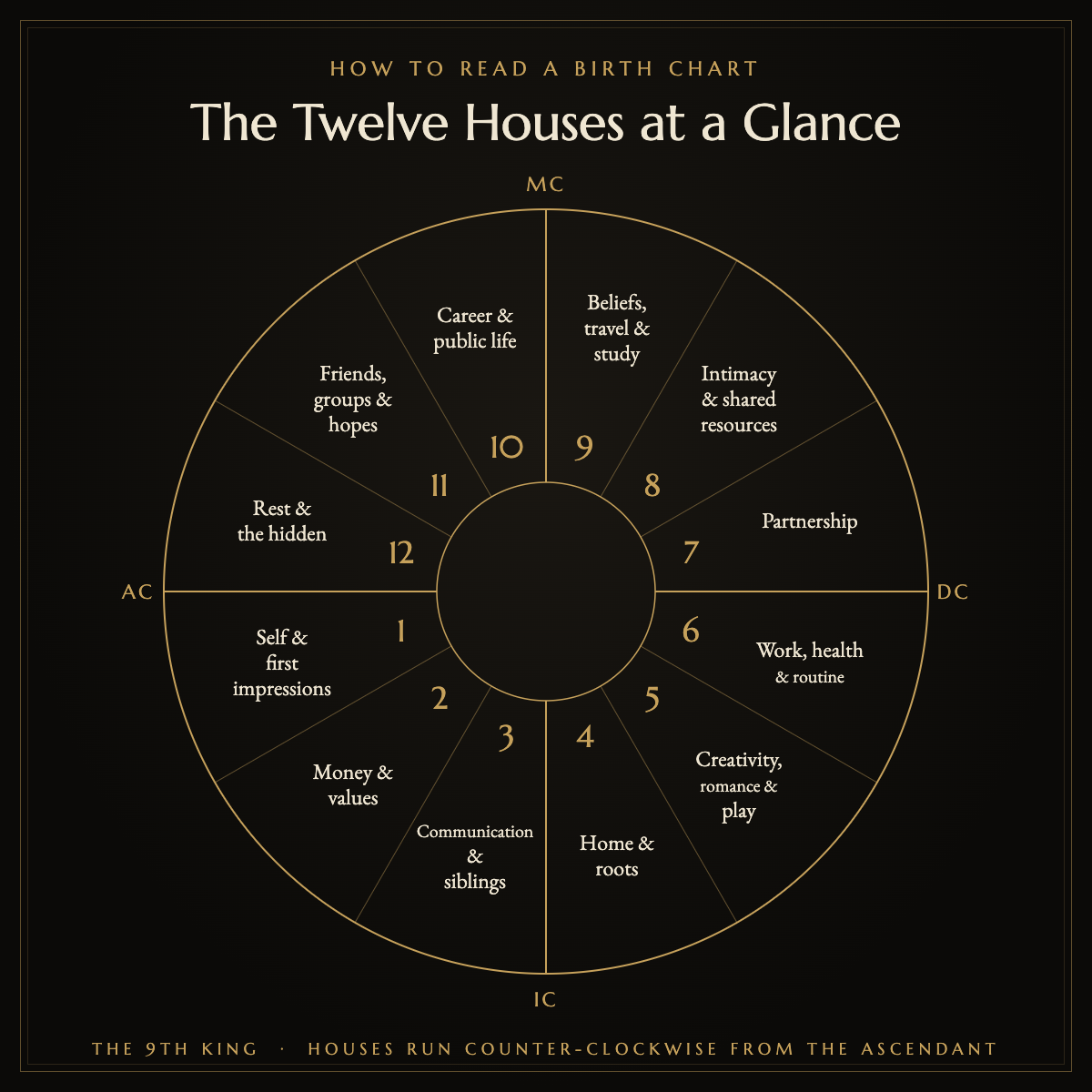
The 12 houses divide a birth chart into twelve areas of life. If planets are the what of a chart and signs are the how, the houses are the where: the part of your life where a planet’s energy tends to show up.
- Houses 1–3: self, resources, everyday mind.
- Houses 4–6: home, creativity, daily work and health.
- Houses 7–9: partners, shared intimacy, beliefs and travel.
- Houses 10–12: career, community, rest and the hidden.
The houses are counted counter-clockwise from your Ascendant (Rising sign), and they depend on your exact birth time and place. That’s why two people born on the same day can have very different house placements.
Table of Contents
How the houses work
Picture the sky at the moment you were born, seen from where you were born. Now cut that sky into twelve slices, like a pie, starting at the eastern horizon. Each slice is a house.
Because the Earth turns once a day, the whole sky appears to rotate through all twelve houses every 24 hours. The signs and planets stay in roughly the same place over a day, but which house each one falls into changes about every two hours. That’s why the houses are the most time-sensitive part of a birth chart, and why a wrong birth time affects them more than anything else.
A few basics:
- The 1st house begins at your Ascendant, the point on the eastern horizon. On most chart wheels it’s on the left, at about nine o’clock.
- The houses run counter-clockwise from there: 1st, 2nd, 3rd and so on around the wheel.
- Each house has a cusp, the line where it begins. The sign on that cusp colours how you approach that area of life.
- Planets in a house bring their energy into that area of life.
If you’re new to reading the wheel, start with our guide to how to read a birth chart, then come back here.
The four angles: the most powerful points on the wheel
Four house cusps are so important they have their own names. Together they’re called the angles.
- Ascendant (AC), the 1st house cusp: the eastern horizon. Read as how you meet the world and first impressions. Code of Ascension’s Rising Sign Meaning (Code of Ascension) covers it in depth.
- Imum Coeli (IC), the 4th house cusp: the lowest point. Read as roots, home and private foundations.
- Descendant (DC), the 7th house cusp: the western horizon. Read as partners and what you seek in others.
- Midheaven (MC), the 10th house cusp: the highest point. Read as career, reputation and public direction.
Planets close to any of these four points are traditionally read as especially prominent in a person’s life.
Angular, succedent and cadent houses
The twelve houses fall into three groups of four. This is one of the oldest ideas in house interpretation, and it’s a quick way to gauge how “loud” a house tends to be.
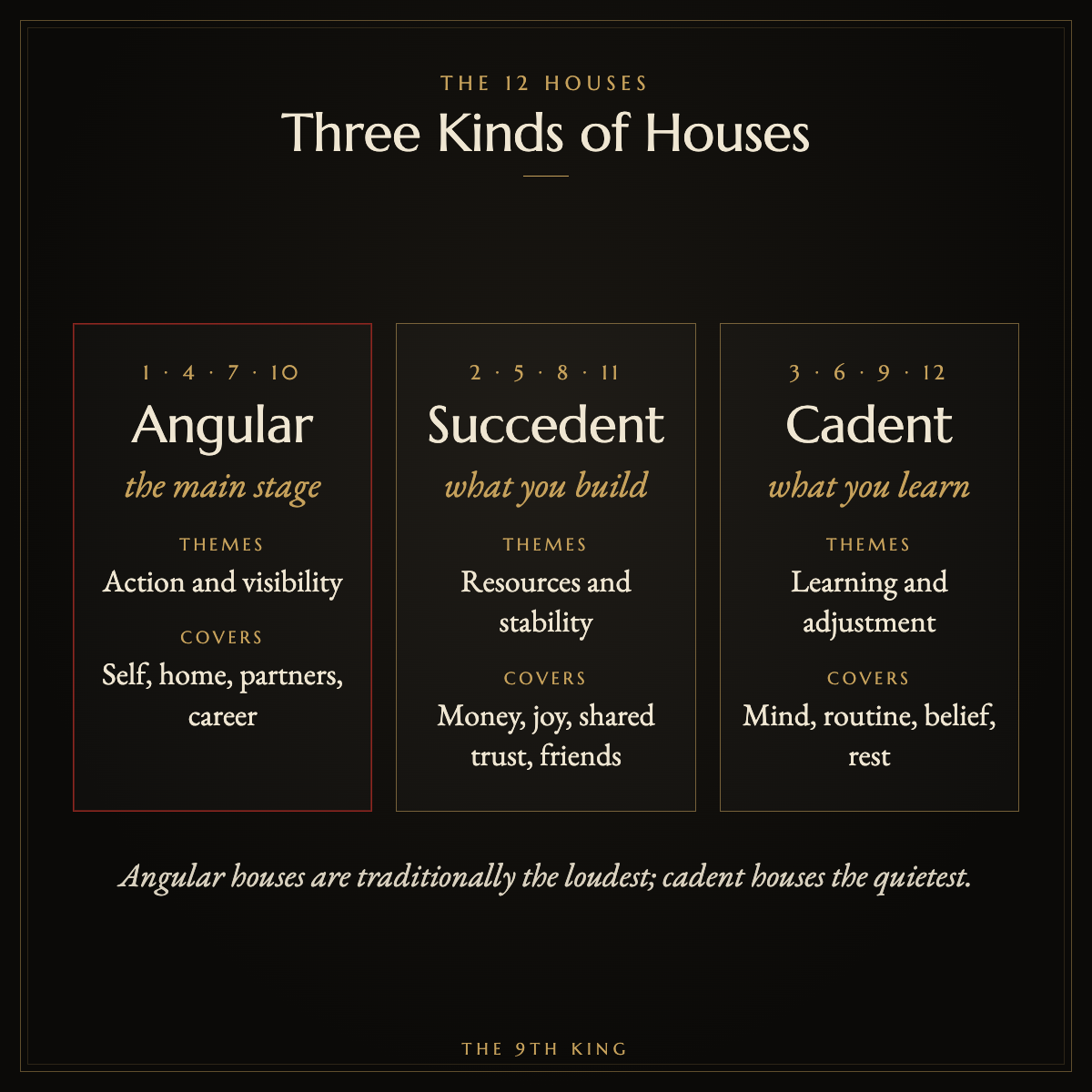
- Angular houses (1st, 4th, 7th, 10th) begin at the four angles. Traditionally they’re the most active and visible areas of life: self, home, partners and career.
- Succedent houses (2nd, 5th, 8th, 11th) follow the angular houses. They’re associated with resources and stability: what you have, enjoy, share and build with others.
- Cadent houses (3rd, 6th, 9th, 12th) fall away from the angles. They’re associated with learning, adjusting and preparing: thought, routine, belief and rest.
In older astrology, planets in angular houses were considered strongest and planets in cadent houses weakest. Many modern astrologers soften that, reading cadent houses as quieter rather than weaker.
The 12 houses, one by one
For each house you’ll find its traditional themes, the questions it asks, and how it’s commonly read. Read these as a vocabulary, not a set of rules.
The 1st house: self and first impressions
Themes: your body, appearance, temperament, how you start things, how others first see you.
The question it asks: How do I meet the world?
The 1st house begins at the Ascendant, so the sign on its cusp is your Rising sign. Planets here are often read as part of your visible personality: what people notice about you before they know you.
The 2nd house: money, possessions and values
Themes: income, possessions, self-worth, what you value and how you earn.
The question it asks: What makes me feel secure?
The 2nd house is about resources you hold for yourself. It’s also about worth in the deeper sense: what you think you’re worth and what you think is worth having.
The 3rd house: communication, siblings and the everyday mind
Themes: speaking, writing, learning, short journeys, neighbours, siblings, your local world.
The question it asks: How do I think and connect day to day?
The 3rd house covers the ordinary flow of information: messages, conversations, errands, early schooling. Planets here are often read as shaping how you talk and learn.
The 4th house: home, family and roots
Themes: home, family, ancestry, private life, emotional foundations, the end of things.
The question it asks: Where do I come from, and where do I feel safe?
The 4th house begins at the IC, the lowest point of the chart. It’s the most private part of the wheel. Planets here are often read through family history and what “home” means to you.
The 5th house: creativity, romance and play
Themes: creativity, pleasure, romance, dating, children, games, self-expression.
The question it asks: What brings me joy?
The 5th house is about what you do for the love of it. Romance in the 5th is the fun, courtship side of love; long-term partnership lives in the 7th.
The 6th house: work, health and routine
Themes: daily work, job duties, habits, health routines, service, pets.
The question it asks: How do I take care of the everyday?
The 6th house is the day-to-day of life: the job rather than the career, the routine rather than the dream. Planets here are often read through work habits and how you look after your body.
The 7th house: partnership
Themes: marriage, committed relationships, business partners, open rivals, contracts.
The question it asks: What do I seek in another person?
The 7th house begins at the Descendant, directly opposite your Ascendant. It’s often read as the qualities you look for, or project onto, in partners. Planets here are commonly read as major relationship themes.
The 8th house: intimacy, shared resources and change
Themes: shared money, debt, inheritance, sexuality, deep intimacy, endings and transformation.
The question it asks: What do I share, and what do I let go of?
The 8th house is the counterpart of the 2nd: resources held with other people rather than alone. It’s also associated with the deepest kind of trust and with life’s big transitions. Our guide to shadow work touches on why astrologers link this house with hidden material.
The 9th house: beliefs, travel and study
Themes: philosophy, religion, higher education, long journeys, publishing, the search for meaning.
The question it asks: What do I believe, and how far will I go to find out?
Where the 3rd house is the everyday mind, the 9th is the big-picture mind. Planets here are often read through study, travel and worldview.
The 10th house: career and public life
Themes: career, reputation, ambition, achievements, authority, public role.
The question it asks: What do I want to be known for?
The 10th house begins at the Midheaven, the highest point in the chart. It’s the most public part of the wheel. Planets here are often read as shaping career direction and how the world sees your work.
The 11th house: friends, groups and hopes
Themes: friendships, communities, networks, causes, long-term hopes and goals.
The question it asks: Who are my people, and what future am I building with them?
The 11th house is about belonging to something bigger than yourself. Traditionally it was called the house of “good spirit,” linked with friends, allies and hopes.
The 12th house: rest, the hidden and the unconscious
Themes: solitude, retreat, sleep, dreams, the unconscious, hidden matters, self-undoing, spiritual life.
The question it asks: What happens when I’m alone, and what am I not seeing?
The 12th house is the most hidden part of the chart. Traditional astrology treated it as difficult. Modern astrologers often read it as the house of rest, imagination and inner work, as well as of habits that quietly work against us.

House pairs: the six axes
Each house has an opposite, and the six pairs are often read as balancing acts. Looking at both ends of an axis can explain a lot.
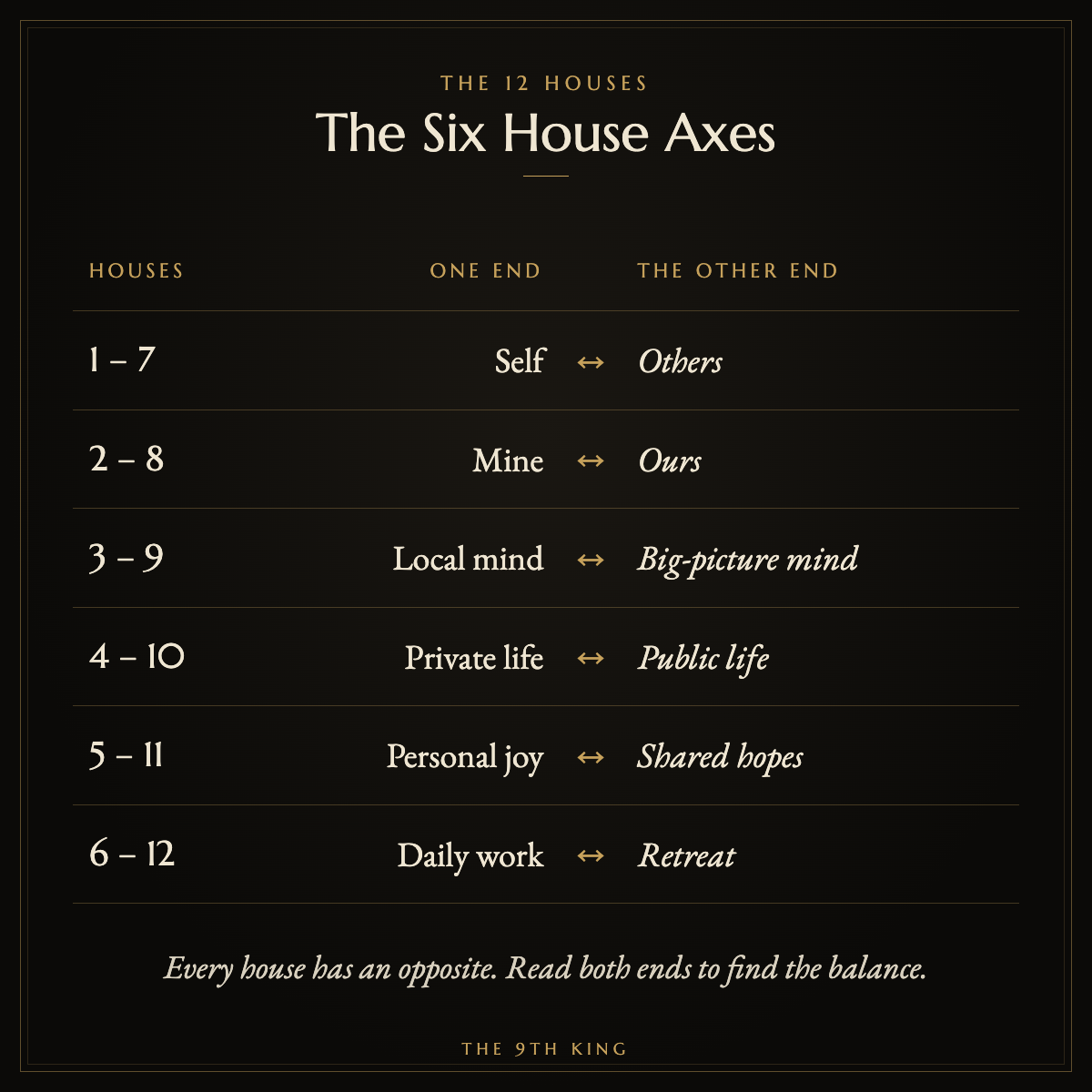
- 1st–7th: me and you. How much of yourself do you keep, and how much do you give to a partner?
- 2nd–8th: mine and ours. What you own alone versus what you share and trust others with.
- 3rd–9th: the everyday mind and the big-picture mind. Details versus meaning.
- 4th–10th: home and career. Private roots versus public direction.
- 5th–11th: personal joy and shared hopes. What you love doing versus what you build with a group.
- 6th–12th: daily work and retreat. Being useful versus being still.
What about empty houses?
Almost everyone has empty houses. There are twelve houses and only ten planets (counting the Sun and Moon), and planets often cluster, so several houses will always be empty.
An empty house doesn’t mean that area of life is missing or unimportant. To read it:
- Look at the sign on its cusp. That sign colours how you approach that area.
- Find that sign’s ruling planet. Where that planet sits in your chart tells you more about the empty house.
For example, if your 7th house is empty and Libra is on the cusp, look at Venus, Libra’s ruler. Its sign and house describe how partnership tends to work for you.
House systems: why apps disagree
If you’ve ever checked your chart in two apps and found a planet in different houses, house systems are almost always why. There are many ways to divide the sky into twelve, and astrologers have argued about them for centuries.
The three you’ll meet most often:
- Placidus: the default in many modern Western apps. It divides houses by time, so houses can be very unequal in size, especially at far northern or southern latitudes.
- Whole Sign: the oldest system, used in Hellenistic astrology. The whole sign containing your Ascendant becomes the 1st house, the next sign the 2nd, and so on. Every house is exactly one sign.
- Equal House: each house is exactly 30 degrees, starting from the exact degree of your Ascendant.
Chris Brennan’s Hellenistic Astrology: The Study of Fate and Fortune (2017) makes the historical case for Whole Sign houses. Many modern astrologers prefer Placidus. Neither is “correct” in any provable sense. The practical rule is simple: pick one system and stay consistent.
How to read a planet in a house
Use the sentence method from our birth chart guide. Combine the planet (what), the sign (how) and the house (where):
[Planet] in [sign] in the [house] house.
“This part of me, expressed in this way, shows up in this area of life.”
Example: Mars in Virgo in the 6th house.
- What: Mars, drive and effort.
- How: Virgo, precise and practical.
- Where: the 6th house, daily work and routine.
Reading: “My energy goes into doing my daily work well. I’m happiest when I’m being useful and fixing things, and I can get irritated by sloppiness, including my own.”
Then test it against your life. If it fits, keep it. If it doesn’t, drop it.
Two worked examples (fictional charts)
Example 1: a stellium in the 10th house
The chart: Sun, Mercury and Saturn in Capricorn, all in the 10th house.
Reading: three planets in the most public house, in a career-focused sign. This person may feel that their identity (Sun), thinking (Mercury) and sense of duty (Saturn) are all tied up with work and reputation.
The useful question: Who am I when I’m not working?
Example 2: Venus in Pisces in the 12th house
The chart: Venus in Pisces in the 12th house, and an empty 7th house with Virgo on the cusp.
Reading: affection that’s gentle, idealistic and private (Venus in Pisces), often kept hidden or expressed through care behind the scenes (12th house). With Virgo on the 7th cusp, look to Mercury to understand partnership. This person might love deeply but quietly, and look for practical, attentive partners.
The useful question: Do the people I love know how much I care?
Both are hypotheses to test, not verdicts.
Using the houses in love, work and shadow work
Once you know which houses matter for a question, you can read your chart with much more focus.
For love and relationships, look at the 5th house (romance and play), the 7th (committed partnership) and the 8th (deep intimacy and trust). Then find the planets in those houses and the rulers of their cusp signs. If your 5th house is busy and your 7th is empty, you might find dating easy and commitment slower. That’s not a flaw. It’s simply information about where your energy goes first. Your Moon sign adds the other half of the picture: what you need once you’re close to someone.
For work and money, look at the 10th house (career direction), the 6th (daily work and routine) and the 2nd (income and values). A strong 10th with a quiet 6th can describe someone who loves the big goal but finds the daily grind draining. A strong 6th with a quiet 10th can describe someone who loves craft more than status. Both are valid ways to work.
For shadow work, look at the 12th house (what’s hidden or avoided), the 8th (what you struggle to share or let go of) and wherever Saturn sits (where you feel tested or inadequate). These houses make good journal prompts: What do I do in private that I’d rather nobody saw? What am I holding onto that’s already over? Read them gently. The aim is understanding, not self-criticism.
Common mistakes with the houses
- Using a guessed birth time. Houses shift about every two hours. A wrong time can move everything.
- Mixing house systems between apps, then comparing.
- Treating empty houses as missing areas of life. Read the cusp sign and its ruler instead.
- Reading the 12th or 8th as “bad” houses. Traditional texts were harsh about them; modern readings are more nuanced.
- Confusing the 5th and 7th. The 5th is dating and romance; the 7th is committed partnership.
- Forgetting the sign. A planet in the 10th house in Pisces behaves very differently from one in the 10th in Aries.
Five journal prompts for the houses
- Which house holds the most planets in your chart? Does that area of life take up most of your attention?
- Pick an empty house. Find the ruler of its cusp sign. What does that planet’s placement say about this area?
- Look at your 4th and 10th houses together. How do your private life and your public life support or strain each other?
- What’s in your 12th house? What do you do when nobody’s watching, and is it restoring you?
- Choose one axis (for example 2nd–8th). Where are you out of balance, and what would one small correction look like?
The 12 Houses: FAQ
What are the 12 houses in astrology?
They’re twelve divisions of the birth chart, each linked to an area of life, from self and money to career, friends and rest. They show where in life a planet’s energy tends to show up.
Which house is the most important?
None is more important overall. Traditionally, the angular houses (1st, 4th, 7th and 10th) are the most prominent, and planets near the four angles are considered especially strong.
Do I need my birth time to know my houses?
Yes. The houses depend on your exact time and place of birth. Without a birth time, house placements aren’t reliable.
What does it mean if a house is empty?
It doesn’t mean that area of life is missing. Look at the sign on the house cusp and where that sign’s ruling planet sits in your chart.
Why does my chart look different in different apps?
Usually because the apps use different house systems, most often Placidus versus Whole Sign. Check the settings and use one system consistently.
Which house rules love?
Romance and dating are associated with the 5th house. Committed partnership and marriage are associated with the 7th. Deep intimacy and shared resources are associated with the 8th.
Which house rules career?
The 10th house, which begins at the Midheaven, is associated with career and public reputation. The 6th house covers daily work, and the 2nd covers income.
What is a stellium in a house?
Three or more planets in one house. It’s read as a strong focus on that area of life.
Is the 12th house bad?
No. Traditional astrology treated it as difficult. Modern readings link it with rest, imagination and the unconscious, as well as hidden patterns worth noticing.
Is any of this scientifically proven?
No. There’s no evidence that house placements shape life outcomes. On The 9th King, astrology is a symbolic language for self-reflection, not established science.

Explore Next
- Start with the wheel: How to Read a Birth Chart
- Your emotional needs: Moon Sign Meaning
- Your Ascendant in depth: Rising Sign Meaning (Code of Ascension)
- How the planets talk: Astrology Aspects Explained
- The map and the weather: Natal Chart vs. Transits
- Coming soon on The 9th King: Don’t Know Your Birth Time?
- Going deeper: Chris Brennan, Hellenistic Astrology: The Study of Fate and Fortune (2017)
Final Thought: Where Your Life Happens
Signs and planets can feel abstract. The houses bring them down to earth: your money, your home, your partner, your work, your friends, your rest. Read them as a map of where your attention goes, and ask whether that’s where you want it to go. Know your terrain. Then choose where to build.
About the Author
King is the founder of The 9th King, where zodiac psychology, relationships and shadow work are explored as tools for self-knowledge rather than fortune-telling. Astrology on The 9th King is interpretation and self-reflection, not prediction or established fact.